News & Announcements
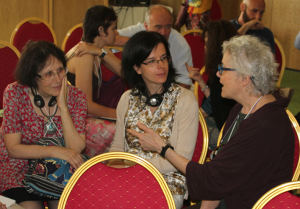
The first IIRP Europe Conference brought 160 people from 23 countries to Budapest, Hungary, on June 10-12, 2015. For three intense days, participants shared stories, practices and research on restorative practices in criminal justice, education, social services, the workplace, faith communities and other settings. They heard how restorative practices are overcoming centuries of distrust between the Roma people and others in Romania, reintegrating prison inmates back into society in Hungary and helping heal victims of sexual abuse in Ireland. In circle discussions, they brainstormed how restorative practices can improve civil society all over the world. Everyone left the conference inspired to take what they learned back home.
Each day began with plenary presentations, attended by all the participants, followed by a large selection of “breakout” sessions.

When civil unrest erupted in Baltimore, MD, during the last week of April 2015, schools that had been implementing restorative practices all year employed talking circles to help students feel safe, heard and restored. Unlike their counterparts in many other schools in the city, these schools felt prepared to respond in a way that strengthened their school communities.
“It was a tense few days,” says Corey Basmajian, principal of Windsor Hills Elementary/Middle School, in West Baltimore, referring to the feeling not only in his school but throughout Baltimore.
In West Baltimore, protests had begun April 18 over the police’s treatment of Freddie Gray, who would die on April 19 of spinal injuries sustained during an arrest April 12. By Friday April 25, some of the protests had turned violent. The unrest peaked the night of Monday April 27, after Gray’s funeral. Baltimore City Schools responded by closing on Tuesday April 28. But when students returned to classes on Wednesday, everyone was anxious about how they would act in light of all the unrest taking place in the city.
The International Institute for Restorative Practices (IIRP) presents a Symposium, Integrating School Climate Reform Efforts: Join the Conversation with National Leaders, July 20 – 21, 2015, at its campus in Bethlehem, PA.
Dr. John Bailie, IIRP president, will be facilitating the Symposium. He is excited about its possible outcomes and potential for impact and shares his thoughts about it.

Last school year, staff at Community Learning Center (CLC), a school in Winfield, Kansas, for students at risk of dropping out of high school, successfully managed a major move by employing restorative practices with students.
“Our students loved that we had always been a separate off-site private school away from all the perceived problems of the other place – the big public high school,” says CLC director Jennifer Muret-Bate, who holds a Master of Science from the International Institute for Restorative Practices.
But in 2014, the school district decided to incorporate the CLC program back into the main school building. Muret-Bate presented a case study about the restorative process they used at the 2014 IIRP World Conference in Bethlehem, Pennsylvania.
Dr. Deppe says, "If we can help everyone — parents, teachers, religious leaders, business people, those in criminal justice — understand emotion and its management, we can do even more to help people make changes."
In the following interview Susan Leigh Deppe, M.D., a Distinguished Fellow of the American Psychiatric Association, Clinical Assistant Professor of Psychiatry at the University of Vermont, College of Medicine, and member of the Board of Directors and Faculty of the Tomkins Institute in Lewisburg, Pennsylvania, talks about the importance of affect and script theory for enriching restorative practices and the fun that will be had during the professional development event she'll be offering at the IIRP Main Campus on September 17 & 18, 2015.

Vidia Negrea will be a featured presenter at the IIRP Europe 2015 conference. The conference, entitled "From Dream to Reality: Dawning of a New Social Science," will be held June 10-12, 2015, in Budapest, Hungary. Learn more »
Vidia will chair the morning plenary session on day one, a panel about applications of restorative practices in criminal justice settings. She will also present in two breakout sessions related to her work in corrections (details below).
Borbála Fellegi, Ph.D., will be a featured presenter at the IIRP Europe 2015 conference. The conference, entitled "From Dream to Reality: Dawning of a New Social Science," will be held June 10-12, 2015, in Budapest, Hungary. Learn more »
The breakout session, “Alternative Ways to Peacemaking in an Intercultural Context,” is scheduled for 1 PM on the second day of the conference.
The IIRP hosted a symposium entitled, "Integrating School Climate Reform Efforts," on July 20-21, 2015, in Bethlehem, Pennsylvania, USA. The event featured a panel of national leaders in school climate reform. Below find presentations and recommended readings provided by each panelist.
Read a day-by-day summary of the symposium and highlights of comments from panelists, "Hope for the future of school climate reform," by IIRP Assistant Director for Communications Laura Mirsky.
Janet L. Fox Petersen, Ed.D., a school psychologist in Wichita, KS, Public Schools, talks about her experience at the Integrating School Climate Reform Efforts symposium:
Two allied events this summer will address the vital issue of school climate reform. Both are designed to help educators seeking answers on how best to engage young people in their education. They will also explore the best ways to address misbehavior, bullying, dropping out and the “racial discipline gap.”
Guidance for educators implementing and assessing school-climate reform
June 25 and 26, the National School Climate Center (NSCC), in partnership with the International Institute for Restorative Practices (IIRP), presents its Summer Institute, School Climate Improvement: Policy, Practice and Leadership Development. What to do and how to do it?
In an article for the Perth Courier, Desmond Devoy writes:
Kate Johnson is not a member of the Hug-A-Thug Club.
Neither does she want to lock up prisoners and throw away the key.
Restorative Works Year in Review 2025 (PDF)
All our donors are acknowledged annually in Restorative Works.