News & Announcements

Language Arts teacher Heidi Fisher employs the Restorative Questions in circle discussions, encouraging students to relate to their reading assignments.
Heidi began implementing restorative practices in her classroom at Indian River Middle School, in Canaan, New Hampshire, the day she returned from an IIRP Basic Restorative Practices event, in Bethlehem, PA.
Her students had behaved poorly with the substitute teacher while she was away, so she decided to try the Restorative Questions to address the issue. “It was incredible just to listen to their responses to the questions,” notes Heidi. “They all acknowledged that they should have behaved better, and they apologized to the substitute.”
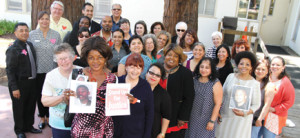
The Catholic Archdiocese of San Francisco Restorative Justice Ministry recently hosted a retreat for nearly 40 survivors of homicide and representatives of organizations that support them. The retreat included Restorative Responses to Adversity and Trauma, a professional development event conducted by the International Institute for Restorative Practices. The event gave participants a deeper understanding of their own trauma and loss as well as skills to help themselves and others cope with similar experiences.
“The most amazing thing was getting people to the leadership moment, where they can actually begin to see their healing on a higher and deeper level, as well as some restoration as a step in their healing process,” affirms Julio Escobar, director of the Restorative Justice Ministry. “We wanted to introduce the concept of restorative justice and restorative practices from an accredited organization like the IIRP,” he explains.
Rhonda Richetta, principal of City Springs Elementary/Middle School, in Baltimore, Maryland, talks to SaferSanerSchools Instructor Steve Korr about the many ways restorative practices has benefited her school and life and tells some great stories.
“Good riddance to zero tolerance!” declared IIRP president John Bailie, Ph.D., opening the IIRP Symposium: Integrating School Climate Reform Efforts. At that, about 150 educators from across North America — superintendents, school climate and safety administrators, teachers, counselors and psychologists — cheered their approval.
They had come, along with a panel of six school climate reform leaders, to Bethlehem, PA, July 20-21, 2015, to explore how the wide array of programs created to replace zero tolerance could work together.
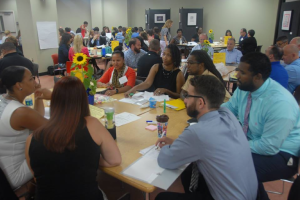
This school year, Pittsburgh, PA, Public Schools (PPS) are set to launch the largest restorative practices Whole-School Change program ever undertaken, with 22 elementary, middle and high schools participating.
The U.S. Department of Justice has provided $3 million of funding for the district’s Pursuing Equitable Restorative Communities (PERC) project. The grant will pay to implement the International Institute for Restorative Practices (IIRP) SaferSanerSchools Whole-School Change program, a comprehensive two-year school implementation model. It will also provide for the RAND Corporation to measure the effectiveness of restorative practices in the 22-school "treatment group" against a "control group" of 22 other schools in PPS that will not participate in the program.
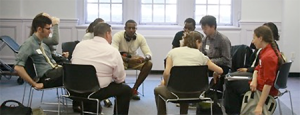
College and high school students showed up to make their voices heard at a conference on restorative practices for New York City schools, in the Bronx, NY. Why? The students are hungry for learning. Mostly from disadvantaged backgrounds, they see their education as a way to liberty and freedom.
The college students were invited to “Transformative Practices & Restorative Justice Conference: A Celebration and Call to Action,” by their education professor at Lehman College, City University of New York (CUNY), David Fletcher, Ed.D. Together with 250 educators, school administrators and community representatives, Fletcher is building a community to implement restorative practices in NYC schools.
Students and teachers from Maine schools that are implementing the SaferSanerSchools Whole-School Change program as part of a 5-year RAND study speak about the positive impact in the classroom of circles and other informal restorative practices. These practices give everyone a chance to be heard.
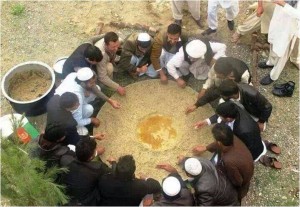
The borderlands of Pakistan and Afghanistan are a dangerous and violent place. But it is here that a student of restorative justice, Ali Gohar, founder of Just Peace Initiatives, based in Peshawar, Pakistan, has worked to reinvigorate and reinvent traditional conflict resolution practices.
In this tribal region, inhabited largely by ethnic Pukhtoon, wrongdoing can spiral into cycles of vengeance. Family feuds can last for generations. For instance, nearly 60 years after the event, a man avenged his father’s murder by in turn killing the original murderer’s grandson. Revenge killings continued back and forth between the two families until a total of a dozen people were dead. Without the intervention of the jirga – a tribal council “organized by wise, respectable, greybeard elders whose decision is unanimous, acceptable to all community members” (Gohar, n.d.) – the cycle of violence would have continued. The jirga sent representatives to each family and convinced them to end the feud “for the sake of God” with no blood money exchanging hands (Lofton, 2015).
During the IIRP Europe 2015 Conference in Budapest, Hungary, Romanian social worker Izabella Kasza discussed her work with a displaced Roma population in the city of Cluj. The group of 300 families lives and works in poor conditions near the city's landfill.
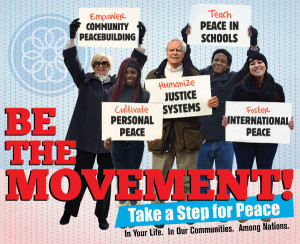
As the restorative practices social movement gathers steam in schools, justice, communities and beyond, practitioners, academics and advocates are looking for new ways to connect and work together to common purpose.
The Peace Alliance, a national grassroots advocacy group based in Washington, D.C., that promotes practical methods for reducing violence, transforming conflict and enhancing cooperation, sees as one of its functions to facilitate these cross connections.
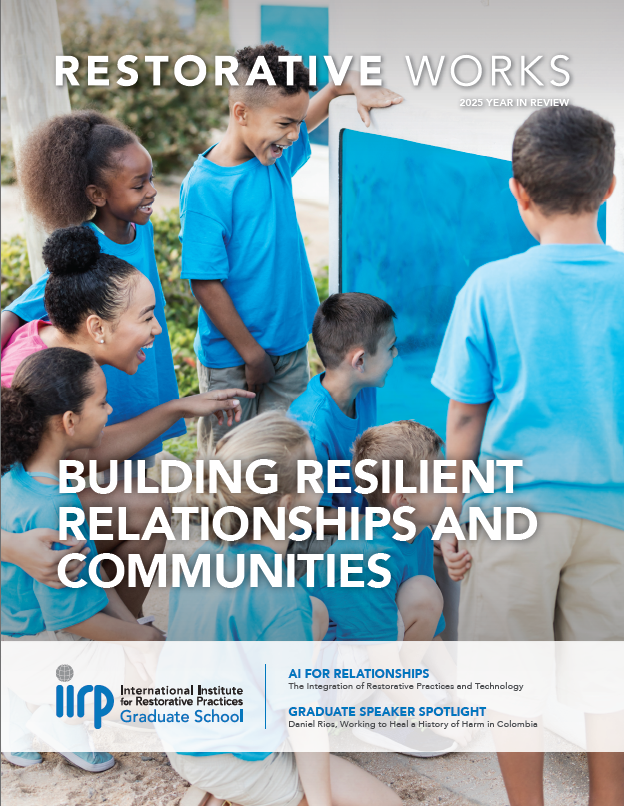
Restorative Works Year in Review 2025 (PDF)
All our donors are acknowledged annually in Restorative Works.