Support the IIRP
  • Bookstore (opens in new window)
  • Library
  • Students (opens in new window)
  • Faculty (opens in new window)
International Institute for Restorative Practices (logo)
  • Restorative Practices
    • Restorative Practices: Explained
    • Presidential Paper Series
    • Restorative Works Magazine
    • Restorative Works! Podcast
    • Resources
      • Schools K-12
      • Research and Evaluations
      • Guides for Implementation
      • Publications
      • Integrating Related Evidence-Based Strategies
      • Case Studies
      • Higher Education
      • Community Health & Restorative Practices
    • News & Announcements
  • Graduate Education
    • Graduate Programs
      • Master of Science
      • Education Specialization
      • Community Engagement Specialization
      • Master of Science with Thesis Option
      • Graduate Certificate in Restorative Practices
      • Graduate Certificate in Relational Facilitation for Healing Trauma
      • Graduate Certificate in Change Implementation in Organizations and Social Systems
    • Course Offerings
    • Registration & Admission
      • Program Application
      • Course Registration
      • Transcript Requests
      • Graduate Course Schedule
      • Frequently Asked Questions
      • Academic Catalog & Student Handbook
        • Introduction
        • Institutional Statements
        • Academic Calendar
        • Academic Catalog
          • Courses
          • Admissions
          • Educational Programs
          • Institutional Learning & Program Goals
        • Student Handbook
          • Health & Safety
          • Technology
          • Student Support
          • Tuition & Fees
          • Financial Aid & Scholarships
          • Campus Location
          • Academic Policies & Procedures
          • Accreditation
          • Institutional Policies
        • Index
    • Transparent Tuition
      • Tuition & Fees
      • Payment Plan
      • Cost of Attendance
    • Scholarships
    • Recruit Our Students
    • Philosophy & Academic Goals
  • Continuing Education
    • View All Offerings
    • Professional Development
      • Restorative Practices for Educators
      • Navigating Conflict: Restorative Practices in the Workplace
      • Restorative Practices at Work: Relational Tools for Culture Change
      • Connection and Content: Integrating Restorative Practices into Classroom Learning
      • Implementing with Intention: Effecting Change Through a Relational Lens
      • Facilitating Listening Circles
      • Restorative Justice Conferencing
      • Putting Theory into Practice for School Staff and Administrators
      • Reimagining Campus Community with Restorative Practices
    • Bring Our Events to Your Team
    • Restorative Practices Training of Trainers
    • Conferences & Symposia
    • Free Webinars
  • Collaborative Application
    • Consultative & Implementation Services
    • Whole-School Change
      • Program Overview
      • School Resources
      • Frequently Asked Questions
    • Restorative Practices in Higher Education
      • Get Involved
  • About
    • The IIRP Graduate School
    • Message from the President
    • Who We Are
      • Faculty
      • Instructors
      • Leadership
      • Trustees
      • Alumni
      • Factbook
    • Support the IIRP
    • Employment at the IIRP
    • Accreditation Information
    • Research Agenda
    • Lenape Nation Acknowledgment
    • Consumer Information (Higher Education Opportunity Act)
  • Contact Us

News & Announcements

Subscribe to IIRP News, the IIRP’s monthly newsletter.

Subscribe to IIRP News

Sign up for our monthly e-newsletter, IIRP News, to receive information on the latest trends in the restorative practices field, encouraging stories from our students and alum, and the latest IIRP offerings. 

Please let us know your name.

Please write a subject for your message.

Please let us know your email address.

Invalid Input

Invalid Input

Invalid Input

Catholic schools adapt restorative practices

Published: May 25, 2016

Screen Shot 2013-10-16 at 8.51.23 AMAccording to a piece in the St. Louis Review, a publication of the Archdiocese of St. Louis, Catholic schools there  and in several other states are adapting restorative practices to a Catholic-school context with great success. In the article titled, "Restoring a safe, positive, welcome for all students," writer Joseph Kenny begins:

Fourteen schools in the Archdiocese of St. Louis have become certified as virtue-based restorative discipline (VBRD) schools, addressing bullying issues through Catholic identity and restoring a safe, positive and welcoming environment for all.

Read more

Restorative justice helps all parties

Published: October 15, 2013

David Karp, a professor of sociology at Skidmore College, recently wrote an op-ed piece for the Albany, New York, Times Union arguing for broader use of restorative justice. Here are several anecdotes used to illustrate the point:
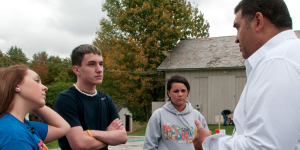
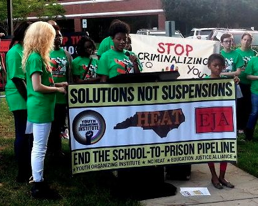
 

Photo by J. C. Rice from the New York Daily News shows several teens talking to Holloway before helping clean his housePhoto by J. C. Rice from the New York Daily News shows several teens talking to Holloway before helping clean his houseOn Labor Day weekend, a large group of teenagers held an unauthorized party at the Rensselaer County vacation home of ex-NFL player Brian Holloway. Pictures from the party and accusations by Holloway that it caused $20,000 in damage have caused a media sensation. So far, six teenagers have been arrested. As the victim of an alleged crime, Holloway is understandably angry, and many of the teenagers and their parents are anxious about potential criminal consequences. Rather than resolving this in court, using a restorative justice approach may be the best solution.

Read more

Roundup: 2013 Week of Action Against School Pushout

Published: October 14, 2013
solutions not suspensions

Dignity in Schools, a national organizations that unites parents, youth, advocates and educators to support alternatives to a culture of zero-tolerance, punishment and removal in schools, reports on its National Week of Action Against School Pushout:

"The Fourth Annual National Week of Action took place from September 28 to October 5, 2013. Over 60 organizations in 22 states joined the Dignity in Schools Campaign to 'Push Back Against School Pushout' in our largest Week of Action to date. Students, parents, teachers and advocates lifted their voices to demand an end to school disciplinary policies that push students out of school and down a pipeline to prison and low-wage jobs.

"During this year’s Week of Action, we raced against the U.S. government shutdown clock with our SparkAction alert urging members of the Senate to support federal school discipline reform. On September 30 our message reached 150,000 people on social media via Thunderclap. Over the course of the week, almost 2 million Twitter posts (tweets) used the #SchoolPushout hashtag and our Facebook posts reached about 13,000 unique users. We also added a Dignity in Schools Tumblr page and an Instagram account to share photos of actions and events across the country!"

Each day of the week featured a theme like Solutions Not Suspensions, Counselors Not Cops and Restorative Justice.

Read about the week in a post that highlights events from across the country day by day.
Read more

Supporting families facing eviction with family group conferencing in the Netherlands

Published: October 10, 2013

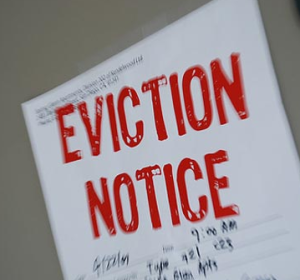
Screen Shot 2013-10-09 at 12.58.12 PMEigen Kracht (Dutch for “Our Power”) is a non-profit organization that has done an incredible amount of grassroots work throughout the Netherlands to make the family group conference (FGC, which in North America is known as Family Group Decision Making or FGDM) the go-to process for empowering people and their communities of care to find solutions to some of their most pressing problems. Eigenkracht has trained community volunteers throughout the country to interface with social services and other government agencies, to coordinate with families, and come up with plans, particularly with regards to caring for children at risk of placement in the social welfare system. But Eigenkracht has always argued that FGC may be used more widely, whenever a family needs to make a plan requiring the support of its larger community of support.

Read more

Guest blog: Robert Koehler: Hope flows from hollow water

Published: October 9, 2013
Ashinaable emblem via Wikipedia

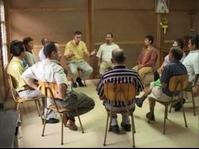
In this piece, journalist Robert Koehler unearths one of the roots of the restorative justice movement in the work of an indigenous community in Manitoba that reached "deep into their souls and into the roots of a lost way of life, to save their children and the future."

Sincere thanks to Koehler for allowing us to repost this piece in full.
Read more

Audio: Sycamore Tree Projects presents outcome of 8-week prisons project

Published: October 8, 2013

The Sycamore Tree Project, a world-wide program of Prison Fellowship International brings groups of crime victims into prison to meet with groups of unrelated offenders. They talk about the effects of crime, the harms it causes, and how to make things right. In a recent project in Queensland, Australia, victims of crime met for eight weeks in a program aimed to help both victims and offenders explore the impacts of crime, with the goal of fostering healing and change.

Reporters Terri Begley and Emma Sykes write:
Read more

Growing Fairness, a film and a social movement

Published: October 7, 2013
Growing Fairness

Bryce Stucki, a reporter at The American Prospect, takes a look at Growing Fairness, a new documentary by Teachers Unite that critiques punitive school discipline policies and suggests they be replaced by restorative practices. He writes:

“Education was where my heart was,” says Tyrone Sinclair in Growing Fairness, a documentary showcasing the impact restorative-justice programs can have in our nation's schools. Sinclair says he was expelled from school at 16, became homeless, and then ended up in jail. Now, he organizes young people in Los Angeles. “I knew that wasn’t the place for me,” he says of prison. “I love to learn every day.”

Read more

Fairfax, Virginia, developing restorative practices in schools, juvenile justice & policing

Published: October 3, 2013

A Fairfax student during a restorative circle simulation from a video about the FCPS Restorative Justice programA Fairfax student during a restorative circle simulation from a video about the FCPS Restorative Justice programPoised between the Blue Ridge Mountains of Virginia and Washington D.C., Fairfax County Public Schools (FCPS), is a progressive and diverse school system on the edge of change. FCPS has initiated a system wide implementation of restorative justice processes in our schools which aims to transform how the FCPS community handles harm and wrongdoing. Several schools in this 200+ school system, the 11th largest in the country, have been exploring the use of restorative justice since 2004 to respond to discipline issues through pilot programs at two large high schools and various trainings for staff.

In 2011, Vickie Shoap, a veteran RJ facilitator in Virginia’s criminal justice system, was hired to develop and manage a system-wide RJ implementation that would educate schools about this valuable tool and train school staff to facilitate RJ processes. The goals of this initiative are to build a culture of support for conflict resolution, including restorative practices for classroom management and restorative justice processes for discipline issues that offer school administrators an effective disciplinary option other than suspending students. FCPS hired a second restorative justice specialist in 2013, Dan Wichman-Buescher, a graduate of Eastern Mennonite University. Shoap and Wichman-Buescher are responsible for training school staff in restorative practices, facilitating RJ processes and training restorative justice school teams for long term sustainability of RJ in FCPS.
Read more

Alternative justice pilot program rolled out in Seattle, Washington

Published: September 30, 2013
Seattle Skyline

Bryan Cohen, writing at Capitol Hill Seattle Blog, reports on a new program to be piloted shortly in Seattle, Washington, to keep low-level offenders out of the criminal justice system.

Andrea Brenneke, who was involved in organizing a restorative circle for a high profile case involving the murder of a Native American carver by a Seattle policemen, will serve as director of the City of Seattle's new Restorative Justice Initiative.

Cohen quotes Stephanie Tschida, president of the East Precinct Advisory Council, who said: “It’s a good idea for some of these residents who deal with a log of ongoing drug dealing and loitering. It could be more constructive avenue to people voicing similar concerns over and over again.”

Read more

A restorative circle team builder around the IIRP World Conference

Published: September 30, 2013

Screen Shot 2013-09-30 at 8.18.41 PM(left to right) IIRP Assistant Director for Communications Laura Mirsky, Director of Communications & Technology Ben Wachtel and Vice-President for Advancement Linda Kligman during a restorative circle team builder (photo by Assistant Director of Technology Steve Orrison)The IIRP teaches others to implement restorative practices, but we also, through a process of continual reflection, strive within our own organizational structure to operate restoratively on a number of levels.

I work in the Advancement, Communications and Technology department. Here we conduct our weekly check-in meetings using a series of circle questions, even as some of us, like me, phone in our participation in the circle by conference call. I also have regular monthly “supervision” meetings (again by phone) with my supervisor, Laura Mirsky, assistant director for communications. These meetings are an opportunity for me to reflect on my work, discuss challenges and get suggestions from Laura. In terms of the “social discipline window,” supervision is very much a “with” process, rather than a top-down “authoritarian” process.

Read more

Page 37 of 106

  • 32
  • 33
  • 34
  • 35
  • 36
  • 37
  • 38
  • 39
  • 40
  • 41
  • Restorative Practices: Explained
  • Presidential Paper Series
  • Restorative Works Magazine
  • Restorative Works! Podcast
  • Resources
  • News & Announcements

Restorative Works Cover
Restorative Works Year in Review 2025 (PDF)

All our donors are acknowledged annually in Restorative Works.

Contact IIRP

531 Main Street
Bethlehem, PA 18018

(610) 807-9221

IIRP on Facebook (opens in new window)IIRP on X (formerly Twitter opens in a new window)IIRP on YouTube (opens in a new window)IIRP on Instagram (opens in a new window)IIRP on LinkedIn (opens in new window)

Get to Know Us

About the IIRP

Restorative Practices

News and Announcements

HEOA Consumer Information

Accreditation

Meet the IIRP

Employment

Digital Accessibility Statement

Explore Programs & Resources

Master of Science Degree

Graduate Certificates

Professional Development

Collaborative Application

Resources and Research

Events, Conferences, and Summits

The Collaborative Center for Restorative Practices in Higher Education

Get Started

Start Your Graduate Application

Register for Professional Development

Request Customized Experience

Become a Trainer

Browse the Bookstore

Whole-School Change

  • Restorative Practices
    • Restorative Practices: Explained
    • Presidential Paper Series
    • Restorative Works Magazine
    • Restorative Works! Podcast
    • Resources
    • News & Announcements
  • Graduate Education
    • Graduate Programs
    • Course Offerings
    • Registration & Admission
    • Transparent Tuition
    • Scholarships
    • Recruit Our Students
    • Philosophy & Academic Goals
  • Continuing Education
    • View All Offerings
    • Professional Development
    • Bring Our Events to Your Team
    • Restorative Practices Training of Trainers
    • Conferences & Symposia
    • Free Webinars
  • Collaborative Application
    • Consultative & Implementation Services
    • Whole-School Change
    • Restorative Practices in Higher Education
  • About
    • The IIRP Graduate School
    • Message from the President
    • Who We Are
    • Support the IIRP
    • Employment at the IIRP (opens in new window)
    • Accreditation Information
    • Research Agenda
    • Lenape Nation Acknowledgment
    • Consumer Information (Higher Education Opportunity Act)
  • Contact Us

© 2015 - 2026 International Institute for Restorative Practices | Site Map