Support the IIRP
  • Bookstore (opens in new window)
  • Library
  • Students (opens in new window)
  • Faculty (opens in new window)
International Institute for Restorative Practices (logo)
  • Restorative Practices
    • Restorative Practices: Explained
    • Presidential Paper Series
    • Restorative Works Magazine
    • Restorative Works! Podcast
    • Resources
      • Schools K-12
      • Research and Evaluations
      • Guides for Implementation
      • Publications
      • Integrating Related Evidence-Based Strategies
      • Case Studies
      • Higher Education
      • Community Health & Restorative Practices
    • News & Announcements

  • Graduate Education
    • Graduate Programs
      • Master of Science
      • Education Specialization
      • Community Engagement Specialization
      • Master of Science with Thesis Option
      • Graduate Certificate in Restorative Practices
      • Graduate Certificate in Relational Facilitation for Healing Trauma
      • Graduate Certificate in Change Implementation in Organizations and Social Systems
    • Course Offerings
    • Registration & Admission
      • Program Application
      • Course Registration
      • Transcript Requests
      • Graduate Course Schedule
      • Frequently Asked Questions
      • Academic Catalog & Student Handbook
        • Introduction
        • Institutional Statements
        • Academic Calendar
        • Academic Catalog
          • Courses
          • Admissions
          • Educational Programs
          • Institutional Learning & Program Goals
        • Student Handbook
          • Health & Safety
          • Technology
          • Student Support
          • Tuition & Fees
          • Financial Aid & Scholarships
          • Campus Location
          • Academic Policies & Procedures
          • Accreditation
          • Institutional Policies
        • Index
    • Transparent Tuition
      • Tuition & Fees
      • Payment Plan
      • Cost of Attendance
    • Scholarships
    • Recruit Our Students
    • Philosophy & Academic Goals
  • Continuing Education
    • View All Offerings
    • Professional Development
      • Restorative Practices for Educators
      • Navigating Conflict: Restorative Practices in the Workplace
      • Restorative Practices at Work: Relational Tools for Culture Change
      • Connection and Content: Integrating Restorative Practices into Classroom Learning
      • Implementing with Intention: Effecting Change Through a Relational Lens
      • Facilitating Listening Circles
      • Restorative Justice Conferencing
      • Putting Theory into Practice for School Staff and Administrators
      • Reimagining Campus Community with Restorative Practices
    • Bring Our Events to Your Team
    • Restorative Practices Training of Trainers
    • Conferences & Symposia
    • Free Webinars
  • Collaborative Application
    • Consultative & Implementation Services
    • Whole-School Change
      • Program Overview
      • School Resources
      • Frequently Asked Questions
    • Restorative Practices in Higher Education
      • Get Involved
  • About
    • The IIRP Graduate School
    • Message from the President
    • Who We Are
      • Faculty
      • Instructors
      • Leadership
      • Trustees
      • Alumni
      • Factbook
    • Support the IIRP
    • Employment at the IIRP
    • Accreditation Information
    • Research Agenda
    • Lenape Nation Acknowledgment
    • Consumer Information (Higher Education Opportunity Act)
  • Contact Us

News & Announcements

Subscribe to IIRP News, the IIRP’s monthly newsletter.

Subscribe to IIRP News

Sign up for our monthly e-newsletter, IIRP News, to receive information on the latest trends in the restorative practices field, encouraging stories from our students and alum, and the latest IIRP offerings. 

Please let us know your name.

Please write a subject for your message.

Please let us know your email address.

Invalid Input

Invalid Input

Invalid Input

Newark, New Jersey, schools and police launch restorative practices project

Published: August 23, 2013

Cami Anderson, State District Superintendent, Newark Public Schools Cami Anderson, State District Superintendent, Newark Public SchoolsIn a press release titled "Zero Tolerance for Zero Tolerance Policies," Newark Public Schools (NPS) and Newark Police Department (NPD) announce the launch of a "Historic Initiative with the International Institute for Restorative Practices to End the School to Prison Pipeline."

The article says:

Staff members from NPS joined forces with NPD to shift school discipline policies from zero tolerance to youth development. The training was facilitated by the world renowned International Institute for Restorative Practices (IIRP). The initiative was spearheaded by NPD Police Director Samuel A. DeMaio and NPS Superintendent Cami Anderson.
Read more

Guest blog: Don't be distracted by the serious school incidents

Published: August 20, 2013
Ivan Webb

Ivan Webb, a retired principal and teacher from Tasmania, Australia, tweets about restorative practices (@IvanWebb). He collects his weekly updates in a weekly online newspaper format, called Restorative Schools (embedded below). In last week's edition, he posted a short sidebar editorial in which he argues that while restorative practices are effective for responding to serious incidents, people should not stop there but consider the reasons for adopting a more proactive approach, "to be restorative for all students all the time."

Read more

Audio: Restorative justice circles in a therapeutic boarding school setting

Published: August 19, 2013
LA talk radio

Here's a radio program about a therapeutic boarding school located in northern Idaho for at-risk teens where restorative justice circles are becoming more and more embedded for responding to problems and helping teens work through conflict. The host is Lon Woodbury and the interview is with Lisa Hester, director of student life at Boulder Creek Academy in northern Idaho.

The player will popup in a new window at LA Talk Radio.
Read more

Strengthening faith communities through restorative practices

Published: August 15, 2013

Update: Seminary students are eligible for a $550 discount on this event. To register call 1-610-807-9221.

Deborah van Deusen Hunsinger, Professor at Princeton Theological Seminary, attended FaithCARE event in Ontario, Canada Deborah van Deusen Hunsinger, Professor at Princeton Theological Seminary, attended the FaithCARE event in Ontario, Canada[/caption]"If restorative practices were more widely known, and its structures and processes more widely put into place, churches would be far better equipped to deal with conflict, harm, or trauma in a healthy manner." -Deborah van Deusen Hunsinger, Professor of Pastoral Theology, Princeton Theological Seminary, Princeton, New Jersey

To this end, the IIRP is offering a 4-day retreat at Kirkridge Retreat Center in eastern Pennsylvania, September 23-26, 2013, titled "Strengthening Faith Communities Through Restorative Practices." The event will be co-facilitated by Bruce Schenk, director of IIRP Canada, and Anne Martin, director of FaithCARE Services, Shalem Mental Health Network, Ontario, Canada.

Read more

Video: “Fixing juvie justice” on PBS

Published: August 14, 2013
Fixing Juvie Justice

This month the Public Broadcast System in the United States is showing a documentary film titled Fixing Juvie Justice. The film provides a critique of the revolving door of youth justice, and its criminalizing effect on many youth who originally commit very minor crimes. Then it turns to an examination of restorative justice as an alternative model, and discusses some of the roots of conferencing in New Zealand.

Dr. Lauren Abramson, founder and executive director of the Community Conferencing Center in Baltimore, Maryland, USA, and Assistant Professor of Child Psychiatry at Johns Hopkins School of Medicine, is quoted throughout the video. She was a student of Sylvan Tomkins, whose theory of affect has been very useful for helping to explain what happens in a restorative conference. Abramson also describes her personal quest to find a better way to work with criminal offenders, especially young ones.

Read more

Offender on the impact of a restorative justice meeting

Published: August 13, 2013

I was struck by the sincerity of this post by an anonymous offender who opts for a restorative justice meeting with the person he victimized:
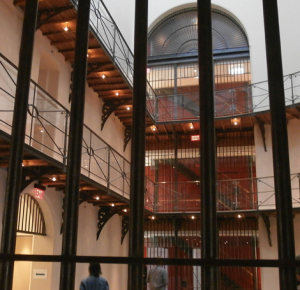


Photo by Mark Watmough at Flickr Creative Commons.Photo of Don Jail, Toronto by Mark Watmough at Flickr Creative Commons.

I wanted to tell people what restorative justice means to me, as someone who has been through the whole process.

In prison, I made so many steps to change and I thought that there was something not there, something that was missing. That’s when I heard about restorative justice. I thought about how my victim felt and so I got involved with it. I wasn’t expecting to get as much out of it as I got out of it.

When I got out of jail and met my victim, it was a really big shock. I would never put anybody through that again. I can say that because I have been through restorative justice and I know how it affects them. I can recommend it [restorative justice] to anybody who is thinking of changing.

Read more

Video: Restorative approaches at Grey Court Comprehensive and St Richard's Primary Schools

Published: August 12, 2013

There are so many lovely short videos now that demonstrate restorative approaches in schools. This one features the voices of many students as well as staff and administrators at two schools in Greater London.

Read more

Aggression Replacement Training: New professional development & graduate course

Published: August 9, 2013

A youth recognized for displaying all 15 character traits as part of the Evidenced Based Aggression Replacement Training Program (photo from the Tennessee Department of Children Services Web Site)A youth recognized for displaying all 15 character traits as part of the Evidenced Based Aggression Replacement Training Program (photo from the Tennessee Department of Children Services Web Site)Aggression Replacement Training® is a new IIRP event which explores how to reduce violence and youth aggression for those working in education, criminal justice, social services and youth counseling. The Aggression Replacement Training process involves engaging and empowering aggressive youth to take responsibility for their behavior and learn healthier ways of interacting with others.

Dr. Craig Adamson, Assistant Professor at the IIRP Graduate School and Executive Director of Community Service Foundation/Buxmont Academy, IIRP's demonstration projects for at-risk youth, said that Aggression Replacement Training is an evidence-based restorative practice that has demonstrated success over the past two years with youth in the CSF Buxmont programs. "What I like about Aggression Replacement Training," said Craig, "is that it's very restorative. It's engaging and empowering. Aggression Replacement Training talks about how youth relate to all the stakeholders in their lives and how to engage appropriately with one another. It also looks at what happens with shame, how you can identify your own feelings in the moment, and it is very explicit with kids."
Read more

Restorative justice bill introduced in Massachusetts

Published: August 8, 2013

Pierre R. Berastaín, a student at Harvard Divinity School and co-founder of the Massachusetts Restorative Justice Collaborative, writes today on his Huffington Post blog:


C4RJ police partners gather for restorative justice legislative hearing at the Massachusetts State House. Left to Right: Sgt. Matt Pinard (Littleton), Lt. Leo Crowe (Carlisle), Det. Mike Sallese, Chief Robert Bongiorno (Bedford) C4RJ police partners gather for restorative justice legislative hearing at the Massachusetts State House. Left to Right: Sgt. Matt Pinard (Littleton), Lt. Leo Crowe (Carlisle), Det. Mike Sallese, Chief Robert Bongiorno (Bedford)

While restorative justice programs continue to sprout throughout the state, no law has helped promote or endorse any of them. This legislative session, however, State Sen. Jamie Eldridge (D-Acton) has introduced Senate Bill 52, an act promoting restorative justice practices. If it goes into law, the act would not only give legislative recognition and legitimacy to restorative practices, but it would also establish a committee to assess programs in the state as well as make recommendations for future programming. This committee would bring together a range of representatives, from court-based programs to community members and academics in the field. For us in the Massachusetts Restorative Justice Collaborative, an organization that seeks to sustain the existing momentum and nourish a more cohesive restorative justice movement throughout the Commonwealth, the Act would further establish our efforts to bring restorative and transformative practices to a number of settings including schools, shelters, and prisons.

Read more

Retired Wisconsin Supreme Court Justice discusses RJ in Belgium, advocates more research in U.S.

Published: August 7, 2013
Janine P. Geske

Janine P. Geske, retired Justice of the Wisconsin Supreme Court and Distinguished Professor of Law at Marquette University Law School, recently spent time as a Visiting Professor in Restorative Justice at Catholic University of Leuven, Belgium. She has written two blog posts for Wisconsin Restorative Justice Coalition inspired by her time abroad. In the first piece, she discusses the framework for national implementation of restorative justice (mostly mediation) processes in Belgium. In the second second, she suggests ways American researchers and advocates could learn from their European colleagues. (Thanks to IIRP's Wisconsin affiliate, Patrice Vossekuil, for forwarding the link.)

Read more

Page 40 of 106

  • 35
  • 36
  • 37
  • 38
  • 39
  • 40
  • 41
  • 42
  • 43
  • 44
  • Restorative Practices: Explained
  • Presidential Paper Series
  • Restorative Works Magazine
  • Restorative Works! Podcast
  • Resources
  • News & Announcements

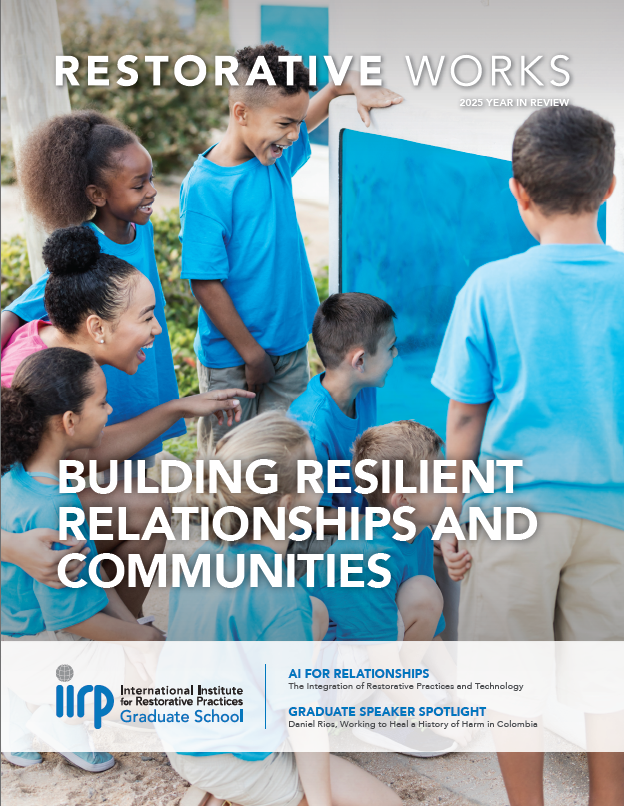
Restorative Works Cover
Restorative Works Year in Review 2025 (PDF)

All our donors are acknowledged annually in Restorative Works.

Contact IIRP

531 Main Street
Bethlehem, PA 18018

(610) 807-9221

IIRP on Facebook (opens in new window)IIRP on X (formerly Twitter opens in a new window)IIRP on YouTube (opens in a new window)IIRP on Instagram (opens in a new window)IIRP on LinkedIn (opens in new window)

Get to Know Us

About the IIRP

Restorative Practices

News and Announcements

HEOA Consumer Information

Accreditation

Meet the IIRP

Employment

Digital Accessibility Statement

Explore Programs & Resources

Master of Science Degree

Graduate Certificates

Professional Development

Collaborative Application

Resources and Research

Events, Conferences, and Summits

The Collaborative Center for Restorative Practices in Higher Education

Get Started

Start Your Graduate Application

Register for Professional Development

Request Customized Experience

Become a Trainer

Browse the Bookstore

Whole-School Change

  • Restorative Practices
    • Restorative Practices: Explained
    • Presidential Paper Series
    • Restorative Works Magazine
    • Restorative Works! Podcast
    • Resources
    • News & Announcements
  • Graduate Education
    • Graduate Programs
    • Course Offerings
    • Registration & Admission
    • Transparent Tuition
    • Scholarships
    • Recruit Our Students
    • Philosophy & Academic Goals
  • Continuing Education
    • View All Offerings
    • Professional Development
    • Bring Our Events to Your Team
    • Restorative Practices Training of Trainers
    • Conferences & Symposia
    • Free Webinars
  • Collaborative Application
    • Consultative & Implementation Services
    • Whole-School Change
    • Restorative Practices in Higher Education
  • About
    • The IIRP Graduate School
    • Message from the President
    • Who We Are
    • Support the IIRP
    • Employment at the IIRP (opens in new window)
    • Accreditation Information
    • Research Agenda
    • Lenape Nation Acknowledgment
    • Consumer Information (Higher Education Opportunity Act)
  • Contact Us

© 2015 - 2026 International Institute for Restorative Practices | Site Map