News & Announcements
The following article by IIRP Assistant Director for Communications Laura Mirsky and IIRP Trainer and Consultant Steve Korr appeared in Principal Leadership, Vol. 14, February 2014. The publication coincides with a presentation by Korr at the National Association of School Principals' 2014 Ignite Conference.

The research referenced in this article, "The Promise of Restorative Practices to Transform Teacher-Student Relationships and Achieve Equity in School Discipline," has since been published in the Journal of Educational and Psychological Consultation. Read the abstract and purchase the report.

You may download a PDF of this article for your personal use.
Detroit, Michigan, USA, can claim some of the highest rates of crime, violence, school expulsion, dropouts and truancy in the country. But as Henry McClendon, a pastor, program officer with the Skillman Foundation and IIRP licensed trainer and board member observed, “We don’t have a crime problem, we have a relationship problem.” To address this problem, McClendon aims to “infuse restorative practices in every major institution in the city, particularly those that touch kids, but adults as well: schools, social work, criminal justice, families and faith communities.”
Recognizing that this goal needed an established organization within the city to “carry the ball,” he brought the idea to Alice Thompson, CEO of the influential Detroit nonprofit social services agency Black Family Development, Inc. (BFDI). Thompson immediately saw restorative practices’ potential, and BFDI became an affiliate of the IIRP, licensed to train other organizations.
With nearly 20 years experience in the UK and Ireland plus affiliates and associates throughout Europe, IIRP Europe (formerly IIRP UK & Ireland) is poised to increase offerings across the continent for training, graduate education and research into restorative practices.
IIRP Europe CEO Les Davey said, "Working with our colleague Vidia Negrea in Hungary (IIRP Europe, Director for Central Europe), we are looking to bring together existing associates of the IIRP in Sweden, the Netherlands, the UK and Ireland, plus new colleagues we’re starting to develop relationships with elsewhere in Europe, in such a way that people can go to one source to find out what restorative practices is about and what’s available in their area."
Henry McClendon, a pastor, program officer with the Skillman Foundation and IIRP licensed trainer and board member, delivered this talk at the IIRP's 16th World Conference in October, 2013, in Bethlehem, Pennsylvania, USA.
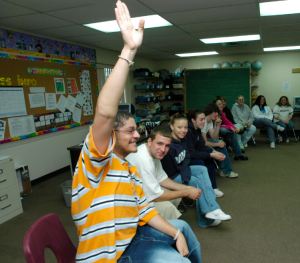
CSF and Buxmont Academy teachers are engaging and involving students in learning by using restorative practices to teach academic subjects.
Chris Boretskii, coordinator of the CSF Buxmont Pottstown School, talks about Pottstown’s social studies teacher, Michael Packard, as an example.
“His classes are almost exclusively taught in a circle,” says Chris. This makes it an expectation that every student will contribute. Students are engaged to participate this way in discussions of current events and history.
"We don’t allow kids to be invisible,” adds Chris. “Everyone has to participate and be verbal. This creates confidence and boosts kids' self-esteem, which can't help but improve their academic performance."
Michael takes the restorative concept of participation and engagement further. He prepares students for tests in a circle, asking them to come up with some pertinent questions to ask in tests.
And the kids love it. Says one student, “Circles make me feel more involved because I am able talk a lot easier. I think if we weren’t in a circle other kids wouldn’t want to participate.”
According to a number of reports in the UK, including this one from the Belfast Telegraph:
At least £29 million will be made available over the next three years for restorative justice - the process of bringing those whose lives have been ruined by crime or conflict together with those responsible for the harm.
A recent study by the Ministry of Justice (MoJ) linked the conferencing process with a 14% cut in re-offending, while 85% of victims who took part said they were satisfied with the experience.
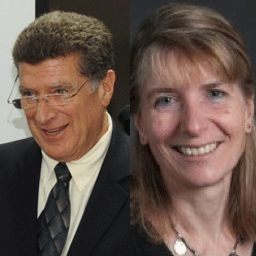
"Restorative Practices: The Promise and the Challenge,” a new graduate course from the International Institute for Restorative Practices, will be offered for the first time during the Spring 2014 term. This elective course (RP 506) is the first IIRP offering that will be completely online with no pre-requisites.
IIRP Founder and President Ted Wachtel, who will co-teach the class, said, “I’m excited about the opportunity to produce a really fun, interactive course that engages people in thinking and talking about restorative practices from anywhere in the world. For all of our other beginning courses people have to attend something. There are so many people that have contacted us that want to take a course but aren’t in a position to travel."
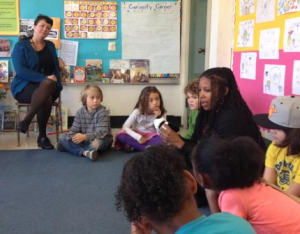
Jan Chien, of San Francisco local public radio KALW, reports on restorative practices at Harvey Milk Elementary School:
In addition to the whole-school circle in the morning, each class has its own daily community circle. Every classroom has a carpeted area where students and teachers sit on the floor to share their thoughts or feelings. In Marisa Martinez’s 3rd grade class, students pass a small stuffed panda around the circle, to mark who has the floor. Today they’re talking about people or animals that have passed on.
This video includes the entire plenary session from day three of the IIRP’s 16th World Conference on the topic of restorative practices in faith communities. Bruce Schenk, director of IIRP Canada, moderated the panel. The panelists included:
Restorative Works Year in Review 2025 (PDF)
All our donors are acknowledged annually in Restorative Works.