News & Announcements

As Hull Centre for Restorative Practice in the UK just completed its Restorative Practice Conference, I'll offer a look back at this eForum story by Laura Mirsky from two years ago reporting on the city's progress toward its goal of becoming the world's first restorative city.
Hull, UK, led by the Hull Centre for Restorative Practices (HCRP) and the International Institute for Restorative Practices (IIRP), is endeavoring to become a “restorative city.” The goal is for everyone who works with children and youth in Hull, one of England’s most economically and socially deprived cities, to employ restorative practices.
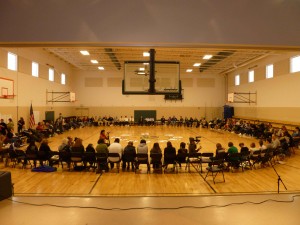
IIRP alum Ben Emery is working with the Colorado Restorative Justice Council and blogs at RestorativeJusticeColorado.org. He writes that he kept hearing about good work happening by the Longmont High School Restorative Justice Team, where teenagers are "facilitating circles, organizing pre-conferences, and even training younger students." When he talked to students about recording an interview about the blog, Sophomore Savannah Iverson stepped in and offered to write a 3-part series.
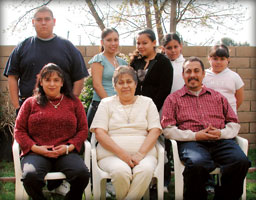
IIRP's sister organization and model restorative practices program, Community Service Foundation (CSF) is a nonprofit organization serving delinquent and dependent youth in eastern Pennsylvania since 1977. Recently, CSF completed this report on its FGDM program, which is highlighted on American Humane's "What's New" in FGDM web page.

University of San Diego's (USD) newspaper, The Vista, has a story by Libby Jelinek about a one-year pilot to establish a restorative justice program on campus. They will be using conferencing in the areas of student discipline and peace circles for working through issues that affect the larger school community.
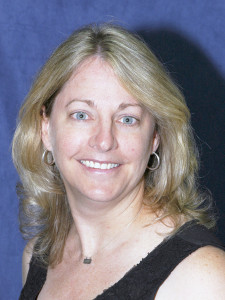
IIRP Assistant Professor Dr. Carol Thomas recently had an article published in The Prevention Researcher entitled "Supporting the Grieving Adolescent: An Interview with a 21st Century Perspective." Thomas introduced the interview by writing:
As individuals enter adolescence, they are confronted with a plethora of changes that occur all at once. Not only are they undergoing significant physical, emotional, and cognitive changes; they also grapple with developing a sense of independence and autonomy, struggle with the pressures of social acceptance and peer relationships, and are adjusting to sexually maturing bodies and accompanying feelings. Experiencing the death of a loved one during this already challenging time of life may leave adolescents confused, angry, or depressed.
Ted Wachtel's keynote from the 2011 European Congress on the Family Group Conference: Democratizing Help and Welfare in Utrecht, the Netherlands, October 19-21, 2011:
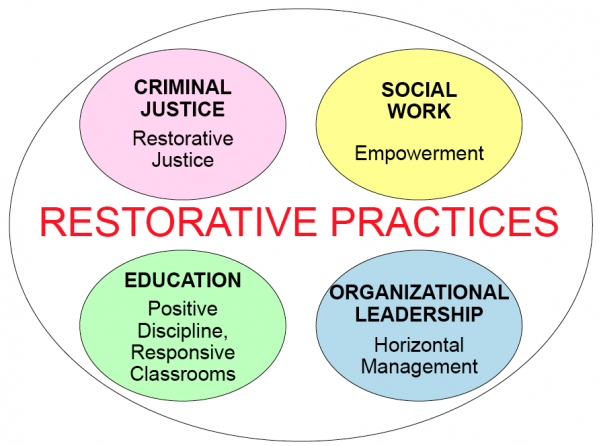
Restorative Practices: Creating a Unified Strategy for Democratizing Social Care, Education and Criminal Justice
I’d like to tell you about the first Family Group Conference story that I ever heard. I heard it in 1994 from an Australian police officer named Terry O’Connell. Terry was traveling around the world on a Winston Churchill Fellowship and he came to where I live in the U.S., in Pennsylvania. When he told this story I was deeply moved. It touched my heart. So much so that Terry said he remembered me because I was the person sitting in the front row with tears running down his cheeks.
IIRP Associate Professor Dr. Tom Simek contributed this piece about some changes to the IIRP's introductory courses. For those who have taken these classes, they might be interested to know about the changes. The changes will make it easier for people to get course credit and to take introductory courses if they live at a distance from the Bethlehem, Pennsylvania campus or if they participate in IIRP professional development events:

This heart-wrenching story involving the traffic death and serious injury to a couple from a community near IIRP's Graduate School in Bethlehem, Pennsylvania, impacts a number of IIRP employees and friends. The message conveyed by the adult children of the victims to the driver of the car that so damaged their family is astounding:
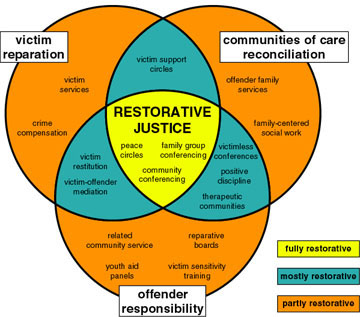
Here's a visual presentation from a paper presented by Paul McCold and Ted Wachtel at the XIII World Congress of Criminology, August 10-15, 2003 in Rio de Janeiro. The chart above and text below describe how three primary stakeholders – victims, offenders and communities of care – must all be included in a process for it to be considered fully restorative. If some but not all of those stakeholders are included, the process may be partially restorative. Comments?
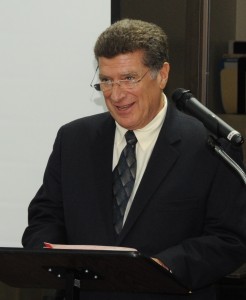
Finally, here in part 3 are IIRP president Ted Wachtel's brief remarks Sunday, in which he calls for a "restorative revolution." We welcome comments and discussion on this theme.
Thanks to Dr. Brosnan for his kind words. Thanks to all of the staff who put together this event. And thanks to all of you for coming. I want to speak very briefly about the mission of the IIRP: to improve human behavior and civil society.
The industrial revolution of the last two centuries brought us dramatic improvements in technology and made us very powerful. But it seems that our technological skills have outpaced our social skills. We still struggle with managing conflict. And restorative practices has the potential to help.
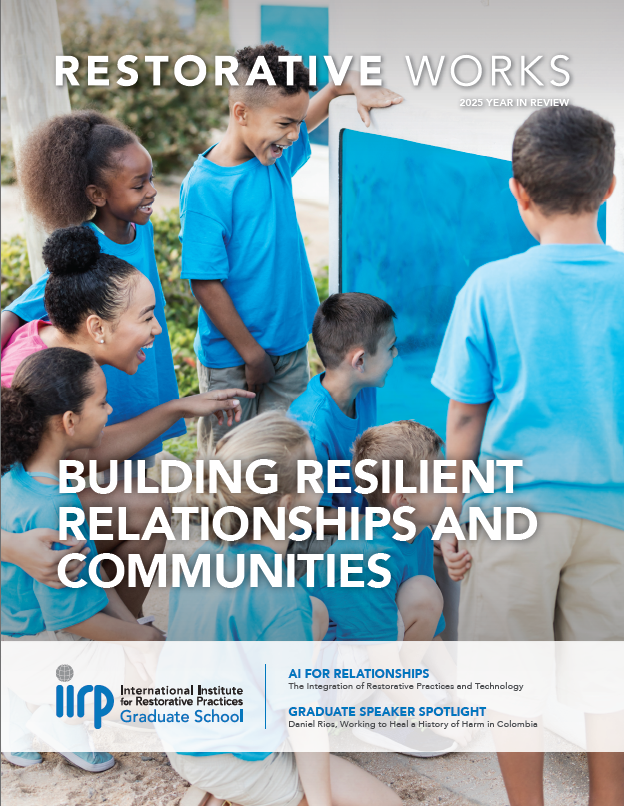
Restorative Works Year in Review 2025 (PDF)
All our donors are acknowledged annually in Restorative Works.