News & Announcements
Paper by Laura Rush, presented in a plenary session at "The Next Step: Developing Restorative Communities, Part 2," the IIRP''s 8th International Conference on Conferencing, Circles and other Restorative Practices, October 18-20, 2006.

Paper by Gwynedd Lloyd, presented in a plenary session at "The Next Step: Developing Restorative Communities, Part 2," the IIRP''s 8th International Conference on Conferencing, Circles and other Restorative Practices, October 18-20, 2006.
Paper by Christopher Hey and Gail Ryan, presented in a plenary session at "The Next Step: Developing Restorative Communities, Part 2," the IIRP''s 8th International Conference on Conferencing, Circles and other Restorative Practices, October 18-20, 2006.
Paper by Anat Goldstein, presented in a plenary session at "The Next Step: Developing Restorative Communities, Part 2," the IIRP''s 8th International Conference on Conferencing, Circles and other Restorative Practices, October 18-20, 2006.

Paper by Daniel Van Ness, presented in a plenary session at "The Next Step: Developing Restorative Communities, Part 2," the IIRP''s 8th International Conference on Conferencing, Circles and other Restorative Practices, October 18-20, 2006.
Paper by Mark Finnis and Paul Moran, presented in a plenary session at "The Next Step: Developing Restorative Communities, Part 2," the IIRP''s 8th International Conference on Conferencing, Circles and other Restorative Practices, October 18-20, 2006.
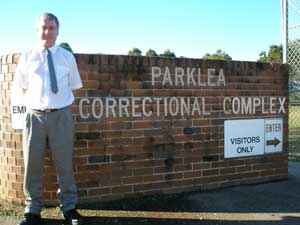
Chaseling discovered the limitations of punitive justice when he began work as a prison officer. He was disturbed to see inmates stripped of responsibility and free will: “From arrest to release from the criminal justice system, whether gaol [jail] or supervision... decisions will be made for them. Things will be done to them, or required of them. In terms of fair process or meaningful engagement, the chances are that very little will be achieved.”*
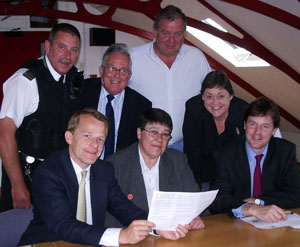
The people of the neighboring towns of Chard and Ilminster, in Somerset County, England, have taken justice in their community into their own hands. They established the Chard and Ilminster Community Justice Panel (CICJP) and are handling local cases themselves, in a restorative manner, with decidedly positive results.
What makes the CICJP different from other community justice boards is the restorative process. As in restorative conferences, as practiced by the IIRP, the CICJP brings victims, offenders and their supporters together face to face to deal with the consequences of an offense and decide how to repair the harm. Victims tell offenders how they have been affected by an offense, and offenders have a chance to take responsibility and make amends. Supporters express themselves, too.
Victims, offenders and their supporters are asked a series of restorative questions. Offender questions include “What happened?” and “Who do you think has been affected by your actions?” Victim questions include “How do you feel about what happened?” and “What has been the hardest thing for you?” At the end, all participants sign a conference agreement.
The emotional and psychological impact of crime can last far beyond the incident itself, in some cases affecting victims’ lives for years. A groundbreaking study has shown, however, that restorative justice conferences can mitigate those effects and help victims heal and move forward more quickly.
 Dr. Caroline M. AngelDr. Caroline M. Angel, a lecturer in criminology at the University of Pennsylvania in the United States, studied the impact of restorative conferencing on post-traumatic stress symptoms in victims of burglary and robbery. Her findings were clear: Conferences reduce the psychologically traumatic effects of crime.
“The most striking thing was that conferences reduced symptoms of post-traumatic stress disorder,” she said. “What you have here is a one-time program that’s effective in producing benefits for the majority of people.”
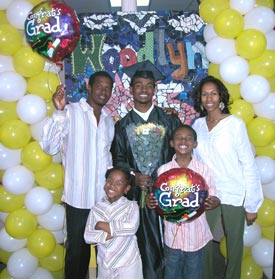
There have been other eForum articles about CSF Buxmont schools and programs that readers may recall reading. (CSF and Buxmont Academy are sister organizations to the IIRP.) I wrote “A Day at a CSF Buxmont School” after visiting the Bethlehem center for the first time. I was so deeply affected by what I saw that day that I ended up leaving my job as a newspaper reporter and going to work at CSF Buxmont.
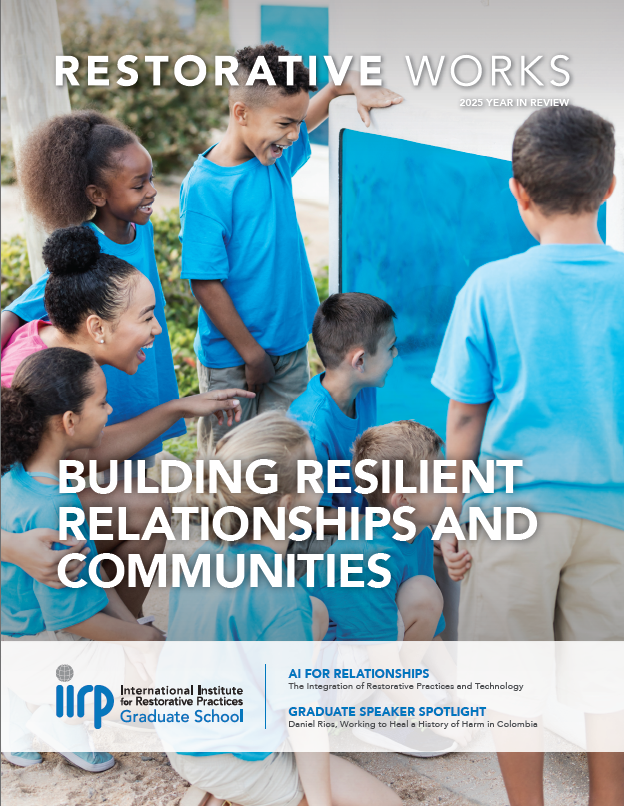
Restorative Works Year in Review 2025 (PDF)
All our donors are acknowledged annually in Restorative Works.