Support the IIRP
  • Bookstore (opens in new window)
  • Library
  • Students (opens in new window)
  • Faculty (opens in new window)
International Institute for Restorative Practices (logo)
  • Restorative Practices
    • Restorative Practices: Explained
    • Presidential Paper Series
    • Restorative Works Magazine
    • Restorative Works! Podcast
    • Resources
      • Schools K-12
      • Research and Evaluations
      • Guides for Implementation
      • Publications
      • Integrating Related Evidence-Based Strategies
      • Case Studies
      • Higher Education
      • Community Health & Restorative Practices
    • News & Announcements
  • Graduate Education
    • Graduate Programs
      • Master of Science
      • Education Specialization
      • Community Engagement Specialization
      • Master of Science with Thesis Option
      • Graduate Certificate in Restorative Practices
      • Graduate Certificate in Relational Facilitation for Healing Trauma
      • Graduate Certificate in Change Implementation in Organizations and Social Systems
    • Course Offerings
    • Registration & Admission
      • Program Application
      • Course Registration
      • Transcript Requests
      • Graduate Course Schedule
      • Frequently Asked Questions
      • Academic Catalog & Student Handbook
        • Introduction
        • Institutional Statements
        • Academic Calendar
        • Academic Catalog
          • Courses
          • Admissions
          • Educational Programs
          • Institutional Learning & Program Goals
        • Student Handbook
          • Health & Safety
          • Technology
          • Student Support
          • Tuition & Fees
          • Financial Aid & Scholarships
          • Campus Location
          • Academic Policies & Procedures
          • Accreditation
          • Institutional Policies
        • Index
    • Transparent Tuition
      • Tuition & Fees
      • Payment Plan
      • Cost of Attendance
    • Scholarships
    • Recruit Our Students
    • Philosophy & Academic Goals
  • Continuing Education
    • View All Offerings
    • Professional Development
      • Restorative Practices for Educators
      • Navigating Conflict: Restorative Practices in the Workplace
      • Restorative Practices at Work: Relational Tools for Culture Change
      • Connection and Content: Integrating Restorative Practices into Classroom Learning
      • Implementing with Intention: Effecting Change Through a Relational Lens
      • Facilitating Listening Circles
      • Restorative Justice Conferencing
      • Putting Theory into Practice for School Staff and Administrators
      • Reimagining Campus Community with Restorative Practices
    • Bring Our Events to Your Team
    • Restorative Practices Training of Trainers
    • Conferences & Symposia
    • Free Webinars
  • Collaborative Application
    • Consultative & Implementation Services
    • Whole-School Change
      • Program Overview
      • School Resources
      • Frequently Asked Questions
    • Restorative Practices in Higher Education
      • Get Involved
  • About
    • The IIRP Graduate School
    • Message from the President
    • Who We Are
      • Faculty
      • Instructors
      • Leadership
      • Trustees
      • Alumni
      • Factbook
    • Support the IIRP
    • Employment at the IIRP
    • Accreditation Information
    • Research Agenda
    • Lenape Nation Acknowledgment
    • Consumer Information (Higher Education Opportunity Act)
  • Contact Us

News & Announcements

Subscribe to IIRP News, the IIRP’s monthly newsletter.

Subscribe to IIRP News

Sign up for our monthly e-newsletter, IIRP News, to receive information on the latest trends in the restorative practices field, encouraging stories from our students and alum, and the latest IIRP offerings. 

Please let us know your name.

Please write a subject for your message.

Please let us know your email address.

Invalid Input

Invalid Input

Invalid Input

Values and Principles of Restorative Justice in Criminal Matters

Published: January 27, 2004

This document (PDF), issued by the Department of Justice Canada, explains the philosophy of restorative justice, defines the restorative justice process and spells out basic principles and procedural safeguards relating to the use of restorative justice.

Read more

Albert Eglash and Creative Restitution: A Precursor to Restorative Practices

Published: December 3, 2003
By Laura Mirsky
Download PDF version

 The concept of creative restitution was developed by psychologist Dr. Albert Eglash in the 1950s. While working with adults and youths who were involved in the criminal justice system, Eglash found that the system lacked both humanity and effectiveness. As a proposed alternative to that system, he developed and promoted the concept of creative restitution. In creative restitution, “an offender, under appropriate supervision, is helped to find some way to make amends to those he has hurt by his offense, and to ‘walk a second mile’ by helping other offenders.”[1]

Read more

Hampshire County, UK: A Place of Innovation for Family Group Conferencing

Published: November 4, 2003
By Laura Mirsky
Download PDF version

Hampshire County, England, has been an important location for the development and use of family group conferencing (FGC), also known as family group decision making (FGDM). One of the largest nonmetropolitan counties in England, Hampshire has a population of 1.5 million and encompasses both urban and rural areas, with communities ranging from prosperous to economically depressed. There has been a wide variety of FGC activity in the county. Starting with child welfare, FGC has moved into youth justice, education and domestic violence applications, among others. This article explores a variety of FGC programs in Hampshire.

Read more

The Wet'suwet'en Unlocking Aboriginal Justice Program: Restorative Practices in British Columbia, Canada

Published: October 21, 2003
By Laura Mirsky
Download PDF version

The Wet'suwet'en Unlocking Aboriginal Justice Program (WUAJ) is a community-driven restorative justice project initiated and operated by members of the Wet’suwet’en First Nation, in northwest British Columbia, Canada. The WUAJ was first developed in 1992, in response to the Wet’suwet’en people’s dissatisfaction with the Canadian judicial system and the disproportionate number of Aboriginal people involved in the federal and provincial court systems. The population of the Wet’suwet’en Nation is approximately 5,000. A matrilineal descent group, the Wet’suwet’en is made up of five clans: Laksilyu—Small Frog, Gilseyhu—Frog, Tsayu—Beaver, Gitdumden—Bear and Laksamishu—Fireweed, which are subdivided into 13 houses.

Read more

Papers from the IIRP's 2003 conference in Veldhoven, Netherlands

Published: October 1, 2003

Plenary session papers from "Building a Global Alliance for Restorative Practices and Family Empowerment," the Fourth International Conference on Conferencing, Circles and other Restorative Practices, August 28-30, 2003, Veldhoven, Netherlands.

Read more

Against Penal Instrumentalism

Published: August 30, 2003

John Blad, of Erasmus University Rotterdam, Netherlands, chief editor of the Dutch Journal for Restorative Justice, discusses the Dutch government's shift from having one of the most lenient penal climates in the world to one that is much more punitive. He attributes the rise in his country's incarceration and violent crime rates to the new policies and argues for implementation of restorative justice instead. The paper was presented at the first in a series of three IIRP conferences with the theme, "Building a Global Alliance for Restorative Practices and Family Empowerment," in Veldhoven, Netherlands, August 28-30, 2003.
Read more

Adult Restorative Justice in New Zealand/Aotearoa

Published: August 30, 2003

Helen Bowen and Jim Boyack, trustees of the Restorative Justice Trust of Auckland, New Zealand, discuss developments in adult restorative justice initiatives in their country, where youth offender family group conferences (FGCs) have been legally mandated since 1989. The 2002 Sentencing, Parole, and Victims' Rights acts have made New Zealand the world's first country to provide for restorative justice practices and principles at all stages of the criminal justice process. The paper was presented at the first in a series of three IIRP conferences with the theme, "Building a Global Alliance for Restorative Practices and Family Empowerment," in Veldhoven, Netherlands, August 28-30, 2003.

Read more

The Northern Territory Police Pre-Court Juvenile Diversion Scheme: A Preventative and Restorative Approach to Juvenile Offending

Published: August 29, 2003

Graham Waite, superintendent, Northern Territory Police, Australia, discusses the Territory's pre-court juvenile diversion scheme, which provides alternatives, such as Real Justice conferencing, to prosecution and sentencing of young offenders (including Aboriginal youth), in the formal justice system. The scheme produced significant decreases in reoffending and high satisfaction levels. The paper was presented at the first in a series of three IIRP conferences with the theme, "Building a Global Alliance for Restorative Practices and Family Empowerment," in Veldhoven, Netherlands, August 28-30, 2003.

Read more

Restorative Practices in a Dutch School

Published: August 29, 2003

Joke Henskens-Reijman and Roel van Pagée, principals, Terra College, The Hague, Netherlands, speak of their encouraging experiences implementing restorative practices in two large, urban secondary schools where the ethnic make up has recently changed from a homogeneous Dutch population to one that includes children from multiple ethnic and national backgrounds. The paper was presented at the first in a series of three IIRP conferences with the theme, "Building a Global Alliance for Restorative Practices and Family Empowerment," in Veldhoven, Netherlands, August 28-30, 2003.

Read more

Addressing Child Protection and Group Care Issues Through the Use of Family Group Conferencing

Published: August 28, 2003

Karin Gunderson, of the Northwest Institute for Children and Families, University of Washington School of Social Work, Seattle, Washington, U.S.A, reports the positive results of two significant studies on family group conferencing (FGC): "Long Term and Immediate Outcomes of Family Group Conferencing in Washington State," June 2000, and "''Connected and Cared for'': Family Group Conferencing for Youth in Care," June 2002. The paper was presented at the first in a series of three IIRP conferences with the theme, "Building a Global Alliance for Restorative Practices and Family Empowerment," in Veldhoven, Netherlands, August 28-30, 2003.

Read more

Page 97 of 106

  • 92
  • 93
  • 94
  • 95
  • 96
  • 97
  • 98
  • 99
  • 100
  • 101
  • Restorative Practices: Explained
  • Presidential Paper Series
  • Restorative Works Magazine
  • Restorative Works! Podcast
  • Resources
  • News & Announcements

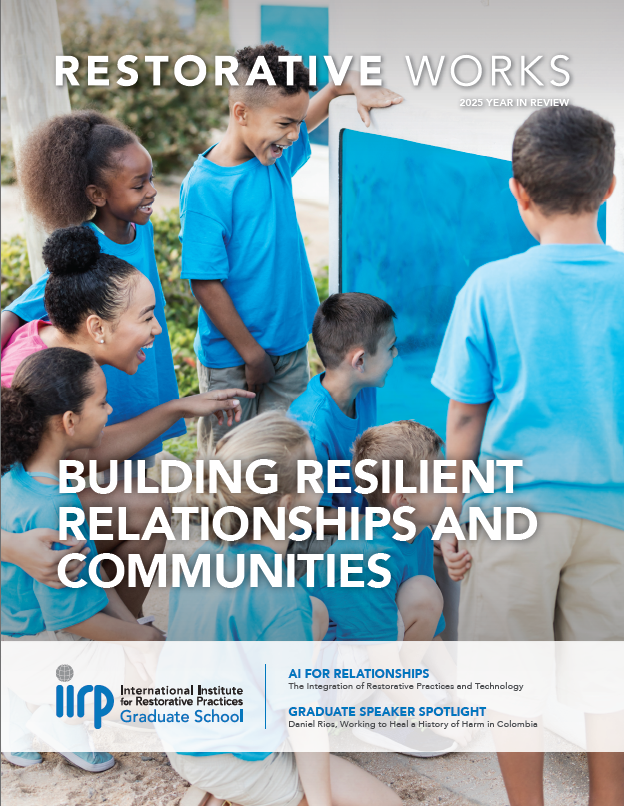
Restorative Works Cover
Restorative Works Year in Review 2025 (PDF)

All our donors are acknowledged annually in Restorative Works.

Contact IIRP

531 Main Street
Bethlehem, PA 18018

(610) 807-9221

IIRP on Facebook (opens in new window)IIRP on X (formerly Twitter opens in a new window)IIRP on YouTube (opens in a new window)IIRP on Instagram (opens in a new window)IIRP on LinkedIn (opens in new window)

Get to Know Us

About the IIRP

Restorative Practices

News and Announcements

HEOA Consumer Information

Accreditation

Meet the IIRP

Employment

Digital Accessibility Statement

Explore Programs & Resources

Master of Science Degree

Graduate Certificates

Professional Development

Collaborative Application

Resources and Research

Events, Conferences, and Summits

The Collaborative Center for Restorative Practices in Higher Education

Get Started

Start Your Graduate Application

Register for Professional Development

Request Customized Experience

Become a Trainer

Browse the Bookstore

Whole-School Change

  • Restorative Practices
    • Restorative Practices: Explained
    • Presidential Paper Series
    • Restorative Works Magazine
    • Restorative Works! Podcast
    • Resources
    • News & Announcements
  • Graduate Education
    • Graduate Programs
    • Course Offerings
    • Registration & Admission
    • Transparent Tuition
    • Scholarships
    • Recruit Our Students
    • Philosophy & Academic Goals
  • Continuing Education
    • View All Offerings
    • Professional Development
    • Bring Our Events to Your Team
    • Restorative Practices Training of Trainers
    • Conferences & Symposia
    • Free Webinars
  • Collaborative Application
    • Consultative & Implementation Services
    • Whole-School Change
    • Restorative Practices in Higher Education
  • About
    • The IIRP Graduate School
    • Message from the President
    • Who We Are
    • Support the IIRP
    • Employment at the IIRP (opens in new window)
    • Accreditation Information
    • Research Agenda
    • Lenape Nation Acknowledgment
    • Consumer Information (Higher Education Opportunity Act)
  • Contact Us

© 2015 - 2026 International Institute for Restorative Practices | Site Map