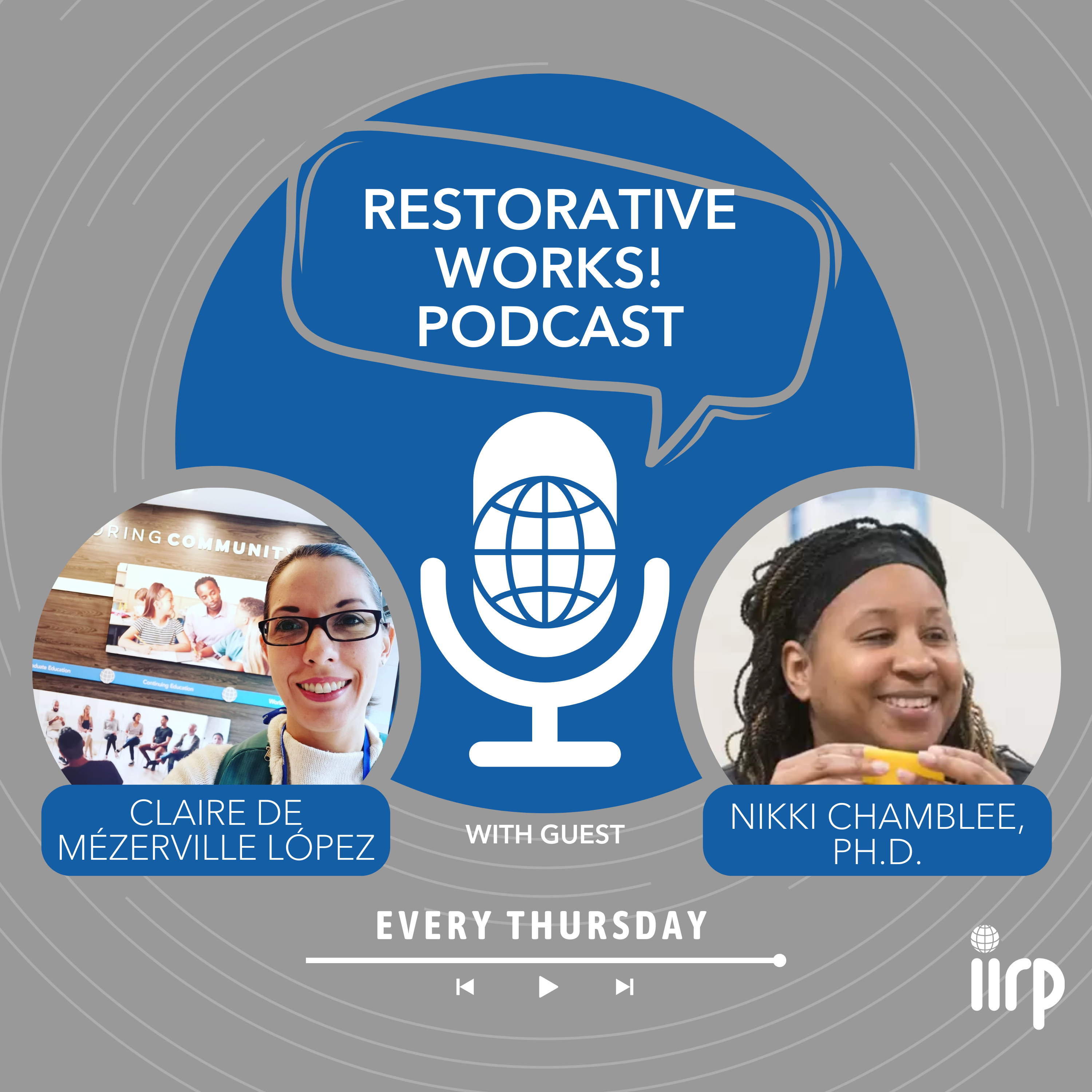
In this opening episode of the Restorative Pedagogies series, Claire de Mezerville López and Nikki Chamblee to the Restorative Works! Podcast to explore what it means to approach teaching through a restorative practices lens.
Moving beyond the idea of restorative practices as solely relational or disciplinary tools, Claire and Nikki reflect on pedagogy as a human-centered practice—one that honors voice, agency, belonging, and emotional safety as foundations for learning. Drawing on research, classroom experience, and theory, they discuss how integrating restorative practices into curriculum planning can create conditions where mistakes are welcomed as part of growth, creativity is nurtured, and students can remain engaged even when learning feels challenging.
Together, they examine how restorative practices support high academic expectations without reverting to fear-based or punitive approaches, and how educators can intentionally embed relational processes into content instruction across subject areas. This episode sets the stage for the series by inviting listeners to rethink what effective teaching looks like when dignity, connection, and accountability are held together.
Nikki Chamblee, Ph.D., has been an educator for over 19 years. She currently serves as an Instructor and Implementation Coach for the IIRP, providing training and coaching to support districts in effectively planning implementation. Her area of focus is the interweaving of restorative practices with other district initiatives. She is licensed in New York and Texas in the areas of English Language Arts, Special Education, and English as a Second Language. From 2017 - 2022, she served as a Coordinator of Restorative Practices for two districts in the Dallas-Fort Worth area. She received Tier 1 and Tier 2 training in restorative practices from the Morningside Center for Teaching Social Responsibility and restorative discipline training from the Texas Education Agency. She holds a Graduate Certificate in Restorative Practices from the IIRP.
Tune in to explore how integrating restorative practices into lesson plans can be a game-changer for your classroom.
Transcription
Claire de Mezerville López
Hello everybody and welcome to Restorative Works, a podcast where learning practice and research open new paths for transformation. name is Claire de Mezerville Lopez and it is my honor to introduce this podcast series titled Restorative Pedagogies along with a wonderful co-host, leader, trainer and coach, Nikki Chamblee. Hi Nikki, how are you today?
Nikki Chamblee
Good. Hello, Claire. Belinda Hopkins defines relational pedagogies as those that foster a stronger connection between teachers and students, among students themselves, and also between students and curriculum. Restorative pedagogies is a series that focuses on the application of restorative practices as part of the pedagogical approach in K-12 to enhance effective learning of specific subjects. Beyond the relational richness necessary to create school community, can restorative practices help us to learn better when it comes to Math, English, Science, or History?
Claire de Mezerville López
In this first episode, Nikki and I will share this conversation. Nikki Chamblee has been an educator for over 19 years. Currently, she serves as an instructor and implementation coach for the IIRP. In this role, she provides training and coaching to support districts in effectively planning implementation. Her areas of focus are the interweaving of restorative practices with other district initiatives. She is licensed in New York and Texas in the areas of English language arts, Special Education, and English as a second language.
Nikki Chamblee
And I will share this conversation with you, Claire. Besides being the host of the Restorative Works podcast, Claire is a licensed psychologist from Universidad de Costa Rica with a master's in education with emphasis in cognitive development, a master's in restorative practices and a PhD in community engagement. Claire has been a member of the psycho-pedagogy department of the Universidad de Costa Rica for over 15 years, a department that you are currently coordinating, so that I know that you are constantly thinking about restorative practices and pedagogical applications.
Claire De Mezerville López
And Nikki, I think that's exactly what goes to the heart of our first question. I'm so happy to engage in this conversation with you. We associate restorative practices with interpersonal relationships, strengthening the community. Many people when they don't know what I'm talking about, they are like, it's a kind of conflict resolution, right? All these relational community aspects, but how do restorative practices relate to pedagogical teaching practices? Wat has been your experience?
Nikki Chamblee
Thanks so much. So, pedagogy is the method and practice of teaching. And then restorative practices is a social science focused on building ourselves, the intrapersonal, others, the interpersonal and community systems. Unfortunately, we know there's a gap between educational research and application, but years of research into high impact methodologies and practices in the classroom teaches that focusing on honoring agency voice and belonging of the instructor as well as students enhances the learning process for everyone.
Claire de Mezerville López
And one of the things that I find particularly important is even if we go back to Paulo Freire, if we go back to these dialogical methods, to learn through dialogue, learn so that people bring what they know, that they are not empty and you are depositing knowledge into people. But the other thing that I found interesting about using restorative practices as a pedagogical approach, and I remember when I read this from George Graeme on this book about the restorative classroom from 2014, how different restorative practices and process can help you to deal with mistakes and can help you to deal with the shame that comes from mistakes; to have this emotional safety so that you can recover and re-engage with learning instead of just dropping it and giving up. And I remember, on working with trainings with people, with teachers, that we will talk about, how effective punitive approaches are. Because yes, of course, fear and punishment, they are going to be the most effective way to get people to react quicker and to do things faster. And that is effective. But creative problem solving, really finding creative solutions for a problem… that only happens when there's emotional safety. And creative problem solving shuts down when you're nervous, tense, or afraid.
Nikki Chamblee
Yeah, I would agree. And I think it happens on multiple levels that when you're in spaces as an educator and you don't feel like you're heard or appreciated or allowed to make a mistake with it being detrimental to your career, then you struggle to give that same grace and space to students as you're teaching them to learn. And we know that the best environments around learning are around growth and around making space for students to feel safe enough to say oops, and then step back and make corrections. And so especially when you talk about populations of students with special needs and English language learners, there are tons of opportunities where mistakes are going to be made because of cognitive issues or because of language delays and there needs to be space in order for them to grow, and in order for them to build that confidence to take on new learning tasks. Otherwise, you get that kind of helplessness that occurs in some spaces.
Claire de Mezerville López
And mistakes should be welcome. Mistakes are teachers. How do we create an environment where mistakes are welcome? And I can see that as English being my second language and how you see students, whether they are children or whether they are teenagers, that they know the words, but they don't want to say them because they don't want to sound silly. They don't want to sound dumb. They don't want to sound like they are saying it wrong. There is no way to learn a language unless you quote unquote, “make a fool of yourself” for a little bit. So, you need to be in an environment where that is allowed to happen.
Nikki Chamblee
I agree. I actually was part of a program that was designed to help teachers understand the difference between students who were struggling to acquire language and students who had cognitive delays. And so, you became dual certified in special ed and ESL, and your task was to go into the classroom and observe and sort of make some determination because we were getting an over-referral of students with language issues as cognitive issues. And so really being able to look and say, well, let's go from an asset-based approach. So, what can the student do? And does what they do apply to, we need to close the gap around language, or we need to close the gap around scaffolding for understanding. And so really being able to separate out those two and make some determinations that really are focused on who is the student in front of you. And teacher, what is your skill base and what more do you need? And so, kind of approaching it twofold.
Claire de Mezerville López
And I think it goes back to that George Graeme chapter that I was mentioning earlier, and I'm probably not saying the name correctly, and I apologize for that, but it's about re-engaging. You know, how through empathy and through a connection you re-engage. And then what happens and what has been my experience with my students at the university that you mentioned, where I work with students that are going to become teachers through the psycho pedagogy department is that they say, okay, this is great because we work with humans, because this is a relational task, but this is not really helping me with my subject. And I get that if we think, for example, about math. How will restorative practices help me if what you need to do is practice over and over again different exercises? I'm not going to say that this is the pedagogical practice. Maybe you can tell me. I remember when I was in high school that we had this teacher that would make us into small groups, some of the best students at math with some of the ones that were struggling, so that they could have these exchanges on how to solve different exercises. And that's a relational approach to solving problems.
Nikki Chamblee
Yeah, again, that's another place we know from research that peer-to-peer learning is effective, but we struggle with trusting ourselves enough to give that space to students, and then we don't trust students enough to manage that space, or to accept that they can go through a process of learning how to manage that work with each other. And so, thinking about how important that is. I was meeting with a group of teachers yesterday and I was saying, we expect students to know how to work together. We expect teachers to know how to work together just because they showed up in the school and we don't take the time to explicitly teach out that expectations of what we want in group work. So then in a math class, we can put students in groups and kind of just be kind of the, on the side supporting the learning process because we've given them all the tools in terms of the content that they need and then the process of what we want them to do. And then we kind of step back and let the learning happen and then step back in if we need to redirect for understanding, but really creating spaces where peers are pouring into each other and more knowledgeable peers. Cause we know from Vygotsky that a more knowledgeable other is really important, whether it's an adult or another student or a parent.
Claire de Mezerville López
That is so important, but that brings me more questions that I want to ask you. How about we take a short break, Nikki, and then we come back so that I can flood you with questions.
Nikki Chamblee
Welcome back to Restorative Works. In this second part of this episode, Claire, maybe we can share some practical stories where we have facilitated or witnessed other people putting these principles into practice and enhancing learning in specific subjects.
Claire de Mezerville López
Yeah, so thank you for that. I had more questions that I wanted to ask you and I'm going to tie them up with this introduction that you and I planned for this second part. We train to teach a specific subject. That's at least my experience at the university. And we've had some struggles, some department struggles, some even political struggles where people, for example, from Math, or from example, from French, they say, we cannot spend so much time on university courses that have to do with the human part, with psychological development or with psycho pedagogical practices because we need various specific didactics, right? We need to have pure math experts to teach us how to teach math. And they are right. They are correct. You need various specific expertise to teach various specific and complex concepts. But my experience has been that, as we do that, we undermine the humanness of teaching, that is not necessarily something that we will already know, that we will have by instinct, that it will just spontaneously emerge. And I think that's a very unfair expectation as people train and educate themselves to become teachers. Being a teacher is something that takes a lot of skill and a lot of personal growth. So, working on this, and this brings me to the question. When I used to teach one of the courses at the Psycho-Pedagogy Department, I had groups of students that were from many different careers. So, they were all in education and they were all having a degree in teaching, but some of them were on teaching French, teaching philosophy, teaching social studies, teaching science, teaching math. So, we will have this class and in this class, we were studying psychological development throughout adolescence. So, what we would do is we would have fairs where we would ask them: I need you to plan for us a seven-minute class on your subject that is going to be engaging for adolescents.
Claire de Mezerville López
And those classes were just the most fun because in four hours we would all learn a little bit of French, a little bit of math, a little bit of biology, a little bit of social studies, a little bit of Spanish grammar. And it was just so much fun, but it was very interactive. It was very relational. And then we would debrief about how we assume that we're going to have this skill set and not necessarily. Restorative practices help with this. I would like to hear what you have to say about this.
Nikki Chamblee
Yeah, so I actually during the pandemic started teaching a course to professors like yourself on how to teach online because the federal government actually had a requirement for a certain amount of interaction. And what we found is professors were just kind of emailing if they didn't, or weren't familiar with the learning management system. And so really going back and building relationships with the professors. So then, because they were coming from all kinds of different department, we could build a culture within the discussion board that modeled the interaction and connection we wanted them to do with each other across the department in terms of skills to be more student facing in this new online environment that we all were kind of navigating at the same time. I feel really fortunate I came into education from social work and then I didn't have a great student teaching experience where I kind of was supposed to learn what does it really mean to be in the classroom? So, I relied really heavily on my social work skillset that I came in with. And so that kind of pushed me to do a couple of things. One was, like, I intensely focused on getting to know my students the first two weeks. And so really studying who they were and making notes of who they were and then thinking about where I could bring those examples of what I knew about them into content, whether it was math, science, social studies, whatever something of an interest a student had coincided, I would bring it in and also think about when I'm designing units of study, how to focus on what I know about either where they're from or an interest that they have so that I could kind of give them a starting point to step in and feel like you didn't just tell me you played baseball, like I really listened to the answer. And so when I was thinking about, you know, fractions and decimals, I came back to you about you, really going to like what we're about to do because we're about to play with some statistics of fractions and decimals, which tie into what you like about baseball.
Claire de Mezerville López
And I think this is important because you are a coach and an instructor and a trainer and a mentor. You know that we insist to communities and to people, restorative practices are not just an extra thing. How do you embed them in everything that you're doing? How can they contribute so that you can feel better about the work that you're doing? That also means keeping high expectations on what students are learning. In Costa Rica, we're going through a very severe educational crisis. Our macro measures on how education is doing are way, way low. Reading comprehension is on record lows in our country right now. And there are many different structural reasons for why that is happening. But what we're hearing is, you're focusing too much on pampering students. And they are not learning what they need to learn. How do we embed restorative practices into having very high quality teaching, very high expectations, teaching? And you mentioned Vygotsky and Vygotsky was very clear. We don't learn our comfort zone, you know, through that zone of proximal development, you are moving towards something that is beyond your capacity, but you are striving to do that. And that's what helps you grow. And that means to expect from people more than they know that they can give with very high expectations, but in a way that doesn't set us back to all of these punitive measures that we think are the easy answer, but in the long term are not necessarily creating the high quality learning that we want to see.
Nikki Chamblee
Yeah, that's challenge because in so many places curriculum is mandated. And so, there's this tug of war between how much time do I have to get to know my students to allow for flexibility in this curriculum that's like, you know, week one, day one, I need to be here. And so, what I really focused on as an educator is where was there space for me in the curriculum? So where were there moments where I could give choice in texts or where were there ways that I could have automatic kind of processes that I taught out to the students to manage their academic difficulties? So, what were some strategies I could teach them upfront to kind of self-manage? I did not know that the expectation as a teacher was for me to do everything. So, I started with them doing everything and me being just the facilitator of learning. And I was very clear with the students about that. Things like, you know, those things that distract like the answering of the phone and the knocking on the door and the tracking who, you know, wasn't here yesterday, but needs papers. Like all of that I designed into a system that students took on so that then I could have that space and energy to focus on how do I provide the best level of instruction? And so like, I was a co-teacher for a period of time in a biology class and so, one of the strategies in order to help students step in in a way that still supported high expectations is I would bring books that were all different levels, all different languages, because I was a New York City public school teacher. And those would just sit in the middle of the tables so that as we were studying something like cells, students could reach in the basket, grab a book that may be all pictures about cells, but they were engaging in it on the level that they could engage in it with the scaffolding needed to eventually produce an understanding of what the parts of a cell were. And so really thinking about who was in the room. And so, I found that to be most helpful in the balance of the expectation is we teach content.
Nikki Chamblee
The expectation is at the end of the year, students in New York City sit for the ELA exam in, you know, elementary and middle school and the Regents exam in high school. And that is over my head. And so, finding that space where anywhere I could give choice, I would give choice.
Claire de Mezerville López
That encourages exploration and mistakes and trying new things and that psychological safety in a learning community that we were talking about before. Nikki, you allow me before wrapping up to ask you one final question because I am so excited about these series that we're co-hosting. What do you expect to hear and to learn with the guests that we're going to have in the coming episodes?
Nikki Chamblee
I think what I'm excited to hear about, and it's part of a big conversation, is one, ways that we put restorative into content that isn't just circles. I'm excited to hear and educate to share examples of that. And then ways that we engage in restorative processes that aren't around discipline or something has gone wrong. And then, the excitement about the opportunity that restorative might be a content in and of itself that we can teach students. So really excited to hear if people have taken that on even in small, even if they've done it in small, like four or five lesson units, but have people attempted to do it just as content in and of itself and what were those outcomes. So kind of excited to see what we, like just what we learned.
Claire de Mezerville López
Yeah, me too. So, Nikki, thank you so much.
Claire de Mezerville López
And thank you everyone for joining Nikki and I into this first episode for this exciting series. Thank you so much for tuning into Restorative Works. To learn more about this series and about our guests, log into IIRP.edu and let's continue to build transformation through dignifying relationships, kind conversations and stronger communities. Until our next episode.