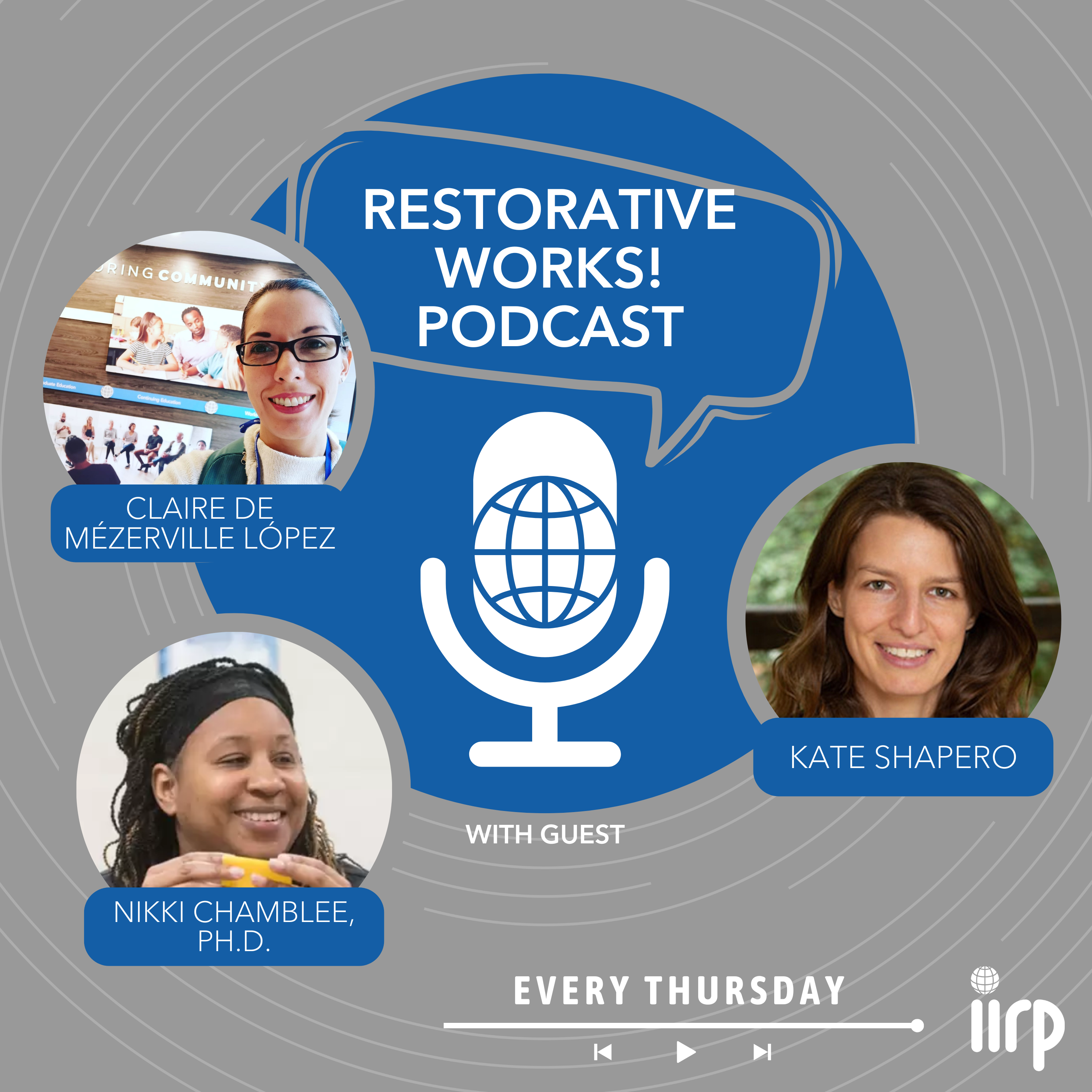
What happens when science education is designed as a relational, exploratory process rather than a rigid set of steps? In this episode, Claire de Mezerville López and Nikki Chamblee welcome science educator and restorative practitioner Kate Shapero to the Restorative Pedagogies series of the Restorative Works! Podcast to examine how restorative practices can transform the science classroom.
Kate reflects on curiosity, experimentation, and learning from mistakes as essential elements of scientific thinking—and how these processes depend on trust, emotional safety, and strong relationships. Through stories from her classroom, she illustrates how student-led exploration, play, and collaborative problem-solving foster both scientific understanding and social-emotional growth.
The conversation explores how restorative practices support risk-taking, perseverance, and teamwork in scientific inquiry, while also developing communication and relational skills that extend beyond the classroom. Kate invites educators to see restorative practices not as separate from content, but as integral to how students learn, collaborate, and engage deeply with science and with one another.
Kate Shapero is a Science Education and Restorative Practices Specialist with over 20 years of experience. After completing her undergraduate degree, she developed and taught science curriculum in independent and alternative schools in the Philadelphia area. Working with pre-K through postgraduate learners, she specializes in progressive curriculum design that is experiential, meaningful, and joyful. As a restorative practitioner, Kate collaborates with students, teaching teams, classroom communities, parent groups, and administrative staff to improve community relational health. Kate's current work includes facilitation, coaching, and professional development. She earned a Bachelor of Science in Bioscience and Biotechnology from Drexel University in 2003 and a Master of Restorative Practices and Education from the IIRP Graduate School in 2010.
Tune in to explore how integrating restorative practices into lesson plans can transform the science classroom.
Transcription
Claire de Mezerville López
Hello everybody and welcome to Restorative Works, a podcast where learning, practice and research open new paths for transformation. My name is Clare de Mezerville Lopez and it is my honor to introduce this episode for this podcast series titled Restorative Pedagogies, along with wonderful co-host, leader, trainer and coach, Nikki Chamblee. Nikki, hi. Let's begin with a definition that you have prepared for us for this series.
Nikki Chamblee
Thank you, hello Claire. Belinda Hopkins defines relational pedagogies as those that foster a stronger connection between teachers and students, among students themselves and also between students and curriculum. Restorative pedagogies is a series that focuses on the application of restorative practices as part of the pedagogical approach in K-12 to enhance effective learning of specific subjects. Beyond the relational richness necessary to create school community, can restorative practices help us to learn better when it comes to Math, English, Science, or History? Today, we'll focus on Science, and for that, we welcome our wonderful guest, Kate Shapero.
Kate Shapero
So nice to be here with you today.
Claire de Mezerville López
Kate Shapero specializes in science education, restorative practices, and social and emotional learning. She currently works with school communities to create safe and supportive environments in the school district of Philadelphia's Office of School Climate and Culture. Early in her teaching career, Kate developed a deep curiosity about the science of relationships, especially how to humanely navigate conflicts and nurture trusting relationships among students and staff. She regards positive relationships as a core value and aims to bring radical and needed transformation to our schools and communities. Kate, welcome. Thank you so much for being here.
Kate Shapero
Thank you so much for having me. I'm excited to talk with both of you.
Nikki Chamblee
So, Kate, it's always a pleasure to see you. I'm gonna jump right in. So doing experiments is all about curiosity and learning from mistakes. So I would think that restorative practices have a role in these processes. What has been your experience in practice with this?
Kate Shapero
So, curiosity and learning from mistakes is a huge part of the scientific process. And when I think about effective science education, I think about how we can create containers where it's safe to make mistakes, it's actually accepted and expected that there's gonna be a lot of points of frustration and even points of failure, and that it's okay to not know things as well. And so, in the science classroom, we spend a lot of time creating a container where that kind of risk taking and exploration and discovery can happen, so that kids don't have to feel like if something goes wrong that they've done something wrong, that actually that could be the way that we find out more. And we do a lot of that work through building that container of trust using circles in terms of doing relational connection activities. Also, just in terms of taking the time to really emphasize that scientists have to know how to build relationships because often they're working with people they didn't choose from around the world, and that it's actually an essential skill to know how to make connections, how to talk through problems, and how to make things better if they feel like they can support the work that you're doing.
Claire de Mezerville López
One of the things that I think restorative practices can help is with creating that safety for flexibility and for questions and for going back if the experiment turns out in a different way than you expected. With my own students, I remember that I was trying to get them to fall in love with research. I am not a science teacher, but I do go back to part of these classes that you do a research project. Do you remember the scientific method? They think about it as a boring content from their science class in high school. And when we start debriefing, well, no, actually this is a method for being curious and for exploring things that you don't know, where your interest is. And that's where I think that science classes offer such a great opportunity for cognitive development throughout childhood and adolescence.
Kate Shapero
Yeah, it's definitely, you know, I feel like it's such an amazing gift to get to explore things through the scientific process. And when someone lays out for you step by step what you're going to do to kind of simulate or practice the scientific process, I really think of it as kind of like someone's doing science for you, right? There, if you're thinking about the engagement windows, they're kind of spoon feeding you like, we'll try this and then we'll do this. Or if they say, I want you to figure something out without giving you that scaffolding, it could feel like they're kind of doing science to you, in the sense that you don't really have the support you need to meet the high expectations. And so, when I think about how to create science experiences that are really dynamic and that students feel really invested in, it's often kind of thinking about how can we co-construct the learning in that with way. We had a lot of classes where we would take materials that we were going to explore in a more formalized way and we would have time simply spent to mess around and play with the materials. And I'd say we're going to use these later, but I want you to just explore these, make some observation, try some things out, ask some questions. And after 15 minutes or 20 minutes of exploring and playing with stuff, students would have so many better questions than I could have ever developed. And often I would have a scaffold for like kind of where we were going in the process, you know, in terms of the core ideas that we were hoping to identify. But the questions that they raised and came up with through time to mess around and get to know materials meant that their questions often led our research because it was no longer about kind of going through the steps of a process, but it was like they needed to know, right? They were invested in finding out what would happen. And we saw that in so many different classes, but I think being able to have that freedom and being able to handle the responsibility of exploring with materials and often building things during workshop time just required a lot of well-developed social and emotional skills in terms of self-awareness when you're using materials, when you're sharing things, thinking about kind of self-management too, in terms of how you're going to handle when something feels frustrating. And so, a lot of our best work I think happened during experimentation that was student-led and then also during workshop time where we had an opportunity to actually build and see things that were personally meaningful to us.
Claire de Mezerville López
Is there a specific content or a specific theme that you can recall that was especially exciting on doing this kind of a process?
Kate Shapero
Yeah, the one that comes to mind is that we often did a circuitry workshop with our fifth and sixth grades. And so, in circuitry workshop, students would have these mini lessons where they would kind of be introduced to, you know, wires, light bulbs and materials that could be used to make different aspects of circuits. And the idea was that during circuitry workshop, there was going to be a brief mini lesson and then the class was presented with a challenge. And a challenge might be something fairly simple, like can you build a switch that can be turned off and on with one hand, using the materials provided? And so that's kind of the physical challenge, but the relational challenge that was layered on top of that was whether you can support yourself and others through this challenge. And so, we had explicit workshop rules that we would often use. And so, the first workshop rule was encourage yourself and others, like try things out, just try something if you're not sure what to do. The second rule was that once you figured something out, it was part of your class responsibility to be able to share that knowledge with other people. And so, we said, we don't want you to run and tell people and have them miss out the chance to learn on their own, but you ask people if they'd like some help. And then if they'd like some help, you're welcome to show them how to do it, but not to do it for them. And so the goal was that everyone did figure out how to make a switch. But by the end of the class, the entire class had the knowledge that everyone had developed. And we would actually do some check-ins on at the end and we'd get to share.
First of all, all the cool things that they made that showed the diversity of ways to solve a problem. But then we would do some reflection on, you know, how did we support each other in meeting this goal and what scientific habits of mind did we practice today? Again, that's where those circle processes, just being a part of our routine, were built in at the end of the day, you know, what habit of mind did we practice today? And kids could say, you know, we shared information with each other, and they could provide evidence and say, point to something that happened in class. Or they could say, you know, we tested out an idea and then be able to share that. So, I just felt like creating this collaborative community again, where if the heart of scientific work is trying to work together to understand the world, always layering those two pieces together, the science content and process with the relational skills that you needed to do that as well.
Claire de Mezerville López
Nikki, that reminds me of what you mentioned in our prior conversation about the books and the cells that you mentioned that you will have different levels of books so that students could go and look into that. Is that similar, Nikki, or is it?
Nikki Chamblee
Yeah, so it's making space for that exploration that students need to do to connect to what you're getting ready to go into content. And it also, I think, to Kate's point, it signals this is a place where you can play. And so that in itself is the language of students. Like, we know that they aren't given enough spaces to play and explore. And so that opportunity to put hands on materials or in my case, to open up and see books in languages that they connect to or in images that are simpler for them to understand than what was in the textbook, I think is a great way for them to kind of relax into the process before you actually get to the learning process or the demonstration of understanding of what the content was.
Kate Shapero
When you just said relax into the process too, I think that's a big part of it is kind of the mindset that students cultivate. I remember I had a new student one year named Robert who joined our school and I had worked with the other students in his grade for a few years. And he came in and one of the first experiments that we were doing, we were building little aluminum foil boats. And so, students were testing different shapes of the boat holes to see kind of how many pennies they could hold before they would sink. And when he came in, we got to the point where the boat was just about to sink and his partner wanted to keep adding pennies and he was like, no, no, no, no, please don't, you know, any, cause it was kind of like, if it sinks, then I've, I've done something wrong. I failed. Right? And so, his partner didn't really listen to that moment, but also wanted to keep going with the experiment and added the penny. And when the boat sank, Robert kind of had a little bit of an upset moment and, and stocked out of the classroom and went to the bathroom, that was right outside the door. And I remember thinking, you know, like, okay, something's going on. And I could address kind of the, you know, like, quote unquote “misbehavior”, or I could try to find out what the need is that's going on here. And just like you talked about in terms of being able to feel safe messing around. When he came out, I decided instead of going to the misbehavior to try to talk more about the need, and I use those effective questions of saying, you know, like, what's going on for you? What's going through your mind right now. And what he let me know was that he was really upset because he felt like he got it wrong when the boat sank. He thought the goal was to do it the right way. And so, by getting to kind of walk through those questions with him and understand, you know, like, well, what happens if we able to find out this or what happens if we don't? We were able to establish that we had to be kind of explicit that, in here the goal was for us to learn through understanding versus kind of always getting it correct. And that if something was not feeling okay, that it was okay to talk with each other about it, that you didn't have to deal with it all on your own. And I just think when you're talking about relational pedagogy, like so much of the risk taking that we need to do in science involves trust. And that student really taught me that, you know, the investment we put in the beginning of building that trust, I think later that day we ate lunch together and built some paper airplanes and kind of just hung out and had a good time.
Kate Shapero
It showed me that you can completely change the trajectory of how that student views a class and also your relationship with that student and being able to move forward in a way where we had fantastic years together for the following years just on the ability to look for what the need was and also to address that the relational importance was more important than kind of anything happening in that moment.
Claire de Mezerville López
Wow, there's so much learning going on and in so many different layers that you described. We're going to take a very short break and then we're going to come back to continue learning about science and restorative practices with Kate Shapero. Please stay tuned.
Claire de Mezerville López
Welcome back to Restorative Works. Kate, I mentioned how my students recall the scientific method as content instead of as an experience. And we also had that experience with the project that we work on at the university: we work with juvenile justice, and we brought this workshop on fixing toys, these were remote control little cars and they would fix the circuits so that they will be accessible for students with disabilities. So, they will have to make bigger buttons and just do this. And I could really observe there what you were describing just now and it clicked to me is just that going into play, you know? They are learning something new, they are doing something different, but they're relying into the dynamic of play that as, as Nikki said, that's their language too. In your experience, what are specific practices that could enhance the development of both scientific skills and social and emotional learning? You mentioned a few, but let's just continue on that.
Kate Shapero
Yeah, yeah. You know, I just love what you said, though, about the students creating an assistive technology, because I think that is one of the most important things is for it to feel meaningful and relevant, to have an authentic purpose. So, I just want to uplift that giving students that challenge and also that there's not one way to solve it is one of the most fun ways to kind of bring that because, you know, they're actually doing the work. And that's one of the most valuable pieces of this. I will share a story, you reminded me that there was once a workshop I went to and the leader of the workshop presented us with all these materials and asked us to build something. And then he said, there's a few tables over here where I'm just going to give them the instructions for how to build it. And what we saw is the tables where people had to figure it out on their own, with enough support, but where they didn't have the instructions, where the tables were when the time was up, we couldn't stop working on it because we wanted to keep improving it. We wanted to keep modifying it. So, it sounds like that was happening to the students that you mentioned, that kind of real investment in it. When I think about building that play in, a couple of things come to mind. Sometimes really just giving students permission to appreciate joy. So something that I thought about this morning is when we would be doing tree studies and kind of looking into learning about photosynthesis and plant development, I often kicked off that unit by saying, let's go outside and we're going to try to figure out which tree you think is the best climbing tree in the area. And I was fortunate that the school I was at recently had a lot of wooded area around it, but kids would look at me and say, like, what? And half the kids knew exactly what to do. went right up the tree and then half the kids kind of said, well, I never climbed a tree. I'm not sure what to do with this. And the idea was that let's put you in relationship to the thing that we're going to study so that it's not just my priority as a teacher, but that you found like an authentic human joyful connection with this material. So now it feels like it's part of your life versus just being something that is kind of brought in by a teacher.
And so I think again, that kind of open-ended exploration in the beginning, but also not knowing along with your students is one of the most important things. So, there were experiments that I kind of felt like were tried and true interesting experiences. But the most valuable experiments to me were the ones where I truly didn't know what was going to happen either because it was an authentic question raised by a student. And so, I was one of those teachers who had a lot of people in their room at lunch and recess where we were trying things and it was a big mess. But I think that was often the most, the richest work that we could be doing. I do have one more story I could share that I think is kind of interesting. I'm talking a lot about this generative play and open-ended exploration, but there's a lot of scaffolding and thoughtful work that goes into kind of supporting students' needs. And I once had a fourth grade class that was just having a lot of negative interpersonal interactions. It was just kind of that assembly of kids and that moment of time. And I remember we had talked in circles, we had kind of talked through more restorative conversations about how it was affecting people and what they wanted to change. But the needle wasn't really shifting as much as it would it typically do in other spaces where that happened. And so, I decided to approach it through a scientific lens. And what we did is we looked at researchers who study teamwork and we checked out a researcher who she studies emergency services teams, so, kind of rescue operation teams. And she looks at what are the skills that those people employ and the students got to learn through some wonderful resources that the biggest skill was effective communication right and she even identified that. Typically on the teams that had the best outcomes in terms of safety and in terms of effectiveness, there was almost a four to one ratio of positive interactions to negative interactions. So again, that proactive relational building piece was there present in those teams. So, after we looked at this research and we learned more about the science of team works, we decided to do some experimenting and I gave students a challenge where in small groups, they had to work on a escape room kind of set of puzzles.
And that was the science challenge, but the meta challenge on top of it was, can you use this four to one positive to negative interaction role while you're solving the puzzles? And so, as students worked, I kind of just went around with post-it notes and anytime I heard a positive interaction, I would just jot it down and place it on the table in front of them to kind of reinforce that this is what we're trying to do right now. And at the end of the session, you know, everybody had solved the escape room puzzles. But we looked at these post-it notes and it was like, this is a skill that you have and you have agency in how you deploy it, right? And then we reflected on how did it feel and how did it function? And is this something that we can intentionally create and continue as we build positive relationships in the school? So, I just thought that it was kind of a fun way to go about, like we're going to use science to help us get there. And it did change the dynamic in that room. I will say for a while until we also just worked on some underlying things that had been there going on, but they really understood that they can have influence on how it feels and functions as part of a team.
Claire de Mezerville López
And Nikki and Kate, I hope you forgive me for making the comparison, but Kate, as I was listening to you, by the time we're recording this episode, we still don't know how Stranger Things is going to end. Yeah, I have many theories, but the science teacher, Mr. Scott, is just one of my favorite characters ever. I love him so much. And these children that are now... adults. They are so engaged in what they learned with this science teacher that was amazing. But you see the different scenes where he's teaching and these kids are very engaged, but the rest of the class is not. It’s kind of bored. So how wonderful would it be that these kinds of practices would help someone as awesome as the Stranger Things science teacher to get more kids involved into science and, you know? Maybe get Hawkins better prepared for everything that was going to happen. Nikki, what do you think?
Kate Shapero
Yeah.
Nikki Chamblee
Actually, I have never seen Stranger Things, but now I'm curious as to what's going on there. And I'm thinking, gee, it's, as you describe it, it might be good clips to throw into the upcoming training and say, how do we fix what's going on here? So, but I think Kate raised some really good points about just how we know in this restorative work, that we start with ourselves. So, being reflective as an instructor, really looking at the students and figuring out where, and then reframing it in terms of relationship. And so, when she kind of tapped the fourth grade student, the whole class, and trying to figure out like what's happening here, how can we connect to each other in a way that's more productive as a class and then shifting that classroom culture? And one of the things that you laid out, Kate, that was really important is this idea of science as a discipline and how some of the skills that we push out of the classroom when we're talking about social emotional learning and restorative practices are those skills that if our students go on and they really do work in labs, they need to have. And so, I think that is helpful to educators to understand that the time you invest in teaching them how to be with others is an employable, an employment skill, not just the, we, you know, we want to be warm and fuzzy in this classroom, but no, if I'm going to work in a lab, if I'm going to come up with the next cure for cancer, I need to be able to communicate and to work with groups of other scientists in an effective way so that my ideas get across to them and their ideas get across to me and that I'm able to think outside the box about not just what processes worked before in this scientific lab, but what haven't we thought about and how do we play with enzymes and other things to come up with solutions. And so, I think that skill that you're putting in with students in science class cannot be underrated.
Kate Shapero
I'll just, add very briefly, a few weeks ago there was a STEM Fest for the school district of Philadelphia and I got to host a little table called Teamwork Makes the Dream Work in STEM and students did a little hopscotch of kind of how would you use affective statements to talk to people, you know, in terms of like these are the skills that you need and I can't tell how many parents said, can you come to my job and do this with the people I work with? And so...
Claire de Mezerville López
Hahaha
Kate Shapero
It is an essential set of skills that only strengthens our ability to understand the world better and collaborate more.
Claire de Mezerville López
I love that. love that. Nikki, Kate, thank you so much for this wonderful conversation. And thank you all for tuning into Restorative Works. To learn more about this series and about our guests, log onto iirp.edu and let's continue to build transformation through dignifying relationships, kind conversations and stronger communities. Until our next episode.
Kate Shapero
Thank you! This was such a pleasure!