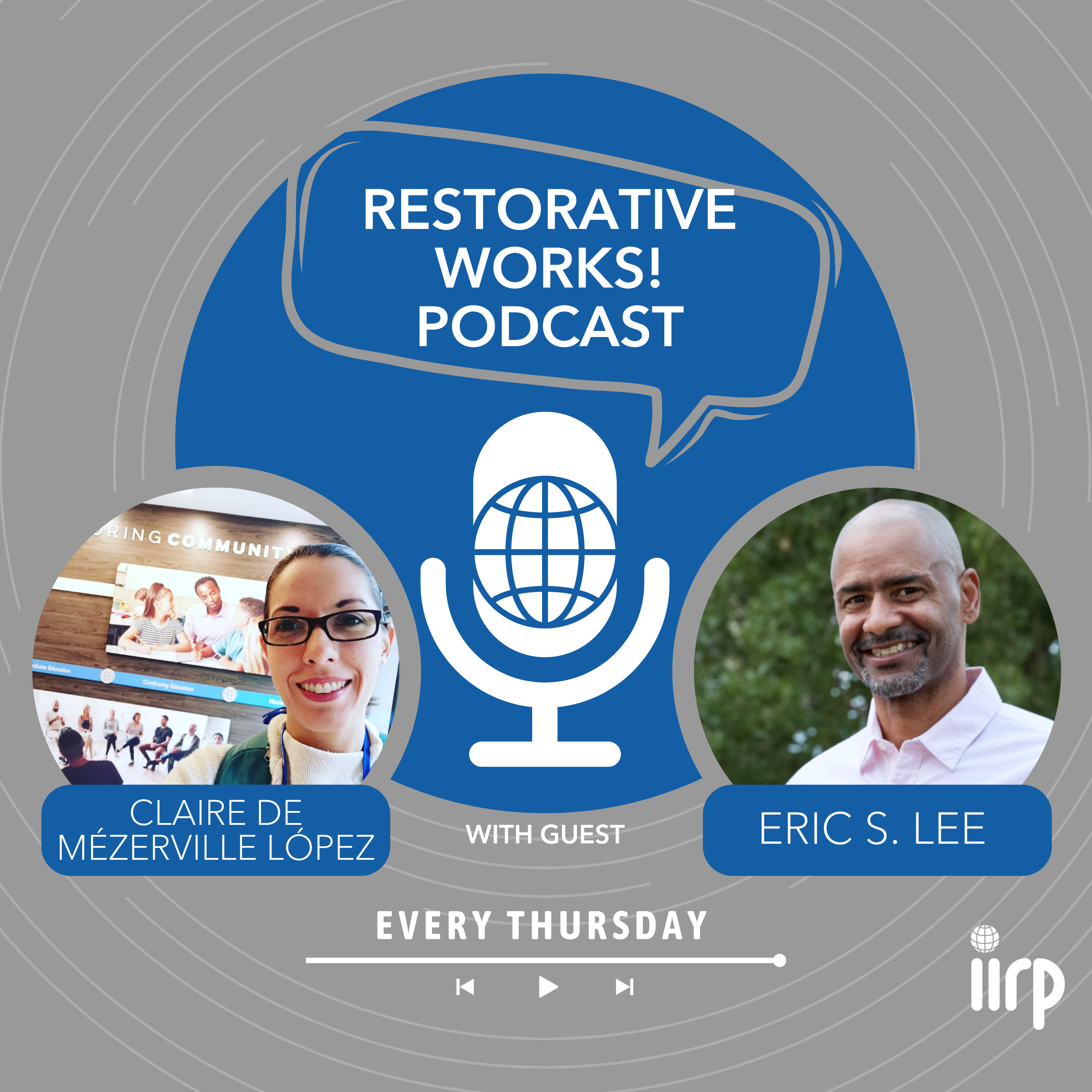
Claire de Mézerville López welcomes Eric S. Lee to the Restorative Works! Podcast.
Eric S. Lee, Executive Director of Full Circle Restorative Justice, joins us to explore a visionary model for transforming how communities guide young people toward healthier, more connected futures. He shares the three-pronged framework that drives Full Circle Restorative Justice: a youth diversion program that offers accountability without lifelong consequences, a restorative schools initiative designed to disrupt the school-to-prison pipeline, and a community services program that builds restorative literacy across organizations, families, and neighborhoods. He explains how each program plays a vital role—but how the real transformation emerges when they work in harmony, creating a system that replaces punishment with connection and isolation with belonging.
Eric S. Lee leads Full Circle Restorative Justice in Colorado. After building a successful career as a chef and restaurant owner of five restaurants in Boulder County, he felt called to something deeper: helping people heal. He pivoted into youth mentorship, holistic life coaching, and restorative justice work, blending compassion, accountability, and spiritual growth. Today, Eric leads one of Colorado's most innovative restorative justice initiatives, transforming school cultures, supporting at-risk youth, and teaching communities how to replace punishment with connection. He also serves as the host of The Spiritual Justice Podcast. He's also the author of 29 Degrees: How to Live a Life of Inner Peace, Joy, and Purpose Regardless of Circumstances, as well as two other books, all rooted in the belief that peace isn't found in comfort, but in purpose, passion, love, and service.
Tune in to hear more from Eric and consider this: when we orient young people toward their highest selves and give them tools to navigate conflict, they can lead us toward a more compassionate society.
Transcription
Claire de Mezerville López
Hello, everybody, and welcome to Restorative Works. This is a podcast to share stories on how the implementation of restorative practices is making a difference in communities and places of work. My name is Clare de Mezerville-Lopez, and I am honored to welcome today Eric S. Lee, Director of Full Circle Restorative Justice. Eric, welcome to the podcast. Thank you for being here today.
Eric S Lee (00:56.614)
Thank you for having me.
Claire de Mezerville López
Before getting started, I'm going to share with our audience your experience. Eric S. Lee is the executive director of Full Circle Restorative Justice in Colorado, but his path to leadership began far from boardrooms and policy tables. Raised in inner-city Detroit, Eric learned early what adversity looks like and more importantly, how to rise above it after building a successful career as a chef and restaurant owner of five restaurants in Boulder County. He felt called to something deeper, helping people heal. He pivoted into youth mentorship, holistic life coaching, and restorative justice work, blending compassion, accountability, and spiritual growth. Today, Eric leads one of Colorado's most innovative restorative justice initiatives, transforming school cultures, supporting at-risk youth, and teaching communities how to replace punishment with connection. He's also the author of 29 Degrees, How to Live a Life of Inner Peace, Joy and Purpose Regardless of Circumstances, and two other books, rooted in the belief that peace isn't found in comfort, but in purpose, passion, love, and service. Eric's mission is simple, helping people see the greatness within themselves and each other. And as I just learned, you're also hosting a spiritual justice podcast, right?
Eric S Lee
Yes, yes, yes, Claire. Thank you, Claire. Can I hire you to just go with me, and every time I meet somebody new, I'm just going to have you lead and say that at my intro? And that just sets the table for everything else. beautiful. Thank you very much.
Claire de Mezerville López
I'm thrilled! And I'm thrilled to speak about such inspiring experiences. So yeah, count me in. Absolutely. Let's get started with the first question, Eric, because I have really been looking forward to this conversation. Please tell me about your three-pronged approach. I really want to learn everything about it. Your three-pronged approach to transforming how our community orients youth to life.
Eric S Lee
Okay, so we talked earlier, we got 20 minutes. This is normally an hour presentation for me. So, I'm gonna distill it down because there's a lot of background. But basically, we do have three programs. There are the Youth Diversion Program, the Schools Program, and our Community Service Program. And I can talk a little bit about each one of those if you like. I think you do. Okay, great. So, let's start with the Diversion Program because for Full Circle, it's the foundational way that we originally started doing work, and we get referrals from the DA's office here in the 11th judicial district. And you know, those of you, and I'm sure a lot of your listeners here are familiar with restorative practices and restorative justice, but what we do and how we explain our service to our community is we're an alternative to the traditional justice system and we offer youth, and it's primarily youth that we serve, the opportunity to accept responsibility for any harms they've caused and repair that harm. And once they complete that process with us in our diversion program, their cases either get sealed or dismissed. And so that way they can learn responsibility, get another chance without having a mark on their life forever with a criminal record. And we think it's a win-win for that individual, their family, and the community because, you know, study and data show that, you know, less crime happens with individuals who go through our restorative justice diversion program and the community is thus safer. Then, you know, in realizing that restorative justice is simply a snapshot in time, there's the whole life of that individual that happened before the event, there's the restorative event. And then there's all the healing that sometimes needs to take place after, right? And we're not involved with that. And what we recognized was that there's some degree of self-harm involved with individuals who entered our system. And I'm not going to go too deep into that. Other than to say, what we also recognized was that part of the harm that was happening was happening in our school systems, our second program, restorative schools.
Eric S Lee
And originally, our previous schools manager was tasked with disrupting the school to prison pipeline by going in and helping schools develop alternative forms of discipline other than suspensions for individuals because again data was pointing to us and to the Colorado judicial system that kids who are suspended from school are two to three, sometimes four times more likely to end up incarcerated later on in life than those who aren't. And they were also two to three times less likely to graduate. And so, they wanted to have us come in and implement restorative practices so that they didn't have to rely on that punitive system of suspensions and things like that. What we also recognized along the way was that one of the things that was missing was the connection, culture, and climate-building piece in schools. And so, we began to pour a lot of resources and strategy into how do we help one, not be the ones who are just parachuting in, helping with disciplinary referrals, but actually training staff so that the whole building understands what restorative practices are and can implement them from the very beginning with connection circles with classes so that kids feel a bigger sense of belonging and that they're identified. And some of our schools started to focus on pointing students towards their purpose and thinking about a job and a career later on, so that they have hope and belief both in themselves and their future so that again, they were less likely to end up being referred by the DA's office. And so, as we started to think about it… I joke with our diversion manager all the time. And we said, if this works right, the school's program is going to put you out of business, Cindy, sorry. But we can put you in the school's program. Because ultimately, what we want to do is like, you know, our numbers, because of trust in us, we're growing in a diversion program, which was bittersweet. It meant that the judicial system trusted us more. But it also meant that there are those cases that we need to take because juveniles are having issues.
Eric S Lee
But at least they're coming to us for a solution instead of staying in a system that causes further harm. And so, we've got all this wonderful work going on, And we're getting good results. We're having a good impact on the youth that we're serving. And I'm the executive director, and I'm a very outgoing person, if you couldn't tell already. And I'm always meeting people. I'm out there. Part of my job is developing relationships with organizations, the community and such like that. And I would introduce myself, and I just moved to this area when I took this job three years ago, meeting new people. I'm the executive director of Full Circle Restorative Justice. And you know how a high-pitched noise dogs go like this and this like this, twitching their ears. That's how people would look at me. It's like restorative what? And it's like, so then I would have to explain, okay, this is what it is. And start from square one, and it brought up a need. And so, we created our community services program as well. And the community services program, simply put, is tasked with community literacy. So that when the community is faced, it may be your kid in school or your kid who gets in trouble. So, when they hear restorative justice, they understand what it means. And we also do trainings with organizations, businesses, other law enforcement entities on training restorative practices. So not only do they know what it is, kind of as a nebulous concept, but they actually understand the principles of it.
Claire de Mezerville López
And you know, I really love this systemic awareness of this work that you are presenting to us, this interconnectedness into each of the layers of these works. So, I wanted to ask you before we go into the break in your own experience, because I know that everything is important, but in your own experience right now, is any of these programs requiring more of your energy?
Eric S Lee
Yes. And again, I talked about trying to, and again, I say this tongue in cheek, trying to put our diversion program out of business because we don't need it anymore. So, you know, the realization of preventative system building in schools is what ends up now taking up a lot more of our time. There's, you know, two staff members, including my support at times in the schools, compared to one staff member dedicated to the diversion. And as far as financial resources, again, more than double goes into the school program and that preventative work than the diversion work. Again, not to discount, Cindy does a great job at what she does, and she's foundational to our organization, and prevention is where we see restorative justice for us moving. And really, I was thinking about retirement till I took this job, and now I can't even see it because this work has just grabbed my heart. It's a passion that fuses all of those things in my background that you talked about. And I see how we can create a positive future systemically for youth who are better to follow.
Claire de Mezerville López
That is so inspiring. We're going to take a short brea,k and then we're going to continue this conversation with Eric Lee. Please stay tuned.
Claire de Mezerville López
Welcome back to Restorative Works. It is my honor to have this conversation with the director of Full Circle Restorative Justice, Eric Lee. Eric, according to your experience, what is the role of restorative practices in the work that all of these programs are doing? How do you think they can help?
Eric S Lee
That's a good question. And it kind of chirps me up because it's kind of embedded in all of them. So, what I'd like to say, I'm maybe answering the question and maybe not. And part of it is that when we go to training and do our training, our initial training has nothing to do or very little to do with the process, restorative process. It has everything to do with getting people to understand what a restorative mindset is. And we expose people in that first training to the social relational, some people call it the social discipline window, right? And getting to that WITH box, right? And we frame it and try to give it to them as a tool so that it becomes the lens through which they begin to look at all of their relational interactions with their kids. It’s like, and I start by saying, look, I've run a restorative organization. I can't be the leader of a sort of organization and not be restorative at home with my wife, with my kids, with the dog, the cat, the person who just cut me off in traffic. You know, I need to be in that and okay, and sometimes in traffic, I lose it and I'm not so restorative. Okay. But I do, but I do, but I do my best, right? But, but as soon as you get that tool to use, you can't turn back. You can choose not to use it, but you know, it's there. And once we can build that foundation of looking at the world and our relationships that way.
Claire de Mezerville López
I was just thinking about the same thing.
Eric S Lee
Including how I treat staff and everything, right? So that's kind of the foundational thinking that we operate from. And I hope that answers the question, kind of.
Claire de Mezerville López
I think it does. My own experience with trainings and workshops is that we really need to spend a lot of time on the foundations of strengthening community, the importance of relationships, of connectedness. Practice is not an end in itself. It's a means towards an end, which is relationships and community. I can relate so much to what you're saying. Eric, in this work, I think it's really inspiring to work to put the diversion program out of work. And I can relate to that too. I still want to ask you on continuing to build on these programs. What would you like to see moving forward in the short-term future and in the long term future?
Eric S Lee
So, thank you for that question. So short term, what we would like to do is have universal adoption for restorative practices in our service area, in schools. And if we could do that short term, we think that the impacts that we see one year from now, two years from now, five years from now, 20 years from now are just going to be remarkable. With that, what I would like to see is a continued movement of restorative practices and restorative justices. I mean, there's already a movement, but I would like to see that movement intensify and become more mainstream. And so that the restorative way of being becomes how we function as a society. You know, and I tell people this. I'm not Dr. King, but Dr. King said something that moves me and motivates how I approach my work. I have seen the mountaintop, he said. I may not get there with you because it's such a long process, he said, but I have seen it. So, through our work and the impacts we see with restorative practices, I see how a society can be transformed when we focus particularly on how we orient our youth to life with restorative practices.
Claire de Mezerville López
I would love to ask you one more question as we get close to wrapping up. Is there a particular story that you would like to share with us that, in your opinion, is a reflection that inspires you about this work?
Eric S Lee
Oh, I was hoping you asked that question. Thank you so much. And this is a personal story, right? And it's back to how I got into restorative work in the first place, right? And I have to talk, my daughter, her name is Erica, and Erica is a firebrand. She has been a social justice warrior and fighter since she was about 16 years old. You know, “Dad, tear the system down. It's not fair.” All the stuff, right? And I was really, as she began to develop, developing my coaching practice and really helping individuals overcome whatever systems and obstacles they were facing through internal strength and resiliency so that it didn't really matter what the system was. So that became this with us. Tear the system down? No, you go ahead, babe. Here's this now, I'm gonna build the individual law. Fast forward till she's in her mid to late 20s, and she's working for an organization in Denver, the Conflict Center, which does restorative justice work, and she recruited me to do a facilitation. And so, she's like, Dad, your skills are perfect for this, your coaching background's gonna be helpful, and all that. So, she actually trained me as a restorative justice facilitator. And as I began to immerse myself in the process, that fusion became the click. And I began to see how I, through my coaching lens, could affect systemic change to both change the system and build a system that builds that internal resiliency that I talked about. And so that is why our organization and our programs function the way they do, because that is the end. And to that, it's a great big lesson. If you follow the youth, if you give them the tools and actually give them a voice and advocacy, they can lead us to the best way to transform society. But first we gotta teach them that accountability, we gotta point them in the direction of their highest selves.
Eric S Lee
And hopefully, through our practices, that is what we're doing. And right here in my family was kind of the micro-chiasm of how that worked, at least from my perspective and how I implemented it was born.
Claire de Mezerville López
Eric, that is so inspiring. Thank you so much for being on the podcast today. And thank you all for tuning into Restorative Works to learn more about our guests and the IIRP log into IIRP.edu, and let's continue to do this to embrace our common humanity. Take care of others. Please take care of yourself, and let's continue to do this work of strengthening relationships and community. Until our next episode.
Eric S Lee
Thank you.