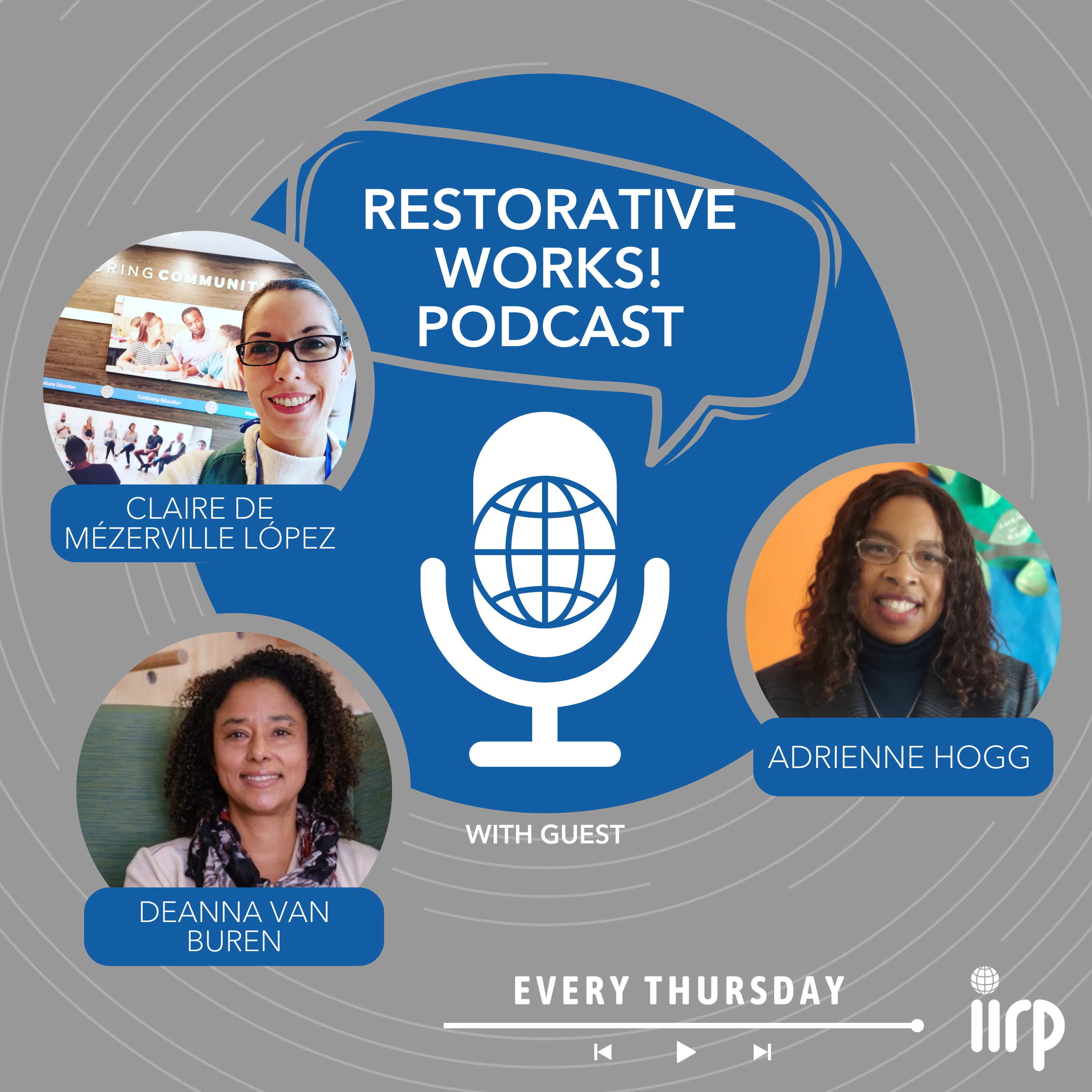
Claire de Mézerville López welcomes Deanna Van Buren and Adrienne Hogg to the Restorative Works! Podcast.
We are joined by Deanna Van Buren, Co-Founder and Executive Director of Designing Justice + Designing Spaces (DJDS), and Adrienne Hogg, Co-Executive Director of Community Works. Together, we explore how spaces, rooms, buildings, and environments in which we gather directly shape our nervous systems, our sense of dignity, and our ability to repair harm. Deanna reframes "trauma-informed design" as designing for well-being, offering a body–mind–spirit lens on how spaces can regulate, inspire, and care for us. Adrienne shares how Community Works brings this philosophy to life by creating warm, culturally rooted, non-institutional spaces where young people, survivors, families, and staff feel seen, grounded, and capable of restoration.
From reimagining classroom design in higher education to redefining what justice spaces can communicate, the conversation weaves together architecture, community wisdom, creative practice, and systems change. Both guests illuminate how co-designing that deeply involves communities, including those most impacted by harm, becomes its own restorative practice.
Deanna Van Buren is the co-founder and executive director of Designing Justice + Designing Spaces. An architecture and real estate nonprofit working to end mass incarceration through place-based solutions, DJDS builds infrastructure that addresses its root causes: poverty, racism, unequal access to resources, and the criminal justice system itself. Van Buren has been profiled by The New York Times and has written op-eds on the intersection of design and mass incarceration in outlets such as Politico, Architectural Record, and Stanford Social Innovation Review. Her TEDWomen talk on what a world without prisons could look like has been viewed more than one million times. She is the only architect to have been awarded the Rauschenberg Artist as Activist fellowship, and she is also the recipient of UC Berkeley's Berkeley-Rupp Architecture Prize and Professorship. Van Buren received her bachelor's degree in architecture from the University of Virginia and her master's degree from Columbia University, and she is an alumna of the Loeb Fellowship at Harvard's Graduate School of Design.
Adrienne Hogg is co-executive director at Community Works. In this role, she focuses on finance, administration, and operations in addition to working with her co-executive director on strategic and development activities. Prior to joining Community Works, Adrienne founded Gather Locally, a startup e-commerce technology company. Before starting Gather Locally, Adrienne was the head of finance and controller for several public and private corporations in the life sciences and construction industries, where she managed accounting, finance, human resources, legal, and facilities. She is an Oakland native who received bachelor's and master's degrees from the UC Berkeley, Haas School of Business.
Tune in to learn more about how the spaces we build reflect the futures we believe in.
Transcription
Claire de Mezerville López
Hello everybody, and welcome to Restorative Works. This is a podcast to share stories on how the implementation of restorative practices is making a difference in communities and places of work. My name is Claire de Mezerville Lopez, and I am honored to welcome today Design Justice Design Spaces, Deanna Van Buren, and Community Works, Adrienne Hogg. Adrienne, Deanna, welcome. How are you today?
Deanna Van Buren
I'm doing well.
Adrienne Hogg
Doing well, thank you.
Claire de Mezerville López
Before getting started, let me tell our audience about your great and wonderful experience. I'll start with you. Deanna Van Buren is a co-founder and executive director of Design Justice, Designing Spaces, an architecture and real estate nonprofit working to end mass incarceration through place-based solutions. DJDS builds infrastructure that address its root causes, poverty, racism, unequal access to resources and the criminal justice system itself. Van Buren has been profiled by the New York Times and has written op-eds on the intersection of design and mass incarceration in outlets such as Politico, Architectural Record and Stanford Social Innovation Review. Her Ted Women Talk on what a world without prisons could look like has been viewed more than one million times. She is the only architect to have been awarded the Rauschenberg Artist as Activist Fellowship, and she's also the recipient of UC Berkeley's Berkeley Rube Architecture Prize and Professorship. Deanna Van Buren received her BS in architecture from the University of Virginia and her March from Columbia University as she is an alumna of the Loeb Fellowship at Harvard's Graduate School of Design. And Adrienne, as for you, Adrienne Hogg is co-executive director at Community Works. In this role, she focuses on finance, administration, and operations in addition to working with her co-ed on strategic and developmental activities. Prior to becoming co-ed, Adrienne was the CFO at CW for almost seven years. In addition to finance, she oversees the administrative functions of HR, facilities, and legal. Prior to joining Community Works, Adrienne founded Gather Locally, a startup e-commerce technology company. And prior to starting Gather Locally, Adrienne was the head of finance and controller of several public and private corporations in the life sciences and construction industries where she managed accounting, finance, human resources, legal, and facilities. Adrienne has been a member of several boards of trustees. An Oakland native who received BS and MBA degrees from the UC Berkeley Haas School of Business. So, first of all, it is such an honor to have this conversation with you two. I am deeply inspired by the actual work of diving into structural solutions. So, let's start with this. Will you please talk to us about the difference between general design and trauma-informed design? And is it okay, Deanna, if we start with you and then pass it on to Adrianne?
Deanna Van Buren
Yeah, sounds good. I'd love to hear Adrianne's answer to this question. I think, you know, we've been trying to reframe the conversation a little bit from trauma-informed to designing for well-being, right, in a sort of more positive direction in the languaging. And it really, for us, means designing for the emotional and physical health and wellness of our bodies. And I'm going to elevate the emotional, right? So the body-mind-spirit approach to how the environment can help us regulate our nervous systems, make us feel respected, cared for, that it mirrors our culture in the space, so that we can have choice. There's a diversity of spaces that are rich in texture and color and light filled and all things like that. You are very resonant for everybody. It's how you would want to be. I always say our spaces should love and care for us. And if you want to call it general design, the way that a lot of our built environment looks is corporate or institutional, and includes our schools. So, all of this applies to education settings, absolutely. As a matter of fact, there's a lot of evidence-based. Yeah, mean, they just, yeah, they just totally, but that's institutions, right? So, institutions have a set of values and a culture that gets trickles down and things just manifest in the built environment, right? Everything our society believes becomes very tactile.
Deanna Van Buren
You have to be very conscious about what we're making and who's leading it, right? Who gets to decide what the environment around us looks like? And Adrienne picked up that mantle a while ago.
Adrienne Hogg
Hahaha. Well, it's funny because despite all of my finance background, I am a design nerd. And so, I really love design. And so, this project was so important to us. At Community Works, we've always believed that spaces where people come together and address harm, matter just as much as the restorative process itself. Place-based design is really part of our philosophy of dignity and healing and community connection. And so, when a young person or survivor or family walks into our spaces, we want them to feel grounded, not in a system of punishment, but in a community that sees their humanity and dignity. And so, by rooting our spaces in culture and history and strengths within our neighborhoods, we support accountability, we're reducing fear, we're really making healing achievable. And so, our physical spaces become living expressions of the justice systems and ecosystems that we're really working to build and ones that are centered on relationships and safety. And believe that people and communities can repair and grow and thrive. So, this is so important to us and this is why this design relationship that we've had with Designing Justice and Designing Spaces has been so important.
Deanna Van Buren
I love that living expression language. I'm gonna copy that. Can I steal that, Adrienne?
Adrienne Hogg
In business, we call that leveraging. You can leverage that.
Deanna Van Buren
Totally leveraging that.
Claire de Mezerville López
We're going to leverage that. We're absolutely going to leverage that. But yes, I think the spaces that we share are communicating something. They are saying something as to not only who we are, how we show up and how we're going to connect and interact. How would this apply, in your opinion regarding the design in education settings? And how about this time we started with Adrienne and then we pass it on to Deanna.
Adrienne Hogg
Sure. Well, in addition to being a design nerd, I'm an education nerd as well. Love colleges and schools and the boards I've been on have all been school boards. I think that the spaces that we have, have to be spaces where you feel calm and where you feel connections. And so, in an education space, I think that's more important than ever. There's so much tension around education. And I think in particular in a college setting where there's a lot of stress and pressure on young people to do well in these environments. And so, if the designed space is not also helping to create a feeling of connection and calm, then I think it just makes the overall experience in school not as enriching as it can be.
Deanna Van Buren
Yeah, Adrienne, you're making me, I was just thinking about the design of education spaces, you know, in this sort of abstract way, but it's not even abstract. It's really, you know, when we design for restorative practices or restorative justice, we're coming from a set of values, philosophies and beliefs about justice. The same is for education. Like, what is the pedagogy of the educational program itself? So, we're, you know, as a designer, we're always coming from the way that you do a thing, right? So, the way that you teach, is it project-based learning? Do you care about the students? Are there resources that are put into the way that people are learning? Because in order to learn as an agent, you can't be stressed out. In order, people learn in different ways. So, this sort of rigidity of the environment actually locks in a certain way of learning. So, when we go to design spaces for education, how is it actually allowing for neurodiversity? How is it allowing for like, actually, I need to go over here and learn in this way. So, I'm just curious about when we talk about it, we can't talk about it generically. We really have to look at the style of learning and teaching that is happening there and start to build environments that support that. At the same time, building an environment that allows for creativity, creative practice, and project-based learning, all of that, can actually influence how we do the teaching. So, I think environments can push back the other way. So, I'm contradicting myself. Everything's a cyclical thing. It goes one way the other. So a lot of the same principles I talked about before apply for education settings, but I do think, I think there are some people doing great work in that respect and we have a long way to go. You know, how and where do we educate and how do we learn, and how does the environment support that?
Adrienne Hogg
I'd also just jump in and say that so often our educational spaces don't bring in culture. They don't really... reflect the local folks. They don't reflect the culture of the folks who are there. And all of these things, and that's what we've tried to bring into our space as well. And so, when you can reflect back on people themselves in a space, it also grounds them in a way that it is not in the educational spaces that, as Deanna said, are so institutional and really devoid of humanity when you go into these spaces.
Claire de Mezerville López
What I'm thinking is, as this reminds me of my own university setting, and Deanna, I love that you mentioned how this reflects the pedagogies that we embrace. And I'm just thinking about how if Paulo Freire is talking to us about having small groups and dialogical spaces and all of this interaction, what does it mean that we have classrooms with chairs that are bolted to the ground and you have just a lot of stairs looking into a very tiny space in the center for a lecturer? You know, so that's communicating something.
Deanna Van Buren
Absolutely. And the lecturer is up there, and we're all in these rows, you gotta drag the chair over, there's like a fixed desk.
Claire de Mezerville López
And very heavy, don't move it!
Deanna Van Buren
And you know, there are innovations, right, in educational settings that sort of allow for that. One of the very first things I did when I started this journey was that I started to look at education settings. And we actually did a space in Oakland, East Oakland with restorative justice for Oakland youth. And it was a peacemaking space. And I started to look at, my God, the furniture needs to be different. And I was like, certainly at these like partial arc tables that could move around and you could make it, you could either work in groups or you could have a circle or you're like, so there was this kind of an abundance of opportunity to really think about. The way that we are not, you know… human beings don't just sit, we don't engage in the same way all day long. We're in, in dyads, right? We're doing group work. We're in a collective. Like how do you make a space that flows with the natural rhythms of the way we learn and interact throughout the day?
Claire de Mezerville López (12:47.082)
I love that. We're going to take a short break, and then we're going to come back to this important conversation with Adrienne Hogg and Deanna Van Buren. Please stay tuned.
Claire de Mezerville López
Welcome back to Restorative Works. Adrienne, Deanna, you may have touched on this before, but I would love to learn more about your insights regarding the role for restorative practices or restorative justice into this vision of designing or redesigning spaces.
Adrienne Hogg
Well, I can jump in there. So, I'm going to say that, you know, at Community Works, we've always challenged the way and the traditional ideas of what justice can look like. And so, our spaces need to do the same thing. We design environments that communicate humanity from the moment someone walks in, right? Our spaces are warm. They're non-institutional. They're community-infused spaces that tell young people and survivors, family, and staff that you belong here and that you are capable of restoration. And so, these are the kind of spaces that are very important as we go through this journey of reimagining what justice can look like and bringing humanity and dignity into those systems also means bringing that into our spaces, and we've worked really hard to make that happen.
Deanna Van Buren
And I'll also add to what Adrienne is saying that the practice of creating and imagining a different world and a different environment is a restorative practice. It is restorative to engage. So, with Adrienne’s team and our team, we were really doing this co-creative, co-design process to design the environment. There's nothing in that environment that they didn't touch and weren't a part of dictating. And in that, I remember we would do a lot of workshops with them, and it feels good. It feels good to get your hands into imagining. And I have done this work in all different contexts: inside of prisons and jails, out in different communities of care, with government officials. And even in the most difficult places, right, in a prison, the creative act of trying to imagine an environment where they could repair harm they may have done, or harm that was done to them actually started to elicit feelings and tears and grief. But also, I've seen joy and excitement right through the process of actually doing art, and Community Works does that work, right? They do that. Design and art are not different things, right? They're very inextricably linked. It's creative process. And I can't think of anything more restorative than doing that kind of work.
Claire de Mezerville López
But you know, that leads me to another question that I would like to ask you because I can see how many people in the social sciences and in education, we are really passionate about this work. We see many different things that we would like to see in our present and in our future in the short term. But how can these become a part of the schooling of future architects, engineers, designers? Maybe there's this interdisciplinary connection that could be strengthened through the way that universities prepare people. Do you have any thoughts on that? Deanna, how about we start with you and then pass it on to Adrienne?
Deanna Van Buren
I have so many thoughts about that, Claire. Yes, I have been through the university system, the brutality of the gauntlet of the university system. There is a group called Design Futures.
Deanna Van Buren
which actually is working with universities to bring them, it's not even like a curriculum, but it's like, I think it's like a summer program where it's temporary and various universities will participate where designers, architects, maybe engineers coming in to really understand the role of design and whole systems change, right? How we are like basically reprogramming them to realize that actually we have a role to play in creating and building a different future. We really need to understand structural and how it happens in the built environment, really kind of waking them up to that. It is, there's also, I think it's called Dark Matter University, which is another architecture-led thing where they're creating their own curriculum around this. There is a small movement in that direction because it's the academy, as I call it, as the institution of the academy is so, for architecture, for sure, is so inextricably heavy and linked to systems of oppression. And that is what gets taught. I think architects actually want to do, they want to help. It's in our nature. So yeah, we definitely should change.
Adrienne Hogg
And I would say it starts with also bringing diversity of voices into the room. And I think so often that's not what happens. I was on the board of a school and had the opportunity to work on a very large project to design a new classroom space, large project for this school. I was one of the, in fact, I was the only black female in the room, which brought me to ask, where, when we were looking, for example, for architects, well, who are the black architects or who are the architects of color that we can bring into just even to bid on this project? And so, I think if you start in a space that is very homogeneous, you're automatically out of the gate, not going to get the kind of diversity of ideas that will allow us to even have these conversations. So, for me, I was always kind of poking and poking, well, what can we do here and what can we do there? Because I came from different experiences than the folks that I was with. And so, I really think that at the university level, at any education level, let's start by diversifying the folks in the room and bringing more voices to the table, people with different experiences. And not all of them necessarily have to be people in an academic background. One of the things that I loved about the work that we did with Designing Justice, Designing Spaces, is they spoke with everyone in the organization and I'm broadening what I call the organization. So, they did workshops with staff but also did workshops with the young people in our program. They also did workshops with women who were survivors of harm or formerly incarcerated young women who are 18- to 25-year-olds, but our new moms. Having all of that come together created the space that we have now that we would never have been able to create if we had just sat in the room with a group of us who say we're the executive staff or the leadership staff of what we thought the space could be. So really bringing in that diversity
Adrienne Hogg
of genders and identities and socioeconomic backgrounds, even if you have to go out into the community to get that because you don't have that in your academic setting, I think is a great way to start.
Claire de Mezerville López
Wow, that is so incredibly important. As we get close to wrapping up this fantastic conversation, will you please tell me more about the importance of creative practice in healing and processing trauma? How do you imagine new spaces as restorative practice as an ongoing design process? Adrienne, how about we start with you?
Adrienne Hogg
That is a great question. I think that it evolves all the time, and I think that we need to just continue to ask people what spaces work for them. And be open to that and to making the changes that people see. For us, our space is a space of well-being. It's a well-being space for our staff. It's a well-being space for folks who are carrying trauma. 75 % of the people that work for Community Works are people with lived experience. They've been formerly incarcerated, or they are survivors of harm, or they are children of incarcerated parents. And so really grounding ourselves in what the space means for them is really what's important, and continuing to ask that over and over again.
Deanna Van Buren
I think I shared a little bit about that in this podcast before, right? Where I was being a prison and I would ask people, what kind of space would you need to face the worst thing that had ever happened to you? What would you need? What kind of environment would you need to face your life crime? And through that process, folks were imagining spaces for wellness and restoration. Folks were imagining spaces where they could sit with their family and be accountable and apologize for the shame they may have caused. So, it was through the imagining of the space that allowed them to access emotions that needed processing. But I love the idea that that could get carried through the actually building it. And I'll say I learned.. I feel like I learned and expanded at the IIRP conference that I was just at in Chattanooga, where I was talking to my colleague Garrett saying, the environments we make need to start, I think, to incorporate more space for art practice in the environment. Like, can we dance in here? You know, can I throw something at some mud at this wall and you know, something that maybe some of our historic spaces now need to have some messier spaces. Or a space to do theater, right? Because there's a range of art practices. So yeah, I'm sitting with beginning to not just the design process, but maybe when we do our next process, we will make sure to include some of this. What kind of environment would you need to actually get some of the anger out, to get some of the joy out in a new kind of way. I think it's a new paradigm. I think we haven't even begun to explore the potential of it. So, it's exciting to think about.
Adrienne Hogg
And I'll just jump in there to say that one of the things about our space is that I like to say that nothing is precious. Everything moves. The furniture moves so we can move around or we can move the furniture out of the way so we can move. So, I agree with you 100 % Deanna, that incorporating our bodies more into the spaces as well and thinking about that is going to be probably the next step as well.
Claire de Mezerville López
Let our bodies and their expression be the precious thing on the room! I am so inspired by all of this. Adrienne, Deanna, thank you so much for being on the podcast today.
Adrienne Hogg
Mm-hmm. Completely.
Deanna Van Buren
Thank you, Claire.
Adrienne Hogg
Thank you for having us.
Claire de Mezerville López
And thank you all for tuning into Restorative Works to learn more about our guests and the IIRP, log in to IIRP.edu and let's continue to embrace our common humanity. Please take care of others, take care of yourself while doing this work of strengthening relationships and community. Until our next episode.