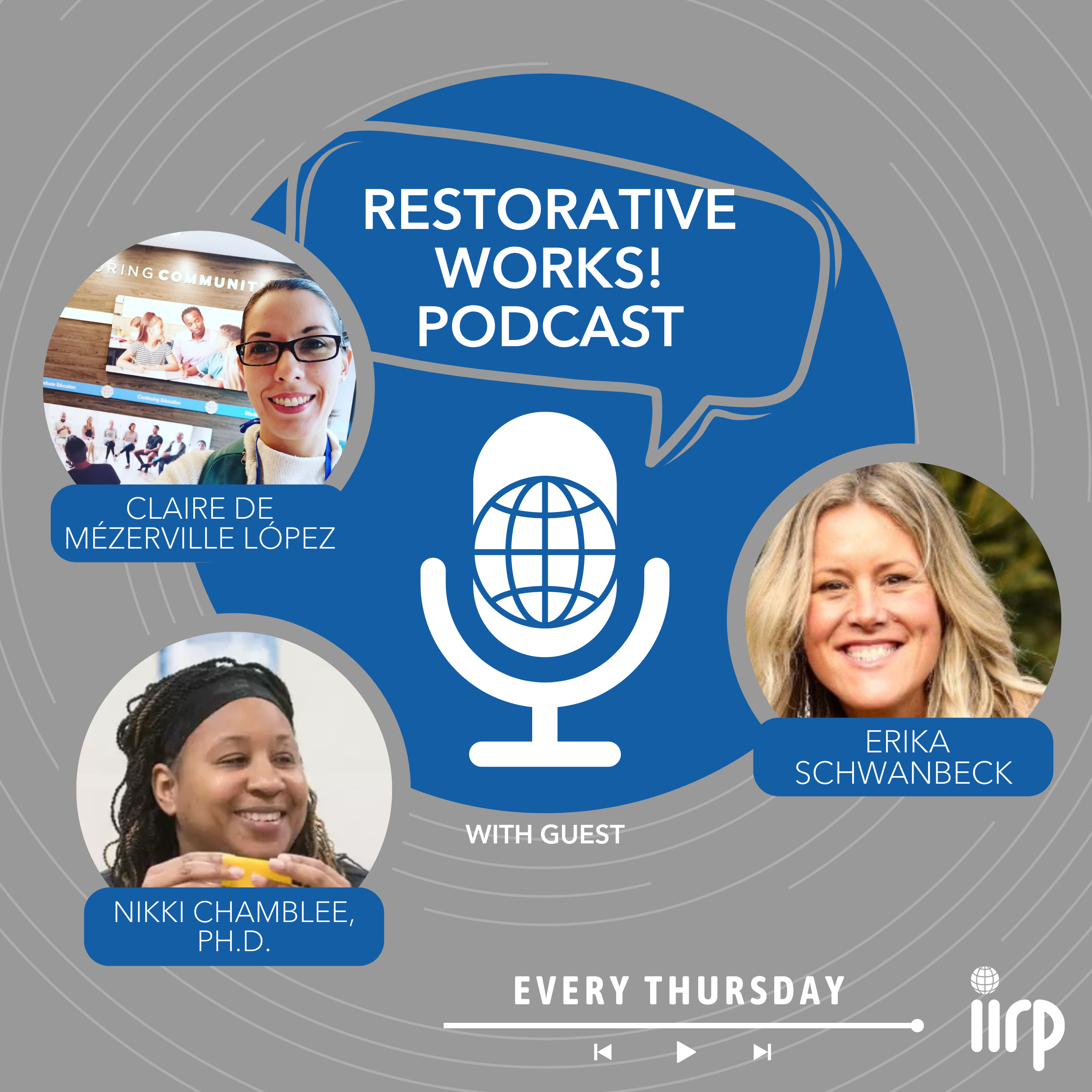
How can restorative practices deepen learning in subjects like English, social studies, music, art, or science? In this episode, Claire de Mezerville López and Nikki Chamblee are joined by restorative practices instructional coach Erika Schwanbeck on the Restorative Pedagogies series of the Restorative Works! Podcast to explore what meaningful curriculum collaboration can look like in practice.
Erika shares concrete examples of how concepts of restorative practices can be intentionally woven into content instruction through reflective circle lessons, student-centered assessments, and collaborative planning with teachers. From analyzing historical leadership through the Engagement Window to writing Blues songs connected to emotional regulation, she illustrates how restorative practices support critical thinking, voice, and relevance across disciplines.
The conversation highlights the power of shared language, reflective tools, and student agency—not only to strengthen school culture, but also to enhance understanding of academic content. Erika emphasizes restorative practices as a way to slow down learning in order to go deeper, helping students connect curriculum to their lived experiences while building empathy, accountability, and relational skills.
Erika Schwanbeck is a Restorative Practices Instructional Coach at the secondary level in the Hatboro-Horsham School District, bringing 20 years of educational experience to her role. In her role, Erika designs and facilitates proactive programming that builds community, strengthens relationships, and equips staff with practical strategies to foster a positive school climate. She also provides responsive support through restorative conferences that prioritize accountability, connection, and repair. In addition, Erika teaches a middle-level restorative practices course designed to help students develop the skills needed for empathy, communication, and problem-solving.
Tune in to explore how integrating restorative practices into lesson plans can transform the learning experience in any classroom.
Transcription
Claire De Mezerville López
Hello, everybody, and welcome to restorative works, a podcast we're learning, practice and research, open new paths for transformation. My name is Claire De Mezerville López, and it is my honor to introduce this episode for this wonderful podcast series titled restorative pedagogies, along with wonderful co host leader, trainer and coach Nikki Chamblee. Hi, Nikki.
Nikki Chamblee
Hi, Claire. I'm going to open with this beautiful definition. Belinda Hopkins defines relational pedagogies as those that foster a stronger connection between teachers and students, among students themselves, and also between students and curriculum. Restorative pedagogies is a series that focuses on the application of restorative practices as a part of the pedagogical approach in K-12 to enhance effective learning of specific subjects. Beyond the relational richness necessary to create school community, can restorative practices help us to learn better when it comes to math, science, English, or history? Today, we will focus on application in a diversity of subjects. And for that, we welcome our wonderful guest, Erika Schwanbeck. It is wonderful to have you here. How are you today?
Erika Schwanbeck
I'm doing well. Thank you so much for having me. I feel so grateful to be with you all.
Claire De Mezerville López
Before getting started, let me tell our audience a little bit about your experience. Erika Schwanbeck is a restorative practices instructional coach at the secondary level in the Hatboro Horsham School District, bringing 20 years of educational experience to her role. She has recently dedicated her work to the implementation and support of restorative practices. Erika designs and facilitates proactive programming that builds community, strengthens relationships and equips staff with practical strategies to foster a positive school climate. She also provides responsive support through restorative conversations and circles that prioritize accountability, connection, and repair. In addition, Erika teaches a middle level restorative practices course designed to help students develop the skills needed for empathy, communication, and problem solving. This work is reinforced through curriculum collaboration lessons where she partners with educators to integrate restorative concepts into content areas through the secondary experience, and we want to ask you so much about that, is passionate about creating environments where students feel heard, valued, and supported. Nikki, how about you kick us off with the first question?
Nikki Chamblee
Thanks. Erika, as Claire said, we are very curious. So if you can share with us in your experience, what does it look like to create one of these curriculum collaborations with educators?
Erika Schwanbeck
Sure. The curriculum collaboration process starts with a teacher reaching out and they really focused with me on a topic that they feel like would make a great connection to restorative practices. And then we plan a time to meet, we connect. They let me know what their, you know, already talking about within their content. And then I go back and reflect and think about how can I tie some explicit restorative practices to the content that they're already learning within their classes. And so I go ahead and I create a circle lesson with a lot of prompts that are rooted in reflection that will be relevant to what they're already learning. And then, you know, the lessons are really intentionally designed to activate student voice and try to increase as much potential connections with the content to what the students are already experiencing within the school community, just in general. They get to kind of generate the answers to the prompts. And so it really ties nicely from what they're already learning into ways that it feels meaningful for them. And then we have the space to then tie them to specific, like I said, specific explicit restorative practices. So then I send that circle lesson plan that I create back to the teacher because I want to make it feel like as much of a width process as possible and encourage them to provide me with any feedback, any suggestions. We take it from there. We make any modifications that we need. And then we schedule a time for me to go in and collaborate with them. And so I feel like deep gratitude towards teachers that reach out to reinforce these restorative concepts within our school community. That's a really great way to support implementation and to kind of also deepen the understanding of restorative practices within our students.
Claire De Mezerville López (06:39.768)
As I listen to you, just think how restorative practices can be versatile to do this work in different content, curriculums, in different classes. Have you experienced a different challenge depending on the subject area that you are doing this collaboration with a teacher?
Erika Schwanbeck
I mean, I wouldn't say that there's different challenges. It just depends on who's reaching out. So the challenge really is in the process, right? So really taking the time to listen to the needs of the teachers and trying to be responsive. Like for example, like the I do a one lesson with a social studies teacher, well, a few social studies teachers in 10th grade, and it's using the engagement window as a tool for reflecting on restorative leadership.
So it's a world history course. And so one of the things that we do is we identify characteristics of people that might come to mind in each quadrant. And then we think about what would a leader in each quadrant do? How would they act? And what would their behaviors be? And then that translates to them having a real framework to look at historical world leaders, do some micro research, and then identify for themselves which quadrant they feel each world leader would fall into. Sometimes it's, they're definitely punitive, you know, and sometimes they're like, well, in this situation, they were restorative, but here they were permissive. And so it really gives them a reflective tool to be able to, you know, tie those restorative concepts to what they're already learning in class and to make it relevant to them. And it's really not the teacher or myself telling them which world leader should be in each quadrant. It's just giving them these reflective tools to be able to process that through themselves.
Claire De Mezerville López
And you talk about them as reflective tools, but they're also reflective tools that can support them to go from very concrete concepts to very much abstract ideas and to enhance critical thought. Erika, how does a student's understanding of restorative practices enhance these implementation process and the overall culture within the school community?
Erika Schwanbeck
So the beautiful thing is that I get to teach all sixth graders 12 lessons. So they have this baseline, they have this framework already developed. And then within the lessons where I go in and collaborate with other teachers, it's just a reminder of the things they've already learned. But then the other part of it is that they make these connections, they might not verbalize them.
But they're making these connections inside their heads as we're talking through things. And it's not just about the world leader from 1758. It's like they're thinking of other people. They're thinking of people that they relate with all the time, people that they engage with. And so not only is it a great way for them to have a deeper understanding of the content, but it also supports them relationally. How are they showing up?
Where do they want to come from? What place do they want to lead from? How do they want to be in relationship? And so being able to take time to, I always say restorative practices and engaging with the work is really a chance to slow down, to be able to speed up, right? So like if they're having this chance within their school experience to slow down and think about how they're showing up in community and how they should be treated, the expectations of how they should be treated and treating others,
It's a great way to promote shared language and this overall understanding within our community so that people can feel connected with each other and understand where people are coming from and use those frameworks to really just cut to, are we in the with? Are we in the to? Are we in the for? Are we in the not? And be able to just get right to a shared understanding of how people are feeling and where they're coming from.
Claire De Mezerville López
This is wonderful. Thank you so much, Nikki and Erika. Before going on with this conversation, we're going to take a very short break, and then we're going to continue to talk about restorative practices, the school community, and curriculum. Please stay tuned.
Claire De Mezerville López
Welcome back to Restorative Works. Nikki, how do you feel about how the conversation is going and what we're learning?
Nikki Chamblee
I think there's a lot of connection when we talk about that piece Erika does where she's honoring the voice and agency of the instructor. And so she's in a sense modeling what restorative looks like in the way she approaches helping them embedded into their curriculum. And students see that whether we realize it or not. And they sense that when Erika and the teacher are working together that they're witnessing what the expectation is for how they relate to each other. And so I think that, like that, again, the importance of those skills that we don't talk about and we don't make space for that collaboration, that conversation, that hearing what other people need to bring forward, I think is really important.
Claire De Mezerville López
And you know, I think he's modeling through practice. And we talk a lot about modeling these values and doing this in the theory. But Erika, can you share with us some stories or tips on using restorative practices to guide the assessment of a lesson or a unit?
Erika Schwanbeck
Sure, yeah. So obviously you want to make sure that all the work that you're doing is age appropriate. So I am a trained trainer through the IRP. And like I said, one of the benefits to my work is that I get to meet with sixth graders. so some of the cool things that we do in that class is students, they get to engage with learning about affective statements and the engagement window and restorative questions. But then to demonstrate their understanding of the learning.
They actually write a letter to someone who they feel treats them restoratively. So there's a whole rubric and they have to identify ways that they're special to them. And they talk about things that that person expects out of them, like ways that they're held accountable by this person and what they've learned from it. They also get a chance to reflect on how this person has supported them and how that's made them feel.
And then they actually give that letter to the person. If it's someone in their personal life, I encourage them to hand deliver it to them. If it's a previous teacher, I scan it and I send it through an email. So that's really cool. So they get to show me that they're understanding the concepts, but also then express gratitude towards someone who has treated them in that way. And really also reflect on the benefits to being in a relationship that feels like it's intentionally restorative. They also get to make posters, which is really fun. They pick whatever theme they want, whether it be like, movie characters or seasons in the year or they've done like different sports teams or even days of the week and they get to create their own engagement windows. So however they think that that engagement quadrant, the quadrant is represented, they get to decide. So they use specific colors and words and like I said, like I don't know why but this year there's a lot of SpongeBob. They pick any characters that they want to do and then they have to explain why they're in that quadrant and then that builds into the collaboration lesson. So some cool examples, I already gave one, but in ninth grade ELA, we just wrapped up a couple ELA teachers in the high school. We just did a lesson on perception and persuasion. So they're learning about how, you know, they consume media that might persuade their perception of things or how they, certain behaviors of characters in books persuade their perception of the characters, things like that that they're reading. And so for our lesson, we really focus on how they are showing up in community on purpose and what are the behaviors that they're exhibiting that would persuade people's perception of them. Now, obviously we have to mention that like, no matter what you do, some people are gonna see you the way they see you. And I think that's important to make sure that they understand so that it doesn't feel like pressure.
But there is something to say for like being intentional about the way you behave in community. And so they write out this, I made up a phrase called Your Perception of Self Statement and they get to write it out and then they externalize out behaviors that might support that statement. So for example, like I tell them that, you want to be someone who's perceived as relational and reliable. So two behaviors would be that I, when I say I'm gonna do something, I make sure to do it. And then I also try to like actively listen and make space for people that feel like they need to be heard. So there are two behaviors that would support being reliable and relational. So they get to do that for themselves. And then we reflect on, you know, who are the people that see you the way you wanna be seen? And we do talk about the engagement window again, the people that listen, that are collaborating with you, that are connected to you.
And so that's a really, that's a really cool lesson. do, we do another one in ninth grade ELA about assumptions. And it's really cool because they read 12 angry men and the, end up doing like a problem solving circle at the end. they're, they, they, they're really get the opportunity to think about the assumptions people have about teenagers. So one kid gets to play the role and then they, call the inner circle. One of the ELA teachers coined it the group chat instead of the inner circle.
And so then it was like, how does the outer circle come in and support the people within to try to give suggestions or feedback for this like adult that they're playing the role of that's making all these assumptions about teenagers. And then that can, that supports their understanding of the work through restorative explicit practices. So it's pretty cool. Tomorrow I get to go into a seventh or excuse me, an eighth grade music class where they're already writing blues songs.
Erika Schwanbeck (17:15.173)
but we're connecting it back to interruptions of positive affect because that's what blues songs are. So they're reflecting on, you know, what are the things that really interrupt their positive affect? And then the music teacher comes in and like teaches them the structure of how they would write the blues song. And then I actually love this lesson. It's so fun. The music teacher is just like a really fun person to be around and it's a fun collaboration, but we...
We write blue songs with them. They get our feedback and they give us their lyrics. And then the exit ticket at the end is really then, OK, what poll in Nathan's Compass are you going to when you have this interruption of positive affect? And what can you do within your control to then feel better? OK, you've wrote the blue song. That was really fun. But now here's the connection to restorative practices.
And they've already learned about Nathan's Compass within the sixth grade class. They know exactly what I'm talking about. They fill out an exit ticket and it's really cool because then I get to see what's on the minds of kids and what they're going through. And I can, you know, partner with administrators and say like, here are some things that I've seen or, and what, what kids are reporting. So, that's another great lesson. I've worked with art teachers at the middle level. There's a lesson called art as a medium for social awareness.
which is kind of twofold because kids want to bring awareness to different things. And so there's a circle that's just about setting expectations for accepting people's differences. And one person on this side of the room might want to bring attention to something that you don't care about, but how are we going to set some expectations so people feel safe to share, freely share what they want to bring awareness to?
So, and that's cool because we go back and forth to this planning document. Like we share in circle and then we go back to the worksheet. And some of the things that kids have come up with are, you know, they want to talk about social justice. They want to talk about clean beaches. They want to talk about bullying in schools. They want to talk about mental health awareness. And so what we do to structure out the planning of the art project is we have them write affective statements related to how they feel about each, well, whatever they want to say about the topic. So they might say like, I feel sad when I see trash on a beach, or I feel empowered to stand up if I see a classmate being bullied. And then from there, they identify images and colors and ways that they would express that through their art, what they're feeling about the topic. And it's really cool because by that time in the year, it's, towards the end of the school year for some seventh grade art majors. And they get to pick, they get to choose the way they want to express it. So do they wanna do clay? Do they wanna do, like I'm not an art teacher, but whatever, however they want to express their art, there's many options that they've already engaged with. So that's pretty cool as well.
So there's a ton, there's a ton of, there's a lot of examples that I can give you, but we've done like, digital citizenship and coding and design classes. We've talked about kitchen expectations and family and consumer science classes, how to stay safe. I've worked with leaders in what's called Link Crew in our high school that welcome freshmen in and we talked about restorative leadership. Connected with students that have social skills lessons and varying topics.
There's just so many things. It's just really responsive to what teachers reach out to collaborate on. There's also like social, there was another social studies writing letters to people to activate social change. So there's a lot of different ways to implement. think that the key to it is taking the time to listen to what the teachers are already teaching and try to connect with what I'm implementing to try to make it a true collaboration. So the key is really just being responsive to the community.
and hearing what is already happening. There's so many wonderful, great things already happening. So it's really just supplementing that with some of the concepts related to restorative.
Nikki Chamblee
Thank you so much for Erika for all of those tips, tricks and wisdom. over here taking notes. One of the things that I think you in the conversation have highlighted is the importance of kind of making it a course where students approach restorative as its own content. And I think about like the graduate work that you're able to do at IRP models for you how to restoratively be in a college course, teaching a college course. And so I was excited to hear you translate that to your sixth graders. The other thing you highlighted I was happy to hear is about data collection. Because often in order to justify why we're taking moments, quote unquote, away from content to this, people want to know what are the outcomes, what's happening. And so what you and your exit tickets and in your circle reflections are gathering is that qualitative data that says students are getting these framework concepts that they need in life anyway. And they're also getting the content of government concepts or, you know, science or art or what it is, but they're slowing down enough to be reflective in that process. And that's that translation that can go to any content area.
Because when I encounter the next problem, I can slow myself down and go back to those processes that I learned in the art class on how to move through difficulty and create a solution. So thank you so much for bringing those nuggets of wisdom to us.
Claire De Mezerville López
I've been taking notes as well. And I just want to thank you both for this conversation. And hopefully we can all find ways to put into practice some of the things that we have discussed here. So Erika, Nikki, thank you so much for being on the podcast today.
And thank you all for tuning into Restorative Works. To learn more about this series and about our guests, log onto iirp.edu and let's continue to build transformation through dignifying relationships, kind conversations, and stronger communities. Until our next episode.