Discover what it really takes to sustain restorative practices in today's complex school systems.
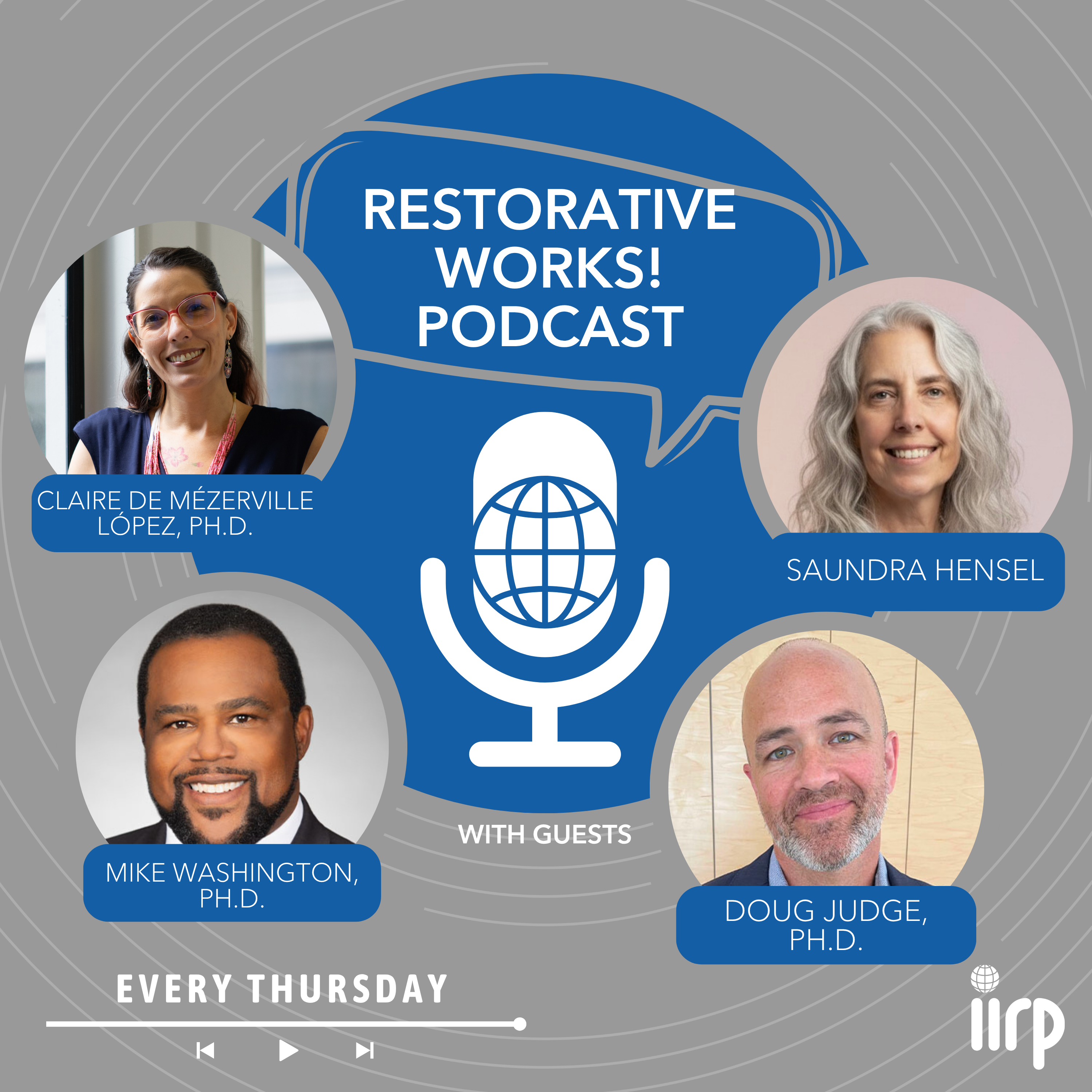
In this episode of Restorative Works, host Claire de Mezerville-López, alongside co-hosts Dr. Michael Washington and Dr. Doug Judge, welcomes veteran educator and systems leader Saundra Hensel. With more than 35 years in education and nearly a decade leading district-wide implementation, Saundra brings unmatched clarity to one of the field's biggest questions: What makes restorative practices stick?
Saundra unpacks how her district scaled training across 70 schools while staying grounded in a critical truth: that training alone doesn't guarantee faithful implementation. Instead, she reveals a blueprint built on intentional design that includes whole-school engagement, long-term investment, and a commitment to building internal capacity before rollout ever begins. She discusses initiative overload as a common tension in education. Rather than positioning restorative practices as "one more thing," she shows how they strengthen and align with existing frameworks like PBIS, social-emotional learning, and trauma-informed care.
Saundra Hensel has been an educator in various roles for over 35 years. She left a career in higher education administration to teach high school in Chicago Public Schools, then moved to Jefferson County Public Schools in Louisville, KY, in 2009. In fall 2016, Saundra was asked to join a team at the district level that was to begin implementing restorative practices. She is currently the behavior systems manager, supporting schools in implementing restorative practices and Positive Behavior Interventions and Supports. Saundra is a National Board Certified Teacher in English, with a bachelor's degree in interpersonal and small group communication and a master's degree in education and school administration.
Tune in to hear how sustainable change demands both patience and precision, because meaningful change doesn't happen overnight, but it does happen with intention.
Transcription
Claire de Mezerville-López: Hello, everybody, and welcome to Restorative Works, a podcast where learning, practice, and research open new paths for transformation. My name is Claire de Mezerville-López.
Along with our wonderful co-hosts today, Dr. Michael Washington and Dr. Doug Judge, it is our honor to introduce this episode, and…
We also have the honor to welcome Saundra Hensel as our guest. Welcome, Sandra Doug Mike, how are you today?
I've been looking forward to having this conversation. Before getting started, Saundra, I'm going to introduce you to our audience. Saundra Hensel has been an educator in various roles for over 35 years.She left a career in higher education administration to teach high school in Chicago public schools, then moved to Jefferson County Public Schools in Louisville, Kentucky in 2009.
In fall 2016, Saundra was asked to join a team at the district level that was to begin implementing restorative practices, and 10 schools were trained and began implementation in summer 2017. She is currently the behavior systems manager supporting schools in implementing restorative practices and positive behavior interventions and supports, and there are now 70 schools in the district that have been trained in restorative practices. Saundra is a national board-certified teacher in English.With a bachelor's degree in interpersonal and small group communication, and master degrees in education and school administration.
Collaboration, proactive approaches to changing student behavior, and leadership development are some of Sandra's driving strengths. And I really want to get right to it, Saundra. Let me begin with this. In my experience, restorative practices are welcomed by several members of the school community. People are glad to hear this; they say, yes, this is good. But they are difficult to sustain. You are close to a decade in the work of implementation. What works best?
Saundra Hensel: Well, I think one caveat is, of course, in your introduction, you said we've trained 70 schools. I'm always very careful to say that we've trained 70 schools. That doesn't mean we have 70 schools that are currently implementing with fidelity. That's always the bigger challenge, right? But we did try to set ourselves up for success, by looking at what we thought would work best for our district
The first big decision we made was, what model are we going to use for implementation? There's lots of different models of implementing restorative out there. We chose to go with wall-to-wall implementation, which means we train an entire school, and everybody in the school who interacts with students, so custody staff, clerks, nutrition, bus drivers, people you don't normally think of training, you normally think, let's train the teachers, right?
So, we wanted to train everybody. I think that has helped with sustainability. Having a high level of commitment from our district when we began implementation in 2016, the district invested over $3 million to contract with IIRP, to pay staff for the team that I'm on now. And, so that was a huge commitment for the district, and have continued to…
Sustain that commitment over the past 10 years. And then, also an understanding that implementation does take time, right? That… the rule of thumb is the implementation takes 3 to 5 years, so it's not going to be a quick fix in a school. It's not going to be an easy process, and…
So we really started slow. So that first year in 2016, we didn't immediately jump in and start training schools. We didn't train schools until 2017. So during the 2016-2017 school year, we had a district leadership team of about 25 people
Made up of key leaders in the district, at the district level, plus some school principals. And we did every training that IIRP offered, and we built our capacity To support schools and speak to RP, and we educated ourselves through those trainings and, built the relationship with IIRP that I think really helped us in those early years. And so, I think those are the things that have really, you know, taking our time with implementation, being slow, being very intentional, building our capacity.And having that commitment have really helped us
That doesn't mean we don't have challenges. Like most urban districts, we face very transient school populations in terms of… I mean, students, obviously, but also staff. They… they'll stay at school for a couple years, and then they move on school leaders.you know, are trained at one school, but then they go to another school that's not RP trained, or… we get a principal that comes to a school that was RP trained, but this new principal hasn't been trained in RP. And so trying to navigate around thatAre some of the challenges we face on an ongoing basis.
Douglas Judge: Thank you, Sandra. I was gonna ask you to please share with us how you see restorative practices aligning with other effective frameworks. I'm thinking things like positive behavior supports. So, aligning with other frameworks to support effective implementation in schools.
Saundra Hensel: So, one of my, latest pet peeves in soapboxes is the whole, trend that I hear when I go to conferences, where, where people say, this isn't one more thing on your plate, this is the plate. And everybody thinks they're the plate. And it's like, well, that doesn't really work, does it? Not everybody can be the plate. And so… I… we can't think that way, right? But at the same time, that's trying to address a very real, concern that administrators have when implementing restorative practices, and the idea of bringing it into their school is, I don't want to give teachers one more thing to do.
Saundra Hensel: We are facing massive teacher shortages around the country. It is really, really hard. I read a statistic that we're now… it used to be that Schools, universities were graduating to Teacher candidates for every one open position, and now that has flipped.where there's two open teacher positions for every one candidate coming out of an educational program. And so we have positions in our district that have been open all year. Kids who have substitutes, and they don't know from day to day who their teacher's gonna be. And so… So it makes sense that…administrators and school districts are very hesitant to put one more thing onto teachers. We want to be taking things off their plate, not adding to it. And so. It's thinking about… Is this really another thing? Is this really another initiative? And my approach, and the approach our district has taken, is that it actually isn't. We were already doing PBIS, all of our schools were required to do PBIS as their foundational behavior system. And… and PBIS is really just multi-tiered systems of support for behavior. So it's 3 tiers of support, looking at data, doing all of that. We also do social-emotional learning. Trauma-informed care. Those are all pieces that are required by our state for schools to be implementing. Every school has to have a trauma-informed care plan, be trained in trauma practices. Our district requires all schools to be doing social-emotional learning curriculum. And… So our… my department, the Behavior Systems Department, is under the umbrella of Culture and Climate, and so all of these departments, bullying prevention, social-emotional learning, trauma-informed care, they're all under the Culture and Climate umbrella, and… So, it's like, are these really different initiatives Or are they all practices that just strengthen and deepen one another? And I think that's really the approach that has been effective for us. One of our favorite in our culture and climate, we laugh that our favorite word is synergy.It's how do these things interact and complement one another, and deepen one another? So… Our… our teams are all cross-trained. So, my consultants, the consultants for social-emotional learning and trauma-informed care.
They've all been trained in all of those things. And so, when my team does restorative practices training, and they talk about Affective statements. They're gonna say, if you're using affective statements with a student, that is trauma-informed.If you are using the restorative questions, that is trauma-informed. And same thing with the trauma-informed people. When they're doing their training, they say, when you're doing these strategies, that is being restorative.
And so we referenced each other's work throughout our training so that people see this isn't another thing.
Saundra Hensel: This is just deepening the practices that you're already doing. And I think we often… in PBIS and in lots of trainings around classroom management, we… we tell teachers it's relationships, it's relationships, right? That's what it's all about. You have to have relationships with kids in order to have good classroom management, period. And we say that all the time. The underlying assumption is that… Adults know how to build relationships with kids
And that's not necessarily true.
And so… What restorative practices, to me, really does is give them the tools to build those relationships.
How do you build a relationship with a kid? Well, through being restorative. And so.
Saundra Hensel: So that's how we kind of try and put all these things together and make them make sense, so that they're not competing initiatives at all. And in the very beginning, that was the model we took. We worked with IIRP, and we worked with PBIS Midwest. to create this model where they worked hand-in-hand. And so we talk in… in our RP training about PBIS, and the PBIS pyramid, and the three tiers, and how restorative fits into that. Because we want people to see that it all fits together, and that there is synergy, that word we love.
Claire de Mezerville-López: I love that. I think it's a fallacy from some… Academic spaces to think that frameworks are meant to compete with each other. Instead of thinking that, in practice, a framework is a vehicle or an avenue for deepening the other and collaborate. Thank you so much for this, Saundra. We're going to take a very short break, and then we're going to continue with this conversation about restorative practices and implementation. Please stay tuned.
Welcome back to Restorative Works. It is wonderful to have this conversation with Saundra Hensel, along with our wonderful co-hosts, Dr. Doug Judge and Dr. Mike Washington. Mike, how do we continue this conversation?
Michael Washington: First of all, I'd really like to say how much I appreciate the wealth of experience you shared, Saundra, so far, and in my experience, implementation processes can be long, but they're made up of stories that happen day to day, and experiences. Could you share, you know, some of what experiences or stories, comprise your background, and talk a little bit about how you knew you were on the right track?
Saundra Hensel: In our first year of implementation, I was working, actually, with an IIRP consultant, supporting one of our most challenging schools. And we were, that day, working with the ISAP instructor. So ISAP is our, like, in-school suspension room, and there's a… an instructor in there, and often that room is just a punishment room, right? We're… we're trying to make it more restorative, that's the vision, that's the goal, but often it's just… A kid's acting up in class, we pull them out, we put them in an ISAP. So we were meeting with the ISAP instructor to try and, you know, help create this vision, and what are some small steps we could take to make this room a more restorative room. So while we're talking to this gentleman, the assistant principal comes in with two students, a male and a female, who, who were doing some kind of back-and-forth taunting, baiting, pre-fighting kind of actions, right? They were just going at each other. And so they were removed from the classroom. And so, the consultant decided this would be a good opportunity to model a circle. And so, here we are, we circle up with these two kids, the assistant principal, the ISAP instructor, myself, the consultant, and these two kids who don't know most of us at all. Right? And, oh, the behavior coach from the building was there, too. So, the consultant explains what's gonna happen, what are the questions we're gonna ask, and all of that. And she starts asking, the girl, and she refuses to speak. She's just like, I'm not talking. Okay, fine. So she starts asking the young man. So he starts answering. Well, of course, then the girl starts jumping in, and it's just like, wait, you will… you're going to be asked the same exact questions. We want to hear your story, right? So they start talking, and… And we're answering, going around the circle, and so we're all talking about how this is impacting. In the middle of this circle, these two kids jump up and go at each other. And… and got physical. We break them up. AP takes… assistant principal takes one out in the hallway. And we get them kind of calmed down and de-escalated.
And the… the consultant said, well, wait, where did the other one go? And I said, she's out in the hallway. And she's like, well, get her back in here. And the assistant principal is like, are you kidding me? We can't bring them back in. And… and the consultant said, yeah, we can. Bring her back in, we sit down. The consultant just starts right… going right back into the questions. And… And now, when we start talking about impact, the people around the table are talking about, well, now I'm worried because you're a senior. And… and now you're going to be suspended. Right? And I don't want you to be suspended. And so… like, that worries me, because now you're going to fall behind, and I know how badly you want to graduate.Right? And so, we were able to have this real conversation, and as the kids just kept going in the circle and answering the questions, hearing from the adults, you could just see. Like, in their physical bodies, you could see them breaking down and opening up. And having actual conversation with each other. And of course, it turns out that they were just listening to other people, saying stuff in their ear. They actually didn't even have a beef with each other. they just… it was people around them egging them on. And so, they were able to come to the realization that they could They could just ignore those people. ignore each other. They're not going to be best friends, that wasn't the goal of the circle, right? But they were able to make peace, Go back to class. And didn't… didn't need to be suspended.
Like, they resolved it, and it was fine, and I just sat there going. Wow, okay, this really does work. And that was a very cool moment for me.
Another time I was in another school. And I was observing the classroom for a teacher. And, a kid walked into the classroom, and there had been a fight out in the hallway, and the kid walks in, and was just like, oh, Mr. Williams, we need to circle up and talk about this. Like. Stuff just went down out there. And I… I love… I was like, okay, the kids are asking. The kids are seeing the benefit of it. And that was a moment for me. And then, in 2018. there was a school shooting here in Kentucky at Marshall High School. And, students were killed.
And so the next day, I again was in a classroom observing, and the teacher decided to do a circle with the students, and Said, you know, I'm sure you've heard about what happened yesterday at Marshall. you know, let's talk about that. And so started helping the students process through that.And… One of the students said I don't think about if that could happen here. I wonder when. Because it's going to happen in our building. And I just don't know when. And so, every day, I walk in thinking, is this today? And the teacher said, you know, I think that's a reality. and I understand that fear, so what can we do? to help students feel safer when they walk in this building. And the kids started processing through that. And it gave them a vehicle not just to process their feelings about this tragedy that had happened. And processed the fear that they're going to experience it themselves. But then also it gave them a vehicle to empower them that, oh, we can do something And I thought that was just so powerful there, to… to use it in that way, and I think the teacher just did a spectacular job with that.
And then we've also just… I've had the opportunity over the years, when we've had a racial incident in a school, I tend to get called in to facilitate those kind of circles to address that with students. We had a student threatening a school administrator, it was not a restorative practices school, but that administrator happened to have come from a school that was trained, and so reached out and said, I need you to come and facilitate a restorative conversation, with this student, because, you know, they've obviously been suspended for the threat.
But they're coming back to school, and… and I need you to facilitate A time for us to reconcile. And was able to do that And then… Just this week, and last week, we did listening circles at a couple different high schools, because Administrators realize that students weren't really having enough of a voice in what was happening in their school, and they wanted to hear from kids, and so they said, would you facilitate listening circles? And so we went in, and Spent all day just pulling kids and having prompts that we ask them about. Everything from how discipline is handled in the building, to how they're acknowledged for positive behavior, what kind of clubs they'd like to see, and activities that aren't being offered. Just all these things. And then we work with the administrators to create an action plan following those kind of circles, because kids need to see that something's being done.with what they've said. Otherwise, it's just performative, and we don't want to do that. So, so those are kind of some things we continue to see, just the…The impact it can have on individual students, on classrooms, that… that tell me that this is just… The right thing to do for kids.
Claire de Mezerville-López: Sandra, this is… so moving, And before we started recording, Dog, Mike, and I were commenting on how much we would love to have an Episode 2, to continue this conversation and to continue to learn from you. We have, a couple more minutes before we wrap up, and I wanted to ask you for a final piece of advice for people that are on the process of developing these skills on the reflection on how to do faithful implementation. So In just a few words, what would be something that you would say to them?
Saundra Hensel: I think you have to have flexibility. It's continually adapting what it looks like in the district as the district changes and moves forward, and…That sort of thing, so having that flexibility and the patience, you know, that 3 to 5 years that we talked about, it's not going to be a quick thing, so meet people where they are, and then move alongside them, to help them move forward. think of it as continuous improvement. We're constantly assessing what does our implementation look like, what does my department need to do next to move implementation forward. And then, for me, personally, it's… it's modeling that I can't ask others to be restorative people if I'm not being a restorative leader myself So, thinking about how am I leading my team, how am I leading this department, how am I leading this work, and am I doing that in a restorative way? Because if I'm not, then I shouldn't be in this job. And then I need to leave. So, those are kind of some of those things. It's that flexibility. continuous improvement, patience, and modeling that I think have to happen in order for the work to really be effective.
Claire de Mezerville-López: Thank you so much, Saundra, Mike, and Doug, for being on the podcast today. And thank you all for tuning into Restorative Works. To learn more about our guests, log onto IIRP.edu and let's continue to build transformation through dignifying relationships, kind conversations, and stronger communities. Until our next episode.