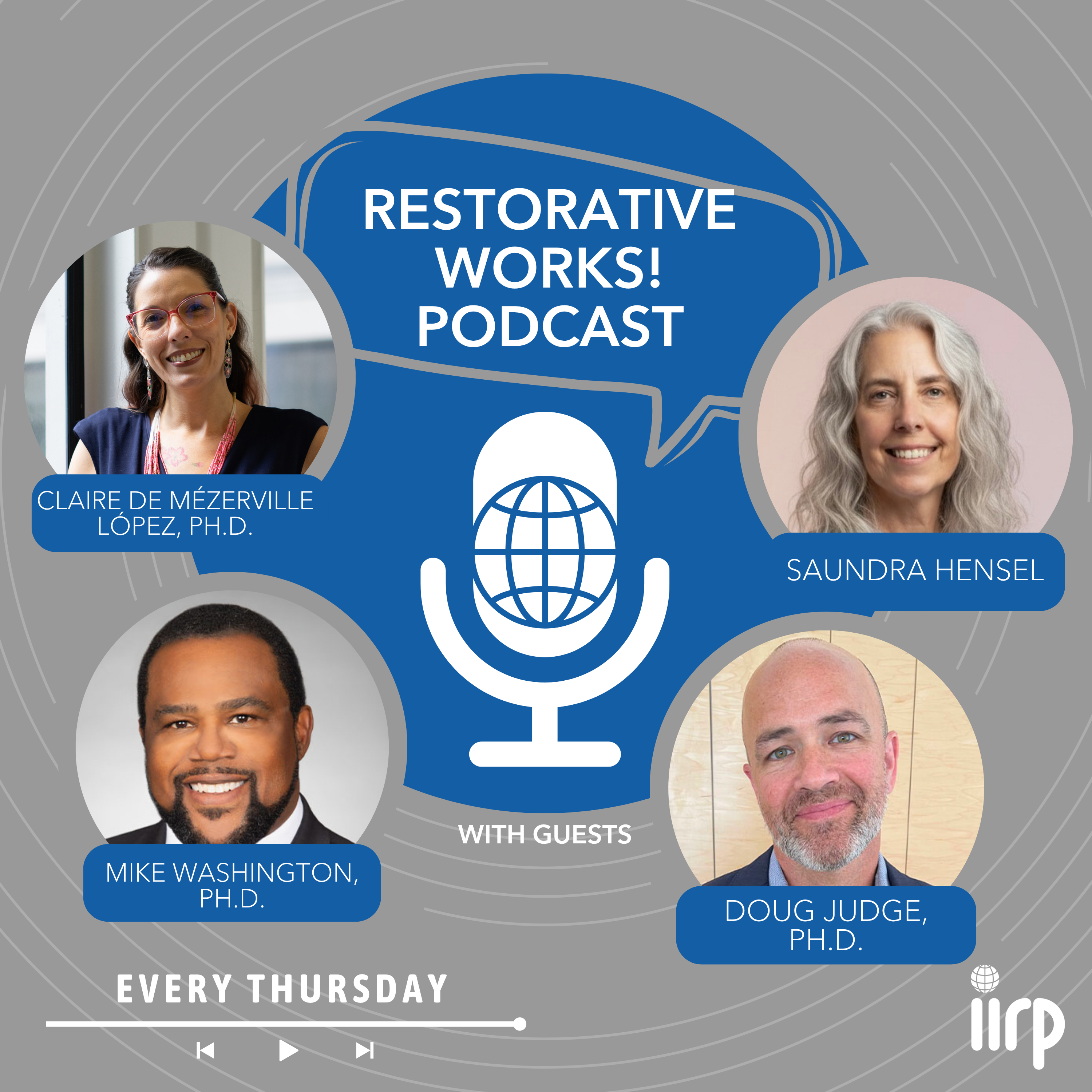
In this second part of our conversation with Saundra Hensel, alongside co-hosts Dr. Michael Washington and Dr. Doug Judge, we continue exploring the long-term, system-wide implementation of restorative practices in a large school district. With over a decade of experience, Saundra shares how integrating restorative practices with social-emotional learning, trauma-informed care, and behavior supports can strengthen school culture and climate. Revisit the first part of our conversation here.
The conversation highlights how students often have strong opinions about discipline but many fail to receive the space to share them. Engaging students, "catching them doing the right thing" and using student voice to move the conversation towards a deep reflection about what it means to build an intergenerational community.
Through practical examples, Saundra illustrates how small relational shifts, like listening, adapting, and showing vulnerability, can transform challenging dynamics between students and educators. This conversation also reflects on sustainability, leadership commitment, and the structures needed to support lasting change, offering valuable insights for anyone engaged in system-wide restorative practices implementation.
Saundra Hensel has been an educator in various roles for over 35 years. She left a career in higher education administration to teach high school in Chicago Public Schools, then moved to Jefferson County Public Schools in Louisville, KY, in 2009. In fall 2016, Saundra was asked to join a team at the district level that was to begin implementing restorative practices. She is currently the behavior systems manager, supporting schools in implementing restorative practices and Positive Behavior Interventions and Supports. Saundra is a National Board Certified Teacher in English, with a bachelor's degree in interpersonal and small group communication and a master's degree in education and school administration.
Tune in to learn more about Saundra's insights and discover, along Claire and co-hosts Mike and Doug, some major take aways regarding restorative practices implementation!
Transcription
Claire de Mezerville Lopez
Hello everybody, and welcome to Restorative Works!, a podcast where learning, practice, and research open new paths for transformation. My name is Claire de Mezerville Lopez, along with our wonderful co-hosts today, Dr. Michael Washington and Dr. Doug Judge. It is our honor to introduce this episode, a second part of a conversation that felt way too short with Saundra Hensel. Welcome, Mike. Welcome, Doug. Welcome, Saundra. How are you today?
Saundra Hensel
I'm good, thank you. Happy to be back.
Michael Washington
But great. Good to be here.
Douglas Judge
Yep. Great to be here.
Claire de Mezerville Lopez
I am so glad that we're back together and we can continue with this conversation. But before getting started, Saundra, I'm going to introduce you again to our audience so people can remember the fantastic work that you do. Saundra Hensel has been an educator in various roles for over 35 years. She left a career in higher education administration to teach high school in Chicago Public Schools. then moved to Jefferson County Public Schools in Louisville, Kentucky in 2009. In fall 2016, Saundra was asked to join a team at the district level that was to begin implementing restorative practices, and 10 schools were trained and began implementation in summer 2017. Saundra is currently the Behavior Systems Manager, supporting schools in implementing restrictive practices and positive behavior interventions and supports. And there are now 70 schools in the district that have been trained in restrictive practices. Saundra is a national board certified teacher in English with a bachelor's degree in interpersonal and small group communication and master degrees in education and school administration. Collaboration, proactive approaches to changing student behavior, and leadership development are some of Saundra's driving strengths. And Saundra, the last time we talked, you mentioned how different departments, bullying prevention, social-emotional learning, trauma-informed care, restorative practices, all of these, they're all under the culture and climate umbrella, and that they are all practices that just strengthen and deepen one another. How about we start with that, with an example based on your experience implementing restorative practices? What was an example that really resonated with these efforts?
Saundra Hensel
So obviously, circles are a key component of restorative practices and really using circles proactively to strengthen relationships. And so that's something we really try to reinforce and push and promote and support in our district with our restorative practices schools. And we also have the expectation in our district that all schools are utilizing an SEL or social emotional learning curriculum and bullying prevention curriculum, which we use a program that incorporates both of those things together. And so that's a lot of like the character skills and social skills and things like that that are part of that curriculum. Many of our restorative practices schools have chosen to kind of integrate the idea of circles with this curriculum, and they use circles as kind of the delivery vehicle for using the SEL curriculum and the bullying prevention curriculum. So they're able to work the lessons in a way that they naturally kind of fit in a circle mode so they can do prompts and have those conversations. And I think also they're learning the skills in social-emotional learning curriculum. They're learning the skills that are needed for self-regulation, conflict management, a lot of the things that restorative practices also supports. And so, when conflict then arises, they have the skills that they've learned through this curriculum. But then also they're familiar with the restorative questions that teachers can use to mediate the conflict. And so that kind of is an example of how schools are using RP and SEL, trauma-informed care, bullying prevention, hand in hand to support one another. and really make each one more effective.
Douglas Judge
Saundra, you also mentioned last time the importance of students engagement and your experience doing it through circles. What do students have to say about how schools are handling discipline and how are teachers and administrators incorporating student voice into your restorative practices?
Saundra Hensel
So as you can imagine, students have a lot to say about discipline. We never have a problem getting them to talk about how they feel about that. But I would say the key themes that we found of what students really want or what they're experiencing is first, they really want consistency, that idea of fairness in discipline. They know when administrators are favoring one student over another, or when two students do the same thing and one gets a different kind of consequence than the other one. And we as adults know that sometimes there are circumstances that warrant there being a difference in discipline and disciplinary systems are set up to allow for those differences. But we have to remember that kids don't understand that. They just see that people are being treated differently. This kid got suspended for being in a fight. This kid just got in school suspension. So what's the difference, right? They don't understand those nuances. And we have to figure out a way to kind of address that and talk to them about it and help them understand without talking about specific situations, of course. Kids also talk sometimes about feeling targeted. I think we, too often, as adults, when we have kids who have some behavior challenges, we fall into the habit of watching the kid and waiting for them to make the mistake and waiting to catch them, right? And I guarantee you, if you watched me, you would catch me making a mistake. If you were looking for it, you will find it. You know, my doctor tells me I need to do better at regularly eating throughout the day. Lunch today was a candy bar. I do not think my doctor would be okay with that had she been watching me. So when we watch a kid to catch them doing wrong, we will find them doing something wrong. So, it's instead we need to shift to catch them doing the right thing. Oddly, and I know it's hard to believe sometimes, but kids really do want our praise. They want our recognition. And that's the other thing that we really have found when they talk about discipline. They talk about wanting a relationship with the adults. They genuinely want that relationship. And it often doesn't feel like it, and they often act like they don't want the relationship, but they do. And so we need to, as adults, really be listening to that need that they have and being the ones that are pushing the relationship and encouraging the relationship, even when we're hitting barriers with the kids. And then as far as how we're incorporating that student voice and what we're learning from the kids, more and more schools are really creating like a student advocacy team or a principal advisory committee. They call it different things.
And so, I think about one school I worked with that we did listening circles just a couple of years ago. And after we did the listening circles, the principal asked me to come in and train his racial equity committee on how to facilitate listening circles. So we did that. Then they said, can you come in and talk to the student advisory team, the principal advisory team? And that team consisted of the leaders of all the clubs, like the leaders of the Black Student Union, the Hispanic Student Group, GSA, the chess club, I mean, it was everything. So, every club, every student group had the president as well as like the president of each grade level as part of this principal advisory team. So I went and met with them. And we took all the information we got from the listening circles. And I shared that with that group. And then we started brainstorming solutions to the problems that the students came up with, because we don't just want the kids to talk about the problems, right? We want them to be part of the solution and help figure out, okay, here's an issue in our school. It's in your power, not just the adults, but it's in your power to change things. So, let's work together to do that. And so I thought that was really a lovely thing that they did. And then another school that was really struggling with getting kids to do the advisory council, this year, once we did the listening circles, they invited every single kid that we had asked to be part of that, they invited them to be on the advisory council and got quite a good response. Because once kids got a taste of having a voice and being heard, they were like, oh, okay, this is what it's like. And so then they wanted to be part of that team that could make a difference in their building. So that's how they're really using that opportunity of hearing from students and using student voice to really start moving their school forward and improving the culture and climate of the building.
Claire de Mezerville Lopez
And I think that can really create that virtuous cycle of students gaining trust on participating and then getting more and more students to take a chance on becoming engaged. We're going to take a short break and then we're going to continue this second part of the interview with Saundra Hansel. Please stay tuned.
Michael Washington
Well, welcome back, Saundra. You know, another thing we talked about was that we may be holding some underlying assumptions that adults know what they're doing in terms of building relationships with kids. And that's not necessarily the case. You mentioned how restorative practices can help in that space. Do you have a story or an anecdote that might illustrate that idea?
Saundra Hensel
Yeah, I have a couple actually. There was one teacher who had a student that she just did not like. And we all know that that does happen. And that's okay. Doesn't matter. You still have to have a relationship with that student that is positive enough that they can learn and that it's a positive classroom environment or a positive learning experience for that student. They just, you know, tended to clash. And this was an alternative school. So it's already a student with behavior challenges. And in the classroom, she was consistently being disruptive, calling the teacher every name in the book. So the teacher knew something had to change. This was not working. It was impacting the learning environment negatively. So she started using a lot of affective statements, talking about the impact that the student's behavior was having on her, on the class, and that sort of thing. And then restorative also just really gave her the context to be vulnerable with that student, which I think was really what transformed it. She was able to ask the student in those restorative conversations, just saying, “okay, so tell me what I do that really bugs you. Because I want us to have a good relationship, and this isn't working. So tell me what I need to change”. She didn't put it on the student. She put it on herself. And the student told her, she's like, “well, I don't like it when you correct me in front of the class, because I feel like you're pointing me out and it's embarrassing”. And she was like, okay, that's reasonable. “So how can I communicate to you that I need you to change your behavior in a way that doesn't feel like I'm pointing it out or embarrassing you in front of the class?” And the student was like, “Well, maybe you could like put a post-it note on my desk”. She said, okay, I can do that. And so the teacher changed how she corrected the student based on what the student said. And so using those affective statements, engaging that student in conversation, being humble herself to say, tell me what I need to change, enabled them to grow that relationship. And I mean, they didn't become best friends. You know, that's not always realistic. But they were able to change the environment and change the structure of their relationships so that they could work together. And then similarly, another teacher talked about in her school, a student who just really didn't have a positive relationship with any adults in the building, did not trust any of them. So this teacher just continually used affective statements, used the restorative questions when an incident would happen, just constantly tried to be in the WITH box with her, use all the practices, and eventually. She became the teacher that that student would turn to regardless of where something was happening. So she'd come knock on her door in the middle of class and say, there's something going on in the computer lab. I need you to come help with that. Obviously, she wasn't always able to drop everything and go do that. But she identified, the teacher identified that what she thought was going on was that. that the student felt a safety in that the teacher was consistent with her. She knew how she was going to handle conflict. And so she could trust that. And so she would go to her because it felt safe and it felt predictable. And that's, I think, another thing that RP gives us is that framework and that structure to be predictable for students and to be consistent so that they feel that sense of safety.
Claire de Mezerville Lopez
And what I really like is that you mentioned, it's not about them becoming best friends, but a bridge was created between them. Before wrapping up this episode, Mike, Doug, I'm so definitely going to ask you for some takeaways, but Saundra, I have another question for you before we do that.
Saundra Hensel
Right.
Claire de Mezerville Lopez
Implementation takes patience. It takes flexibility. What is an example of positive support that you have received from a colleague or a student or another leader that gave you strength during a long implementation process?
Saundra Hensel
Yeah, sometimes it's hard to believe that it's been 10 years that I've been doing this work. And then in other times it feels like it's been two years. So I think the things that have sustained me is one, seeing the impact that it's had on our students and school staff. That's really motivating to me when I see teachers talking about it changing the relationship that they have with students, seeing it change the way a classroom functions. I love that. And then, family and friends commenting on how I personally am when I talk about restorative and they've talked about how they can tell my passion, my enthusiasm that they know I found exactly what I'm supposed to be doing. And so that's kept me motivated and keeps affirming me in my work. And then finally, my team and the district and my boss's ongoing commitment to the work. Again, for a district to be committed to this for 10 years, I think is pretty significant. And that's through multiple changes in leadership and multiple changes at the board level, and yet it stayed consistent. And so I think
the fact that I had that support from my supervisors, from my team, and from the school district as a whole, the board and the superintendent, that keeps me going.
Claire de Mezerville Lopez
I love that. And sustainability and consistency are definitely to be praised. We aspire to that so much. Mike, what's the takeaway that you bring with you?
Michael Washington
One of the things that came to my mind as we were speaking was that the adage that folks, you know, don't care so much for what you know until they know something about how much you care. And I think the relational context
and connections that are articulated or we articulated doing this podcast to sort of demonstrate that adage.
Claire de Mezerville Lopez
Doug, how about you?
Douglas Judge
Saundra, thanks again for doing this. There are so many layers of wisdom, I think, and for those of us that are engaged in helping other schools, like put the right pieces in place in the right order. A big, clear takeaway for me is this idea around, you know, we have to think like architects in this work around creating the spaces and the conditions. And the salient theme that I heard one of them from you was just the framework is built, like you built the framework to create those conditions, you know, through your very thoughtful integration of PBIS and trauma-informed practices and restorative, the restorative approach, the circle, even the circle itself can be considered a structure and a framework. And then within that, you're, you know, you've created the space for that young student to go to that teacher and say, hey, I don't appreciate the way you're correcting me in front of others. Like there's a framework for the innovation. Because I think restorative practices, you know, it is, it is restorative practice, is not restorative perfect. You have to create the space for people to
kind of make mistakes and adults especially to make mistakes and get some insights. So then I would just say the testament, the duration, the fact that you've been doing this for so long, you know, despite these kind of predictable turnovers in leadership at the school and district level speaks again to like that the foundation is really strong. So I just want to say thank you. Thanks for bringing that up. Sometimes we narrow into like particular moves people make at the individual level, but this kind of broad systems approach has been really a gift. So thanks a lot, Saundra.
Claire de Mezerville Lopez
Doug and Mike, thank you so much for co-hosting today. And Saundra, thank you so much for coming back.
Saundra Hensel
You're welcome. Happy to be here.
Claire de Mezerville Lopez
And thank you all for tuning into Restorative Works. To learn more about our guests, log on to IIRP.edu and let's continue. Let's build transformation through dignifying relationships, kind conversations, and stronger communities. Until our next episode.