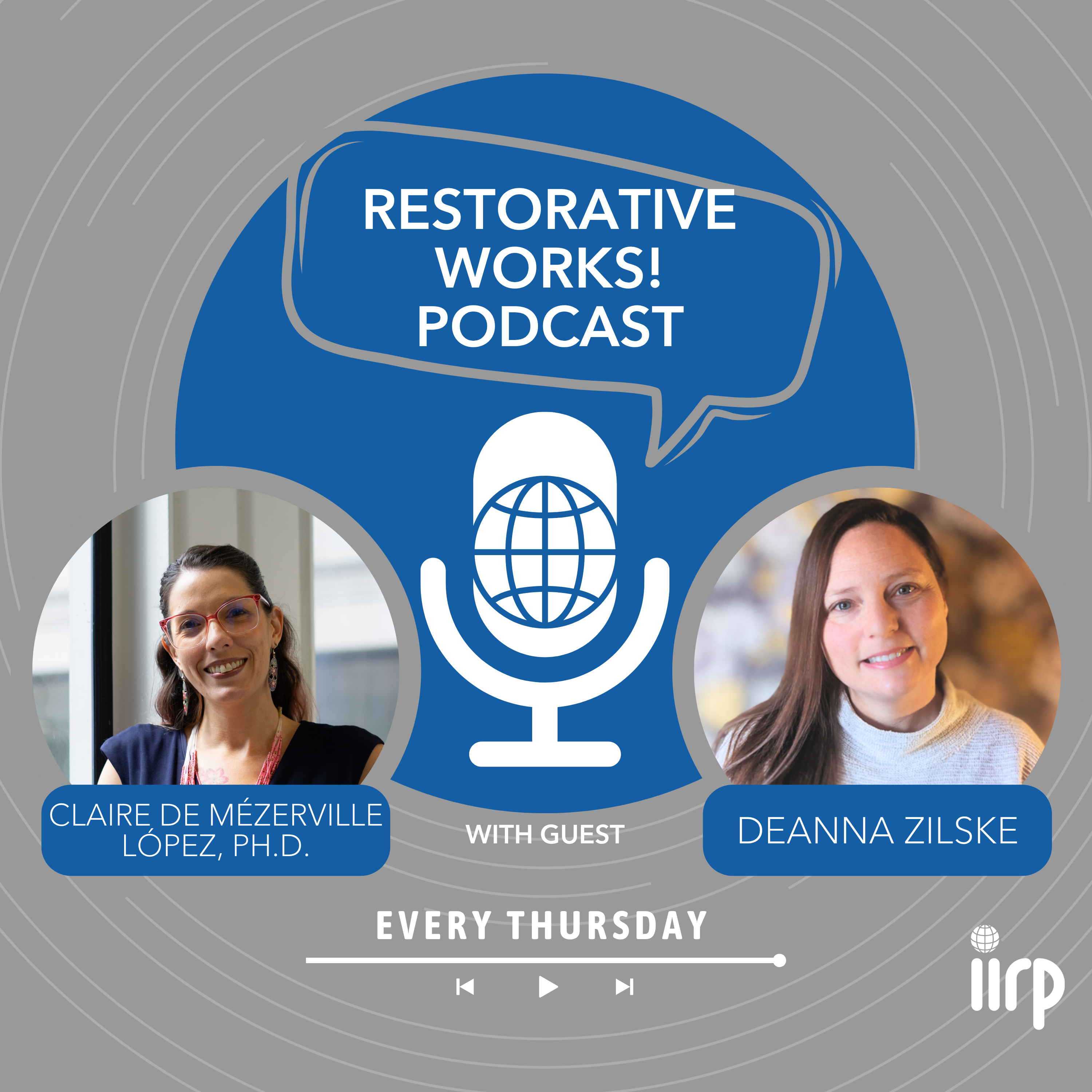
In this episode of Restorative Works, host Claire de Mezerville Lopez is joined by Deanna Zilske, school leader, theater director, and restorative practitioner, to explore the powerful intersection of restorative and embodied theater practices.
Drawing from her work with a community of educators, artists, and practitioners, Deanna shares how integrating narrative practices, such as compassionate witnessing and reauthoring maps, with movement, voice, and improvisation can deepen storytelling, empathy, and connection. When words are not enough, the body becomes a powerful tool for expression, allowing individuals to explore lived experiences, trauma, and preferred futures in ways that feel both accessible and transformative.
Deanna also shares moving examples from the group's experience, illustrating how embodied storytelling can support healing, release, and reconnection, both with oneself and with others. As one participant reflected, the process created an opportunity to listen differently and to carry others' stories with greater care and empathy.
Deanna Zilske currently serves as the Principal at Jaffrey Grade School in Southwestern New Hampshire. Before that, Deanna served as Principal at Keene Middle School and as a Principal and Instructional Coach at Harrisville-Wells Memorial School. In addition to her work in education, Deanna currently directs the Lions Club Foundation's annual Summer and Winter Musicals. Before moving into administration, Deanna built her foundation with ten years of classroom teaching experience and a background in theatre and arts education. She holds a Master of Science in Restorative Practices, alongside Graduate Certificates in Relational Facilitation for Healing Trauma and Change Implementation in Organizations and Social Systems from the International Institute for Restorative Practices. In addition, she holds a CAGS in Education Administration, an MTA in Elementary Education, and a BA in Theatre Arts.
Tune in to discover how embodied theater practices can expand restorative work, opening new pathways for expression, understanding, and collective transformation.
Transcription
Claire de Mezerville Lopez
Hello everybody and welcome to Restorative Works, a podcast where learning, practice and research open new paths for transformation. My name is Claire de Mezerville Lopez, and it is my joy to introduce our guest, Deanna Zilske. Deanna, hi, how are you today?
Deanna Zilske
Thank you and thank you for having me on. I'm excited to talk about the work.
Claire De Mezerville Lopez
I am very much looking forward to this conversation. We have so much to talk about, restorative practices, theater, embodiment. There's so much to dig into. But before getting started, allow me to introduce you to our audience. Deanna Zilske currently serves as the principal at Jaffrey Grade School in Southwestern New Hampshire. Prior to her time at Jaffrey Grade School, Deanna served as principal at Keene Middle School and as principal and instructional coach at Harrisville Wells Memorial School. In addition to her work in education, Deanna currently directs the Lions Club Foundation's annual summer and winter musicals. Deanna deeply believes in using restorative practices in all aspects of education and theater. She holds a Master of Science in restorative practices, alongside graduate certificates in facilitation for healing, trauma and change implementation from the International Institute for Restorative Practices. She actively integrates restorative practices into her work with school communities, which brings us to the conversation today. So, Deanna, please tell us the story of how you created, you envisioned, this powerful connection between restorative practices and embodiment.
Deanna Zilske
It started when I was taking two courses with the IIRP with Dr. Frida Rundell, the Transgenerational Resilience and Community Striving class and the Narrative Inquiry for Empowering Facilitators courses. And we were doing a lot of work with the narrative maps and narrative process of Michael White and Freedman and Combs. And we used a lot of that work in small groups and community work. And at the same time, I was looking at the embodiment work that we did with Shapiro and I started to wonder how the connection of that with improvisation techniques, movement techniques, what we ended up turning into the phrase of embodied theater practices techniques, could be utilized to enhance the storytelling that comes out of compassionate witnessing and reauthoring maps and how we could use our bodies and our voices to continue to explore the stories of our lives and the lives of others. And then from there, I started thinking about the community aspect of it and the possibilities that could come from it in enhancing empathy and understanding if others engaged in embodying the stories of both what has currently been told and preferred self and preferred futures, how that could also enhance community understanding, empathy, while also providing storytellers the opportunity to explore how it will feel in their bodies to act out what's currently happened, as well as explore possible future selves and future stories. And so, I started to just think about how those two things could work together and put together a proposal and with the wonderful support of IIRP, I was able to do that work with a community of seven practitioners and artists this past fall.
Claire de Mezerville Lopez
That is beautiful. You know, I was thinking about those times where you use that expression, fake it till you make it. And I'm just thinking how wonderful it is to have a community safe space where you can act that future that you're embodying for yourself. Which will lead me to my next question. Something that I really appreciate is how to make restorative practices more inclusive on telling your story and having those narratives. Sometimes people are not as much of using words, but how powerful it is to use other tools in your body. How does this work look like and feel like?
Deanna Zilske
So, when I was doing research for the courses I had spoken of earlier, I came across a few different studies that referenced specifically in compassionate witnessing and in narrative, the use of narrative maps, really struggled to use words to express what had happened to them, especially if there had been some significant traumatic events that they were looking to explore that they would shut down, wouldn't be able to find words for it, but you could see it in their bodies and they could tell you where they were holding it in their bodies. And so, from understanding that, theater and movement provides for us an opportunity to explore things without the use of words sometimes. And being able to use sound to be able to connect body to feeling to know this part of my body feels heavy or hot or cold and being able to show that instead of tell it enabled people to connect to their bodies and their lived experiences in a way that they couldn't when they were trying to speak. For some of our community members, they noted that they felt their story in their throats or in their voices and it actually stopped them from being able to speak. But then when they were with a partner or with a small group, looking to explore their story and the emotions of their story and their bodies, they were able to act it out or hold their bodies in a way that expressed what was really happening for them in those moments. And so that embodiment piece enabled storytelling in a way when words did not. And it also allows for people that have various language skills or cross languages to be able to share their stories without the need of having the spoken word be at the core. You can create shared vocabulary. You can create shared understanding in a way vocabulary doesn't have to be spoken words specifically. So, you can create shared definitions and shared understandings in a different way than just using words. And we were able to explore that in ways that were really unexpected.
Claire de Mezerville Lopez
That sounds like such a rich experience. And we're going to talk more about this after the break, but maybe you can introduce me a little bit to how the group gets prepared to do this in a way that everyone feels safe and comfortable. How do you work with them through this?
Deanna Zilske
Absolutely. So, all of the people in this particular community had been involved with theater or dance prior. And so, they had experience knowing how to connect to other people's stories, typically not their own, but other people's stories. So, what we did was that we really focused on when I created the plan, the Relational Care Ladder that Dr. Frida Rundell created and really focusing on that safety rung first. How can we create community? So the first few sessions were only about creating safety and community. We sat in circle, we talked, we started with really foundational basic theater technique activities that came from the work that Augustus Bowle did with Theater for the Oppressed that had to do with physical connection with each other, physical connection with the space so that the community became comfortable with physical contact with each other, that we want to make sure that that is a comfort level if we're going to be using our bodies to express, make sure that there's comfort with that. And so at the very beginning, we just created safety through conversation and foundational activities with each other. It is also amazing how the use of the reauthoring maps specifically moves through that ladder naturally by the questions and the way that the questions are asked and the process. So that the questions are asked in this way and the listening, compassionate witnessing creates this opportunity for complete open listening in a way that doesn't place somebody else's story on somebody else's story. You don't tell somebody else how to feel, you just provide the space for understanding and empathy. And so the questions themselves and the art of compassionate witnessing helped with that safety. So the first few sessions were only about safety, only about using theater techniques that created and enhanced safety. And then once through our check-ins, people started to express a deeper level of safety, because they didn't all know each other before this, is when we started to move into exploring some of the stories that people felt comfortable sharing that had to deal with their own either traumatic history or what was happening with them currently that they wanted to explore.
And then from there, we would start with that check-in. We would start with the reauthoring map. Sometimes I would facilitate, sometimes somebody else would facilitate. And then we would go into the embodied theater practice. So we would take that story and the community would get into partnerships or sometimes in full group. And they would have time to just say, how do we want to tell this story? And they were provided total freedom in how they wanted to represent it with their bodies and their voices. More times than not, words were not used, but physicality was and then they would come back and they would share that. Sometimes the storyteller was a part of the embodied theater practice. Sometimes they were part of a different embodied theater practice and watched other people showing what their story seemed to express to them. And then we had our reflection circle. So then we came back and had our circle about what did you see? How did you feel? What were major takeaways? And then we would do our checkout. So that would be our 60-minute session or work together every week was our check-in, our narrative map, our embodied theater practice, and then our reflection circle, and then our checkout. And people really brought their authentic self in ways that I was incredibly impressed by. They brought vulnerability and authenticity, and I feel like that takes a lot of courage. And everybody, I would say about the second or third time that we met together, really led with curiosity. And that guided us towards an openness that proved to be powerful when we were retelling each other's stories. One person in reflection had noted that when they knew they were gonna be embodying somebody else's story, it made them listen in a different way. That they listened for the pauses and they listened for the tone. They listened for more than just the words that people were telling when they were telling their stories. And I thought that that was a really powerful reflection from the community members.
Claire de Mezerville Lopez
That is so beautiful and it inspires me so much to think about people becoming so aware of being respectful on how to hold other person's story and building that empathy. We're going to take a short break and then we're going to continue this conversation with Deanna Zilske. Please stay tuned.
Claire de Mezerville Lopez
Welcome back to Restorative Works. Deanna, I am so inspired by the work that you do. There are some issues that we have discussed before about doing this work together in community, making sure that the experiences are deep, safe, and positive for everyone. I can imagine that for some people, they might experience emotions and reactions that surprise them. These might become very therapeutic very quickly, and people might need support.
Deanna Zilske
Very much.
Claire de Mezerville Lopez
How has the community dealt with that?
Deanna Zilske
That's a great question because there were people who chose to share unexpected experiences that they have lived through and wanted to explore relationships that had really affected their lives. And from that, there were several emotions that they even voiced: “I didn't realize I was still holding on to that, or I didn't realize how that made me feel”. And so part of that was that at the beginning of every we got together there was the reflection that if, at any time, somebody needed to stop or not engage in the embodied theater practice because it didn't feel safel, for lack of a better word for them, that was a complete freedom that they could do. Throughout the course of it, every few times we got together we had a reflection on how are people feeling about the process? Is there anything that they needed differently from me or from each other? And so people were really open and honest about if something needed to change about how we were engaging with each other. There was a clear request that we needed a checkout every time. One week I forgot to do the checkout for lack of a better, I just forgot. And it was an immediate reflection. Community members emailed me that night said, please don't forget the checkout. We need that to help bookend the experience and be able to walk into our next steps in that day to be able to have closure to this. We also talked a lot about how if something came up that they felt that they needed to explore more, I was very clear that I am not a therapist. And so that if something came up that they felt that they needed further exploration of, or if I felt that it was getting to a point where we were exploring something that I was not trained in a way enough to provide that experience, that they had other people that they could speak with, to be sure that they were able to fully explore. We did not have that. We had people reflecting that this experience helped them explore things that they hadn't previously expected to explore, but they felt in the community that it helped them feel lighter. One community member who explores something very serious, I reached out to them afterwards and they said, I feel so much lighter because I told someone something I've never told anybody.
Deanna Zilske
And so just that, but we did talk a lot about if people needed additional support, who they had in their lives that they could also reach out to and speak with if they felt were safe and comfortable for them. So that we made sure that people had that experience with them. And we also made sure within the experience that we were always thinking about the care ladder, making sure that we wanted to move to exploration and we wanted to move to that, but making sure that that hierarchy is being met, that that safety rung is there. And ensuring that if there was topics that were being explored that felt more advanced than the purpose of this particular experience or needed to be explored outside of 60 or 90 minutes, which was as long as we had with each other, that they could either reach back out to me or that they had supports outside. In addition to that, one of the community members is a counselor. I did that purposefully and they felt very comfortable with that and providing feedback as well, so that they were also there to be able to say “maybe this experience needs to be explored outside of this as well”. And again, that didn't have to happen over the course of this, but this was only a 10 week experience. So I think that if this became a longer experience, that would definitely need to be there. But having a counselor as part of the Circle community was really important as well.
Claire de Mezerville Lopez
And it makes me feel very hopeful to know that these kind of practices create a community space for people to explore their humanness, creating that sense of trust and creating that larger support network because we all need a larger support network to do this work of exploration. Deanna, before getting closer to wrapping up this conversation, will you please share with us a couple of stories that, when doing this work, gave you a sense of wonder, a sense of gratitude.
Deanna Zilske
There are so many, I would say every week there was something where I felt so grateful for this community of people and their generosity of spirit and trust and curiosity with each other. I have three specific stories that felt really powerful to everybody in the group and that many of them reflected. We talked about connecting the head, the heart and the hand. And so this idea of those three pieces being together with it and they all noted these three particular experiences. We used body mapping for one of our weeks and then turned that into embodied theater work. And one of the community members had shared that they had just received the news that they needed to have a major surgery. And she was sharing about how her feelings were about self-body hatred and confusion and worry and her image was so incredibly powerful. And then from there, the whole group embodied that feeling for her and created weight on the areas of her body that she had reflected were feeling heavy and that she was having self-worry and hate around and confusion. And then as they continued with the movement activity, they moved away from her and creating lightness and openness for her physical body. And she remained steady within that. But they still continued to touch her to remind her that it is still a piece of her to be able to release it and have that understanding and awareness. And so at the end of the movement activity, she was in the middle of this community of people who had, from what she reflected, had removed the weight and the hatred from those pieces of her body so that she was able to see her body for what it truly was and was able to start to move through that. So many people were reflected on that being a really powerful experience within that. And we were all physically a part of that experience.
Deanna Zilske
Another one had to do with one of the community members courageously sharing about an abusive ex that she had never talked to anybody about before and the passing of that person and how she couldn't release it. And in doing so, her daughter felt disconnected and felt connected in these different ways. And so the community created a scenario in which the movement, there was no speaking in this one either, where the movement reflected the release of that. She held out her arms to one community member and held out her arms to another community member while other community members wrapped around her physically to show that she had community and had people that were there, safe with her. And then the community member that was enacting being her daughter released her hand and she held out after it and stayed connected to the person who was acting out her past, not necessarily that one specific person, but her holding onto the feelings of abuse and not being able to release it. And then the last moment of the movement was her making the physical choice to release that, and hold the hand of her daughter again. And it was so profound to everybody, so unexpected, right? It was just one of those moments that the whole group came together unexpectedly. It was really powerful in how courageous and generous of that person to explore that with us and to talk about it and in the reflection to be able to say I needed to let that go so I could hold on to these other things. And it was, I think all of us were changed from that experience. And there are so many more, I could talk about it forever. This group, this community, they just really created in themselves and in others a mindfulness of listening and how important it is to provide space for each other to just be and to just talk and to be able to reflect that back to each other with no judgment. Just this is what your story felt, looked like, sounded like. And for the person who has told that story to be able to see that and say, are the pieces that I want to take with me into the future. These are the pieces I need to release. We created community and empathy in ways that were really unexpected, that also provided people an opportunity to, I had community members say, I learned that I needed to treat myself the way I treat other people. And with kindness and with community. And so it was just a really powerful way to merge together these experiences of embodied theater practices and narrative practices and reauthoring maps to see how we can restore relationship with ourselves and with each other and to deepen our understanding to understand that we are connected in so many ways and how we can help each other remember.
Claire de Mezerville Lopez
I think my main takeaway is that when you have a strong community and trusting relationships, there are so many avenues for restoration. What you shared is so inspiring. Deanna, thank you so much for being on the podcast today.
Deanna
Yes. Thank you for having me. It means a great deal to share this and I'm so grateful to have the opportunity and thank you for all that you do to continue this work throughout the world.
Claire de Mezerville Lopez
I appreciate that so much. And thank you all for tuning into Restorative Works. To learn more about our guests, log on to IIRP.edu. And let's continue to build transformation through dignifying relationships, kind conversations, and stronger communities. Until our next episode.