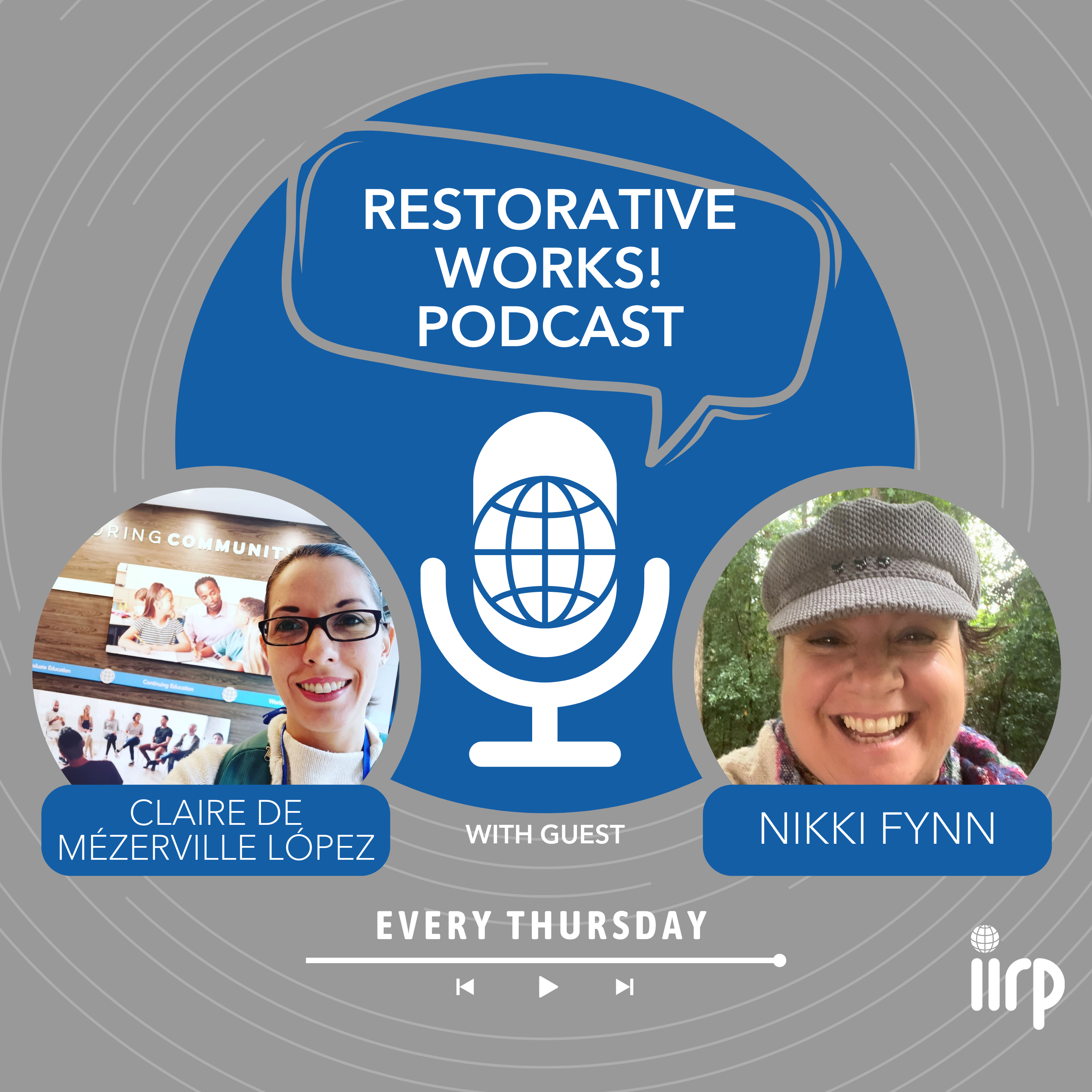
Claire de Mézerville López welcomes Nikki Fynn, Ed.D., to the Restorative Works! Podcast.
We are joined by Dr. Nikki Fynn, a restorative education and leadership consultant whose journey through guilt, grief, and shame has reshaped her approach to healing, leadership, and human-centered systems. She shares with us a pivotal moment from 2018, when a mentor's story about a monkey trapped by its own grip opened a new path for self-examination. That metaphor sparked a deep exploration into the "pulp" she was holding, false beliefs about worthiness, over-functioning, hyper-independence, and the emotional labor she thought she owed the world. Her narrative invites us to reflect on the stories that keep us stuck and to imagine what becomes possible when we finally let go.
She explains how expressive arts, attunement, and holding space became essential tools in her healing and now shape her consulting work with nonprofits, leaders, and communities. Dr. Fynn reminds us that transformation doesn't happen through correction, but through connection, presence, and being truly seen.
With 20 years of trauma-informed education experience, Dr. Fynn taught inclusion to pre-service teachers, supported neurodiverse students through transitions, and secured funding for education and enrichment programs that serve youth of all ages. Equipped with a doctorate in education leadership, a certification in expressive arts, and a master's in public health, she hosts "Words of Heart" sessions for adults to help them with relational issues that influence their professional success. Dr. Fynn's personal restorative work has shaped her leadership approach as a compassionate disruptor in dysfunctional systems. She applies her expertise to grant writing, capacity building, and burnout prevention in nonprofit organizations.
Tune in to hear Dr. Fynn's message: when we reclaim our nervous systems, embrace our differences, and examine our patterns with compassion, we build healthier teams, stronger communities, and more humane organizations.
- View "Words of Heart" sessions: https://restorativeducation.carrd.co/
- View art from restorative sessions: https://www.redbubble.com/people/GrowthUP/shop?asc=u
- Linktree: https://linktr.ee/GrowthUpEducation
- Email
This email address is being protected from spambots. You need JavaScript enabled to view it. - LinkedIn @ Nicole Penelope Fynn
Transcription
Claire de Mezerville López
Hello everybody and welcome to Restorative Works. This is a podcast to share stories on how the implementation of restorative practices is making a difference in communities and places of work. My name is Claire de Mezerville Lopez, and I am honored to welcome today Dr. Nikki Finn. Dr. Nikki, how are you today? It's so great to have you here.
Dr. Nikki Fynn
I'm great, thanks for having me.
Claire De Mezerville López
I am really looking forward to this conversation, but before getting started, I'm going to share your experience with our audience. Dr. Nikki Fynn is a restorative education and leadership consultant who applies her expertise to grant writing, capacity building, and burnout prevention in nonprofit organizations. With 20 years of trauma-informed education experience, Dr. Fynn taught inclusion to pre-service teachers, supported neurodiverse students through transition, and secured funding for education and enrichment programs that serve youth of all ages. Equipped with a doctorate in education leadership, a certification in expressive arts, and a master's in public health, she hosts words of heart sessions for adults to help them with relational issues that influence their professional success. Dr. Fynn's personal restorative work has shaped her leadership approach as a compassionate disruptor in these functional systems. And I am crazy about saying it like that: a compassionate disruptor in these functional systems! That's amazing, Dr. Fynn. It's such an honor to have you on the podcast. So let me start with a first question. Please tell us tell us your story, the story of how you have transformed guilt, grief and shame into pathways for healing.
Dr. Nikki Fynn
Great, well, I can pretty much narrow it down to a moment in 2018. I was in a meeting room sitting with a new sponsor, not sponsor, but mentor, excuse me. And I wasn't sure what I was in for. I just knew I needed some help. I needed something different. Patterns in my life just kept repeating. It just seemed like life was having its way with me. So, I didn't know where to go from there. So, we got to know each other a little bit. And after some conversation, she shared a story with me. And essentially, it's about monkeys who researchers would try to trap and study. And so, the researchers would hollow out gourds in Africa, or just leave the sweet pulp inside of the gourds and leave it for the monkeys.
The monkeys would reach in, grab the pulp, but once they made that fist and grabbed that pulp, it was hard for them to pull their hand back out. So, the monkey wasn't really trapped by the gourd, but it was trapped by its own grip. Freedom required letting go. And immediately I saw myself. I was like, what is my pulp? What is this pulp that keeps not working for me that I need to let go of? You know, what is it that maybe I'm controlling that I don't need to control? And so really, the first realization I had was I was holding on to a bunch of lies, lies I'd been conditioned to believe in my life, lies like my worth was earned through performance, over-functioning meant that I deserve love, and it was the only way to obtain love. And that hyper independence was a strength instead of just survival. That carrying other people's guilt, shame, or emotional labor meant that I was good and that's what I was supposed to do. It kept the peace. And if I did enough or did more than enough, then people would finally see me. And other people basically were in charge of my worth. So those are all lies.
Dr. Nikki Fynn
Now, those beliefs dictated everything unconsciously, unknowingly. We only know what we know and we don't know what we don't know. So, it showed up in patterns at work, how I interacted with supervisors, how I parented, how I advocated, essentially how I breathed. My breath was just real fast and pulsating and short. And I had to learn to enjoy a little bit more peace and hope. Whole joy longer. That was the work. And so, like the monkey, I realized I was in parcel the architect of my own trap. I didn't even know it. The pain of changing seemed like nothing compared to the pain of staying the same. So, I went for it. I said yes to growth and this mentor helped me grow. And for about a year, we met steadily and as I began realizing those false beliefs and shedding what I call old skin, old behaviors, I started to reclaim my nervous system. My confidence grew, my agency was restored, anger surface, grief surface. I didn't even know I had those things because I learned that we just operated on mad, sad, and glad emotions, but no one really talked to me about the grief, the childhood I didn't have, the true self I never really got to be yet. I grieved the betrayals and changes I hadn't fully processed. So much transition happened in my life and that just meant I had lost. I had lost and changed. And so, there's grief in that. And because I couldn't find the words, I started to draw. And with that, it helped me digest some of the shame, some of the guilt, even false guilt that I had from others. And I reached an emotional truth that it was okay to be myself. It was okay to embrace my difference. And it became clear the very patterns that kept me stuck kept other people stuck too. Now the youth that I worked with, the leaders that I worked with, the nonprofits that I served in,
Dr. Nikki Fynn
all showed me the same thing. We all have a part to play in our own problems or challenges, but also the empowering part is we have a role to play in our solution. So I've worked with nonprofits for over 20 years, and I've seen it again and again. So many people like me were, you just need to unclench their fist, right? The fist of that pulp that keeps you just hanging on and doing the same thing over and over again, maybe without realizing it, maybe thinking that change is too scary. So, I've seen people hold on to outdated practices, punitive cycles, survival-driven leadership, and systems that really are built on compliance rather than connection.
Claire de Mezerville López
I love that and I can relate with the idea of overworking as a way of coping also when you feel so surrounded by suffering or grief. And I can absolutely see how this experience that you mentioned, and these insights, have to do with preventing burnout. You know, I think we live at a day and an age when we carry exhaustion as a badge, as if we should be proud of being exhausted all the time. And you've mentioned the importance of breaking free from over-functioning and under-being to find clarity, to prevent and relieve this burnout. Please tell us more about that.
Dr. Nikki Fynn
Sure, well really, we do also have a role to play in our burnout, right? Because over-functioning is how we contribute to our own burnout and we can stand in our own way because it's really entrenched in our language. It's our survival language, almost. So, people would tell me when I was growing up, when I asked for help, you can figure it out. You're independent. I was the oldest of eight children. I have my doctorate. So, people just assumed that just because you have book smarts that you can figure everything else out. And that was not really true. So, I really had to show up for myself because other people didn't know how to. I was asking people around me for help that they could not give. So essentially, I was asking the wrong people and I didn't know that. So, I compensated, I anticipated needs, I was a fixer, was like, let me rush in and fix this, even without people asking for help. And so, this really has taught me how to undo that language and how to help people find their own success, be on their own journey and how can I support them. So, I didn't know I was in survival mode and I guess I had to realize that those problems or patterns had to dissolve on their own and they come in layers also. So sometimes a one and done restorative session with me isn't really a one and done. Like, we have to keep practicing this because these behaviors that we have, they can't be just unlearned in one session or one time. Like, we had to keep practicing them because they become our default response. And so, I had to remember that trying to prove my worth and being right, I didn't need to do that. I didn't need to bring more research and more facts to prove who I was at meetings. None of that mattered. I was merely focusing on the wrong things. And what I needed to focus on was me, what I can control, what was in my lane, in my hula hoop, and let the rest go. That was the pulp.
Claire de Mezerville López
I keep thinking about how hard it can be to let go and how important it is to connect with this self. Let's take a very short break and continue with this important conversation. Please stay tuned.
Claire de Mezerville López
Welcome back to Restorative Works. Dear Dr. Nikki, I really want to ask you more questions about how to let go, how to connect with yourself. When we were preparing the questions, you mentioned the importance of holding space with nonverbal communication. Can you please explain that to us?
Dr. Nikki Fynn
Sure. During my doctorate in education and leadership, that whole process and journey, I was really interested in expressive arts work, especially with what I knew drawing meant for me. And by no means… I don't really consider myself a professional artist or anything, but it was just the process of making and creating that really was holding space for me. And so I fell in love with Winnicott's work on holding space. And to me, it happened not only with art that I was making, but it also happens with intentional presence. And so that means being okay with the silence, listening to the words, or like what's beneath the words, what's not being said, tracking body language and accepting the messiness and humanness, right? So, like the tears would come in some of these sessions and it's okay, it's okay to release. I tell people crying is frozen feelings thawing because you've held it in for so long, they've got to find a way out to thaw. And so, letting people really discover themselves has been fantastic to witness because people get the aha moment just like I had with my mentor in the meeting with the monkeys. I was like, oh my gosh, this is what I've been doing. I can't even believe this is what I've been doing. Surely it was other things around me that were to blame. And so, I can see the pattern repeating. Like I wasn't alone. I wasn't the only one that fell prey to victimhood or life is happening to me instead of what can I do about this? You know, and so holding space was just really, it seems simple, but it's not easy and it comes with some skillset, right? So, I had to realize what did I need when I was younger? Or what do I need even now in a support system as an adult? And so, I had to not shame, I had to refrain from judging, and not doing the "shoulding." "Shoulding" is shaming. You tell people what they should do, and advice-give, people internalize that. Kids felt it, adults felt the work that I was doing, employees felt it, parents witnessed it with their kids when they came home and shared what was going on with them. And some people called me the kid whisperer; some called me their school mom. Really what they felt was though, it was attunement. I was just letting them be who they are and find themselves if they didn't know who they are. And I got to witness that. And so, it was just an incredible concept for me, the idea of holding space. But this is how humans transform. It's not through correcting. It's through connection, co-regulation, and being seen for all of who you are.
Claire de Mezerville López
That certainly is a compassionate disruption! On humanizing systems and environment, it is so important. As I was listening to you, I was reminded of the psychoanalyst, Catherine Malabou, that will say that wonder is the affect that best connects us to ourselves. Because on discovering something on the outside, you discover something on the inside.
Claire de Mezerville López
I really like to draw myself. You know, maybe we can exchange drawings and talk one day. Tell me more about this work on restoring ourselves, this work of healing processes. What is your hope on how this work will continue to develop in the future? What is a desirable future for this work?
Dr. Nikki Fynn
Well, I think what becomes possible when we repair our relationship with ourselves is we build our own self-intimacy. We examine patterns and thoughts. We develop space for humility. And we can rest inside ourselves. We don't have to over function, pick up the shame, overdo. We can choose a more accurate language about how we're feeling. It is not just about, I'm fine, but fine isn't on the feelings wheel. Like, it's nowhere on there. So, it's not really a feeling, it's a thought. And the internal piece creates more purposeful leadership and caring. It does humanize systems because humans are running the systems. So why aren't we investing more in the human-centeredness of the system? We can foster organizations where self-care isn't about spending money or about getting our nails done, but about cultivating emotional capacity and presence to show up fully, support others, and live more meaningfully, and not as fine what that means to others. Because what is meaningful for me might not be true for other people. You know, everybody's got to find what works for them. So... I think that by helping staff for legal is keeps them trapped or keeps that fist in the gourd. It's about building sustainable systems, sustainable people because sustainable people do build sustainable systems. It intersects with grant funding, funding capacity. And when people are sustainable, they are ready to keep growing, to transform. They're saying, yes, I subscribe to being my true self and liberating others to do the same thing.
Claire de Mezerville López
What you're putting on the table here is so extremely important. I heard about this research some years ago, maybe about 10 years ago, that it was about religious clergy and burnout. And it mentioned how when some of these priests were especially burned out, two things would happen. They would neglect their spiritual practices, and they would start overworking. But then, overworking would be more conflictive. So, I can see how we really need to follow these keys that you are presenting to us on saying over-functioning is not really caring in the best possible way for others if you're not caring for yourself.
Dr. Nikki Fynn
Right, it's the ultimate self-abandonment if you think about it because you're neglecting yourself, and you're learning that because of some maybe of the past emotional neglect in ways that other people have shown we just didn't have the language for.
Claire de Mezerville López
Especially if we're doing work of strengthening communities. It's a work that is never going to end. It's a work that will continue to be there waiting for us to continue to do very important things, but how do we make it sustainable, as you just said.
Dr. Nikki Fynn
Right.
Claire de Mezerville López
Thank you so much, Dr. Finn, for being on the podcast. This has been such an important conversation. If you could offer us just one small nugget that you would like for people to take with them after listening to you, what would that be?
Dr. Nikki Fynn
I just think that it's important to be brave and daring in your own self-discovery because you won't know what you can find if you don't go looking for it.
Claire de Mezerville López
I suspect it is going to be a path of wonder. Dr. Fynn, thank you so much for being on the podcast today. And thank you all for tuning into Restorative Works. To learn more about our guests and the IIRP, log in to IIRP.edu. Let's continue to embrace our common humanity. Please take care of others, take care of yourself while continuing this work of strengthening relationships and community. Until our next episode.
Dr. Nikki Fynn
Thank you so much.