Key takeaways:
- Southern New Hampshire University chose restorative practices as an evidence-based framework for working better together as a mostly remote workforce supporting over 200,000 students worldwide, 183,000 of whom are online.
- Participatory multi-tiered implementation makes organization-wide restorative practices sustainable.
- Program fidelity is achievable when leadership is invested in restorative practices training, coaching, continuing education, and practical application.
One of the largest universities in the U.S., Southern New Hampshire University (SNHU), is invested in restorative practices as a framework that helps staff work better together. Since 2016, restorative practices has served as the guiding philosophy and approach for all of their equity, diversity, and inclusion work, resulting in the integration of human-centered and equity design principles in their programs and strategic planning. SNHU is dedicated to creating a culture in which human difference is valued and innovation is ongoing, and restorative practices offers an academic framework that supports this mission. The university employs 5,000+ staff who serve over 180,000 online students. In a largely online environment, how does a university of this size introduce, model, and train employees with fidelity? Through participatory engagement and an intentionally led program implementation from leadership who believe in restorative practices and the vision of their institution.
In an effort to move from dialogue to action as a large online higher education workplace, the university’s Office of Diversity and Inclusion launched a three-year program that provides restorative practices training, coaching, projects, and ambassadorship opportunities for all staff. Senior Vice President and Chief Diversity & Inclusion Officer, Jada Hebra, laid the groundwork for this initiative. A committed restorative practitioner, Jada sought to implement a training program that was designed to help staff learn more about restorative practices, gain restorative practices skills, and identify ways to incorporate and embed those skills into their work in an online environment with thousands of employees.
The program was created by Program Manager for the Office of Diversity and Inclusion, Jen M. Torres. Jen believes that “restorative practices is really the practice side of what diversity, equity, and inclusion work is to get to belonging.” Having experience in K-12 education and restorative practices, Jen built this program with an emphasis on the proactive methods of building relationships and trust amongst staff.
Participation in the program is entirely voluntary and begins with SNHU staff receiving a foundational introduction to the principles and methods of restorative practices by participating in the IIRP’s professional development event, Reimagining Campus Community with Restorative Practices. From there on, they meet with Jen for one-on-one coaching and begin ideating and building their own projects where they embed restorative practices skills for themselves, their teams, and others. These projects challenge staff to address how they are using what they've learned and implement it into their everyday work lives. Using what resonated most with them, they create projects ranging from facilitating check-ins and fishbowl activities to offering their colleagues short trainings on the foundations of restorative practices and more introspective work. The first cohort is made up of 24 participants with a diverse range of roles from across the university, including student-facing staff such as academic advisors, counselors, and admissions workers, as well as those in financial, human resources, and technology departments. In year two, participants can become restorative practices ambassadors to continue to share what they have learned with their coworkers and receive continuing education with the IIRP to build upon their foundational skills. To achieve fidelity, year three restorative practices ambassadors become mentors and coaches to the newest cohorts after having completed a co-created event through the IIRP. This model is self-sustaining and reinforces restorative practices through creative and practical application.
SNHU is doubling down on its mission and commitment to its staff and students with its investment in restorative practices. When leaders focus on fidelity and proactive skill-building, the needle moves in both expected and unexpected ways. As seen through the year-one staff projects, participants are shaping what restorative practices can look like through the lens of human resources, technology, student services, and more.
On the impact she has seen on the staff involved in the program, Jen states, “They found something that makes them feel like, ‘I can be a better human, and I can practice this at whatever capacity I’m able to.’ It’s been really beautiful to watch people be inspired, to be hopeful, to want to engage in civility and respect.”
With three completed cohorts, the program is continuing to grow with the goal of establishing the next cohort in Fall 2026. In addition to the restorative practices cohort work at SNHU, the Office of Diversity and Inclusion also engages staff through seven different conversation rooms connected to various areas of equity, community, and belonging work across the university. One of these spaces is the Restoration Hour, a monthly conversation room where staff can learn more about restorative practices, build restorative skills and insights, engage in community-centered dialogue, and explore opportunities to join future restorative practices cohorts.
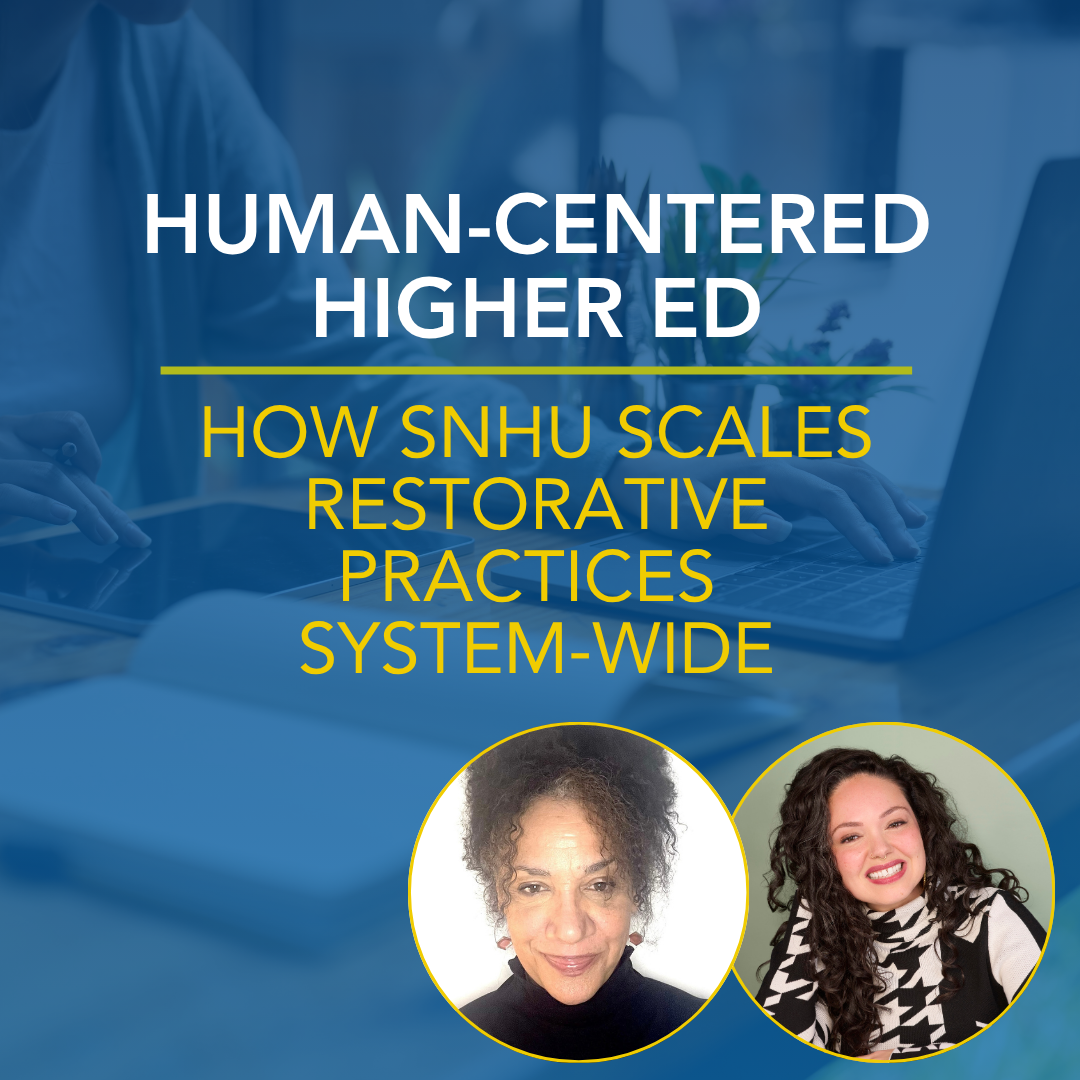
To hear more from Jen on the implementation of restorative practices in a widespread and multifaceted workplace, check out our podcast episode, Human-Centered Higher Ed: How SNHU Scales Restorative Practices System-Wide. To learn how you and your organization can tackle implementation through relational practices, join us at our professional development event, Implementing with Intention: Effecting Change Through a Relational Lens, or to learn more about collaborative application services, contact us today.