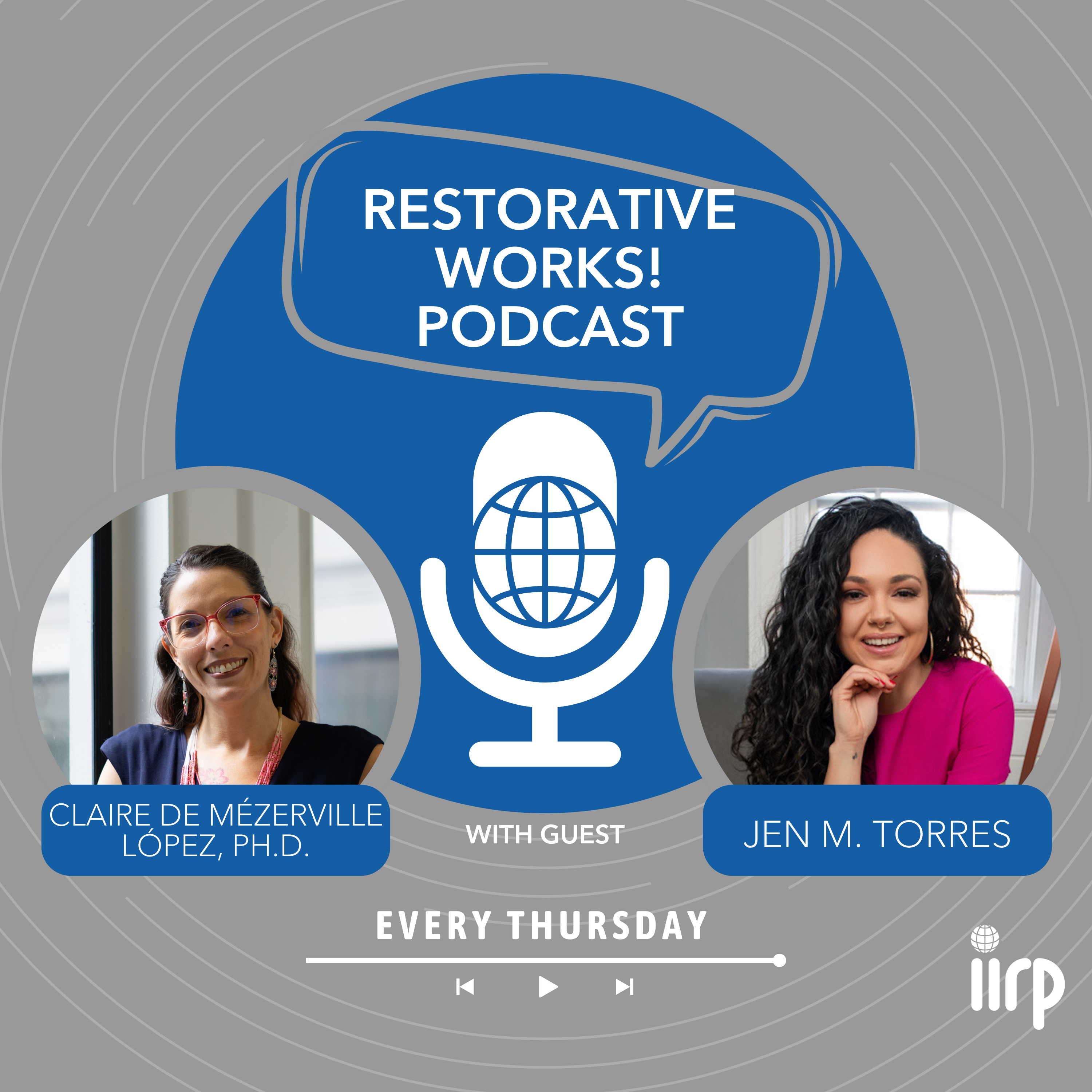
We are joined by Program Manager in the Office of Diversity and Inclusion at Southern New Hampshire University (SNHU) Jen Torres, to explore what sustainable, system-wide implementation of restorative practices in higher education really looks like.
Jen brings a practitioner's lens to a challenge many institutions face: how to move from reactive, discipline-focused approaches toward proactive, relationship-centered campus communities. She walks us through SNHU's three-year restorative practices implementation process that brings theory to life through real-life examples. From using AI tools to audit communication for relational language to tracking real-time shifts in restorative practices approaches with students, these stories demonstrate how innovation and human-centered practice can coexist and thrive.
On the topic of the use of AI, Jen reminds us that technology can enhance efficiency, but it cannot replace human connection. In an era of eroding trust, restorative practices become essential to rebuilding and maintaining strong relationships.
Jen M. Torres serves as program manager, social justice advocate, and liberatory learning designer for SNHU's Office of Diversity and Inclusion. With over 16 years of experience across education, nonprofit, and corporate sectors, Jen founded SimplyLead, LLC, and specializes in antiracist practice, conflict transformation, restorative practices, and liberatory approaches to leadership and culture repair. Her work centers on dismantling systemic inequities while helping teams and institutions move through conflict with honesty, accountability, and care. Known for blending deep relational practice with clear strategy, Jen designs and facilitates spaces that are brave, grounded, and action-oriented. Through workshops, leadership development, and collaborative learning experiences, she helps teams build cultures rooted in belonging, shared responsibility, and lasting change, where conflict is engaged as an opportunity for growth, learning, and collective transformation.
Tune in to discover what it takes to truly weave restorative practices into the fabric of higher education.
Transcription
Claire de Mezerville Lopez
Hello everybody and welcome to Restorative Works, a podcast where learning, practice and research open new paths for transformation. My name is Claire de Mezerville Lopez, and we have the honor to welcome Jen Torres as our guest! Hi Jen, welcome. How are you today?
Jen M Torres
Thank you so much for having me. I'm doing well. Thank you for asking. How are you doing?
Claire de Mezerville Lopez
I am doing great. I've been looking forward to this conversation and to learning from you. But before we do that, let me tell our audience a little bit about you. Jen Torres is a program manager in the Office of Diversity and Inclusion at Southern New Hampshire University. Jen has been working closely with the IIRP to bring in cohorts of the reimagining campus community with restorative practices online program to SNHU. Jen has a deep passion for restorative practices. With her background in curriculum design, she has developed a comprehensive three-phase implementation plan across SNHU that supports internal staff in embedding restorative practices into their work through training, project planning, and coaching mentorship. Jen's efforts are a fantastic example of how restorative practices can be integrated and scaled within higher education, and Jen, welcome to the podcast. I will just start with the first question: how has it been different to implement restorative practices in higher ed, in comparison to K-12? Because K-12 is a very specific environmental culture!
Jen M Torres
Yes, and I'll speak of course of my personal experiences in both and I'm sure there are differences across the world and our nation. I think for K-12, restorative practices are really often structured and it's really systems driven. So, it could show up through their policies, maybe even through discipline and classroom culture. And so, it really is embedded through that lens. Secondly, I often find that they really focus on the repair part of restorative practices and oftentimes miss the rest of what restorative practices does. And so that's my experience in K-12. When I moved into higher education, in that space, they focused more on individual learning and how do we invite folks, right, that buy-in to the work.
So it doesn't really live within their systems or their policies, but it's embedded in the work and in the culture that we do. And so, we often try to really focus on, when we talk about the 80-20 model that IIRP trains us on, in higher education, we're trying to focus more on the 80 % where we're building trust and relationships. And of course, right, when we have to, we go into the repair. But we try not to really focus and live in just the repair. So that 80-20 model, I feel like in higher ed, we're hopefully leaning towards the 80. And in K-12, the real focus has oftentimes been in the 20. And I think that's really where I see the difference between the two.
Claire de Mezerville Lopez
I think it's a significant difference because in higher ed, every student is kind of on their own. And you're trying to build that learning community. Allow me to share this example because this just happened last night. I teach at a higher ed and we have this WhatsApp group of teachers of the same cohort because it's a cohort that is going through the special ed career. And this teacher was very concerned because she says “this student continues to use headphones while I'm teaching class and I don't know what to do. It makes me really uncomfortable, and when I told her, you know, what's up with the headphones. She says, no, but I'm listening to you” and the conversation in the group was very much about what are the norms? Are there any rules? Am I going to get in trouble if I ask her to take them off? Like very adversarial. And I was just thinking, restorative practices could help in this situation, but how? We're working with adults.
Jen M Torres
Yeah, no, that's a great example. Even with working with adults, I think all of this work is crucial. And oftentimes when we're in training or I'm coaching folks, even they will be like, well, I've never tried this or I've never really practiced this skill. And these are people, you know, between the ages of 20 and 65. And so it doesn't matter how old you are if you've never really interacted with affective language or you haven't practiced those skills or you've not been participating in a circle, it's gonna feel new to everyone. And so, it's really about how do we introduce the work slowly and by creating that buy-in and really invite folks into that space. And we really want to understand that WITH instead of FOR. So how are we actively working with someone else, with others and building with others? That's really crucial in the work that we do at SNHU as well.
Claire de Mezerville Lopez
And especially as we mentioned before, we focus on the 80 on how, yes, you're going through these scores because you're going through your career and it's your own career, but also having a learning community that is beneficial for everyone.
Jen M Torres
Yeah, exactly, exactly.
Claire de Mezerville Lopez
But speaking of which, academic environments, they have very particular dynamics. I sent this question to you beforehand because I was wondering, beyond teaching, there's research, there's publishing, there are other elements that influence the way that relationships develop and create more individualistic environments. And Jen, what has been your experience with staff embedding restorative practices on their work, particularly through coaching, and mentorship.
Jen M Torres
Yeah, I think what's really fascinating, I'm gonna explain this really quickly, because I know we're short on time, but at SNHU, we've built out a three-year program with our restorative practices work. And so, in that first year, they're doing a lot of learning, and we start that with our two-day IIRP training, which is fantastic. You all have killed it, we love it. And so they come as a cohort. We use about 20, or we have 25 participants per cohort. And in year one, they go through the two-day training with you all, but then we lead them through coaching and mentoring for the entire six months after. And in that cohort, they get to build individual projects that really support their work within SNHU. We're focusing on staff within our cohorts. And then in year two, folks can become ambassadors and continue to lead in the work, get more training, learn a little bit more, and build their skills while still implementing restorative practices within their work. And then in year three, they get to become coaches and mentors to new people coming into the program. So that cyclical approach is really key to the work that we're doing at SNHU. But to go back to your question about coaching, I think what creates that really the impact of the work is in the coaching and mentoring because people feel like they can be more vulnerable in a one-in-one space. They feel like they can really practice how to be vulnerable, how to build trust in relationships, how to ask questions that maybe they wouldn't ask in a larger setting. And so that really starts building trust between myself, the coaches and the people doing the work. And so I think that that really creates a sense of safety, trust and a sense of empowerment to really continue growing in their work at SNHU. And so, they get to go through this three-year process if they want to continue to really build on those skills. And not only do they get to be coached, if they want, they get to train and become coaches to other people and really start embedding that work across what they do in their role, right, with other staff members. We have academic advisors who work with students who are student facing, and so they get to build their skills to work with students through a restorative lens. And so coaching has become really crucial to how they build and support their work moving forward.
Claire de Mezerville Lopez
What I find fascinating about what you're saying is creating that psychological safety in the work environment. And that is so necessary. I really hope that many higher ed communities can learn from this experience because there's a lot of mistrust in academic environments, especially if there's a lot of work instability, which we see a lot. I was looking at this post the other day that said, you know, higher ed teachers are asked to be mental health experts, but now we're also asked to be LLM experts, because of, you know, large language models and artificial intelligence... it’s hard. Working in higher ed is hard. It is very complex and creating that psychological safety seems very difficult too.
Jen M Torres
Yeah, it is very difficult. And I think what we have found is that through the work of restorative practices, it opens the door and the invitation to really start building that psychological safety through steps that feel safe and, you know, manageable. People feel like they can really come into the space at whatever level they're in and really grow their skills through that sense of safety. And so that's what I love about building out this sort of three-year cycle of work because every year they get to grow more and more in the work and feel more and more empowered and confident in building not only that psychological safety between their coach and you know me and them, right, one-on-one but also with other staff members across their team across their leadership, across the university so it really builds that safety within our community.
Claire De Mezerville Lopez
I love that. We're going to take a very short break and then we're going to continue this conversation with Jen Torres. Please stay tuned.
Claire De Mezerville Lopez
Welcome back to Restorative Works. Jen, it's so wonderful to have you here in the podcast. Please share with us some stories. We learn so much from stories of what people experienced in real day-to-day life. How restorative practices can be integrated in higher education project planning? What have been stories or anecdotes?
Jen M Torres
Yeah, so I love what people come up with when they join our cohort. Like I mentioned before, once you join a cohort, you take six months to build some kind of project that supports the work that you do already through a restorative lens. And so, what has been fascinating is to watch how differently people take the work. I had an academic advisor or a student, yes, academic advisor who took, we use Microsoft Teams, so we use Copilot. So they actually asked Copilot to scan all of the communication that they have sent out or have had with their students for the last six months. And they asked Copilot to sort of assess how much affective language or restorative approaches were used within those six months of work. And then they used that report to try to build more affective language, and restorative approaches to how they communicate with their students and then track how the students react and respond to those changes and shifts and how they're trying to build those new relationships. I just thought that was so fascinating. I don't think I would have ever thought, one, to use AI because, I'm an elder millennial and so I'm still like, okay, what do I do with AI? But I just thought it was fascinating that they were like, this is what I'm gonna do and it'll assess and it'll support and then I can build from there. So, I thought that was a fascinating approach to the work. I had another student, or sorry, another staff member who worked with students and really wanted to use the social, I might say the wrong name, the social discipline window. So, when we're looking at the WITH and the TO, so they wanted to approach whenever a student had maybe a challenge in front of them and they were having that one-on-one conversation, they wanted to assess how often they were either jumping to problem solving or fixing for them or really trying to stay within the WITH, like how am I actively supporting the student and working on whatever the challenge is together? And so they started assessing how often they lived in the WITH quadrant versus the other quadrants. And then, sort of practice staying within the WITH quadrant more often. And so that was the approach they took and they built an entire project around how often they were living in that quadrant as students were actively sharing their challenges, which I thought was just so fascinating. And then finally, I'll share that outside of these sort of projects that individual people are doing, we're also looking at the work through a strategic lens. So, when we're building or looking at strategic practice, best practices when we're redesigning performance rubrics, for example, across the university, we're actively looking and identifying ways where we can incorporate that restorative language as well, so that it starts to become more a part of our culture and the way that we sort of are at SNHU so that it lives within the work that we do. So not only are we trying to create impact with individuals, we're trying to create restorative impact across the entire university and sort of our ethos of what we do as a community. So it's just fascinating what you can do with restorative practices as you continue sort of learning and growing your own skills within the work.
Claire de Mezerville Lopez
I really like how you mentioned before the break how restorative practices open this window into something deeper because I'm thinking on higher ed. I keep remembering about bell hooks and how in Teaching Community she brings out what's the role of love in teaching? And when you're thinking about K to 12, you're thinking mostly about minors. But when you're thinking about working with adults, what's the role of love when teaching? We just had a teach-in at the department at the university that I work with, about AI, because again, that's the theme. We're all very concerned about AI and figuring it out. And one of the underlying themes was about trust, you know, the trust that we've lost in students and in their assignments and the trust that they have lost in us too. Because also students are saying teachers are using AI for doing their job and you lose that trust, you break that relationship and that relationship is so crucial for teaching, especially at a higher ed level.
Jen M Torres
Yeah, absolutely. And something that I share often is, you know, AI can support the scaling of things. It can support our learning. It can support our work in so many ways, but it cannot do the human work. And so how are we actively doing and continuing the human work within, right, what's happening across the world with technology and AI? How do we merge the two? How do we continue to build on the human work? For us, it's through a restorative lens, right? And continuing to double down on DEI and really thinking about psychological safety and belonging. And how are we actively supporting the work through AI because it is something that exists and will potentially be around for a long time. But how do we do both and continue to do that in a way that supports our learning and our human side?
Claire de Mezerville Lopez
Well, and I keep thinking because I live in a small country, that students graduate and then down the line you run into them and you start working with them. And now you are colleagues. And what a difference it makes if you had a strong relationship, a strong pedagogical relationship, and then you can build a strong colleague relationship. But like you mentioned before, we don't necessarily know how to do that.
Jen M Torres
Yeah, yeah, it's fascinating. It's fascinating work.
Claire De Mezerville Lopez
So I think that leads me to the question that I have for you before wrapping up our interview. Jen, what is something that you would like to see other higher ed communities in the United States or around the world try on their attempt to bring in restorative practices into their own educational cultures? And I understand that there are many different cultures in higher ed.
Jen M Torres
Yeah, my gosh. I always like to, I think, you know, in higher ed and in just education in general, we're moving so fast all the time. We're always trying to do something new, do something different, like support our students in different ways. And I really do feel like you can start small and start slow. It's okay to take your time in building psychological safety and building these skills, and really staying consistent and focus on real conversations on the human side of the work and really take that approach of really living in that 80 % versus in the, “my gosh, I have to turn off this fire”, this 20%. How are we actively looking at the work through the 80 % as often as possible as we build the skills together as a community and continue to build that buy-in? So move slow to move fast. I think that's always the best approach in the work. Even though we're often told to move really, really fast all the time in education.
Claire de Mezerville Lopez
Yeah, go fast, go fast, go fast. But it works going slower. You get farther.
Jen M Torres
Yeah, absolutely. Absolutely. Yeah.
Claire De Mezerville Lopez
Jen, wonderful. Thank you. I really appreciate you being on the podcast today. And I really hope that we continue to learn about how to bring restorative practices into higher ed environments. I appreciate you so much for being here today.
Jen M Torres
Yes, thank you all so much. The work that you all do is fabulous. It really has sort of created such impact at SNHU and I have had such, I mean, it's really been an honor to do this work at SNHU and to support them in building out restorative practices across the entire community and the ethos of what we do. And so, I know that Jada, our chief diversity officer is committed to this work. I'm committed to this work. Lisa, our president is committed to this work. So, it's just so nice to have a leadership team who really is supporting the work and having folks like you to support us in building those skills, because we could not have done the work without you. So, I just find it all so fascinating and fun. So I really appreciate having the time to share a little bit more about what we do with you and anyone else who wants to learn, right? Like, come on over. I'm going to promote you all, IIRP. Listen to them. Take trainings with them, and sort of reach out. I think it's been fabulous. It's just all been really fun to be a part of, so thank you.
Claire De Mezerville Lopez
And these experiences, the ones that you guys are creating absolutely need to be promoted as well. So, it brings me so much hope to listen to you. Thank you so much. And thank you all for tuning into Restorative Works. To learn more about our guests, log onto iirp.edu and let's continue to build transformation through dignifying relationships, kind conversations and stronger communities. Until our next episode.