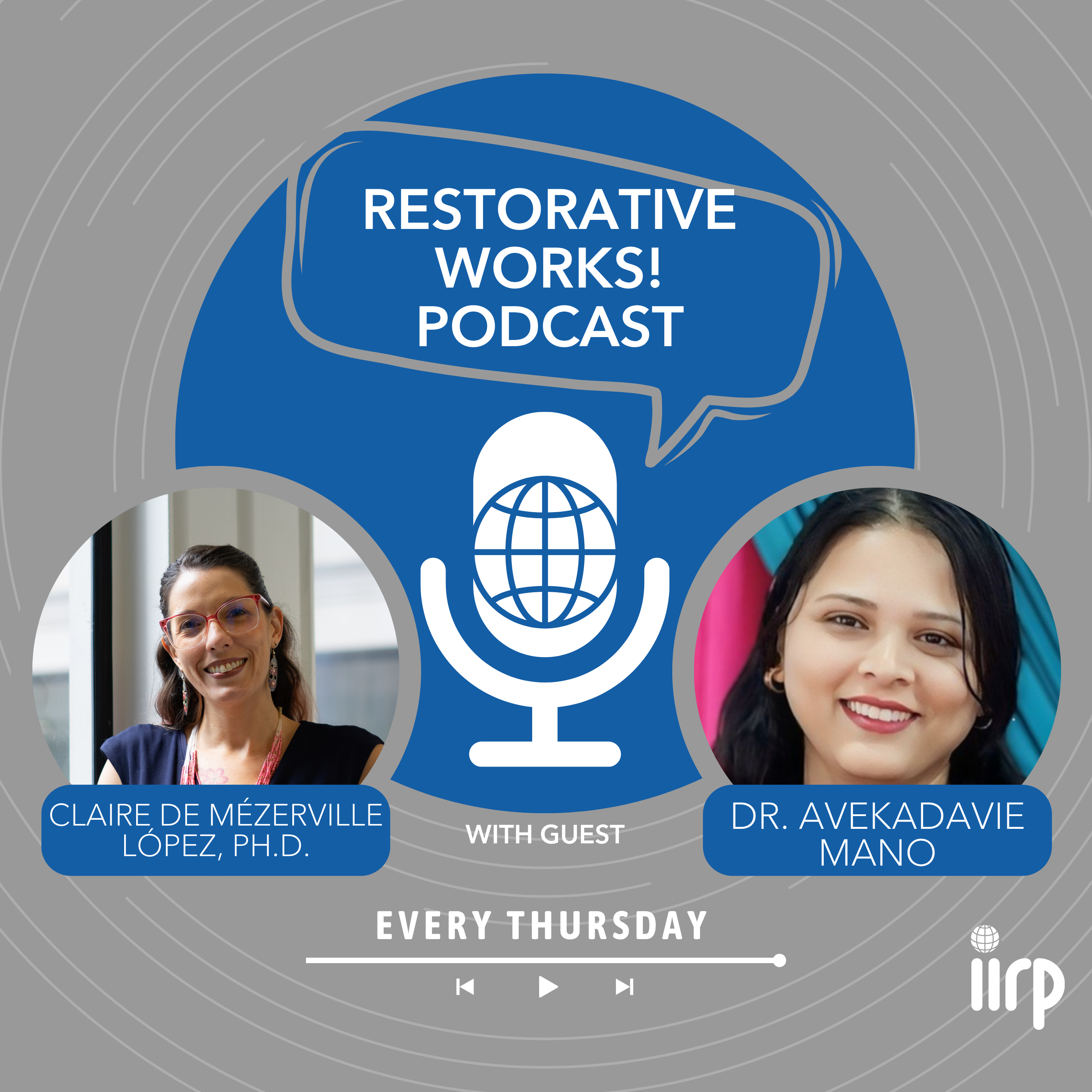
We are joined by criminologist, researcher, and educator at the University of Belize, Dr. Aveka Mano, to hear about the impact of restorative practices on the lived realities behind complex issues like gang involvement, human trafficking, and youth reintegration, and its connection to higher education.
Dr. Mano challenges traditional approaches to justice by emphasizing long-term reintegration over short-term punishment. She highlights how stigma, lack of opportunity, and systemic gaps often push individuals back into cycles of harm, and how restorative practices can interrupt that pattern. She asks us to consider what it would be like if we prepared individuals leaving institutional systems with the same intentionality we bring to higher education.
Dr. Avekadavie Parasramsingh Mano is an assistant professor and distinguished researcher at the University of Belize within the Faculty of Management and Social Sciences. Trained at the University of the West Indies, she specializes in Criminology and Criminal Justice, with a focus on Belize's socio-legal landscape. Dr. Mano is widely recognized for her fieldwork on gang culture, human trafficking, and sex worker migration. Her scholarship engages with complex issues at the intersection of crime, human rights, and social inequality. Beyond academia, Dr. Mano collaborates with the Forensics Department, the Leadership Intervention Unit, and other organizations working with at-risk youth. Her work is grounded in a commitment to bridging theory and practice to advance sustainable approaches to crime prevention and community development in Belize.
Tune in to discover Dr. Mano's roadmap for sustainable crime prevention rooted in early intervention, community collaboration, and restorative practices.
Transcription
Claire de Mezerville Lopez
Hello everybody, and welcome to Restorative Works! A podcast where learning, practice and research open new paths for transformation. My name is Claire de Mezerville López and we have the honor to welcome today Dr. Aveka Mano as our guest. Avie, welcome how are you today?
Avekadavie Parasramsingh Mano
Thank you so much for having me. I'm doing pretty good.
Claire de Mezerville Lopez
I've been looking forward to interviewing you and learning from you, but before getting started, allow me to introduce you to our audience. Dr. Aveka Mano is an assistant professor and distinguished researcher at the University of Belize within the faculty of Management and Social Sciences. Trained at the University of the West Indies, she specializes in criminology and criminal justice with a focus on Belize's social legal landscape. Dr. Mano is widely recognized for her field work on gang culture, human trafficking, and sex worker migration. Her recent research, A Southside Story, examines the lived realities of gang involvement and the challenges of reintegration in Belize City. More broadly, her scholarship engages with complex issues at the intersection of crime, human rights, and social inequality. Beyond academia, Dr. Mano collaborates with the forensics department, the leadership and other organizations working with at-risk youth. Her work is grounded in a commitment to bridge in theory and practice to advance sustainable approaches to crime prevention and community development in Belize.
And I had the honor to meet you and to learn from you at a working group on restorative justice and you have such great experience in higher ed. So, Avie, it is such a pleasure to have you as part of the podcast. Let's start with this. Would you please help us to understand the work that you're currently doing at the University of Belize?
Avekadavie Parasramsingh Mano
Okay. Sure, Claire, no problem. Again, it's wonderful to be here. Thank you so much for having me. In terms of my work, I teach within the Criminal Justice and Criminology program here at UB. A lot of what I do is grounded in qualitative research, really trying to understand people's lived experiences. My work has largely focused, as you mentioned, on areas like gangs, human trafficking, sex work, and human rights. But what ties all of this together is an interest in the human side of these issues. Not just the statistics or the theories per se, but how people actually experience these systems and environments. One piece of research that really stands out for me was an in-depth phenomenological study I conducted on the life of a former gang member. I looked at his experiences largely through a mental health lens, trying to understand how he made sense of his life over time and what really stayed with me wasn't just what he had been through. Yes, that was significant but also how he talked about himself. There was a lot of reflection there. He didn't see himself as inherently criminal but as someone shaped by his environment and his circumstances. But what was especially powerful was the role of restorative justice and what that played in his transformation. It wasn't just about punishment. It wasn't even just leaving that lifestyle. It was about being given the space to reflect, to take accountability in a meaningful manner, and then to reconnect with a sense of self that wasn't defined by harm or wider society.
Avekadavie Parasramsingh Mano
Alongside that, I also run an annual Criminal Justice Symposium here at the university. We're only in our second year, but it's something that I'm really proud of. We bring together people from the prison system, youth facilities, community policing, grassroots organizations and, importantly, our students. They don't just attend, they present their own research as well, and everything is centered around restorative justice. So, it becomes this really dynamic space where we have lived experiences, policy and then academic work all coming together, and what I've come to appreciate is that those conversations are incredibly powerful because they start to bridge these gaps that don't usually then get bridged.
Claire de Mezerville Lopez
I find it so inspiring because this is an old conversation about qualitative and quantitative and mixed-methods research. We know that, but still just trying to go deeper into a particular unrepeatable lived experience and just bringing the human dignity of that and how that permeates not only research, but the whole learning process through higher ed. And that's where I see the value. I was going to ask you about the symposium, but you went ahead of me a little bit on that. How rich is it for students to be exposed not only to doing research and learning theory, but to learn from other people from different places that come and share what they're doing and what they've seen, especially on such complex issues like these, what is the feedback that you've received from your students on this experience with the symposiums?
Avekadavie Parasramsingh Mano
They are highly appreciative because a lot of them, you know, they just understand theory. They understand what they read in the literature, what we discuss in class. But then when they attend these kinds of events and they hear people who have lived that life or they hear from people who have to deal with certain issues on a daily basis, then the reality kind of hits them in a different way. They understand the severity of the issues. They understand more, I believe, the complexity of the issues and they can relate. Their writing increases, the level of writing is much better versus those individuals who don't have those experiences because I believe they relate on a more personal level as well.
Claire de Mezerville Lopez
And restorative practices is so associated with storytelling and creating space for storytelling. And I think in higher ed, we need so much of that. Avie, in your experience, what could be the role of restorative justice in processes of youth reintegration after incarceration? This is a theme that we have discussed before, and how these processes of reintegration and the work that you're doing in this field, impacts you as a teacher?
Avekadavie Parasramsingh Mano
Okay, well, in terms of restorative justice and youth integration, I really see that as something central, especially within the context of a country like Belize. What we often see is that young people leave institutionalization, I don't want to use the word incarceration in this sense, in a traditional way and then return to the exact same environments, the same labels, the same lack of opportunity. So even if something shifts while they're inside or apart from wider society, there's no real support for what happens afterwards. So that traditional system has not been working for us. Restorative justice now shifts that. It asks different questions, not just what laws were broken, but who was harmed, how to repair that harm in a meaningful way. And I do think it's important to say that. Belize has been taking some initiatives when it comes to restorative justice, especially when it comes to our young people. We're seeing more attention being given to alternatives. We're seeing more community-based approaches. We're seeing a growing recognition that punishment alone simply isn't working. It's not enough. But at the same time, we're still in a building phase. So, the intention is there. The conversations are happening, but there are still gaps. Gaps in terms of consistency, the availability of resources, long term reintegration support as well. And I've seen how important it is to create spaces, just as you mentioned earlier, where these conversations can happen.
Avekadavie Parasramsingh Mano
As a teacher, one moment that really stayed with me was during that symposium we had, the last one, when a student presented their research. Now the response afterwards, that level of positive feedback, the praise that we were given was just incredible because they did not, I think, realize just how much students were actively engaged in these kinds of debates. And it mattered because it wasn't just about the research itself. It was about being heard, being taken seriously, and for the students realizing that your voice has a place in these conversations. And as a teacher, that in itself had a big impact on me. I don't just teach theory. I try to push students to think about what this actually looks like here in Belize. What does accountability look like in our communities? What would real reintegration require, not just based on what you read in the textbook? And then it becomes this shared space because my students challenge me as well.
Claire de Mezerville Lopez
That is so inspiring. And I was thinking as I was listening to you about how that connection with community is so important in your development, not only as a professional, but as a person. But if you allow me, let us touch back on that as soon as we come back for the break. Please stay tuned.
Claire de Mezerville Lopez
Welcome back to Restorative Works. It is my honor to interview today Dr. Aveka Mano and, dear Dr. Avie, as I was listening to you, I don't mean to make an unfair or insensitive comparison, but just please bear with me as I explore this. As you described the symposium, it just becomes so clear to me how during higher ed in your professional and personal development, that connection with the community, with lived experiences, with what's going on in society beyond closed-door classrooms is so important. But then... how we have a totally different mindset when it comes to preparing youth that are leaving, as you said, institutionalization because they are serving a sentence. We know that we prepare professionals for life in higher ed, but we're not necessarily preparing people for life when it comes to justice. So... What are your thoughts on that and how could we make a bridge regarding that need for awareness?
Avekadavie Parasramsingh Mano
When it comes to these individuals, let's go back to the ones who have been institutionalized in that sense, yes? A big factor, I believe, is stigmatization, when they return to society, they face a lot of stigmatization, face a lot of inconsistencies, they feel segregated within their own society. So, I do believe that yes, having these kinds of conversations is something that we need to do, because these things are not going to be fixed in the short term. We have to think way ahead, because we're trying to change societal perceptions now. So, if we were to change society, the best place for us to start is through education. These are the young people who are going to be in positions to make those decisions in a few short years. So, I strongly believe that the more we expose them to realities, the more we expose them to have conversations with these individuals who have come from this life and for them to realize that, just because they made some mistakes doesn't mean that's the end for them. There is potential. They just need to be helped in a particular way. And yes, that's what my position is as a researcher and as a teacher and as a member of the community.
Claire de Mezerville Lopez
And what I find inspiring about listening to you is that in social sciences, we would talk about this and we would talk also about how society failed, but then are we talking enough about how to imagine a society that does better in these kind of situations? Dr. Mano, your work seeks sustainability regarding crime prevention and community development. Would you share with us an example of what that could look like?
Avekadavie Parasramsingh Mano
Just to continue off where I left off, I still think that the key thing is moving beyond short-term reactive responses. And that is something that we tend to do. Yes, we want to pacify a situation rather than think in the long term. A lot of what we do is focused on responding to harm after it has occurred. But if we look at sustainability, it's about really creating systems that support people before they enter the system and then continuing to support them afterwards. So that includes early intervention that would include working with at-risk youth in society, supporting families, creating access to education, providing better opportunities for employment and essentially building trust between communities and institutions. And honestly, some of the most important shifts I've seen come from small but meaningful spaces. Even something like the symposium. That's comparably small, but it does create a space for people who don't usually sit together, having real conversations. We have practitioners, students, community voices. And then we see the shift starting and how we understand the problem. It becomes less about fixing individuals and more about understanding the conditions that shape their choices. And to me, that's where sustainable change really begins.
Claire de Mezerville Lopez
Wow, that's incredible. Dr. Avie, as we get close to wrapping up our conversation. I still would like to explore with you what would you like to see in the short term and in the middle term future of both restorative justice and then more preventive restorative practices? What do you imagine? What do you envision?
Avekadavie Parasramsingh Mano
Well, of course, I do believe strongly in the long term, but we cannot ignore the short term because it's happening around us. I'd really like to see restorative justice move beyond something we just talked about to something that is actually embedded in our practices. So that would mean having clearer policies. That would mean having more training, stronger collaborations between institutions as well, having collaborations with schools, courts, community organizations. But I also think it's really important that restorative justice is grounded in our context, in the Belizean context in my case. It cannot be something we adopt. It has to reflect Belizean realities, Belizean communities, and the specific challenges we face. Because when I think back, that individual I mentioned earlier on, when I was looking at his life and everything that he faced, what made the difference wasn't just punishment. It was the opportunity to reflect, to take accountability and to be seen differently. And that's really what restorative justice offers. It's not just accountability, but the possibility of repair. And that is something we need to take seriously if we're thinking about long-term change and taking the necessary steps in looking at how we get there. We have to make these changes in society.
Claire de Mezerville Lopez
Wow, and it takes a lot of collaboration from many different actors in society. And I think that's where the challenge is. But then going through it in education, I imagine your students can offer you very interesting questions, comments, and maybe some pushback when you go on these topics. Before closing the episode, I would just like to squeeze in a final question on that. What are some of your experiences with your students on going through this?
Avekadavie Parasramsingh Mano
A lot of them are police officers, as you can imagine. So, they like to talk about their experiences dealing with these young individuals in these specific communities. So, they would share how difficult it is to reach them and then we would have conversations on strategies that maybe they can adopt. There's training that they could attend. So, it's a conversation where it makes us think that what we learn in class, in that textbook or in those papers that we read, we can't just grab it and just apply it because in certain specifics it just won't work. So, we're realizing now that what we have to do and they're the ones who are pushing it forward. Yes, they are making those connections and they're seeing themselves that yes, we understand the theory and practice, but we have to understand how we have to adopt it to our local reality. And all in all, my students, you know, they keep me on my toes a lot, quite often. And I keep coming back to the point that if we are serious about crime prevention, we have to be just as serious about reintegration. Because how we respond after the harm is what shapes whether or not it continues. And that is something I try to push when it comes to looking at alternatives, the approaches and how we can adjust certain strategies and so on.
Claire de Mezerville Lopez
That is so important. And I love this education that is so connected to community. I find it so inspiring and absolutely necessary. Thank you so much, Avie, for being on the podcast today.
Avekadavie Parasramsingh Mano
Thank you so much for having me.
Claire de Mezerville Lopez
And thank you all for tuning into Restorative Works. To learn more about our guests, log onto iirp.edu and let's continue to build transformation through dignifying relationships, kind conversations, and stronger communities. Until our next episode.