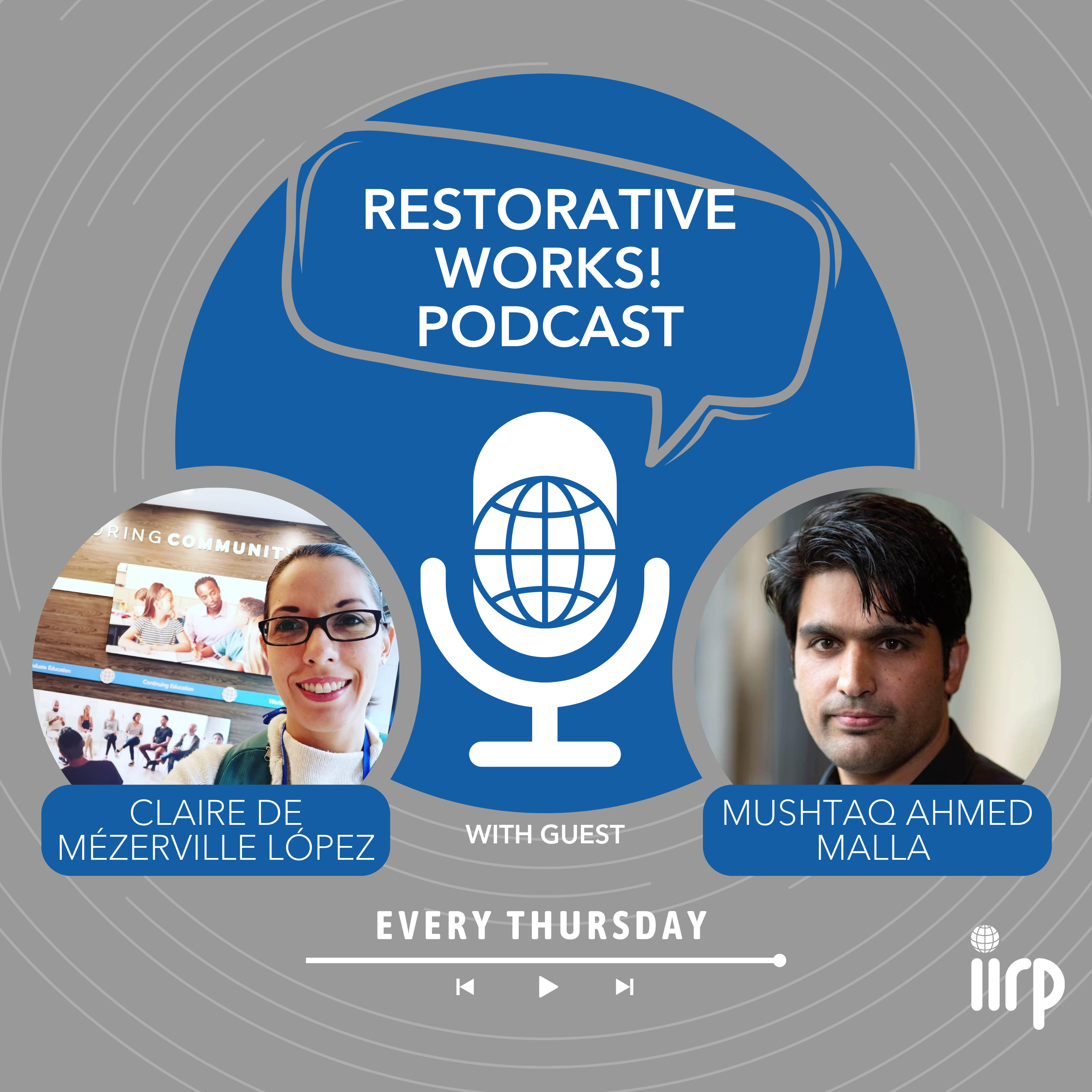
Claire de Mézerville López welcomes Mushtaq Ahmed Malla to the Restorative Works! Podcast.
Mushtaq joins us and shares his journey that weaves together youth education, mental health counseling, child rights advocacy, and an unwavering commitment to creating humane, relationship-centered systems of justice. He discusses how his Fulbright–Humphrey Fellowship at the University of Minnesota introduced him to restorative practices and connected him with a global network of practitioners. He explains how those insights sparked innovative programs inside his facilities in the Jammu and Kashmir Prisons Department in India, including Writing to Victims, a reflective writing initiative inspired by apology-letter models he observed in the United States. By turning this concept into a structured competition and a circle-based process, he invites incarcerated people to confront their choices, articulate their emotions, and begin the difficult work of self-understanding. The initiative has already led to powerful personal breakthroughs. Mushtaq plans to compile selected writings into a future publication.
Throughout the episode, Mushtaq reflects on what relationship-building means in a prison context, why indigenous cultural knowledge matters, and how restorative approaches can shape policing, schools, reentry, and even national criminal justice policy. His vision points to a future where restorative justice becomes a recognized and respected alternative that supports safety, accountability, and dignity across communities worldwide.
Mushtaq currently serves as the Superintendent in the Jammu and Kashmir Prisons Department, a role he has held for over 12 years. He is responsible for the administration and management of a prison as its head. As a leader in the prison system, he has focused on young offenders and their reformation, with special attention to their access to education. Before working in prisons, he worked in the field of child rights protection for 6 months with the National Commission for Protection of Child Rights, India, and in the field of mental health counselling and awareness with organizations Médecins Sans Frontiers/Doctors Without Borders (MSF) and Action Aid in Kashmir, India. He holds a bachelor's degree in science and a master's in social work (MSW) from Kashmir University.
Tune in, as this conversation shines a light on how restorative practices take root in some of the most challenging environments and how they open pathways to accountability, healing, and hope.
Email:
Transcription
Claire de Mezerville López
Hello and welcome to Restorative Works. This is a podcast to share stories on how the implementation of restorative practices is making a difference in communities and places of work. My name is Claire de Mezerville López, and I am honored to welcome today Mushtaq Ahmed Malla. Before getting started, let me introduce our guest to our audience. Mushtaq Ahmed Malla is currently working as superintendent jail with Jammu and Kashmir Prisons Department for more than twelve years. His role and responsibility include administration and management of the facility, and during his 12-year career in prisons, Mushtaq has dealt with many challenging situations with a focus on youth education. Prior to working in prisons, Mushtaq has also worked in the field of child rights protection for six months with the National Commission for Protection of Child Rights in India and in the field of mental health counseling and awareness with organizations Doctors Without Borders, and Action Aid in Kashmir, Mushtaq possesses a bachelor's in science and a master's in social work from Kashmir University. He was also a Fulbright-Hubert H. Humphrey Fellow 2021 at the University of Minnesota Humphrey School of Public Affairs in the United States. And it's so wonderful to have you on the podcast today. Welcome. How are you?
Mushtaq Ahmed Malla
Thank you, I'm good, and thank you for inviting me.
Claire De Mezerville López
Thank you so much for being on the podcast. Please, let's begin with this question. When did you hear or come to know about restorative practices, and what programs on restorative practices are you currently applying to in your work?
Mushtaq Ahmed Malla
To be honest, when I went for the Humphrey program, there was a component of identifying the course areas and I had taken one on public policy. Then I was quite seeing which course I would take. And then I came to know about the restorative practices. And that's how I was introduced to this thing. And then I studied restorative practices at University of Minnesota. I also got an opportunity to interact with many professionals and practitioners around the globe. And also do a of professional affiliations, including with the IIRP. And that's how I came to know about restorative practices. And then towards the end I was like seeing how I can implement these things in my current profession as well as outside. So, I began with an initiative called Writing to Victims, which is based on something I observed in Minnesota prisons called apology letters, where inmates write apologies to the victims of their crime. But since in our setting, it's not recognized yet, so I did something different. I called inmates who were accused of serious crimes to write these letters in the form of a writing competition which included having rewards for them also and to encourage them and then first following a competition structure and then following a circle structure. So, I did it at one of the presentations and we very happy to see some good writings coming up, though many inmates were not open to accept their wrong doings but somewhere but it was also good to introspect into their lives and into their feelings and I could also observe some inmates getting overwhelmed by writing, so I was, like, now this is making an impact. So, I'm continuing with it at the current prison also. And then there's also program like some of the selective writings will be compiled into a book in the future. So that is the program. And then also do sometimes a circle process with my staff and inmates to kind of keep the prison environment conducive, which helps in reducing the incidence of violence or dealing with the incidence of indiscipline and some other things, and also addressing the grievance of issues of the prison, you know, when we make joint committees. And then I'm also working on a restorative justice conferencing model for offenders who are incarcerated in violent crimes, for which I have also gotten connection with some other professionals of the field, including India as well as one from the Harvard University. So, we are jointly writing it, currently. Everybody is giving input, and I'm also collecting some stories from the field which are required. And then it's a program that we will develop it, and we will submit it to the people in the hierarchy of prison and criminal justice system or maybe in the judiciary to consider it if this can be implemented in our prison system.
Another thing that I have in mind is based on the arts, restorative arts, because through the Harvard program, we also get sometimes the opportunity to get funding from projects, you know, to implement in other areas. I recently got one project I put on capacity building on leadership. So, my second plan is like, because I also have an interest in poetry and arts, so the idea is to bring poets and artists together for expression, healing and community building. And that's my second plan. That poetry will also be uploaded on the YouTube channel, also for content creation, giving these people a platform, and also kind of healing as well as community building.
Claire de Mezerville López
What amazes me about everything that you're doing is that there are so many layers to the different restorative works that can be done in a community, like the one that you're working on. I can see how the arts relate to that writing of letters that, I can only imagine, how it builds awareness in the person about their own story and their own process for accountability. But I can also see how having circles among the staff is so important to cope and to have a connection among a community that is dealing with difficult situations. What has been your experience in building relationships with the people around you as you lead these projects?
Mushtaq Ahmed Malla
I think relationship building has always been a wonderful experience because previously I have worked in the field of mental health also. In mental health also when you do counseling you need to build a relationship with your client. And with restorative practices it takes it more further with vital applications and it believes in building relationships, relationships, positive relationships and helping people to bring their perspectives, bring their stories in front so that they get an environment where they are understood, they are listened, they are encouraged and they're also... I'm glad to listen to others, listen to their perspectives, which helps in mutual understanding as well as developing the relationship and community building, as well as coming together.
Claire de Mezerville López
Before going into our break, I would like to ask you, what is something that you would like for people who do this kind of work in other countries or in different settings… What would you like for people to understand about this kind of work that you do?
Mushtaq Ahmed Malla
I think one thing is that the restorative practice has also been part of the indigenous cultures in every society. There's a part of restorative practices, then as a developing field, think they can have... They look at both the things, the knowledge as well as the indigenous culture, and then try to link them up, how they can use these practices, having the adequate knowledge but at the same time taking the culture as the indigenous nature of a place into consideration. And secondly, I think that, since this practice has wider applications, it can be applied in any settings from schools to presence to community as well as in the situations where there is violence, extremism. It's a great field to explore for the issues and the problems we have in the contemporary world. And I think people around the world, wherever they are applying it, they can also connect with the people around the world in different settings and learn from them, from their experiences and come with some common programs or acceptable ways which can be applied everywhere.
Claire de Mezerville López
Thank you so much. We're going to take a short break, and then we're going to come back to this important conversation. Please stay tuned.
Claire de Mezerville López
Welcome back to Restorative Works. It is my honor to share this conversation with Mushtaq Ahmed Malla. And Mushtaq, you had the opportunity to travel around the world. I actually got to know you as you were doing an internship with the IIRP. How did that international experience contribute to your work experience and to your insights right now?
Mushtaq Ahmed Malla
I think what was great about it was like I got to know many people, particularly in the field of restorative practices, who are applying it in different settings or who are teaching it in different settings. Learning from them has been a great experience. Firstly, to know for the knowledge building as well as the practical applicability. And secondly, it has given me encouragement that these different people are applying it in different settings, even in difficult circumstances also, and I started doing it in my own settings so it's it is it's not something that that cannot be, that cannot be applied if you have confidence, you have knowledge and you have zeal to do it, these can be applied. And the third important thing is, like, whenever I need any feedback for anything which I intend to do, there are contacts around the world with whom you can take feedback or people who are there to help for any idea or any project or the further knowledge building on the subject.
Claire de Mezerville López
I would like to ask you two questions. I want to ask the first one, which is more focused on you, on your experience and your vision for the future for your own work, but then the other one about your vision for the future for restorative justice in general. So let me start first with these questions. What are your future projects and plans for using restorative practices?
Mushtaq Ahmed Malla
As I said, there are a couple of projects. One is the writing to victims, which I'm already doing. Then there's restorative justice conferencing model, where we are working on it. And thirdly, there's this restorative arts project, which we'll be doing in the future. Then I'm also thinking about doing some trainings with police, and usually on restorative policing. And then also maybe schools, restorative practices and some other places where I get the opportunity and time to tell people anywhere about this subject and these practices.
Secondly, if I talk specifically about our police, restorative justice is certainly a very new concept. It's not very much embedded in our criminal law yet. But there are certain little pockets within our criminal law that use restorative justice in full or partial form. But I'm happy to see that there are many professionals in this part of the world who have degrees in restorative practices or who are applying it in different settings. And I see the future in the justice arena belongs to restorative justice. It will pick up slowly but positively in the coming times. I'm sure in the whole part of the world, the policy makers and practitioners will see restorative approach and restorative justice practices as better alternatives to our old criminal justice system.
Claire de Mezerville López
And I really think it's inspiring how you have this perspective that integrates self-awareness, circles with staff, a vision for a restorative conference, engaging arts, just how many layers can be considered for implementing a restorative way of approaching justice. So, Mushtaq, before wrapping up this episode, I wanted to ask you about your vision in general for this field. What is something you would like to see in the field of restorative justice, and what is your hope for the future?
Mushtaq Ahmed Malla
I think, first of all, we had to see there are two levels of it: one is the micro level and the second is the macro level. On the micro level, we had to see, like, what are the possibilities, you know, the different areas you see the work or where you can apply these practices. For example, I'll give you a recent example. I wrote a piece on restorative payroll recently. That's how we can bring it into the payroll. Similarly, there are many small areas in prison in other settings, like payroll, interview, or meeting with family members, meeting with inmates, meeting with staff. And then, as I said, there are also the policy level interventions, that is, recognizing the importance of restorative practices, specific restorative justice practices, and where we can bring them into the criminal law justice system and bring the policy changes. Since the jurisdiction continued to evolve, we have seen recently that criminal laws in India have also changed. We had new criminal laws. There has been progress on the involvement of victims, not to a large extent. Still, it means that the idea of restorative practices is finding its way also in the policies as well as the laws now. And I'm happy to have seen in the US and also other places that these practices have been applied in vital settings, prisons, in the form of place of extremism and violence, as well as many settings. And people are trying to kind of implement it and propagate as the advocate for these practices. And I'm sure, with so many professionals working in this field, it's going to grow day by day and give world a better way of dealing many, many challenges. And I've also seen that there's also on the programs, or restorative programs for prisons, already published by UNODC, I guess. There's a lot of work going on. I think what is important is that we need more professionals who are trained in this field, and we need also to tell others, tell students that this is also a field where they can explore their careers, which can give it a boost, so that when we have more professionals trained in the field and then we can see a path for its implementation.
Claire de Mezerville López
It is certainly a marathon and not a sprint, a work that needs to continue and that we build strength for. Mushtaq, thank you so much for being on the podcast and sharing your experience.
Mushtaq Ahmed Malla
Thank you so much, and thank you for inviting me. It's really pleasure being here.
Claire De Mezerville López
And thank you all for tuning into Restorative Works. To learn more about our guests and the IIRP, log in to iirp.edu. And let's continue to embrace our common humanity, take care of others, take care of yourself, and continue this work of strengthening relationships and community. Until our next episode.