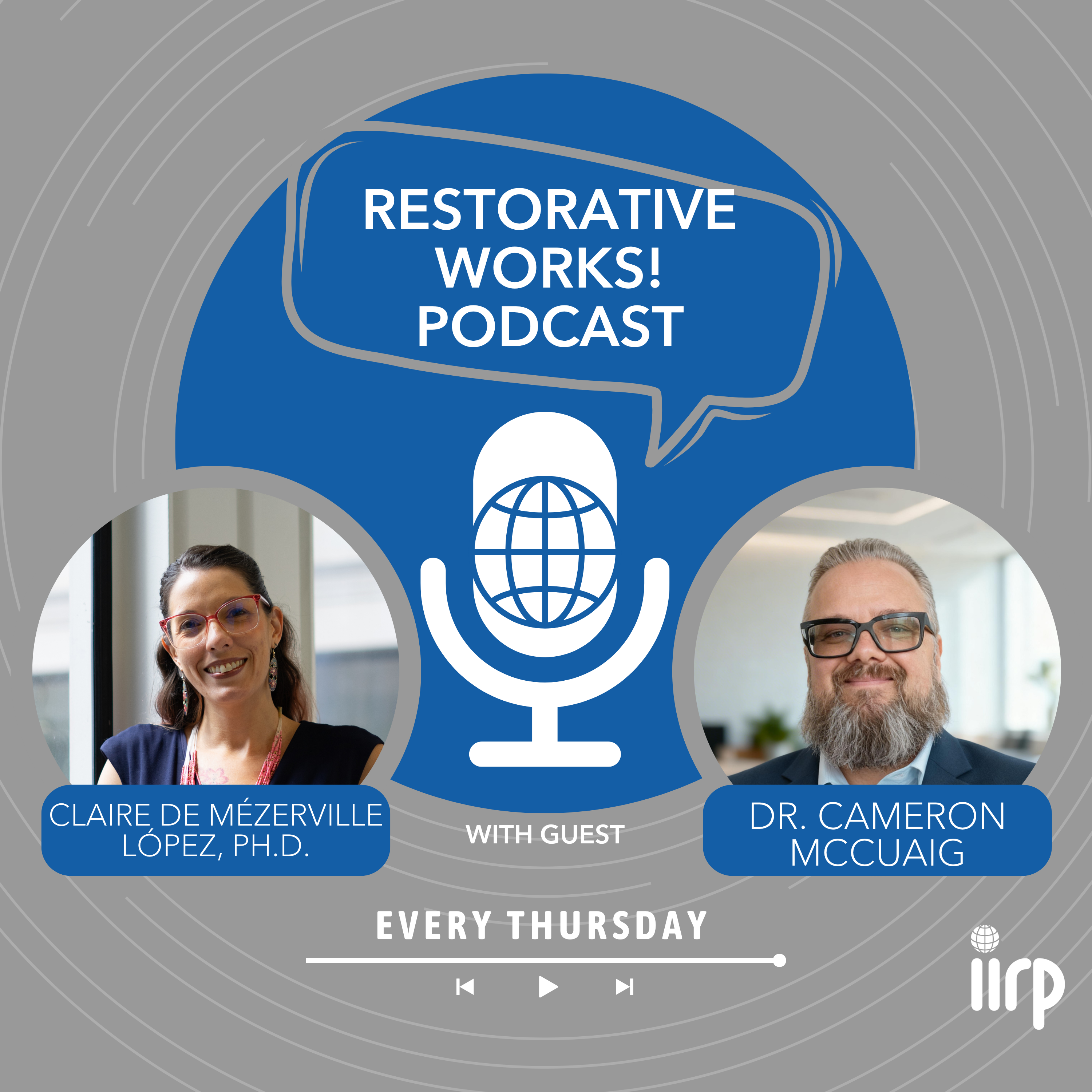
In this episode of Restorative Works!, host Claire de Mezerville Lopez is joined by educator and researcher Dr. Cameron McCuaig to explore what it truly means to center student voice and reimagine schools as spaces of service, dignity, and community.
Cam challenges traditional models of education by contrasting compliance-driven systems with a more relational, student-centered approach. Using real classroom experiences, he invites listeners to reconsider the role of educators: not as directors of learning, but as guides who walk alongside students, helping them navigate barriers and pursue meaningful engagement.
Through powerful stories from his work with young children, Cam illustrates how even the youngest learners can understand complex ideas like rights, responsibility, and mutual care. At the heart of this episode is a compelling reminder: restorative practices are not simply reactive tools, but proactive, preventative ways of being that prioritize relationships and belonging.
Dr. Cameron McCuaig is a Canadian French Immersion principal, educator, speaker, and creator of the Web of Rights, a practical framework that helps schools move from compliance-driven discipline toward structured, rights-informed learning communities grounded in dignity, student voice, and shared responsibility. He holds a Doctor of Education from Northeastern University, where his research examined democratic school models in Ontario public elementary schools. With more than two decades of experience in schools and professional learning spaces, he supports educators and school communities through workshops, webinars, consultation, and practical implementation tools. Through Student Rights Education, he shares strategies for rethinking classroom management, conflict, and school culture with greater dignity, clarity, and accountability.
Follow him at @dr.cammccuaig and tune in to discover how centering rights, voice, and relationships can transform not only classrooms, but the future of education itself.
Transcription
Claire de Mezerville Lopez
Hello and welcome to Restorative Works!, a podcast where learning, practice and research open new paths for transformation. My name is Claire de Mezerville Lopez and it is an honor to introduce our guest, Dr. Cameron McCuaig. You told me that I can call you Cam. Cam, welcome. How are you today?
Dr. Cam McCuaig
I'm wonderful, thank you, how are you?
Claire de Mezerville Lopez
Good! Before getting started, allow me to introduce you to our audience. Dr. Cameron McCuaig is an educational leader and speaker focused on helping schools shift from compliance driven discipline systems to structured rights informed learning communities grounded in equity and student voice. His work refrains classroom management by positioning schools as institutions that exist to serve students rather than control them. Drawing on policy insight and practical school-based experience, Dr. McCuaig challenges traditional behavior systems that rely on compliance and punitive discipline. Instead, he supports educators in building environments that prioritize dignity, shared responsibility, and clearly define rights-based structures. Through workshops, webinars, and leadership consultation, Dr. McCuaig equips educators with actionable strategies to implement rights-informed practice in real classrooms and Cam, it is an honor to have you on the podcast. You talk about transforming the classroom environment to transition from compliance to community. Would you please tell us more about that?
Dr. Cam McCuaig
For sure. So, our traditional schools right now, compliance is rules that are basically put on students by the system, by the principal, by the classroom teacher. Sometimes it's a little bit secretive, and they make the students feel like they're involved. But when you walk into a classroom and you see that list of classroom rules, in every single classroom in every single district, the rules are pretty much identical because as adults, we have a perceived power imbalance where we can manipulate kids to agree with those rules, oblige with the rules that are being put on students. So that's where compliance comes from. So as educators, we're already kind of behind the wall when students are first coming to school because we're not inviting them to school. We're making them come. They're forced to come. They have to comply. And so they enter an environment where they quickly learn that if I comply, if I wear what the teacher wants me to wear, if I do what the teacher wants me to do, if I say what the system thinks I should say, if I solve this math problem the right way instead of some unique way, I'm going to be accepted. I'm going to get A's. Maybe I'll be able to be on the student council because all of the teachers like me, if I comply, and then I'm rewarded. And that works for a very few percentage of students. The rest of the students who don't want to comply, can't comply, recognize that complying to some of these things is nuts. They struggle with school and we're even getting to the point now and Ontario specifically, but I think everywhere where there's just absenteeism everywhere because kids down to like third grade are just saying, I don't want to go. And they're just not coming to school. So we need to build systems that move from compliance to community and restorative practices and restorative justice is huge in that because it's all about community and understanding each other. And that rule of, you know, putting your hand up ends up becoming something that's intrinsically motivated for the students to want to put their hand up, not because they're complying to the teacher, but because they understand that Susie's talking right now and they shouldn't interrupt her because they're friends with Susie. And they understand that Susie doesn't talk much and whoa, she's talking right now. So I should shut up and listen. So it might look exactly the same, but the system that you're developing doesn't happen on day one when you make that chart and say, hey kids, this is what you're going to do. It starts on day one and it works through K to 12, where you're building that, the capacity of children to understand their place in community. And that's the goal of school because we as adults obviously struggle to understand our impact and our capacity and community greatly as we see right now and some of the things going on.
Claire de Mezerville Lopez
And as I listened to you, I remember this story when I was teaching, these are university students that are going to become preschool teachers. And so one of them asked me, “well, these restorative questions, I don't know if they will work with children that are so small”. And the next week she came so happy and so proud to say the questions worked: “And you know, before I would have asked this child go apologize to this person, he, answered the restorative questions and said, I'm going to apologize to this person”. The behavior was the same, but it was different because it came from them, you know, instead of being an order. So I am very interested in what you're saying. And I can also see how if you're not an A student, you might become easily disengaged. How do you keep engaged those students that are not in that small percentage? You have mentioned, Cam, that you believe that schools have a mission of service. What are situations that you think may risk schools from losing that focus of serving and engaging? And what would help?
Dr. Cam McCuaig
Well, to kind of preface this concept of school being a service industry, I'll just use an analogy. Right now, our system is like a horse race. And the horses are the students and the jockeys are the teachers and the course is the system. And the jockeys are trying to get the horses to do whatever they can to go maybe as quick as they can or do whatever they need to do in horse races, follow the path and we all get to the same ending. And what a service industry would look like in teaching is the jockeys are still there, but they get off the horse and maybe they have an apple in their hand and they are with the horse and they're getting to know the horse. And if the horse wants to veer right, the horse veers right. And our job as educators is to make sure that if there is a barrier in the way that the horse can't see or a barrier that we know the horse can get over, that we help them out, help them understand that barrier. Maybe with coaxing them with an apple, maybe with understanding that this horse really doesn't like water, so let's find a bridge. It's the same in school. We need to get to know our students and teach what they want. And we often try to implement that in our classrooms and the schools I've worked in. Teachers all over, they want to do good. They definitely want to jump into the service model but it's really, really hard because they have this structured, rigid curriculum that they have to follow. So they have to figure out how to incorporate Pokemon into world history, right? And that's a big struggle. I think your question was more specific about a specific example. And in Ontario, it's standardized testing. I can speak specifically to that in Ontario. I know that there's standardized testing that affects education systems all over the states as well. In Ontario Elementary, there's EQAO standardized tests in grade three and grade six. And the teachers in those years, it's happening right now, like in the end of May, beginning of June, the teachers for grade three and grade six start freaking out by about January because they're not certain that they're going to have their kids ready for this test. That has no bearing on these students' marks, none. Parents are learning that it has no bearings. Parents just don't send their kids to school fairly frequently while this testing is going on. And the government is able to manipulate the way the tests are done from year to year. It's pretty clear and there's statistics that I have not right on the top of my head, but statistics that show that governments have manipulated testing so that the scores seem higher as they're going into election years.
Claire de Mezerville Lopez
Allow me to say in Costa Rica what happened last year is there has been a huge complicated crisis on standardized testing that I will not go into right now, but they realized that items on the test, had to go from third to sixth grade. All items were third grade curriculum so that the grades will be higher overall.
Dr. Cam McCuaig
Yeah. So that's the, I think that's the easiest example because we know that standardization of school, it does have a little bit of purpose, but we're using it for political gain and not serving students.
Claire de Mezerville Lopez
I can relate to that so much. And I can see how the risk is on losing that focus. Are we really serving students and getting them to learn and to thrive? Now, let me make a little bit of a shift before going into the break because I would like to ask you for an example. Will you share with us an example where two or more students' rights came into conflict and how our restorative or rights-informed approach helped move that situation forward?
Dr. Cam McCuaig
For sure. You spoke a little bit about that university college student wondering if those questions are gonna be above a primary or a young student. I was teaching kindergarten when I developed the web of rights and to frame the thinking of these students, I just asked them something very simple. These are four and five year olds. I asked them to leave the classroom, walk down the hall about 50 yards, 25 meters or so, or 30 meters or so, and touch the door at the end of the hall and come back. And there was classrooms down that hall with their doors open, teachers teaching. That was it. I gave them no more instructions. And my teaching partner and I watched as some kids ran as fast as they could. Other kids skipped. Some kids took the time to talk and get, you know, get some conversation in. One girl got knocked over by one of the speedsters and she was okay, but she got bumped. So when they came back to the carpet and we discussed what happened, the outcome was, well, they understood what a lineup was for. They knew that the loud people disrupted the rights to education from the classes that had their doors open. The fast people weren't that safe because they bumped over one of their classmates and they were all over the hall. So they understood that, you know, let's stay on the right. They understood the rules from a rights perspective instead of a compliance perspective. And so with that understanding, the best example that came from that class was there were three friends that loved to play together. It's outdoor exploration time and they're all really into wrestling. I think Moana had just come out and the rock was in it and they got into wrestling, whatever, whatever that connection was, they were really into wrestling and one of the kids was a lot bigger than the other two. And one of them was really, really worried about getting hurt. You know, a stick brushed his leg and he would cry and things. So they really wanted to play together. So we talked about the rights. Well, they want to wrestle. I don't get to tell them what they get to play or not. We just have to come up with, with agreements to allow the play to honor everyone's rights. And so the right to safety for the one kid meant that he decided to be the ref. And the other student who was still small had a right to safety because he didn't really want to get squished by his friend who was a lot bigger. So they talked about, we need to stop. The ref needs to call it when I'm hurt. Well, how do you know when you're hurt? Well, we need a safe word. So I suggested avocado because I always suggest avocado as a safe word. And so they would have some rough and tumble wrestling in the snow and their buddy would be listening for that avocado. And if you heard avocado, freeze, he'd yell and they'd stop. And so the right to play was honored, the right to safety was honored and the right to identity were honored all in this little community that we built because they understood what rights were and they understood that I couldn't say, no, you can't wrestle. My job with the apple and the horse is to say, hey, why don't we go this way a little bit so that we can get to where you want to be.
Claire de Mezerville Lopez
I love that. you imagine if all children went through this experience? love that. We're going to take a very short break and then we're going to continue this interesting conversation with Dr. Cameron McCuaig. Please stay tuned.
Claire de Mezerville Lopez
Welcome back. Cam, this is so interesting. When elevating student voices, doing this work of engagement, of working with them, how can restorative practices help and how can we ensure that we are creating inclusive and equitable spaces?
Dr. Cam McCuaig
I think when I built that web of rights that I just spoke about, my district hadn't jumped on the restorative rights bandwagon, despite the fact we're like 100 kilometers from Kitchener where the concept of restorative justice kind of began in the legal system. When I learned about restorative practices and restorative justice, you know, eight or nine years ago, it just made sense to me because it was basically that web of rights. I think that one of the things that systems, public systems are doing is they're not diving in deep enough. Our system suggests, you know, take the first three days of school to build community. And we know that that's not really what they mean. And as administrators, we really try to push, no, you build community all day, every day. That's the goal number one. And when restorative justice is implemented through a two or three hour training process to 300 administrators who then take that and do a half hour training process to their staff, what ends up is everyone gets the cards with questions and it ends up being only a reactive method. And that's not at all what it's supposed to be.
So I think the biggest piece to make restorative justice and all of the frameworks that can live inside of that, like the democratic school model and the web of rights, you need to understand that it's like 90 % front loading and preventative. And that's where the community is because we know, know, when, kids build snow forts and they build them together and they're included, they don't wreck it. But the one kid that was told not to, not to build, he's going to sneak out and wreck the snow for her. And if we don't build community for everyone to be a part of, then we're always going to have an outlier who might come in. And so our job as educators isn't to teach kids math our way. It's to build community so that we all understand that when Suzy's speaking that I'm going to wait and put my hand up. And we have a really strong understanding and trust that we understand each other. And I think you're going to ask me about an example, but I'll hold off on my example for now unless that's the next question.
Claire de Mezerville Lopez
Well, I think I will need an example, but I have a heavy one for you first. So let's see what we can do with this. Can we know that institutions, including schools, they are not neutral. They can reproduce inequitable outcomes, but we can be intentional in the work of creating just a humane educational spaces. And I know that's kind of a heavy load, but what would be a story or an example that brings you hope that we might actually find a right track to respond to this scenario.
Dr. Cam McCuaig
Sure. So as we talked about being proactive and preventative and front-loading restorative justice and practices so that you're building community. Once you have a community that really understands each other, beautiful things happen. When I was doing some research on the democratic school model and implementing that in public school system that has unionized workers and there was a classroom that really jived, think they'd been going, not I think, they'd been going to school together in a smaller school for a few years, so they knew each other. They weren't starting from scratch. They understood each other's idiosyncrasies, and so community came a little bit quicker in this classroom than some of the other classrooms I was studying. And they got to a point where they agreed they wanted a class pet, and the teacher really didn't, but she understood that in a democratic school model, she's one person out of 25 or so and so. Her job isn't to say no; her job is to say, “All right, let's get the information and see how I'm gonna vote, you guys vote.” As they were going through the process of figuring out what animal they wanted there was discussions about well everyone wanted a dog, but they knew that that was against the... I mean it wasn't great. It had to be an animal that was gonna be contained, caged or put in a tank or something. So they knew they couldn't have dogs and there were some funny conversations about “we should get a tiger”. And everyone was allowed to be themselves in these conversations. But as they whittled it down to an ocelot, a gerbil or a guinea pig, I can't remember, or a snake, someone said, well, we can't have a snake because, and I'll use a different name, because Claire is deathly scared of snakes. That had never come up in conversation. This other student just knew Claire. She knew this information from somewhere else and said, Claire is not going to say anything because she's a little bit timid and passive, but she's not going to come to school if there's a snake in the classroom. And instantly, every single person in the class was like, well, snake's off the list. Because they understood that even though I have a right to my identity and snake is my favorite thing, not at the expense of Claire's right to education in that situation. And so, when you build that strong community and you're proactive about restorative justice, you have those conversations and those kids make those decisions. Imagine how those restorative circles are going to be after this conflict. This was pre-conflict. If there's going to be conflict, those conversations are going to be so much more powerful. And like we kind of talked about before, we're internalizing it all. It's intrinsic. It's beautiful.
Claire de Mezerville Lopez
And I think it opens up this perspective of interdependence. I want to be engaged. I want to participate. But also, I am aware of what's going on with the other people around me. And I dignify that. I will say it again. Imagine if all children went through these experiences, how things would look like in 20 years.
Dr. Cam McCuaig
Yeah. Absolutely. I think that's a great goal. In the last school I was at, we really pushed these kind of ideas in the younger years because we knew that the grades seven and eights were...maybe they weren't going to have enough time. A year, eight months wasn't enough time to really build this foundation. So starting in kindergarten and having those kids in 10 years follow along this path, I can't imagine. We still did this in the grade seven and eights and it was beautiful, but it was a little bit superficial.
Claire de Mezerville Lopez
Cam, I've learned so much from you today. Thank you so much for being on the podcast.
Dr. Cam McCuaig
Thank you for inviting me, it was lovely.
Claire de Mezerville Lopez
And thank you all for tuning into Restorative Works. To learn more about our guests, log on to IIRP.edu. And let's continue to do this work, build transformation through dignifying relationships, kind conversations, and stronger communities. Until our next episode.