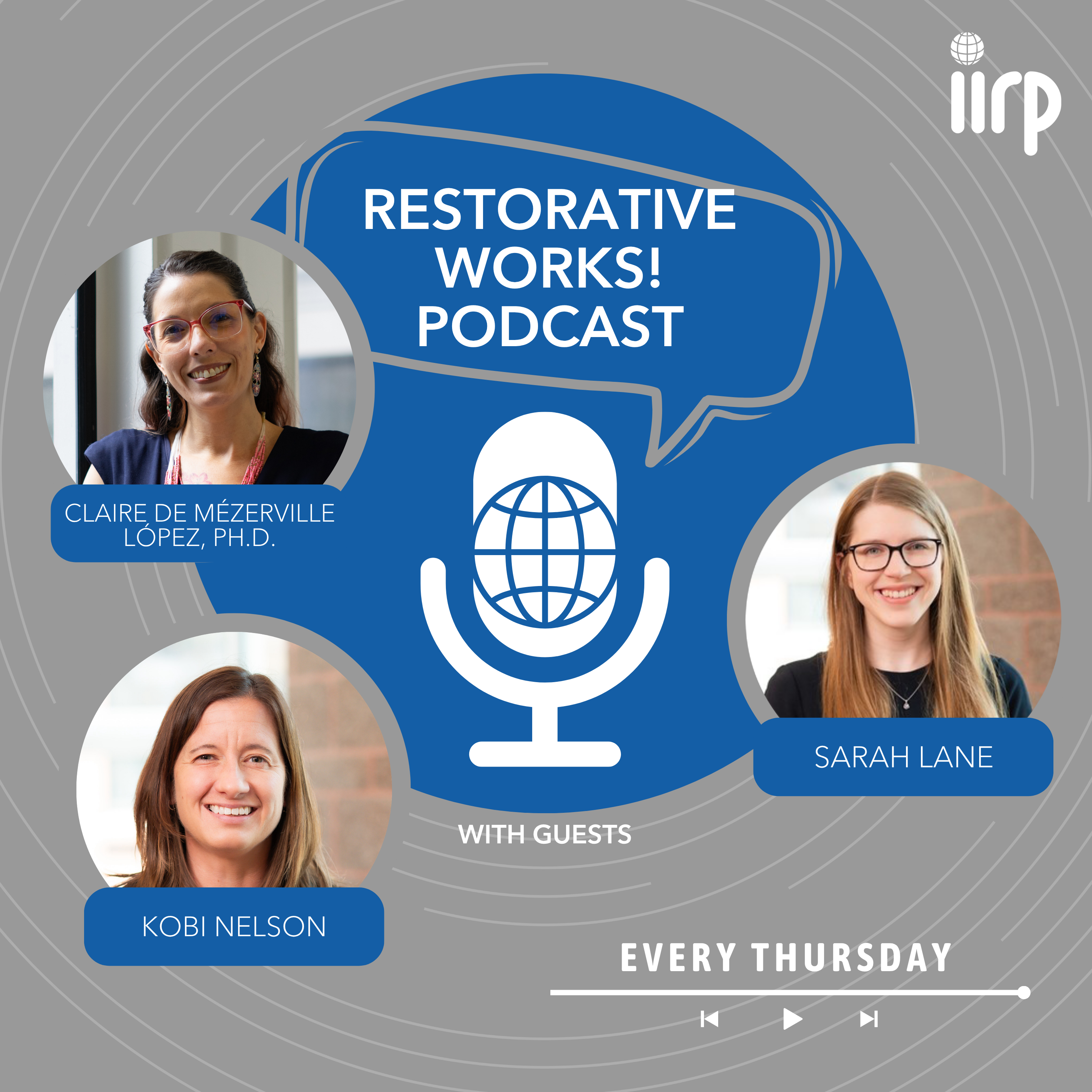
In this special collaborative episode of Restorative Works and The Teacher's Sphere Podcast, hosts Dr. Claire de Mezerville Lopez, Dr. Kobi Nelson, and Sarah Lane explore how educators can cultivate stronger school communities through civil discourse, restorative practices, and meaningful dialogue.
Our hosts invite us to examine the role teacher leaders play in fostering civil discourse among colleagues, emphasizing the importance of listening, intellectual humility, and curiosity. Sarah introduces Sphere's AWARE framework (Assert, Wonder, Accept, Respect, and Establish) as a practical tool for guiding productive conversations and building understanding across differing viewpoints.
Explore how teachers, administrators, families, and staff can move beyond adversarial thinking and focus on shared goals that support student success. We dive into cognitive biases and their impact on decision-making, relationships, and school culture. Our hosts examine how self-awareness, restorative practices-rooted dialogue, and intentional engagement with diverse perspectives can help educators recognize and navigate these biases more effectively.
Kobi is the content development specialist for Sphere Education Initiatives. She hosts Sphere's podcast, The Teacher's Sphere, and creates curricular resources in collaboration with K-12 teachers and content scholars. Kobi has two decades of experience teaching reading, writing, and literature in middle schools, high schools, and colleges. Kobi holds a bachelor's and master's in English as well as a master's in Curriculum and Instruction. She earned her doctorate in Education and Human Development from the University of Colorado.
Sarah is a manager of alumni and educator engagement for Sphere Education Initiatives. She also supports hosting Sphere's podcast, The Teacher's Sphere. She leads professional development across the country to partner with educators and administrators to foster spaces of civil discourse and community. She has K-12 experience as a teacher, instructional facilitator, and curriculum writer. Sarah has a Master of Science in Curriculum and Instruction, principal certification, and is a National Board Certified Teacher.
Tune in to discover more practical insights and valuable resources for anyone committed to creating educational environments where dialogue, empathy, and diverse perspectives can thrive.
Resources from Sphere Education Discussed in Today's Episode:
- The Civil Discourse Primer
- Bias Bites
- Sphere's Leadership Toolkit for Civil Discourse (full of tools for leaders to use to cultivate the culture of civil discourse discussed in the episode)
Transcription
Claire de Mezerville Lopez
Hello and welcome to this collaboration between the podcasts The Teacher's Sphere and Restorative Works!. We came together today to talk about what it might mean to continue creating a culture of dialogue and a stronger sense of community, where teacher leaders can foster civil discourse among students and with other teachers.
Kobi Nelson
Hi, I'm Kobi Nelson, content development specialist for Sphere Education Initiatives and host of the Teacher Sphere Podcast. The Teacher Sphere podcast amplifies the voices of practicing educators who share how they successfully create spaces for civil discourse and viewpoint diversity in today's schools.
Claire de Mezerville Lopez
Thank you, Kobi. My name is Claire de Meservi Lopez, and as the host of Restorative Works!, we believe that learning, practice, and research in the field of restorative practices open new paths for transformation.
Sarah Lane
Thank you for joining us today. My name is Sarah Lane, Manager of Alumni and Educator Engagement for Sphere Education Initiatives, and I'm a co-host of Sphere's podcast, The Teacher's Sphere, with Kobi. Claire, please get us started with what prompted this collaboration.
Claire de Mezerville Lopez
Thank you, Sarah, and welcome to you both. So, in the field of restorative practices, we firmly believe that a strong community is better prepared to face conversations that need to happen while facing tensions, unrest, dissent, and concern. Inspired by the work of the Sphere Education Initiatives, we created an invitation together to go through a circle of questions for the three of us to explore today. As a first question, well, we're suggesting to do go-arounds. We really love to have circles. So Kobi, I would love to invite you to go first, and then we go to Sarah, and then I wrap up this first go-around, and then we continue with other questions. So, in your experience, this is the question. What are ways that teacher leaders can foster civil discourse with other teachers, that is, with their peers?
Kobi Nelson
Yeah, thank you for that question. You know, before we get started talking about leaders, I think it would be important to ground our conversation in civil discourse itself. So, in our work at Sphere Education Initiatives, we've really found that students enjoy engaging in civil discourse with one another, and that civil discourse itself leads to a better classroom climate. When teachers are modeling and supporting civil discourse, it really is modeling what we hope for in society and it's showing students exactly what we want them to do. So, civil discourse, according to Sphere Education Initiatives, we have a primer, it's called the Civil Discourse Primer, and I don't know, maybe we can put it in the show notes. And so, Sphere defines civil discourse as the mechanism by which people in a healthy society interact and overcome their inevitable disagreements in a peaceable manner. So that listening piece is really key because in order to be able to enter into a conversation effectively, we really need to be able to first of all listen to ourselves, you know, and where are we at in as we enter into a conversation and then be able to listen to others.
Sarah Lane
Yeah, so to build on that, I really like how Kobi brought in how we define civil discourse because in thinking about the ways that we as teacher leaders or interacting with other teachers can foster civil discourse, is I think of something that we call our AWARE framework. And AWARE is just an acronym to help us remember all of those components of the successful listening and speaking pieces. So AWARE stands for assert, wonder, accept, respect and establish. And don't want to dig too deeply into some of those, but I'll share some highlights. So one being assert, which we're asserting with facts and evidence and using that as part of our conversation to assert our viewpoint. Wonder is my favorite. I'll come back to that in a second, accept is that we might not change one another's minds in a conversation. So I think that's really important too as we work amongst teachers and with one another, that our viewpoints might not change, but that we'll better understand one another and our viewpoints as a result of the discussion. Respect, kind of self-explanatory, and then establish being that we're establishing a goal for the conversation. So what is our aim in having this conversation? And if it steers off path, we might need to pause and revisit it or acknowledge that we got off path in the conversation leading toward that goal. And wonder is the one that I like to focus on a little bit more, both as one that we encourage with students, but also with fellow teacher educators, is sharing a bit more on why we have the perspectives that we do. And we might not change the mind of someone in that, but really just saying, tell me more. Why is it that you think the way you do? And what experiences have you had to lead yourself to this? We don't always have to start into complex discussions either. I feel like we're automatically jumping into thinking, really tricky social discussions or complex political issues. No, it's also those “getting to know you” conversations and learning more about one another and our viewpoints to get things started.
Claire de Mezerville Lopez
Yes, I love that. And when we talk about civil discourse, I remember this saying that said “they told us not to talk about politics, soccer ball, and religion. When they should have told us how to talk about politics, soccer ball, and religion”. And I can understand that families have a huge role on how to have these conversations, but it is in schools, also in the neighborhoods and other spaces. But I'm going to focus on schools where you really find yourself in a situation where there are people that see things differently. And how do you approach that? And as teachers and as educators, we should lead the way or facilitate these spaces or offer the tools on how do you do this? It's difficult, there are affects, there are positions, there's an awareness of the existence of different viewpoints of different situations and life experiences. But then there's the assumption that we as teachers know how to do this and we don't necessarily do. So, I think that's the importance of also wondering how do you do that with your peers as adults to create the spaces for students.
Sarah Lane
Yeah, I I like that point a lot, Claire. And I think about we talk about Thanksgiving dinners a lot and and what's what's safe to talk about at that. And it and it does impact all different aspects of our personal and professional lives. so in focusing into that school layer a bit more, I'm curious for our next question to talk about how can we create a culture where teachers are open to the idea that administrators are not othered, but are on the same team. And does that apply to other members of the school community? So, Claire, let's start with you and then Kobi and then I'll go.
Claire De Mezerville Lopez
Thank you. And so I think that we are living in a very adversarial historical time. And before talking about administrators, I would use the example of families, especially if we're talking about high school and working with teenagers, where as a parent, you start to experience that your child is older and more autonomous and more independent. So you don't have to go to so many meetings. You don't have to be so much on top of everything as when they were smaller. Although research shows that parenting supervision in high school is very significant as a protection factor for their development. So we as parents, and I have a teenage son, we as parents, we're kind of wanting to let go because we're tired and we're busy and we have so much work to do. But at the same time, teachers are needing support and they are facing situations that they don't necessarily know how to face. So I'm sticking with this example for a little longer just to say that it might be very tempting for teachers to say, “the parents are not doing enough” when something happens. And for parents to say, “But this is on teachers”. And it becomes adversarial instead of thinking, well, but we're actually on the same team. We want the same thing. And we need to create a way to bridge this frustration and create collaboration. And I think that's what happens with administrators as well because we are navigating different tensions and different demands from the school system, from the community ecology, from everything that's happening. And we might lose sight of the main goals that we continue to share, even though there is a perception that might be very justified and real, that there are conflicts of interest with some things. But as we continue to keep that common goal in mind, then it's easier to take that othering off and say, “well, we're actually on the same team”. And with that I'll with that I'll pass it to Kobi.
Kobi Nelson
I really love those insights. I think you know, particularly the idea of you know, what are the common goals and how can we see each other as being on the same team. You know, in the United States, we're a very polarized society right now. And it's it manifests not only in politics, but also in beliefs. And so it trickles down into families and schools and communities and all of those things. And I think what you're talking about, Claire, you know, it's even a problem if you think about the content silos that teachers tend to put themselves in. You know, for example, an English teacher saying something like, you know, I'm not a math person or vice versa. And then, you know, you just silo yourself off into only being able to teach these certain skills and only being able to speak to this specific set of you know whatever it is and then, like you said you know it there becomes a divide between what you're doing in the school. So if you're an administrator, you're doing specific set of things and then teachers another specific set of things and then even like, paraprofessionals, you know, like just all of these differences. And it is so easy to be like, as a teacher, I don't understand, you know, the pressures of admin. And so, you know, I see myself as working harder or vice versa, or that kind of a thing. And getting into this space where it becomes, teachers versus administrators. Right? And I think one way, and this is me coming from a former teacher perspective, I was not an administrator, but I was a teacher. And one thing I think that teachers can do is be open to administrators being on the same team if a school culture really encourages viewpoint diversity. So thinking about the diversity of viewpoints that makes up a school and the school as a complex system that needs all of those different viewpoints. And I think, you know, with regards to administrators, that also puts the burden on administrators to be really transparent with their goals and to open up, you know, the door to teachers and that listening piece, which we talked about at the beginning with civil discourse, is that listening piece is so key. Another aspect might be creating a culture where one becomes more aware of the tendency to place ourselves and others in groups and and then actively work to maintain an awareness of that and to find common goals. You know, we're all working towards the same thing, even though we have different job titles, different roles, we teach different content areas and have different responsibilities.
Sarah Lane
Yeah, and to add on to what Kobi was sharing is we definitely see administrators as critical to supporting teachers. We at Sphere, for example, have a lot of teacher-facing resources. But then recently we were developing leadership-facing resources in our leadership toolkit because we want leaders to be equipped with the knowledge and tools to support civil discourse too. Oftentimes leaders don't have as tailored professional development or resources or they're looking at teachers' lesson plans is through a different lens and they need their own set of resources. And in thinking about that, really being careful about when administrators are partnering with educators in the space, that to make civil discourse implementation stronger, that they're working in collaboration with the teachers. And this type of really sensitive work is also, in my opinion, best suited when it's not evaluative. So, goal setting together, building these practices, doing supportive walkthroughs that aren't tied to a formal evaluation. Although certainly improving civil discourse skills leads to better student-centered learning and goals that might be tied to an evaluation, but keeping it separate in that. And then also an administrator can support with what you were saying, Claire, on the parent aspect of things. And having an administrator communicating at things like open houses or ongoing parent communication on why viewpoint diversity matters and these conversations in the school and the classroom matters as a whole community can help back up what the teachers are doing in those classrooms. And I think the only other point I'll add is just that we focus a lot on the planned civil discourse in classrooms and how can we structure those? How can admin support? But when talking about the question of does this apply to all members of a school community, you think about where students are having discussions: in the cafeteria and on the bus and while playing soccer or playing a variety of different school activities where these discussions are happening. So by investing in the practices in the classroom, that filters into those other environments, but also having a staff and a team that's all on board with this, so that someone working in the cafeteria or a coach or a PE teacher, they're all on board and knowing what this looks like in practice and how to support one another with it.
Kobi Nelson
I really love these thoughts. I think yeah, you bring up such an important point, Sarah, about, you know, everyone being involved, right? And all different kinds of aspects of the school community and how important they are, and to maintain an awareness of that as leaders, as educators. And you know, thinking about that awareness, I'm thinking a lot about cognitive awareness and honestly cognitive biases, right? So like binaries; we create a lot of binaries in our minds. And that's part of being a human being. and I'm wondering what are some ways that we can become more aware of these cognitive biases and navigate them. Sarah, I'd love to start with you and then, Claire, I'd love to hear from you, and then I'd love to share a little bit about bias bytes.
Sarah Lane
Yeah, so some ways I think about being aware of biases are to first practice self-awareness, like what you were saying, Kobi, being aware. And we've talked about that in terms of even the acronym AWARE for guiding civil discourse, but being self-aware to question what first comes to mind in situations. So many of our biases are automatic. So you can make sure that you pause and intentionally think, why do I think this way? So I think about one of the cognitive biases as dichotomous thinking, which is also known as black and white thinking or something along the lines of all or nothing. So we can view things in the extreme without thinking about the nuances or the shades of possibilities there. And I guess the perk of that is “hey, we can make quick decisions in a moment”, and that's helpful at times. But then in other situations, it might lead us to reinforce biases or lead to more extreme views aligned with our opinions. So, you see this in action with students. If a student assumes, hey, I just had a disagreement with my friend and now they are an enemy. They're no longer an ally. And it's this either or. Or what we were saying earlier in the podcast, the us-versus-them mentality with adults, that's that either or as well. And eliminating the shades of nuance and relationships and goal setting together. So, with those types of situations, with both students and adults, we can pause and question the thinking that we're engaging in with reflection and slow down with it. The other thing I'd add is just to make sure we're actively seeking different perspectives and evidence in this. So for example, biases like confirmation bias or in-group bias are becoming stronger when we're only listening to people who think like us. It's even in sports, right? The longer you're around your people that are your favorite team, the more committed you are to that team. But it's the same with our opinions and things as well. So we might be providing unequal attention to the people that think and look or on the same team as us in so many different ways. And it's the same with our students. So for both adults and students in these situations we can try to intentionally learn more from one another and work together towards shared goals, even with our diverse backgrounds. And increasing that contact with members from different groups can help us to navigate our own biases. Claire, curious for your thoughts.
Claire de Mezerville Lopez
Yeah, I think that just understanding that we might not fully control our own biases, it's
a step of discovery that takes intention and that it takes humility. And I think education is a wonderful space for that. Just to be able to make ourselves aware that we grow and we learn and we broaden our perspectives and we get new information and sometimes we change our minds on things when we learn something different. And just to appreciate the importance of having that flexibility. I think that's something that we can really invite students to do, we can invite ourselves to do. But I think that first step is hard. And I I will go to Kristen Neff's concept of self-compassion in that, on having self-compassion and understanding that it's part of my nature as a human to be open to the idea that I might not know everything about this and that I might feel differently if I learn something new. So I think if we have that sensitivity first, then we can do very concrete things that can be helpful and that do not rely only on ourselves and our own heads, which is tricky. Just to think I'm going to be disciplined enough to remain aware and to not be biased: you cannot do it on your own. It's just not possible. And that's the part where I really rely on restorative practices; on thinking, okay, how many circles am I participating on where I am being able to listen to others that see things from a different perspective and, are we having that discipline of creating those circles where we are not only listening to the same people that think the same thing, which is what social media is doing for us? They are creating these eco, they have created for years, these eco chambers. Am I having that discipline as a community? Are we creating that culture of having those circles, of having those questions that we sometimes call restorative as to say, well, how is this affecting myself and others? And what needs to happen for things to feel right for everyone? And then I think those will be like the structured concrete practices that you can do that help you to recenter and help you to see things differently, but you need others. You cannot just do it on your own. And it's a culture that we get to create. But I'm just really curious about bias bytes. So Kobi, please tell us everything about them.
Kobi Nelson
Yeah, well, you know, I appreciate what you said about humility because these are really built around having intellectual humility and creating a culture of intellectual humility, which is so necessary, as you said, for us to become aware and to maintain an awareness and not just be like, nope, one and done, you know, I'm not biased anymore. So, these bias bites, they're 10 many lessons created by a Sphere alumna, and they're created for administrators to use in professional development. So they're about 20 minutes long each. And the idea is that our brains often take shortcuts, like Sarah said, and sometimes they can be helpful and sometimes they can lead us astray. So, in addition to some of the bias bytes that Sarah mentioned, there's like negativity bias, which motivates us to address negative situations and outcomes, but you know, like too much of it can lead to an outlook of pessimism. And I think that that can be really tempting, especially with, you know, the new cycles that we continually see. So, like maintaining an awareness of that can be super helpful, especially for teachers who are creating, you know, cultures within their classroom. And you know, with their ability to create a positive culture. And then another one is the bandwagon effect. So, this is one where people have a tendency, you know, someone starts dancing, another person starts dancing, and then the whole group starts and everyone wants to join in. So that creates social cohesion, which is a great thing. Like you want social cohesion, you want bonding. but again, taken too far, it can suppress individuality; it can suppress critical thinking. So maintaining an awareness of that for so that there's a balance is really important. And then one more I really want to highlight is called the Pygmalion effect. And this is where the idea that high expectations lead to improved performance. And I think that this bias is particularly important to think about. when you're thinking about administrators and teachers, you know, it's not too different, I think, from the way sometimes that teachers can also look at students and think, okay, this person is going to perform in a good way. They're gonna be a high performer. And then potentially not seeing the same thing in another student. And honestly, like that can lead to outcomes that are not equitable. So, I think that thinking about that and about high expectations and being aware of that and aware of your own thinking can be really vital in this whole process. So, the goal of these is to increase critical thinking, intellectual humility, and to really foster that idea that we're all learners, educators, administrators, students. And as learners, we're constantly learning about ourselves as we're learning about other people.
Claire de Mezerville Lopez
Kobi, that is so important because I'm thinking in this era of AI, how do we focus on the importance of that critical thinking, that flexibility, that not being just information passers, but actually actively engaged into what learning is. So, as we get close to wrapping up, there's a final go-around that I wanted to invite you guys that we share. And it's about pending questions. As we share this conversation, what are some pending questions that we might be discovering? And Kobi, how about we start with you and then we pass it to Sarah, and I wrap up.
Kobi Nelson
Yeah, for sure. So you know, the question that still kind of pokes at my mind is really thinking about practical tools that school leaders can use. And I think about that in terms of trusting relationships, like building trusting relationships, because those are so necessary for a team mindset. And so, you know, I would love to think about some concrete ways that school leaders can create those trusting relationships. What tools can they use to do that with teachers so that it can, you know, mitigate some of the tendencies that can lead to an “us versus them culture”.
Sarah Lane
Yeah, and for me, I thinkof two parts. I think that engaging in conversations is exciting, but there's also a couple of things that we need to think more about, which is how can we help students that might be anxious to engage in these conversations? And what can we do for students to build their practices to lead up to important civil discourse skills? So thinking through that, and then also on the flip side, the other people in the room that might be uncomfortable are the teacher and or the leaders supporting this work. And so, how do we help teachers and administrators feel comfortable, especially with the conversations, but a challenging conversation in the moment? There are so many things that can pop up and moments of uncomfortableness that can happen. To have some strategies in your back pocket for how you'll navigate those, whether that be pausing, reflecting, addressing the moment, moving forward. So, really making civil discourse a place where you grapple with maybe things that are uncomfortable and engage with critical thinking while also setting yourselves up for success and thinking through everything that might happen in that. And Claire, I'll turn it back to you.
Claire de Mezerville Lopez
Yes, thank you, Sarah. And I share those same questions and I will just add also the one about intrinsic motivation. How do we talk about that when we're thinking teachers, students, families, administrators that might say, “well, civil discourse is a nice to have, but it's not a priority”. And just to wonder about that intrinsic motivation of when is this going to become the center of some of the things that we really, really need to create a school community that actually educates for citizenship? So that's a pending question that I look forward to continue to explore with you. So Kobi, Sarah, thank you so much for sharing this roundtable with me today.
Sarah Lane
Thank you, this has been great.
Kobi Nelson
Thank you so much, Claire. It's been a pleasure.
Claire de Mezerville Lopez
And thank you all for tuning in to Restorative Works. To learn more about Restorative Works, log on to IIRP.edu. And to learn more about the teacher sphere, visit sphere-ed.org. And let's continue to build transformation through dignifying relationships, civil discourse, and stronger educational communities. Until our next episode.