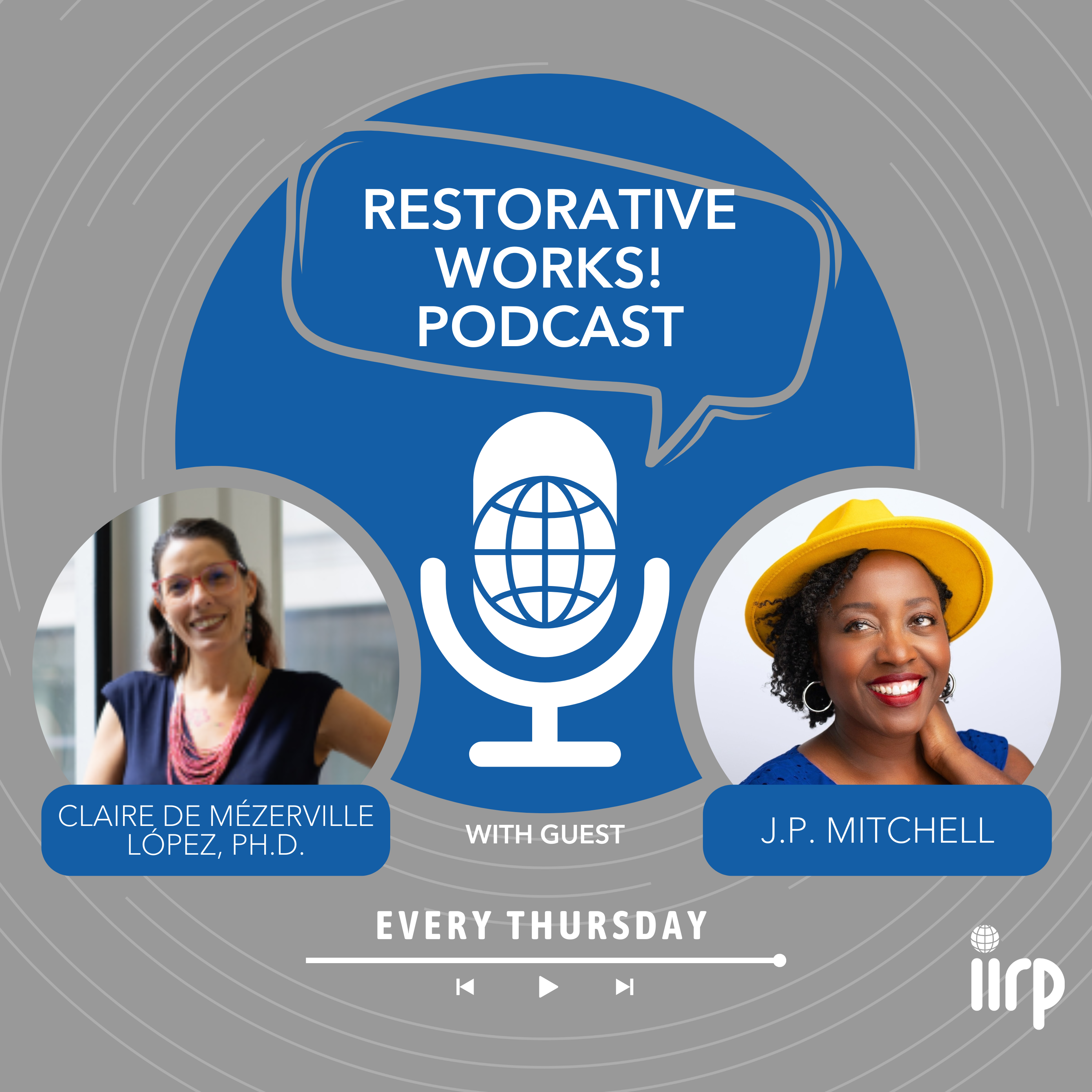
Welcome to season four of Restorative Works! Podcast! In this episode, Dr. Claire de Mézerville López welcomes Johari "J.P." Mitchell for a discussion around positive self-talk, children's literature, and how the power of storytelling helps shape how we relate to ourselves and one another.
J.P. explores how children's literature, especially picture books, can serve as a restorative practices tool across all ages. She emphasizes the concept of restorative practices-rooted self-talk: the internal narratives we use to make sense of shame, grief, identity, and belonging. J.P. illustrates how stories offer young people and adults pro-social alternatives to dealing with shame. She explains how picture books act as mirrors and windows, reflecting our inner lives while inviting us to step into experiences we may not yet have lived. Through age-appropriate storytelling, children gain language for complex emotions like loss, difference, and empathy long before crisis arrives. This proactive exposure builds emotional literacy, resilience, and relational capacity.
The episode also challenges the assumption that children's books are only for children. J.P. and Claire reflect on how picture books speak powerfully to adults, educators, parents, and leaders by reconnecting us to the "child within" and creating space for intergenerational dialogue. From navigating grief to understanding identity and difference, children's literature becomes a shared entry point for meaningful, restorative conversations.
Johari "J.P." Mitchell is an educator, writer and speaker whose passion is helping leaders link vision to opportunity through the power of words. J.P. is a restorative practices trainer with Columbus City Schools, as well as a 2-time TEDx speaker, author, and Gallup-Certified Strengths Coach. She lives in Columbus, Ohio with her family.
Tune in to learn how to become a friend of children's literature, not just a consumer, and use stories as a bridge to stronger relationships and healthier communities.
Transcription
Claire de Mezerville-López
Hello, and welcome to Restorative Works, a podcast where learning, practice, and research open new paths for transformation. My name is Claire de Mezerville López, and it is my joy to welcome you to the beginning of our fourth season of the Restorative Works podcast. We celebrate 3 years of storytelling and restorative conversations. And we look forward to the beginning of this fourth season for our channel. And it is my honor to introduce this episode and this fourth season to learn more about building restorative self-talk through children's literature. And for that, today we have the honor to welcome Johari J.P. Mitchell as our guest.
Johari, welcome! How are you today?
J.P. Mitchell:
Thank you, thank you so much for having me, and all is well. It's probably funny that I go by Johari and JP, but that's because in my everyday life, I'm an educator, and a mom, a wife, all these things, but I'm also a children's author, and so J.P. Mitchell is my pen name, so that's why I go by both. But yes, it's nice to meet you.
Claire de Mezerville-López
I love that, and we take on so many names because we are so many things to different people!
J.P. Mitchell
Yeah, yeah.
Claire de Mezerville-López
Before getting started, let me tell our audience a little bit more about you. Johari J.P. Mitchell, as you just mentioned, is an educator, writer, and speaker whose passion is helping leaders link vision to opportunity through the power of words. JP is a restorative practices trainer with Columbus City Schools, as well as a two-time TEDx speaker. Author and Gallup-certified Strengths Coach. You live in Columbus, Ohio, with your family, and Johari, please, Let's begin like this. Explain to me this idea of restorative self-talk through children's literature, and particularly picture books. Tell us about that.
J.P. Mitchell:
So, as I studied restorative practices, and when we're studying restorative practices, we learn about the Nathanson's compass, or the compass of shame. And, you know, this idea that, in the face of an interruption of positive experience or positive affect, that we as human beings tend towards Ways of reducing that shame, or eliminating that.
And so, his compass explains that there are, like, four directions that we run into to reduce that sense of shame, attack others, attack self, withdrawal or… withdrawal or avoidance. And the premise of restorative practices is that we have other options, right? Outside of the compass of shame in order to process life proactively and responsibly in healthy ways, right? Pro-social ways. And so, when I was at the IIRP World Conference this past October I presented on this topic of restorative self-talk through children's literature. And as I was preparing, I realized that…The reason why children's literature is so robust today and continues to grow, you know, through picture books, chapter books, etc, is that they teach… it teaches young people about, social-emotional skills. and also literacy, of course, but also the world. And so, literature provides a blueprint. It provides an opportunity to see what we might do in different situations, how we might respond to different people, how we might process different challenges, right? So, it becomes a blueprint, it becomes permission, becomes like a potential playbook. And so, we live vicariously through characters, etc.
But especially with picture books, I was thinking about how these picture books provide a mirror for young children and children of all ages, and the child inside of us, who are adults, right? To think about the world. And so, I want to say two more things about that piece, which is that Self-talk is how we decide to tell ourselves a story about our lives, right? And our self-talk, I believe, can be informed by the children's literature that we have access to. And so that was what I really was thinking about, when I was making my presentation. So, I shared about 4 picture books. One was mine, but there were other people, there's so many brilliant people out in the world, and I wanted to highlight some of them, you know, and their work. And just thinking about how the scripts that we have in our heads about ourselves, about who we can be, can be informed by children's literature. And the other thing I just wanted to say was that after the World Conference, the IIRP conference. I went to another book fair, shout out to the Buckeye Book Fair in Ohio, and I ran into the author, Lindsey Bonilla, of one of the books that I had featured at IIRP, and it's called The Hole. And we talked about… she said something I thought was very interesting. She said her book basically is a story of a child who lost a sibling. And so, there's, like, a hole…at the dinner table, right? And they have an illustration of, like, this this picture of this hole, right? And the hole follows this child, and the adults feel the presence of the hole, right? Because the child's not there anymore. And I thought it was a really brilliant way to help kids understand how to think about grief and so forth. And so, this author said to me that, basically, people sometimes don't realize that they're interested in this book because they say, oh, what's the book about? And they learn that it's about death, and they think, oh, well, we don't need that. And I started to think about how people tend to think, I need this book because I want to talk about this specific thing right now that's in this child's life. And I started to think that. What if restorative practices, because it focuses on 80% being proactive and 20% being responsive... What if children's literature is our opportunity to be proactive by exposing young people to stories that they may not have encountered in real life yet, but it's preparing them, right? So, instead of, oh, this child has lost a friend.
Oh, there's been a death in this child's family, now let's go get a book about how to process a death. What if… Just exposing that child to the story in a non-scary way allows opportunities to have conversations proactively, in advance, before that child even has to process death, so that when it comes, because it's not an if, but it's a when, death is going to come, right, in all of our experiences. We're going to lose someone, we're going to know about someone who passes away. What if we have that opportunity through children's literature to give them a proactive lens and look? Different people in the world who may not live in our hometown, who may not have seen them yet, right? Different things, so that was really the, the premise for my talk, but then also after the talk, you know, at the conference, I really started to think about children's literature, and particularly picture books, giving us this proactive, restorative opportunity.
Claire de Mezerville-López
And what I love about what you're saying is that it doesn't only allow you only to experience, through literature about things that you may face, but about things that other people may face. So, you grow in empathy, you grow in the possibility of understanding things that I am not going through, but others may go through, and I might learn about that. And I really like what you said about how children's books may also speak to the child that we have inside ourselves, and I remember, when I would get children's books for my own kids, or when I would get them when I had, psychological clinical practice many, many years ago, and I worked with children, that some of the books and the things that they showed, they actually spoke to me.
J.P. Mitchell
Yes.
Claire de Mezerville-López
And they remind me how to manage… there was this beautiful book by Ana Llenas, from Spain, that is called The Void. She's also the author of The Color Monster. There are children's books about the color monster, who is… each color of the monster is an emotion, and they're just so beautiful.
J.P. Mitchell
Yes.
Claire de Mezerville-López
The void is kind of like this book that you mentioned, because it's this girl, and she has a void, and she's trying to figure out what to do about it. And I thought to myself, this is very deep and complex. This speaks to things that I, as an adult, sometimes struggle...
J.P. Mitchell:
Yes. On how to describe. I'm so glad you said that, because that's a huge point. I'm glad you pointed that out about empathy, because it's not just…I may experience this later, I'm going to encounter this later. I may never encounter it, but other people who are alive in the world, who matter just as much as me, are encountering it, and that's a huge piece. And, you know, I won't get into anything political, but there's a reason why removing opportunities for children to experience empathy through different picture books is a thing right now. That's all I'll say, but there's a reason, right? It serves a purpose. And so, I think that I just wanted to speak to what you said about adults. I… when I wrote my picture book, I originally thought it was supposed to be for the kind of typical picture book audience, right? Maybe 4 to 8, you know, max 10. This book has spoken to adults. I share about it in, you know, leadership spaces with adults, middle schoolers, high schoolers, preschoolers, all the way across, I was told that there was this librarian in Virginia who read my book, and she was, like, 80 years old, and she started crying when she read it, and she said, I wish I had had this when I was younger. And that's… when I heard that story, I realized… that was when I started to realize how much picture books matter for adults, too, and we should not just share picture books and say that they're for children. Yes, they're primarily for children, but they're really for humans, you know? And so, if we have the humility to remember the child inside of us and say, hey, what can I learn from this? I just think we all benefit, and, you know, what I like to say is. really, picture books give us the opportunity to have great conversations across generations. That's what it's about. So, it should feed the adult who's sharing it with the child as much as it feeds the child, and it should feed the relationship, right?
Claire de Mezerville-López
That is so beautiful. We're going to take a short break, and then we're going to come back to this conversation with Johari J.P. Mitchell. Please stay tuned.
Welcome back to Restorative Works. Johari, you have mentioned the importance of not exposing children to topics beyond their years, but rather, in an age-appropriate way, making sure they feel they can navigate some of the life stuff, that may come in life. And you mentioned before, we talked about before how children's books are also for adults, but, you know, adult complex topics should also be, in an age-appropriate way for children. Can you please tell us more about that, and give us a few examples?
J.P. Mitchell:
So, there are lots of experiences that, you know, that children can have, and as educators, we talk about the author's purpose. What is the function of this book? What does the author intend to tell us? And I think this book I mentioned earlier, The Hole, does such a good job of dealing with this huge, big. Life issue of death. but in a way that is just… it's gentle, right? It's not, heavy. Even though death itself is heavy, the treatment of it is not heavy because of the way the story is told, because of the illustrations. There's another book that does the same thing called A Walk in the Woods by Nikki Grimes, and, you know, Jerry and Brian Pinckney were the illustrators. Same thing, it talks about nature and Connection as a way to process death. But it doesn't go deeply into, like, the logistics of death itself, if that makes sense. So, I hope that makes sense. Those are two examples.
Claire de Mezerville-López
I love that. I can relate profoundly with the need to protect my children and all of our children, and at the same time, not shield them, but find a way to walk together. JP, you have mentioned how restorative practices can help the whole kid lit community, meaning this ecosystem that is children's book authors, illustrators, creators of written works for children, including agents, editors, publishers, designers, and other professionals, is an entire community. Would you please tell me more about this vision?
J.P. Mitchell:
Yes, so when I was at… again, I keep referencing this IIRP World Conference, because it was a… it was a watershed moment, I guess, for me in a lot of ways. I'm still processing it. But…one of the things that happened was I have a literary agent friend who was kind enough to come an hour… from an hour away to come and see me, and participate in my session. And we talked, and she was blown away by the things I was sharing about IIRP. She had not heard of the Nathanson's Compass. you know, the compass of shame. She had not heard about these restorative practices. And I did not realize that as big as IIRP is, and as big as it has been becoming in my world, right, and in my school district, I didn't realize that there are people who do big work for children who haven't yet heard of this work, who haven't been able to access these tools, and so that's when I started to think, wow. What if the people who are creating books for children access to information about the Compass of Shame, for example, to say, oh, this… if we delve into this philosophy, or this framework, and we apply it to the writing of stories for young people, or the telling of stories, the marketing even of stories. we can tap into a piece of their psychology and meet their needs even more, kind of, precisely than we could before we knew about IIRP. So, I… I would love to be a part of, you know. somehow opening up this world of restorative practices to professionals who create for children. Kid-lit authors, right? Agents, like you said, publishers. This is important work, and spreading the deep, mechanisms or the inner workings of what empathy looks like and how we build, you know, restorative people, that needs to be accessible to everybody. So, that's my thought.
Claire de Mezerville-López (ella/she/her):
I love that, because it also reminds me of how we can commit deeply to our work, and do it passionately, and at the same time, remember that we're never doing our work alone. We're part of an ecosystem that is bringing this work into the world.
Restorative practices are sometimes seen as not yet appropriate for the smallest kids. Can you do this with preschoolers? Because there's a lot of talking, you know, and because of their developmental stage. But maybe this is a bridge to engage them through books and pictures. What would be a final piece of advice that you would like to share with our audience?
J.P. Mitchell:
I would say…
Become a friend of children's literature. Not just a consumer, not just someone who buys a book occasionally for a birthday gift, or, you know, buys a book because it's your duty, right, as a parent to make sure you're reading to your child at night. But, like. engage in children's literature, and particularly, we're talking about picture books at this point, as an art form.
As, you know, if you're an art lover, or even if you don't see yourself as a lover of art.
If you take time, just periodically, to tap into the social media of a few authors, or, you know, publishing houses, agents, etc, they will share favorite books that are coming out, and things like podcasts, and all these things, and you can start to learn about different books that are coming out.
And a person may say, well, how would I do that? I don't have time for that. Where would I even find it? You could befriend a children's librarian in your city, or somewhere in the world. Like, I learned recently that the New York Public Library, you can get a card even if you don't live in New York, and I'm sure it's that way for lots of libraries.
Befriend a public librarian, a children's librarian, and just start to ask questions, right? And you'll learn so much. Picture books are quick reads.
So, you can check out, you know, a few of them at a time, enjoy them, take in the art, take in the message, share them with a child, share them with an adult. I buy picture books for adults as gifts, back to the point we made earlier. But, you know, engage the world of children's literature for yourself as a learner. And as a lover of art, and then just share that passion with other people.
Claire de Mezerville-López
I love that. Reading is something that you do in quote-unquote solitude, but I think that the energy around books is always an energy of community. Thank you so much, Johari, for being on the podcast today.
J.P. Mitchell
Thank you so much for having me, I loved this conversation.
Claire de Mezerville-López
Yes, me too, and thank you all for tuning in to Restorative Works. To learn more about our guests and about this series, please log on to IIRP.edu. Welcome again to our fourth season, and let's continue to build transformation through dignifying relationships, kind conversations, and stronger communities. Until our next episode.