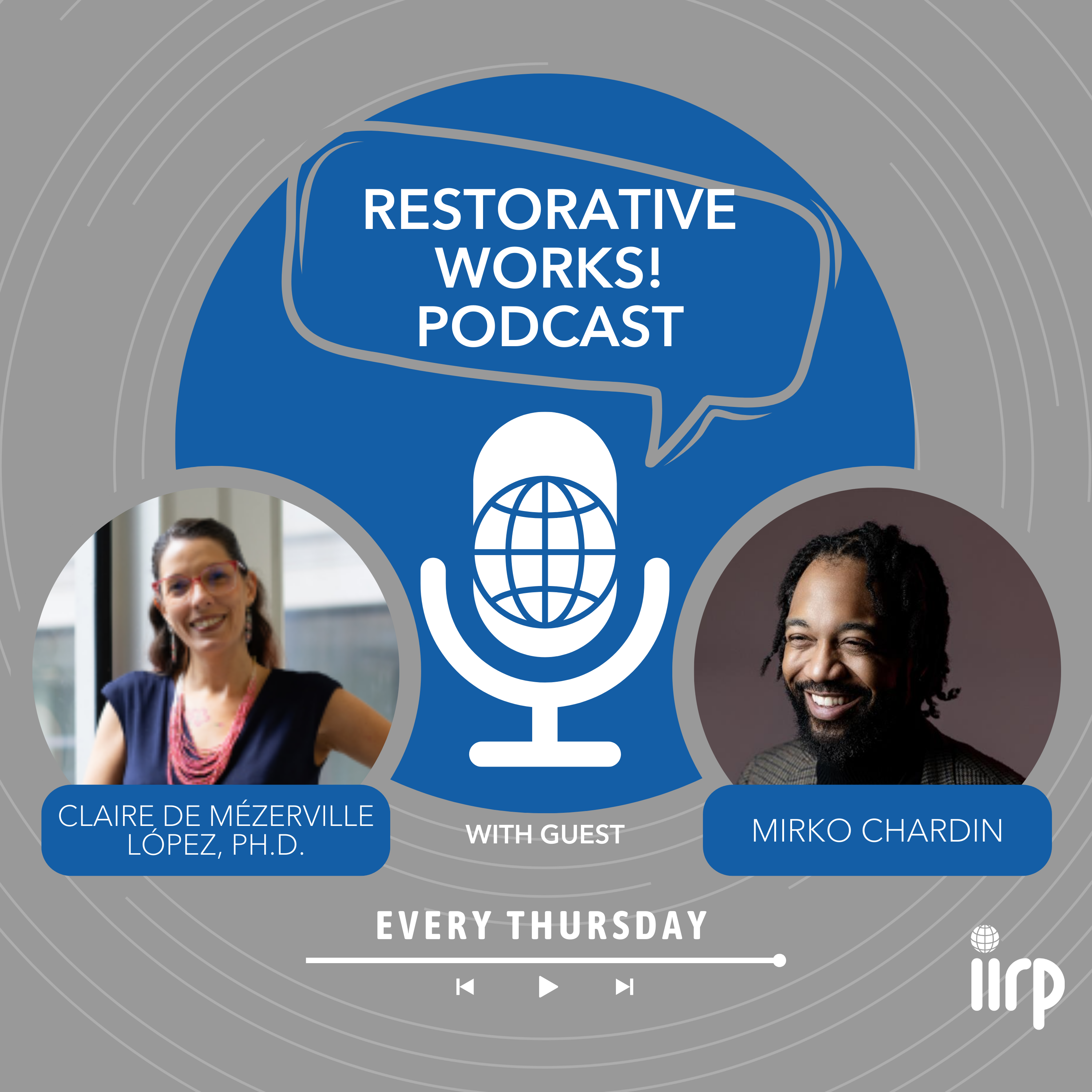
We are joined by nationally and internationally recognized educator, leadership coach, and bestselling author Mirko Chardin for a deeply reflective conversation about healing school communities through restorative practices and equity-centered design. Drawing from lived experience and decades of leadership in education, Mirko shares how schools can move beyond compliance-driven systems and cultivate cultures rooted in trust, belonging, and authentic relationships.
Throughout the conversation, Mirko explores the principles behind Universal Design for Learning (UDL) and how educators can intentionally design classrooms that anticipate learner needs rather than reacting to them. Rather than treating equity as an afterthought, he argues that schools must plan for it from the start by creating multiple pathways for students to engage, understand, and demonstrate learning while maintaining rigorous expectations for all.
As a school founder, Mirko has spent decades supporting schools and organizations in moving from compliance-driven systems toward cultures rooted in trust, accountability, and relationships. He is the co-author of Restorative Practices That Heal School Communities and Equity by Design, and his work draws deeply from lived leadership experience, restorative practices, storytelling, and social-emotional learning. Mirko partners with school leaders, executive teams, and organizations who are navigating change, conflict, and cultural transformation.
For educators, school leaders, and advocates for equitable education, this conversation offers both inspiration and practical insight into how restorative frameworks can create classrooms and communities where every student can thrive.
Transcription
Claire De Mezerville Lopez
Hello and welcome to Restorative Works, a podcast where learning, practice and research open new paths for transformation. My name is Clare de Mezerville Lopez, and I am so glad to introduce this episode to learn about restorative practices that heal school communities and equity by design. And for that, today we have the honor to welcome author and leader Mirko Chardin as our guest. Welcome Mirko, how are you today?
Mirko Chardin
I am, wow, very excited to share about this great work.
Claire de Mezerville Lopez
I am really looking forward to this conversation, but before getting started, I'm going to introduce you to our audience. Mirko Chardin is a nationally and internationally recognized educator, leadership coach, and bestselling author whose work centers healing, belonging, and human-centered leadership. A founding head of school, Mirko has spent decades supporting schools and organizations in moving from compliance-driven systems toward cultures rooted in trust, accountability, and relationships. He is the co-author of Restorative Practices that Heal School Communities and Equity by Design. And his work draws deeply from lived leadership experience, restorative practices, storytelling, and social emotional learning. Mirko partners with school leaders, executive teams, and organizations navigating change, conflict, and cultural transformation. Through his coaching and consulting practice, Mirko integrates restorative frameworks with reflective leadership, identity work, and sustainable wellness practices to help leaders show up with clarity, courage, and compassion. His work is grounded in a simple belief. When leaders lead with honesty and care, communities can heal and thrive. Mirko, thank you so much and welcome to the podcast. So how about we start with your own story? What brought you to this work?
Mirko Chardin
So, what brought me to the work is that, my experience was that of an individual who received healing and restoration. I am the secret child of a prominent Roman Catholic priest, the only child of a bipolar schizophrenic mom. I was someone who was expelled from three middle schools along my journey and believe that I had permission due to all of those statistical things, to not get to a place of success. And it wasn't until I encountered a school community, just a regular school community, not a prescriptive program, that believed in developing relationships, that believed in universal design, that believed in what I now see as the fundamental foundational practices of restorative practice that led to my re-engagement and put me on trajectory towards being a success and believing that I actually had the capacity to become a success.
Claire de Mezerville Lopez
Wow, that is so moving and it is so inspiring. Mirko, you talk about equity by design and soon I will ask you more about your book, but let's talk about universal design for learning. I work in Costa Rica in the university in the school of special education and counseling. And we talk a lot about universal design for learning and having a flexible curriculum and being inclusive, but sometimes it's hard to get it through to the classrooms and to the experiences. Some of your audience might be new to something like that. I believe that restorative approaches align beautifully to it. Will you please give us an introduction so we can all be on the same page before moving on?
Mirko Chardin
Absolutely. The long and short of universal design for learning is that it's an educational framework. And I always put emphasis there because sometimes when people hear the work, they assume that it's just language that revolves around strategies or practices. There are certainly a deep rabbit hole of strategies and practices that are aligned to universal design for learning. But as a framework, we must first acknowledge that it's a set of principles, beliefs, values that guide our work that are really rooted in three strong tenants. Number one, that neuroscience has communicated that all of our brains are different. The neural pathways that make up the sections of our brains that hold information are different, so all of our learners don't need to do the same thing at the same time; if there are 30 individuals in a room it's both plausible and possible that there may be 30 different ways to connect be present to make sense of things folks who understand universal design. Don't wait until they hear that there might be different ways of receiving material, we plan and implement it in that way. Secondly, acknowledging high expectations, that we hold the same expectations and goals for all of our learners, that we acknowledge that when we change a trajectory, when we shift that, when we shift the target, rather, we shift the trajectory, and that our learners always land where we expect them. So, when we assume that some piece of knowledge is out of their capacity that it's too hard for them when we give them something else, we've essentially sent them on a detour opposed to wrestling with why do we assume it's too challenging? What are the supports necessary to ensure that they get it and, foundationally, you know, the belief that all of our learners not just the ones that we think are the most engaged that I'd have the most support but authentically all of our learners including the ones that are challenging, including the ones that may be coming to us in the same circumstances that I did when I was young, that all of our learners have the capacity to meet rigorous goals when we as adults can identify and remove the barriers, including if the biggest barriers are invisible, meaning that they might live during our own unchecked thinking and assumptions about who our learners are. When we view things through the lens of universal design, we understand that our learners are the direct recipients of the instruction that we provide. So we have a laser light focus on them and ensuring that they can get to success because it's about their experience and not necessarily the experience of the service provider because we already have the information.
Claire de Mezerville Lopez
Mirko, thank you so much. And continuing on this universal design for learning and its principles, would you please tell us examples of how something like that can be integrated into lesson planning?
Mirko Chardin
Absolutely. So as it pertains to the universal design, I want to lift up that the notion of designing really is another way of framing planning. So we're really talking about investing in our planning process, not a triage model where in real time we are trying to wrestle with the fact that perhaps some of our learners needs aren't met. But as we anticipate who's going to be in our classroom, as we wrestle with what it is authentically that our learners are supposed to know and be able to do as a result of this lesson, how do we plan pathways that ensure that our learners, through our actions and deeds, when they enter into our classroom spaces, feel seen and heard? That they can see evidence in our planning that we've made the type of decisions that we'd only make if, A, we knew that those learners were going to be present, and two, if we believed that they had the capacity to be successful. Typically, when I tell folks to think through these lenses, it really revolves on unpacking our standards or learning targets and objectives and really wrestling with not just as the educator can we understand the language, but what is it communicating that our learners are supposed to know and be able to do? Do we have a conceptual framework? Do we have a narrative, a movie that plays in our brains in which we can actually envision what success looks like? Now, once we have that, how do we translate that to our learners at the onset of the lesson or the beginning of the learning journey so that they understand what is expected of them? If we can't see it and we can't communicate it to them clearly, then how are they going to be able to do it? And once we've wrestled with these pieces, thinking about who the learners are that we have today, not last week or six years ago, can we wrestle with what may be barriers, roadblocks, things that might get in the way of these learners being able to learn this new information or show us that they've acquired this new skill set? And how can I design, plan, construct the lesson that takes this into consideration and ensures that my learners are still able to get to success?
Claire de Mezerville Lopez
And that is so important when I speak to teachers sometimes, one of the conversations that arises is the student that is often the one that is giving us the hardest time is the one that we most need to stay in the classroom. And I think that's the root of it. Do we celebrate and want them to be here when everybody is different?
Mirko Chardin
Absolutely.
Claire de Mezerville Lopez
We're going to take a short break and then we're going to continue with this fundamental conversation with Mirlo Chardin. Please stay tuned.
Claire de Mezerville Lopez
Welcome back. I was commenting and I want to ask you about celebrating students in the classroom as the heart of trying to learn from these frameworks, trying to understand how to apply this equity by design. Would you please tell us about your book, Restorative Practices that Heal School Communities and Equity by Design? It's such a title. So, tell us everything about it.
Mirko Chardin
Absolutely. Both of those texts build off of each other. We landed on the title for the first text of Equity by Design because we wanted to communicate that equity is always possible if it's part of our design process. If we are planning for equity, we can make equity a possibility. But it's all about us providing ourselves with the time to be able to plan in that way. Almost in the same manner that if we were preparing a dish, a feast, something that we were doing to celebrate folks that we really appreciate. We plan the menu. We'd ensure that we have the right ingredients. We'd ensure that there aren't things that anyone is allergic to and that we're honoring customs that allow those who are coming to the feast of celebration to feel supported. It's the same type of thinking we want to use in the classroom. And this notion of restorative practices that can heal school communities are really the idea of acknowledging that schools, first and foremost, are for those who are the direct recipients of the instruction, of the learning, of the planning. So how do we create and communicate through action and deed that we value them, that we believe in them, and that we see them? And one of the simplistic ways, most simplistic, although at the same time it's quite challenging, is ensuring that the voices of our learners are at the center. That's actually the goal of Universal Design for Learning, by the way. Learner agency, developing the voices of our learners so that their voices can be wielded in ways that are strategic and resourceful. Essentially communicating that if we do a good job with these children when we're before them, we're supporting them and not being able to need us any longer and being able to move forward in their journeys independently towards adulthood because we have supported them in developing voice and in operating with a sense of independence.
And we can only do that if we create trusting spaces. The notion of restorative practices being able to heal revolves around the idea that if we establish positive trust bank accounts, opportunities to develop relationships with our young people, where we listen to them when things are safe and fine in the classroom, then certainly when we have those moments of tension that might come about as we go on our journeys, we can borrow from that trust. We can borrow from the fact that our learners already know that we'll listen to them because we have when everything's great. And we can then use that relationship and those moments of tension to solve things, but only if we establish that trust proactive.
Claire De Mezerville Lopez
It is such a relational endeavor. I had a special educator that explained to me once, if a child is struggling to learn, to get the materials, they will often, between being the dumb kid and being the bad kid, they will choose to be the bad kid. And it comes sometimes from a detachment from learning and not having that relational way of reconnecting to the learning experience and having someone that walks with them. Will you share with us some stories that will illustrate what you're teaching us today?
Mirko Chardin
Absolutely. When our learners shut down, it's often because they don't feel safe. And sometimes, as adults, it's easy for us to miss that. In fact, my former school community, the one that I founded in Cambridge, Mass, in the year 2012, we first began wrestling with restorative practice because we were in a place of crisis. We felt like our school community was falling apart. Our discipline data was high. Our achievement data was low. I honestly did not think that that new school community was going to be successful. It seemed like everything was falling apart, despite the fact that the adults said they believed in equity, despite the fact that the adults always said that they believed in kids. Now, to try to figure out what was going on before we gave up, I instituted a survey, one that asked the same questions of the faculty as it did of the learners. And there's one question in particular that changed everything for us. And it's one that asked the faculty: did they believe that students were well known and treated with respect and dignity? Well, over 80% of the faculty said yes. We wish we went to a school like this. Kids don't understand how blessed they are. We worked so hard. This place is great. Now the students, when we looked at their response, they were also in agreement. Overwhelmingly, over 80 % of the students also said the same thing, but it was at 180 degree difference than the adults because the kids said that they hated the school, that they weren't well known, that they weren't treated with respect. And when we got that data, it was hard for the adults, including myself, to actually acknowledge it. There were some who said it was like a gut punch. The kids are just saying things that make us upset. They are just saying things that we shouldn't take seriously. But we held to the data, even if it made us uncomfortable, to unpack what it was communicating. And we realized that despite the fact that we were very well-intended in what we said we believed, we actually didn't have any mechanisms to capture student bullies. Although we said we believed in their voices, we had no tools that allowed them to share feedback with us and allowed us to authentically hear from them. And it showed us that despite the best of our intentions, our impact was not what we wanted it to be. And that the only way that we can ensure that our impact was positive in the life of our kids, even though it's scary, was to normalize hearing their voices. And if they weren't gonna authentically share with us things when things were funky, when they knew that they might be things that we didn't want to hear, we could only set them up to do that if we normalized listening to their voices when things were good, and that we could actually establish trust that we would not shame or blame them for what we said, or what they said rather. That's when we learned the power of restorative practice, and we learned that, or at least I learned as a school leader, that in the absence of including the voices of our kiddos, we don't authentically know if our work is effective and if we are truly creating circumstances that I would frame as being worthy of the humanity of those young learners and scholars who would depend upon us but often don't have power in classrooms or schools when adults don't listen to them or give them the privilege of sharing their voices and opinions.
Claire de Mezerville Lopez
I think what you're saying is so important and it reminds me, and allow me to use a personal example, of how I often miss doing circles with my own children. I am a mom. So, I assume: come on! I have a lot of restorative practices at my home. I'm very open to listening to them. I listen to them all the time, but then I really don't. There was this situation where I told them, hey, sit down. We're going to have a circle about this. And I just realized how much I wanted to interrupt them and how I'm probably doing that all the time, but I couldn't at that time because they had the talking piece and I had to wait. And it just, it was so eye-opening about how maybe I perceived myself as being open and approachable and centering their voice, but maybe in the practice that's not really what's happening, especially on the frantic dynamic that we adults are usually going through.
Mirko Chardin
It's such a great example. And I often share with adults in school communities that one, to make this work possible, it has to be detangled from discipline. It has to be normalized that talking and sharing is just what we do. And if the kids don't trust you, don't have a relationship, don't believe that you are safe, just because you say so, restorative practice is not going to change that. They're humans just like us. And two, before we even start trying to institute these practices with the kids, let's normalize it in the adult culture. Now, is it authentically safe for us to share with colleagues critical feedback? Or is the expectation that we're only sharing positive things, that we're not asking questions, and that there's no trust to lean into a space of deeper intimacy? If we can't do that as adults, it's almost impossible to normalize doing that in authentic ways with the kiddos.
Claire de Mezerville Lopez
Those are the challenges that we have and let me present this to you as a final reflection before wrapping up, is that historically, restorative practices in schools... we have been evaluating them through rates of suspensions and through a disciplinary lens which has been okay, it has given us information that is useful and we've learned from that. But maybe the challenge that we have is not aligning restorative practices as much with suspensions and discipline as an alternative and more towards pro-social behavior, school climate, positive relationships, joy in learning, things that have to do more with that celebration of having students in the classroom that will allow us to implement that equity by design. I think we still have a long way to go on that path.
Mirko Chardin
I agree with you 100%. A large part of my work is helping folks understand that restorative practices, particularly tier one restorative practices that are for everyone, revolve around community building. And that when we build community, we can actually see the strength and the power and promise of designing with our kiddos and having restorative circumstances where we're always able to resolve conflicts easily when they emerge. But that's if we understand that the practices are to build community and they're not just magical, mystical things to try to fix the problems. We already have a problem. If we establish that community in the right way, then again, we borrow from that trust. I think I alluded earlier to the analogy of a trust bank account. And I think it's a rich one because if we proactively make deposits in the account, when withdrawals inevitably have to take place, we know that the kids on the other side will allow it and will not look at us and say that our accounts are overdrawn and we don't have overdraft coverage, so they're not going to engage with us. It's why we do this proactive work of investing in that relationship so that that relationship can be the mitigating agent to ensure that we have a smooth experience.
Claire de Mezerville Lopez
Thank you so much for being on the podcast today.
Mirko Chardin
It was an honor.
Claire de Mezerville Lopez
And thank you all for tuning into Restorative Works. To learn more about our guests, log onto IIRP.edu and let's continue to build transformation through dignifying relationships, kind conversations, and stronger communities. Until our next episode.