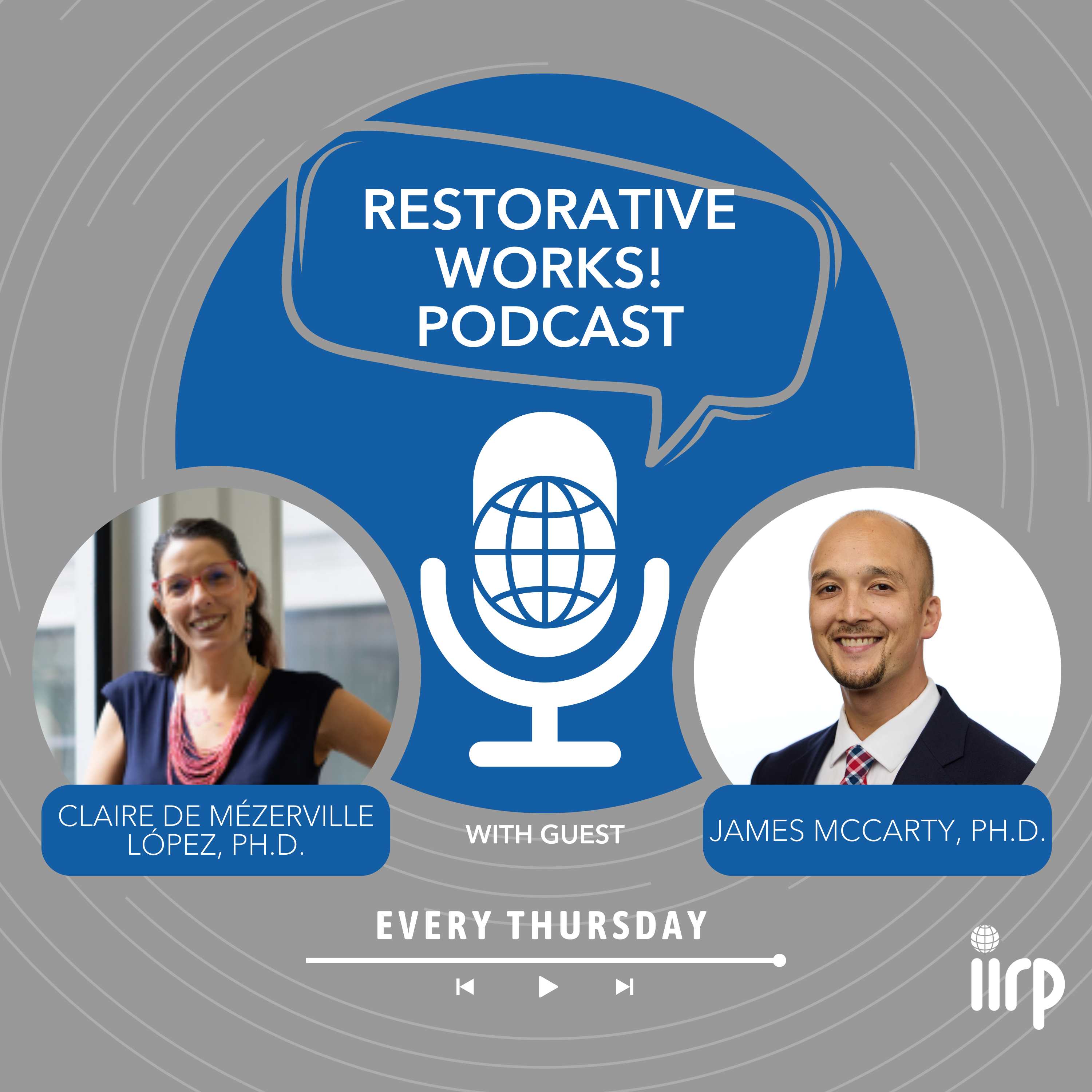
Boston University Professor James W. McCarty, Ph.D., joins us to explore how restorative justice and conflict transformation can reshape the way communities engage in disagreement, repair harm, and build collective power.
Dr. McCarthy invites listeners to rethink one of society's most misunderstood realities: conflict. Rather than treating conflict as something to avoid, he reframes it as a powerful opportunity for growth, learning, and social change. From personal relationships to large-scale movements, conflict is the friction necessary to experience new futures. He discusses the critical role of community in navigating conflict. Whether within social movements, faith communities, or grassroots organizing efforts, strong relationships provide the foundation for constructive dialogue and collective accountability. Practices such as peacemaking circles and storytelling help communities surface difficult truths while strengthening the relational bonds that make change possible.
A clinical assistant professor and director of the Religion and Conflict Transformation Program at Boston University's School of Theology, Dr. McCarthy also serves as a faculty affiliate with the Institute on Culture, Religion, and World Affairs at the Pardee School of Global Studies. He is the author of multiple peer-reviewed journal articles and the editor of two books, the most recent of which is The Business of Incarceration: Theological and Ethical Reflections on the Prison-Industrial Complex (Cascade) published in 2025.
Tune in to discover valuable insights into how dignifying relationships and courageous conversations can transform conflict into an invitation for growth.
Transcription
Claire de Mezerville Lopez
Hello and welcome to Restorative Works, a podcast where learning, practice and research open new paths for transformation. My name is Claire de Mezerville Lopez. It is a joy to introduce this episode to learn more about restorative justice and conflict transformation. And for that today, we have the honor to welcome director of the religion and conflict transformation program at Boston University School of Theology, James McCarthy as our guest. James, welcome. How are you today?
James McCarty
Thank you, I am well, it's good to be here.
Claire de Mezerville Lopez
Thank you, I'm really looking forward to learning from you this morning. Before getting started, allow me to introduce you to our audience. James W. McCarthy, PhD, is a clinical assistant professor and director of the religion and conflict transformation program at Boston University's School of Theology. At Boston U, he is also a faculty affiliate with the Institute of Culture, Religion, and World Affairs at the Pardee School of Global Studies. He's the author of multiple peer-reviewed journal articles, and the editor of two books, the most recent of which is The Business of Incarceration, Theological and Ethical Reflections on the Prison Industrial Complex, Cascade published earlier this year. And James, welcome. Conflict is a necessary part of life. Sometimes we want to avoid it, sometimes we want to escalate it. How do you understand transforming conflict, and how could restrictive justice help?
James McCarty
Yeah, thank you. Well, already you're further ahead than many of my students who show up in the first day of class when I teach conflict transformation courses, who come in sometimes with the presumption that conflict is kind of a bad thing, right? And you've already named, like it's a necessary part of life. It's a very common part of the human experience. Some kinds of conflicts are just natural. Some of them are the result of the societies that we live in. But there's really no living with other people, especially in diverse societies, especially in societies with forms of injustice where there's just gonna be no conflict, that just doesn't exist. And so, the question is then what do we do with conflict? Many of us presume conflict is bad because we've seen it to be destructive. And conflict definitely can turn toward destruction. Lots of us have experienced that in our own lives, relationships destroyed at its most extreme levels. I have examples of mass violence happening in societies. But conflict is also often the space where transformation happens. It's where there is enough attention, enough friction around issues that are contested or causing harm that enable intentional action to do something new, do something different. And so basically every major social movement has been driven by some kind of social conflict, or political conflict, and even in our own lives. Like, I'm an educator, right? Oftentimes for a student to be ready to learn something, they've got to sit in the discomfort of their received wisdoms, the things they think they already know. And sometimes that brings themselves into conflict with themselves, with the things their family has taught them, things they've learned in other kinds of spaces. And so, what I like to think about conflict as is opportunity, as invitation to actually engage the things that might need to be transformed. And I don't think that's that different from restorative justice in the sense that restorative justice practices are often responses to some form of direct or ongoing harm. Harm is one source of conflict, right? And it's an intentional way of engaging instances of harm that can move toward accountability, move toward healing and repair by trying to do or engage in relational social practices that are humanizing, are centered in truth telling, that are based on the experiences of humans in relationship, and that seek some form of transformation. So, I think one of the myths about restorative justice is sometimes people think it's only like a backward looking practice. But really, think what's most powerful about restorative justice oftentimes is that it enables possible new futures, right? People coming together and choosing to live together differently going forward, rather than being stuck in the cycles that we've received or have been living in for a while. So, in that way, I think restorative justice and conflict transformation are really complementary approaches to one another, both of which don't try to run from hard things, and also aren't scared of hard things, but take advantage of hard things as opportunities for change, for transformation.
Claire de Mezerville Lopez
Possible new futures. That is a beautiful way of saying it. So let me tell you this. I've been part of this civil society movement. We've been organizing, and it's a long story that I am not going to go into right now, but we had a conflict recently within the movement and it escalated rather quickly. And I felt really infuriated by the way that some people were reacting, behaving, and speaking. And I was speaking to the people that I was closer to and I really needed to put my mind and my heart at a balance and say, despite my own feelings, there is no way that we can solve this without talking with them, without working out with the leaders from this other side that I really don't like. So that's the part of conflict that it really feels like tectonic plates. They get you through earthquakes that are rather uncomfortable. What's the role of community throughout a process like that?
James McCarty
Well, first, I just want to name and honor, I think the spaces oftentimes where I've seen the most conflict is in places where folks have things in common, right? So, in a social movement, shared political values, those things really matter to people. And so, they hold onto them and cling onto them really tightly, right? And disagreements quickly become not just a disagreement, but a difference of morality, right? Or a difference of political commitment or something like that or can be interpreted in those ways and those are oftentimes the spurs for conflict spiraling into destruction. But again, they can also be opportunities for people to think about whatever it is that folks within a movement are wrestling with. But that's only possible, usually speaking, when there is some kind of existing relationship, I would expand that between the interpersonal to some kind of community, right? You do know you have some shared values. You have some shared experiences with one another through the planning and the organizing and the things that you've been a part of. And not losing sight of that, even when there's deep disagreement about this or that policy or practice or we're going to use this tactic for this action or we're going to think this way about our budget. Sometimes we can be so focused on the particulars of that we lose sight of the communal context in which that's happening. And I think that's one of the things restorative justice does well. It's one of the reasons I really am drawn to restorative justice practices like peacemaking circles, family group conferences, which center communal voice and communal relationship building. It's not that every restorative justice practice has to be a circle or a family group conference or something that's so explicitly communal, but I often think those are the most transformative kinds of restorative practices because of the role of the community and being able to voice broader harms, broader accountabilities, broader context, so that folks can understand what is happening there. But it's hard, right? It's one thing to think about conflict and like social change in relation to the people that we disagree with vehemently on the other side of this or that political project or issue, but inside sometimes can be the toughest.
We see that in religious communities, too, right? So, I teach in a school of theology. Oftentimes, the worst fights are not between the most low church Protestant and the most high church Anglican or something. It's the folks who are just next to you, who are mostly like you, but you disagree on that one or two thing. And those are the fights that get really sometimes the ugliest is because there's so much in common. And so being intentional about keeping the communal relationship as the context in which this is happening and the context in which transformation must occur is, I think, central to that kind of work. But it's really hard because it's easier to take stuff personal when you have relationships with people. So, it's kind of this catch-22. You can do so much restorative work and if you're not intentional about continuing to do restorative work, oftentimes you can create contexts in which things feel a little more targeted toward us as individuals than if they were a total stranger, which is just a reminder for me, restorative justice is not really any one particular practice. It's an invitation to a way of life, right? This is where my indigenous teachers have really emphasized to me, it's not about this or that issue. It's not about this or that practice first. It's about how are you living in the world? How are you showing up in a good way? These kinds of things. And the kinds of context or conflicts you've just named are a reminder of that to me, that it's about how we're gonna be living a way of life together, no matter what the particular issues that might arise in that life becomes. It doesn't have to be direct harm; it can be these moments of ideological conflict or something like that.
Claire De Mezerville Lopez
And it's so easy to lose sight of that basic foundation of showing up and acknowledging other people's humanity and experience. James, thank you so much. We're going to take a short break, and then we're going to continue this interesting conversation. Please stay tuned.
Welcome back to Restorative Works. James, I would really like to ask you about your book. Racial justice is such an urgent and yet difficult conversation. In your opinion, what would a restorative approach towards racial justice look like?
James McCarty
I mean, in many ways, it's like all restorative practices, it's hyper contextual, right? So, I'll speak about my context in the United States as an example for that. One of the things that we're living through right now is denials of parts of our history that relate to racial injustice, experiences of racialized violence. And so, the first thing that I think a restorative approach is gonna do is center forms of truth-telling, right? This is what we do in restorative justice. We sit down with one another, we tell each other our stories, we listen to the stories of other people, and then we have some shared place from which we can do the work of repair and healing. So, the first thing I think that becomes really important is the ability to tell and hear hard truths. I've taken students, American students, on international travel courses to different places. Most recently, Brazil and South Africa, both of which have very robust forms of public storytelling about hard times in their history through museums, memorials, et cetera. I regularly, both of those courses in previous times I've taken students abroad, what my American students will say to me, especially my students who are black Americans will say something like, it's incredible to see a country that's being so honest about the history that has happened in this place, whether it's dictatorships and torture, whether it's racialized apartheid, whether it's else, mass violence, war, genocide in certain contexts. There's an honesty and a directness in the truth-telling that they don't experience living in the United States, where every memorial is contested. Every school textbook is often hyper-politicized in ways that make it really hard to tell basic.So truth-telling is number one, right? That's what we do with restorative justice. We sit down, we tell stories, we use stories as the basis for relationship and for addressing harm, right? So I think that's really important.
Claire de Mezerville Lopez
It's like the Commissions for Truth and Reconciliation. There cannot be reconciliation without truth.
James McCarty
100%, right? That's kind of, doesn't guarantee, truth telling doesn't guarantee things like racial justice or reconciliation, but there's not going to be any without it, right? So, it's kind of a starting place. The other thing I think oftentimes people who are skeptical of restorative justice are skeptical because of the way, what I think of as like the kinds of stories that make the news here in the United States are often ones that are really inspiring and incredible stories of families, of victims who basically adopt folks who've done great harm to their families, these kinds of things. And so, folks think that restorative justice oftentimes is first about something like forgiveness, or it doesn't address harm seriously enough. But my experience is not that. Now, I don't think that's the theory of restorative justice either. The first thing that we're concerned about or the central thing we're concerned about, is one, healing of folks who've been harmed, and then practices of accountability, that doesn't equate to punishment all the time, but accountability. And part of what that means is doing work of repair. And so, I think the next thing after truth-telling is beginning to do the work of repair, right? That comes out of the truth-telling. So, what are the particular kinds of racialized harms? Here in the United States, we can think about, depending on the community, various kinds of things, but there's two kind of fundamental experiences, kind of at founding of the country that we still haven't fully reckoned with and repaired, is the genocide of native folks here and the enslavement of Africans who were brought to these shores. And so, forms of repair around that become central as well. And then the third thing is, as I mentioned in my earlier, restorative justice isn't just backward-looking. It's a forward-looking process. It's about coming together and agreeing with one another about how we want to live together going forward. And so I think that kind of what I would call moral visioning or moral imagination would be another piece of what a restorative approach to racial justice would be. And that's always going to be rooted in practices of relationship, rooted in practices of storytelling, rooted in practices of trying to repair harms that we can name pretty directly, those kinds of things. But those big three are what I think I would point to: truth-telling, repair, and envisioning or imagining a future together.
Claire de Mezerville Lopez
James, that is so powerful. Thank you. Going back to restorative practices, when people are not familiarized with them, and they ask me, what are restorative practices? If I want to take a shortcut, I tell them something like, well, they are very helpful for conflict resolution. But we know that restorative practices are not only, they are not exactly conflict resolution, but it's very helpful because conflict is something that is very relatable, it is something that feels very close. Community organizing is without a doubt our hope for the present and for the future. How could restorative practices help?
James McCarty
Yeah. Yeah, it's a wonderful question. It's one I think folks haven't done enough thinking around and is one of the areas I'm working in my own kind of research and teaching right now. So, I'm teaching a community organizing class right now. At the same time that I teach restorative justice and conflict transformation classes, right? So, I think they go hand in hand for sure. One of the things that we get confused about, I think, in both the work of community organizing and in restorative justice is that we often focus on process or outcome as the purpose. But I would argue in both traditions, all right, the tradition of restorative justice, the tradition of community organizing, if you start to get into the weeds of it, what it's really about is people experiencing transformation, empowerment, and being able to live in a new way. So, community organizing is often about helping regular, everyday, on the ground, grassroots kind of people who don't have direct access oftentimes to lots of money power or something like that, being able to build people power together. It's how to become more powerful to be able to make change in society. And that happens through learning to exercise citizenship, learning how to try to make change in society with other folks, learning how to come together around issues of shared concern so that you can focus a campaign to make change. And if you talk to community organizers, many of them will tell you some version of, yeah, we won this campaign and we lost this campaign and we got most of what we wanted. But the thing I wanna tell you about is how this person who was never engaged before is now a leader in their community. And the focus really is the empowerment of people in communities. Similarly, I think restorative justice is the same. We often wanna focus on this particular practice. So much of our courses, our writing, our workshops and trainings are focused on how to do the mechanics of this, that or that practice with the goal of some kind of outcome, especially if it's directly tied to the criminal justice system, right? Some kind of diversion or something like that. But what's really happening is we're inviting people to live in a restorative way, right? To center. Rather than focus on particular actions to focus on relationships and context, and so that folks can go forward living in a good way with one another. And so, in both of those, I think one of the overlaps is the importance of kind of people empowerment, helping people to find an exercise agency for themselves and with other people. Peacemaking Circles is an example of that, a community exercising agency together to address harm.
There's then overlap, right? So how do we do build power? How do we do things like repair harms? Well, the place that we start in both places is hearing each other's stories, meeting each other in places with real life issues of concern, whether it's this social policy or political policy that is not meeting the needs of a community, or it's this direct harm that's happened between people or communities. You start there, you build a relationship out of which you can transform that into something new; a new political policy, a new way of living with one another. And so, in community organizing, folks will often focus on things like you have the one-to-one where you tell stories with one another. And then we sort of work on justice, we might sit down in a circle and share stories with one another. But both of those are practices of listening to others, expressing ourselves in public to be heard and seen, building a relationship out of that, out of which we can now act differently with one another, whether that's a repairing and healing harm or whether that's exercising power and agency in public together. They're rooted in a similar impetus, which is, I think, actually us living 21st century neoliberal global capitalism that has often individualized, isolated us, made us think our primary mode of engagement is like consumerism or the individual casting of a vote. And both community organizing as a tradition, restorative justice as a tradition, invite us to think about our agency as something that's rooted in relationships and community together to solve problems together. And so, I think that's where a lot of the overlap can happen.
Claire de Mezerville Lopez
And so together we can create new possible futures. James, thank you so much for being on the podcast today.
James McCarty
100 % new possible futures. I love it. Thank you for having me. It's been a pleasure. It's lovely to meet you.
Claire de Mezerville Lopez
And thank you all for tuning into Restorative Works. To learn more about this series and about our guests, please log on to IIRP.edu and let's continue to build transformation through dignifying relationships, kind conversations, and stronger communities. Until our next episode.