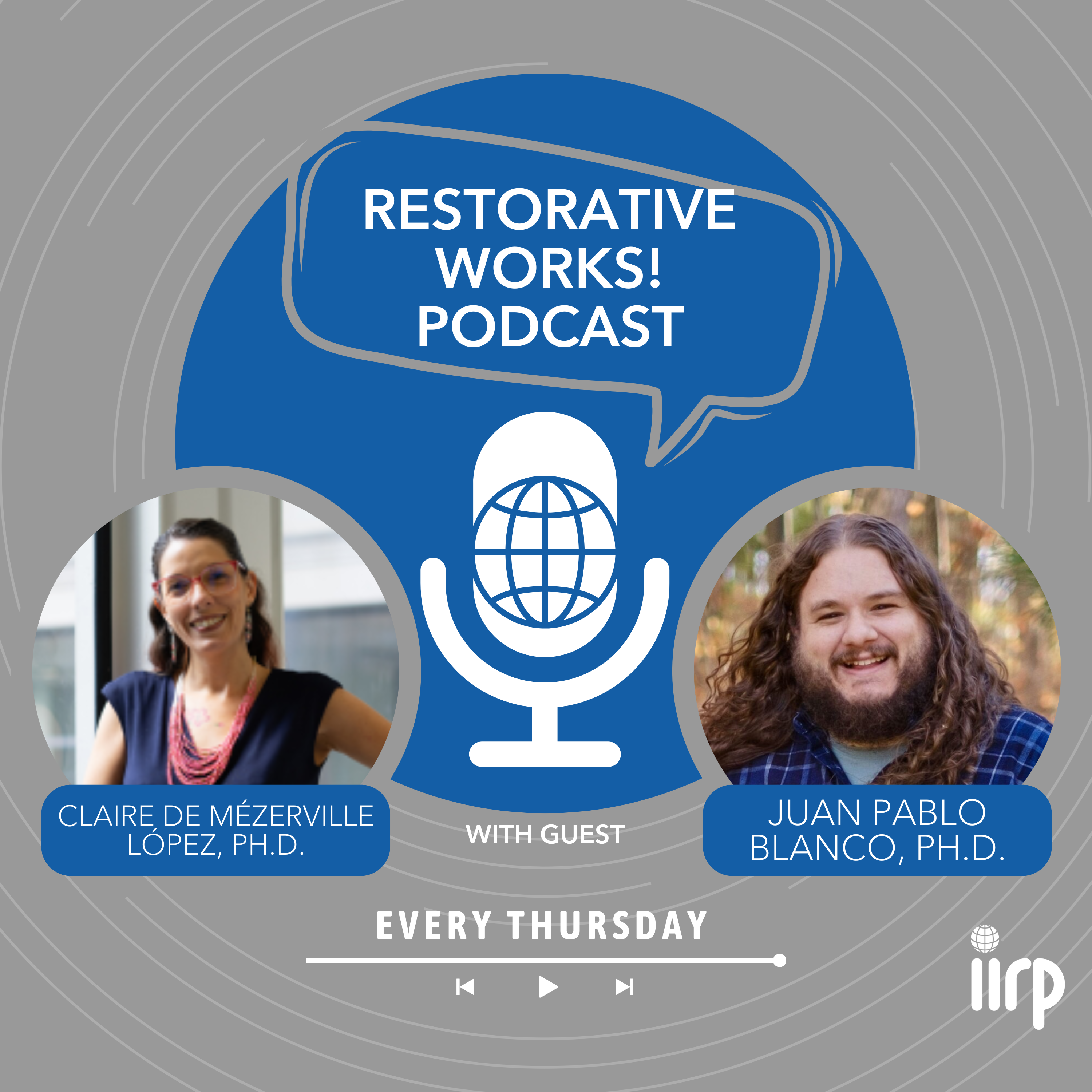
In this episode of Restorative Works! Podcast, Dr. Claire de Mézerville López welcomes Juan Pablo Blanco, Ph.D., for a discussion about intergenerational collaboration, youth leadership, and education justice as a basis for transforming systems that affect youth and families.
Dr. Blanco brings more than a decade of experience in community organizing and community-engaged research to this conversation. As Research Manager at CYCLE, The Center for Youth and Community Leadership in Education at Roger Williams University, he works alongside youth, parents, and community organizations to make research accessible, actionable, and rooted in lived experience. Drawing from his own journey as an immigrant and longtime organizer, Dr. Blanco shares how inequitable systems pushed him toward collective action, and how those experiences now shape his commitment to language justice and intergenerational power.
Dr. Blanco explains how CYCLE brings together young people and caregivers to co-create equity indicators, challenge traditional data practices, and transform research into a tool for advocacy rather than exclusion. He unpacks why school and district data often misses what communities care about most and how changing that process can lead to more transparent, relational, and just systems.
Dr. Blanco currently serves as the research manager at CYCLE (the Center for Youth and Community Leadership in Education) at Roger Williams University in Providence, RI, and as an adjunct professor. CYCLE supports young people and parents engaged in education justice efforts throughout New England and beyond. In this capacity, Dr. Blanco is part of CYCLE's Research and Learning team, supporting community organizations with their research needs and training community members on how to conduct their own research and engage with data for advocacy and organizing. Dr. Blanco holds a doctorate in Community Engagement from Point Park University, a Master of Science in Critical Ethnic and Community Studies, and a Bachelor of Arts in Philosophy from the University of Massachusetts Boston. His dissertation focused on intergenerational collaboration between young people and adults in education justice spaces in Rhode Island. He is currently developing resources for the field based on the findings of this study.
Tune in to gain a greater understanding of why relationship-building, trust, and restorative practices-rooted responses to conflict are not "extras," but essential to sustainable change.
Transcription
Claire de Mezerville-López: Hello, and welcome to Restorative Works, a podcast where learning, practice, and research open new paths for transformation. My name is Claire de Mezerville López, and it is my honor to introduce this episode to learn more about intergenerational collaboration with Community Engagement PhD Dr. Juan Pablo Blanco. Welcome, Juan Pablo!
Juan Pablo Blanco: Hi, thank you for having me.
Claire de Mezerville-López: I am so looking forward to this conversation. Before getting started, I'm going to introduce you to our audience. Juan Pablo is a community researcher with over a decade of community organizing and community-engaged research experience. He is currently the research manager at Cycle, that is the Center for Youth and Community Leadership in Education at the Roger Williams University in Providence. and as an adjunct professor. Cycle supports young people and parents engaged in education justice efforts throughout New England and beyond. In his capacity, Juan Pablo is part of Cycle's research and learning team, supporting community organizations with their research needs, and training community members on how to conduct their own research and engage with data for advocacy and organizing. Through this work, Juan Pablo hopes to make research more accessible, useful, and impactful for those most impacted by educational inequities. He's particularly passionate about language justice and intergenerational power in this work. Being born in Argentina and migrating to the United States when he was 11 years old greatly shaped Juan Pablo's educational and professional trajectory. He was undocumented for 15 years, which at the time meant being kept from post-secondary education opportunities, something which greatly impacted how he understood inequities and injustice, and ultimately led him to community organizing. His entry into organizing was first organizing his fellow restaurant workers, then shifting into the immigrant justice space, and for the past 5 years, focusing on education justice work. Juan Pablo holds a PhD in Community Engagement from Point Park University, a Master's in Critical Ethnic and Community Studies, and a Bachelor's in Philosophy from the University of Massachusetts Boston. His dissertation focused on intergenerational collaboration between young people and adults in education justice spaces in Rhode Island. And he's currently developing resources for the field, based on the findings from this study. And in his free time, Juan Pablo enjoys playing bass, cooking, and going on walks with his wife and his baby daughter, and his dog, Okra. And…Juan Pablo, it is so good to have you on the podcast. Here, we talk a lot about restorative practices, and in different episodes, we have insisted that these are practices that we do with children and with youth, not to them.
So, let's get started with this. Would you please describe to us your work with youth regarding educational justice?
Juan Pablo Blanco: Yeah, so thank you, first of all, for the kind introduction. A lot of what we do at Cycle is working with young people, but also working with parents and family members to build intergenerational power. Right? I think we often see young people and youth work, quote-unquote, be really siloed from work that happens with adults, and something we try to do as an organization is sort of break down some of those barriers, because they're made-up barriers, right? Like, these are sort of folks that are fighting for the same things. Oftentimes, and, for some… sort of the way the field has developed, sort of work separately. But my work specifically with the research and learning team at Cycle.
So, to me, the way I look at it is, like, this is the perfect intersection between community organizing, sort of the practice of trying to build power and create change, and community research, right? And we really try to break down what research means, so that it's no longer sort of this idea of, you know, some old man in a white coat somewhere. But research is something I could support organizing, right? It's not just research for research's sake. And something that we do is sort of bring in… something we have been doing for the last few years is bringing in together intergenerational groups of caretakers and family members and young people to work together. Something we've been working on for the last few years is a project called SCORE, which is Schools and Communities Organizing for Racial Equity.
We've done this project in three communities in Rhode Island, Providence, Central Falls, and Newport. And we brought together these intergenerational teams of young people and parents from those districts, and sort of, like, taught them how to do research. Right? Because we know that if we sort of skill-build in communities and increased capacity, they'll need to rely on organizations like ours less, right? These folks sort of, like, know what their experiences are, and they know sort of what possible solutions to them might be. We just sort of want to help them get the right tools that they need to be able to sort of make these things actionable.
So I think what we've been doing is, you know, we saw this issue in a lot of school districts, where we know school districts measure a million things, right? To report to the federal government, to the state government, sometimes to their own sort of equity work. And we know that community members want to know a lot of things, but those aren't always the same thing, right? So we know that there's a lot that's missing in what schools sort of measure, in what data they present. And even when they do measure what communities want to know, they don't present it in an accessible way, right? You need somebody with very specialized training to be able to engage with it.
So we try to flip that process on its head, and have these young people and parents develop equity indicators to see, like, how's my district doing and the things that we care about? Sometimes these are things the districts are already measuring, and that's great. Sometimes these are maybe, like, blind spots for the districts. And obviously, you know, we've had a very mixed sort of reception to this work from school districts. Some have been like, yes, this is great, we want those that are the most impacted sort of making decisions about how we measure how we're doing. Others have been very, defensive, maybe, sort of with this idea that, like, we don't want to be shamed, right, if we're not doing well in certain areas. So, some of our work, sort of, in the coalition-building space, has been to sort of change those conversations into, like. you all care about the same… like, a lot of the same things that community members really care about. Let's be transparent with how we're doing, and let's work to make things better.
So that's one of the big things we've been doing, and again, this work is only positive, only possible with youth leadership, and with youth, saying, like, these are the things that impact us deeply.
And we couldn't do that TO young people, right? It has to be WITH young people, and if anything, like, we need to know when to step out of the way and let them sort of lead this work.
Claire de Mezerville-López: It is quite a challenge, and I love it, because it's looking at research. When you think about research, and also when you think about school district reports, you are thinking about statistics, you're thinking about pie charts, you are thinking about very complex matters, like you mentioned, sometimes they may not feel as accessible, and when I think about my own students, they are 17, 18 years old, and when I say, well, for this course, we're going to do a research project, and the class is like, ugh. And I'm that teacher that says, what are you talking about? Research is cool! I want you to think that research is cool, but then just creating that space for, let's find where our curiosity is, and let's find where our passions are, and what's going on with that, so we can learn how to go into that data information, into those realities. So, I think this is…So interesting and important. And in your dissertation, you focused on intergenerational work. Can you share with us a little glimpse of your findings?
Juan Pablo Blanco: Yeah, and this literally came from when I started my position at Cycle at this point 5 years ago. I was new to intergenerational spaces. I had done community organizing with adults before, with college students, or, like, young adults.
So, when I first got here, I was like, okay, let me go online and find some resources. Let me, like, skill build myself and see what I could do, and I found very little there. So when I got to this doctorate program, I was like. maybe I need to start sort of building some of this, right? And that's sort of where I ended up with this topic about intergenerational collaboration and education justice, because again, it's something that I do for work, but it's also something that I'm really passionate about, and that I saw sort of a gap both in the academic literature, which obviously I'm interested in, but most importantly, in sort of the practice side. Which, you know, most people aren't going to be going to an academic journal to see how to do their work. I wanted to see how we could build some, like, really actionable and accessible tools. You know, I learned so much more than I ever thought I would in this process, as somebody who's deeply embedded in this field and in this work. I think some of, you know, in my… in the… findings of the study, I focus on barriers to intergenerational collaboration. And also some necessary structures that have to be put in place if we're gonna be able to do this in a way that's actually, like, capacity building for both young people and adults. And we're not replicating some of the same, like, adultist relationships, where, like, adults sort of set the agenda, and maybe ask young people to say, yes, that's cool with me, and then continue the work, so that we can actually do something that's more transformative. For both sides of this relationship. And you know, I found… I ended up… my dissertation has recommendations for, like, all the stakeholders that we work with, from individuals who want to do this work.
Community-based organizations, funders, which was a big thing, like, these structural barriers for organizations that are like, we want to do this work, but it takes a lot of capacity, and funders don't… often don't want to fund things that aren't measurable. And, like, relationship building, trust building, these aren't things that you could very easily sort of put into a grant report. So what I hope, you know, with the tools that I will be developing from these findings, is that funders can read that and be like, okay, maybe we need to sort of reframe how we're supporting this work.
We've been lucky enough that some of our funders with Cycle have been open to having those conversations. Our executive director is really good at sort of, like, translating this into funder talk, so that they can understand what we need from them, which isn't always easy, and it's something that I'm learning how to do. But also policymakers, right? Like, when we have a lot, for example, here in Providence, and I can speak a lot about Providence, because is not only where I work, but also where I live.
There's a lot of policymakers that are really interested in, sort of, the youth perspective, but don't have the right, sort of, like, training and the right, sort of the right resources to know how to have youth support, and have youth lead into some of sort of what they see as solutions to our problems, and I think this is where we come in a cycle and be able to do some of that translational work between young people and policy makers. But yeah, like I mentioned before, I have this long dissertation, it's a real page-turner, really recommend everyone read it. But in reality, no one's… you know, most people aren't going to be reading a dissertation to sort of find these things. So I've been working with a few participants, you know, this is sort of like a beginning of the year project for me, is to get together and think, like, how do we create, like, actionable protocols, actionable, like, information sheets, things that, like, organizations and individuals could use. To be like, we're interested in intergenerational power, this is how we do it. At Cycle, we've been able to develop some of that already, but, I think… this dissertation process has really opened up my eyes to more of the nuances of how we do this work, and my hope is to sort of turn this into things that will be useful, and that then will be field tested, because to me, that's something really important, right? Like, I can develop a whole toolkit about things. But if somebody actually is on the field trying to use them and they don't work, then it's kind of useless, right? So, it's going to be this iterative process of creating the tools, testing them out on the field, both as Cycle, but also our partner organizations that are interested in this, and then going back to the drawing board and editing, changing, sort of making these things, like. Really stand, sort of their use case.
Claire de Mezerville-López: I love that. Because we are very curious about how to turn this…data-driven, curiosity, research-based efforts into practice, community, relationships, and actions. We're going to take a short break, and then we're going to continue this interesting conversation with Dr. Juan Pablo Blanco. Please stay tuned.
Claire de Mezerville-López: Welcome back to Restorative Works. Juan Pablo, you have a lot of experience with coalition building, too, particularly across stakeholders, like district leaders, community-based organizations, parents, youth leaders. Also. you bring yourself into everything that you do, your life story, your experience, all of the organizing stories that you have built over the years. So, remaining in this topic of intergenerational collaboration. In some parts of the world, we see both exclusionary practices from adults but also a reluctance from youth to engage in community organizing, and I will just… speak, for my own country, we're going towards presidential elections, and we see that some of the population that are most likely to not go to vote are from 18 to 35 years of age. So, what have you observed on how could we, as communities, do better to engage youth leadership.
Juan Pablo Blanco: No, and thank you for bringing that perspective, because, you know, obviously you're speaking about Costa Rica, and I'm coming from the U.S. context. There's a lot of parallels. There's a… young people really feel… sort of alienated from electoral politics. And this is both at the federal level, this is our, you know, most importantly for us, like, at the municipal level, right? Like, our city elections, our state elections that really impact education in a way that sometimes, like, federal elections don't impact it as much. because of the way the U.S. works, right? Like, education happens at the state level. But one thing I'll maybe push back against is sort of, like, the idea of reluctance. of engaging in community organizing, right? Because I think a lot of young people are engaging in community organizing, even if they don't call it that, right? They may not have, maybe, like, the wording for it, they may not have maybe sometimes, like, the very, like, specific skills to do community organizing in a… in maybe, like, a super impactful way sometimes. Sometimes it's more about, like, releasing this energy that they have, that they need, like, we see issues and we really want to do something about them.
But I think, like, something we've been able to do well at Cycle is tapping into the organizing that's already happening with young people, right? Providence is a small city, but somehow we have, like. seven, youth-serving organizations that are doing work, which is… we're really lucky to have that sort of organizing ecosystem. That brings its own challenges sometimes, because, right, like, we're fighting for the same pots of funding sometimes. But, it really has developed sort of this ecosystem of collaboration and work. where there's a lot of youth that are already super involved, right? They're already, like, at the forefront of the organizing space here. But I think one thing that we've had to do is be really intentional about, like, how do we capture the experiences and voices of young people who aren't super involved?
Right? Like, those that don't consider themselves leaders, that don't consider themselves work that is quote-unquote for them.
And something we've done is be really intentional about how do we, when we recruit these intergenerational teams, for example, how do we bring in young people that aren't, like, the valedictorian that aren't the students that are, like, in the school newspaper, because they're already, like, doing so much in their schools. And it's hard, right? Because, again, like, I think a lot of young people have internalized this idea that this doesn't work for them, that sort of what they do isn't gonna change anything. I think…Because of the way our schools operate, too, with this idea that, like, young people don't know anything, and it's adults' job to sort of fill their head with the knowledge that they don't have. You know, sometimes I see that replicating outside of school, and it's our… something we need to fight really hard for, is to not make these engagements feel like school.
Because that's not working… the school setting is definitely not working outside the school setting. So that's something we've been doing. You know, it's difficult, it doesn't always work. Sometimes, you know, it's a reality that some young people may drop off and say, like, hey, this isn't for me, and it's up to us to, like, pivot and figure out how do we capture them or recapture them. And I make them understand that this work is meaningful, and it's impactful.
But that's something that we've been doing a lot in the last few years, is sort of how to do that, and also leaning into our partners. Like, we don't do our work by ourselves, we're this huge coalition of organizations throughout New England that both share skills, share learning, share best practices, to be able to do what we do. So that's one thing I will say about, sort of, the youth organizing space. But I think on the adult side is, and this is something that I'm hoping to do with the findings from my research, is…how do we sort of have adult, even well-meaning adults, understand that sometimes they're gonna do damaging things? Like, conflict is gonna happen, they're gonna sort of fall back into problematic dynamics just because that's the way our society operates, right? Like…we could create these bubbles where we try to be a lot more just and a lot more better organized, but the reality is we live in an adultist world, right? Where adults are sort of the supreme leaders, the ones who have all the knowledge, the ones who have all the wisdom.
So we're gonna mess up. And our job is, for ourselves as practitioners, but also to the folks we work with, is to understand, like, we're gonna mess up. And our work, you know, and it's a great conversation for this podcast.
It's about restorative practices, right? Like, how do we regain trust? How do we build back relationships in a way that doesn't just say, like, hey, just ignore what happened and forget about the trauma that you were caused. But, like, let's work through it, let's have these difficult conversations, let's move slower.
Which, again, going back to this funding conversation, like, funders don't love when we work slower, because, you know, they have, sort of, reports to present to their boards. But we know that, like, relationship building takes time, and it takes trial and error, and it takes, like, redoing things multiple times until you get it right. So, we've been trying to do, on both ends, like, on the practice side, on the funder side, trying to make sure, like, our whole field is understanding that, and sort of living up to that value.
Claire de Mezerville-López: And I love that. I was going to ask you about restorative practices, but you went ahead of me, so let me ask you this other thing, because I would love to ask you this question. Your journey also started as a youth leader, but…As it happens, time passes, and then we become adults. We're not the youth leader anymore, but now we're the adults working with youth. Through your… not only your dissertation and all your community organizing work, I think through everything that you do, in the recent years, you have worked with a lot of young people.
Is there a story or an anecdote that you would like to share with us as we get closer to wrapping up this conversation about something a young person said or did. That you thought, wow, this is an eye-opener for me now, as an adult.
Juan Pablo Blanco: Yeah, it's interesting, because I got into community organizing I would say, quote-unquote, as an old person, compared to some of the young people that I work with, that are, like, somehow 13-year-olds that are just, like doing amazing things, and sort of, like, really pushing…Right? I started, you know, in my 20s, because, you know, I had to sort of… this, maybe a conversation for another time, but I had to unlearn a lot of my own understandings of what I was able to do, what I should be able to do.
But yeah, sort of in my 20s is when I got into this work. But, I mean, I… it's hard to come up with one sort of specific situation, because I met so many incredible young people that have impacted me so deeply. I think something that…
I, to this day, I continue to lean on is sort of young people being able to just say no. And I mean this both in the sense of…you know, when there's injustices and there's inequities that they see, just saying, like, no, I'm not… I… we just can't accept that as a given.
Right? Like, the world has to be different, because if not, like, what are we doing here? And that's something that I always remind myself, like, a lot of the assumptions we have about the world, and how people just say, like, that's just how things are.
Well, young people often remind me that it doesn't have to be that way, and it's up to us to change that. But then also, on the other hand, something that I've loved about working with young people is them, you know, we're, like, strategy building and thinking about how, you know, campaigns might work, and they can just say, no, I don't want to do that.
And at first, I was like, well, you have to, right? Like, you're part of this work. But it's about young people saying, like, having… empowering themselves to say, like, that is not a role I want.
And, you know, sometimes, particularly young people who are, you know, especially in our communities that are working full-time, going to school full-time, helping their families in a myriad ways. And they're like, I don't have capacity for that. And that has been so eye-opening for me as a practitioner, to also remind myself, like, I need quality of life, and I need to sustain myself, because if not, I'm going to burn out, and then I'm no longer going to be doing this work. So it's both something that I saw when I first got into organizing, you know, talking to elders, folks who are these, like, 50-year, you know. have these, like, 50-year-long careers in organizing, and sort of learning from them what has sustained them over all the years. I think it's been even more impactful just to sort of learn from young people, just say, like, learn when to say no, learn when to say maybe later, and learn when to say, like, we can't do this now, but maybe we'll do it in a month.
I think… that has really, like, pushed me to think about my own practice. Yeah, and I could give you a list, a long list of young people that had sort of, like, taught me that lesson over and over again.
And I think I'm finally at the point where it doesn't, like, shock me anymore, because I've… I find myself that I've learned from them. But it's a great constant reminder, because, you know, we have these conversations at Cycle as an organization a lot about, like, our well-being as people in this work.
You know, I don't… I'm sure there's a study out there that tells you what the average lifespan of somebody in this work is, and I'm sure it's pretty short, because we care about this so deeply, we're so passionate, that sometimes, like, you get into your own way, and end up burning out.
And young people are saying no. They're, like, changing the field in front of us, and I love that, and I'm here for it.
Claire de Mezerville-López: That is so inspiring. Juan Pablo, thank you so much for being on the podcast today.
Juan Pablo Blanco: Yeah, thank you for inviting me, it's been wonderful.
Claire de Mezerville-López: And thank you all for tuning in to Restorative Works. To learn more of our guests, log on to IIRP.edu, and let's continue to build transformation through dignifying relationships, kind conversations, and stronger communities. Until our next episode!