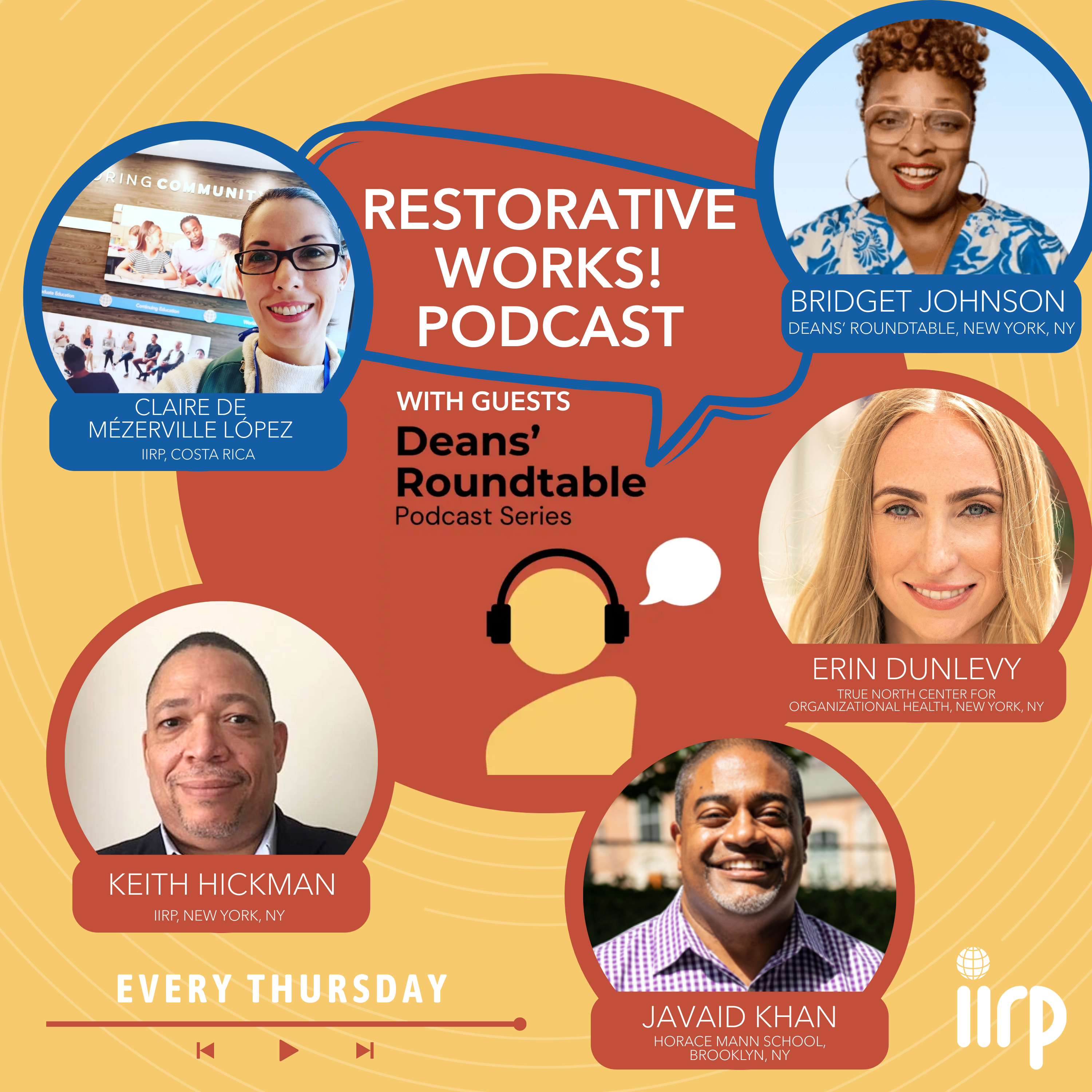
In this special collaborative episode, Claire de Mézerville López is joined by cohost Bridget Johnson, current IIRP graduate student and founder of the Deans' Roundtable, an organization that supports student life professionals. Together, they dive into this collaborative episode on Restorative Practices That Move the Needle. Through the power of storytelling and the exchange of in-depth experience, they engage leaders to talk about the implementation of restorative practices, focusing on what it looks like to experience a significant collective transformation that centers community and group empowerment. They are joined by leaders in education: Javaid Khan, Erin Dunlevy, and IIRP Vice President for Partnerships, Keith Hickman.
The panel names a truth many schools and workplaces struggle to confront—hierarchy and efficiency often overshadow relationships. Guests explore why slowing down feels risky, why vulnerability can unsettle leaders, and why communities still default to punitive systems even when they aspire to healing. Erin highlights how true restorative work demands time and trust-building, emphasizing that you cannot restore what has not yet been built. Keith moves the discussion toward the deeper paradigm shift required, urging leaders to move from "fixing to facilitating" and from "power over to power with." He shares how structures of belonging, thoughtful preparation, and shared norms transform spaces into communities capable of meaningful change.
Javaid brings a practical lens, illustrating how schedules, routines, and institutional habits, though inanimate, behave like living barriers unless leaders approach them with curiosity and intention. He shares the transformative power of modeling vulnerability and staying present with staff as they navigate new ways of working. Bridget and Claire guide the dialogue toward the heart of the issue: restorative practices are not quick solutions. They are long-term commitments to culture change, shared language, and humanizing one another in everyday moments, not only in times of harm.
Tune in to find inspiration and clear direction for educators, leaders, and communities seeking sustainable transformation.
Transcription
Claire de Mezerville López
Hello everybody, welcome to this shared episode of Restorative Works and the Dean's Roundtable where storytelling meets transformation. Through strengthening our communities, we lift up the voices of those who are weaving restorative practices into the fabric of their interactions within each collective, family, workplace and classroom. I am Claire de Mezerville Lopez, and I am truly honored to co-host this episode alongside Bridget Johnson, current IIRP graduate student and founder of the Dean's Roundtable, an organization that supports student life professionals. Together, we are diving into this collaborative episode on restorative practices that move the needle. Hi, Bridget.
Bridget Johnson
Hi Claire, how are you today?
Claire de Mezerville López
I am so happy to be here and to have this conversation with you and with this wonderful guest.
Bridget Johnson
Yes, so am I. And so, through the power storytelling and the exchange of in-depth experience, we engage leaders to talk about the implementation of restorative practices focusing on what it looks like to experience a significant collective transformation that centers community and group empowerment. I am so excited today to be collaborating with the IIRP and having the table podcast as a collaboration to chat with Javaid Khan, Erin Dunlevy and Keith Hickman about Moving the Needle. So, Claire, you wanna introduce our guests?
Claire de Mezerville López
Absolutely, and there's so much to be said about each one of you. Thank you so much for being here. Before we get into the conversation, I'm going to start telling our audience a little bit about each one of you. I'm going to start with you, Javaid, if that's okay. Javaid Khan currently serves as the head of the middle division at Horace Mann School. Prior to his appointment, he was the head of upper school on grades five to eight at Bank Street School for Children.
Bridget Johnson
Mm-hmm
Claire de Mezerville López
Javaid received his bachelor's degree in sociology from Wesleyan University and his master's degree in educational leadership from New York University. Previously in his career, Javed worked in various capacities at Poly Prep Country Day School in Brooklyn, including as an English teacher, basketball coach, and the director of diversity. After leaving Poly in 2000, Javaid pursued a career in music, spending 10 years DJing full-time. And during that decade, Javaid was also a curriculum writer with the New York Times Learning Network and served as a director of The Boys Project, a nonprofit organization. He's a former member of the Board of Trustees at the Town School in New York City and former co-teacher in the ISM, leading the effective middle school institute. Javaid currently co-leads the NYSAIS Experience Teachers Institute, is married to a fellow division head, is the father of two hilarious kids, and lives in Fort Greene, Brooklyn. And it's so wonderful to have you in the podcast today. Welcome.
Javaid Khan
Thank you so much. It's great to be here.
Claire de Mezerville López
It is great to have a conversation with you and with Erin, who was in the Restorative Works podcast a little bit ago. Hi Erin.
Erin Dunlevy
Hey, Claire, great to see you again.
Claire de Mezerville López
It's so wonderful to see you again. Let me tell our audience about you. Erin Dunlevy is a New York City based restorative justice practitioner and educator with nearly two decades of professional experience in schools and universities throughout the US. And she currently works on projects around the country training stakeholders from schools, districts, community organizations, and for-profit companies who influence education. Her areas of focus include developing restorative justice models for peacemaking across lines of difference, truth and reconciliation, and critical consciousness. Her work has also focused on developing and implementing restorative justice models for addressing equity issues within secondary and higher education classrooms, specifically as an advocate for culturally responsive pedagogy, native language arts educations, and in-class restorative circles.
Erin has written and presented extensively about evaluative measures for restorative practices in institutions cited for disproportionality and high incidences of violence. In addition to field work, Erin is a trained intimacy professional and instructor at the New York University Metropolitan Center for Research on Equity and the Transformation of Schools. The Institute for Democratic Education in America is an adjunct professor at Columbia University and is vice president of True North Center for Organizational Health. And Keith, so great to have you on the podcast today, Keith. How are you this morning?
Keith Hickman
Feeling pretty good, Claire. Thank you for having me on. And thank you, Rob Bridget, for having me on.
Claire de Mezerville López
I'm looking forward to listening to the three of you, but before we do that, allow me to say that Keith Heckman is vice president for partnerships for the IIRP, where he leads strategic efforts to strengthen relationships, empower communities, and advance restorative practices worldwide. Keith has worked across education, justice, and community systems, advising initiatives such as the Maryland Commission on addressing the school-to-prison pipeline, CASEL's Equity Work Group and the California State Healthy Responsiveness School Network. His efforts have helped shape restorative practices in cities like New York, Chicago, Los Angeles, and Louisville, as well as internationally in the country of Jamaica. In Detroit, he collaborated with schools, law enforcement, community organizations, and a local foundation to embed restorative practices in their work benefiting children and families. So, we really want to have this conversation about moving the needle, Bridget, what you think.
Bridget Johnson
Yeah, I'm ready to go. What a great group, I'm feeling like maybe I should have like polished up my resume and my accolades. We've got some really special people in the room today. So, I'm super excited to jump in and get started with this conversation. And so, in the first half of this episode, I will present the questions and suggest an order for our guests to respond. However, this is really a conversation. So, feel free to kind of jump in and delve deeper as you need. Let's get started. The first question is: give us a little bit of background about how long you've been doing the work that you do and how you were introduced to restorative practices. Javaid, how about we start with you and then we'll go to Erin and then to Keith.
Javaid Khan
Thank you, yeah, I'm happy to take that one first. My story is gonna be tied to another panelist that you have here, Keith Hickman. So, I'll start by saying that I attended a few restorative workshops with educators years before I met Keith, and I was very intrigued by the process. I felt like they kind of opened the surface, gave me a little opening into what this work could look like. And I had seen some films on work that was done in prison systems, and so I was trying to figure out how does that combine and translate to the school. And then one day we had, while I was at Bank Street, parent-teacher conferences, and in our school the students run their own conference at age 10, so at fifth grade they run their own conference. And Keith happened to be a parent in one of our grades, and he came up to me afterwards and said, I don't know if you know this, but this school is primed for restorative work. And I was like, you know, I've always felt that, you know, I didn't know how to get it started. And he said, maybe you don't know what I do. You know? Little did I know that I had the guy here in my own midst. And that turned out to be a multi-year relationship. Keith and I have really, I've relied on him more than he's relied on me, but I’ve really reached out to Keith in moments of looking to really understand how restorative work translates into certain situations we had, whether with faculty, students, or families.
Bridget Johnson (09:28.965)
Mm-hmm.
Javaid Khan
And it's been an important tutelage for me to really learn under him. Keith has also come in and spoken in our school. He's done assemblies, et cetera. But really my kind of move into deep dive of restorative practices started with Keith and IIRP. We started that at Bank Street together. We did a year where we introduced the program to faculty and kind of got the community ready and then moved on to Horace Mann. When I left, I brought Keith up there with me. My first year happened to be that 2019-2020 year where many of you will remember that time. And we moved our plans to do a workshop. We were going to do two six-hour days, and we did them online instead at a time where people hadn't even done a lot of online work in schools. And, all of a sudden, here we were doing six hours in June. And I thought it was going to be a disaster.
I figured I have faith in these things, but I thought the faculty really would be unhappy with spending that much time online. And it was the exact opposite. It was one of the richest experiences. It kind of created the platform from which we've just evolved from there. We've done work every year. All of our new faculty get trained. We've done work with families, with students. So, it's been an incredible journey. And I think the biggest switch for me was really understanding that restorative practices was about the community and not just about a discipline issue. And once I got that, things started to make sense for me.
Bridget Johnson
Absolutely, and it's a marathon, not a sprint, right? Take some time. Erin, how about you?
Erin Dunlevy
Thanks so much, Bridget, and it's great to meet you. I think I'm connected to both of these panelists in different ways. So, I've worked with teachers at Horace Mann, and we're neighbors up here, Javaid, so we'll have to chat later. And I think I've done quite a bit of work with and a lot of learning with IIRP. Some of that had to do with Keith as well. So, it's great to be with you all. My initial training in restorative justice actually happened in Minnesota. I was teaching for five years, teaching and living in New York City and I was doing quite a bit of theater with young people, you know, theater activism. And someone said, you know, if you really like storytelling, I have a feeling, and activism, I have a feeling you'd love restorative justice. And so, I went out to Minnesota and I did a week-long training where I was in circle for eight hours a day for five days with an organization called The Restorative Way. My teachers were Jamie Williams and Oscar Reed, always have two. Shout them out. Oscar Reed was a Minnesota Viking, and then he got into juvenile justice and started doing restorative justice work. And when I tell you eight hours of Circle, by day three I was like, I'm not gonna make it. I'm not gonna make it. And I remember one of my trainers said, the Circle has no rules. And I had been a high school teacher for almost five years at that point. Nobody's gonna tell me there's no rules. How do you do anything with no rules? How dare you? How dare you?
And then by day four, I was deeply transformed as a person, deeply transformed. And this was a circle we were doing with firefighters and police officers and really civil servants and teachers, educators, people who face the public. So, I brought that back to the school that I was teaching in Manhattan. It was called the High School for Arts, Imagination and Inquiry. within one year, I mean, it was really just me and some friends. We have to do this. We have to try this. We started meeting in circle as teachers and I think that's really essential. As adults we were meeting first in circles. We were having our UFT meetings in circles. We were having our department meetings in circles, and it just started to grow that way organically and then many of us were doing circles in class and we noticed, we started to do what I would call now participatory action research: we started to notice like a dramatic reduction in suspensions within like six months. Dramatic.
Young people were having circles in the hallway, we had talking pieces everywhere, we started a little Justice League. And I was so interested, I wanted to continue my training, so then I went to IIRP and did the training of trainer’s program. And we then invited IIRP to come to our school and to try on full implementation. collaborating also with local organizations in New York City at that time to push to get restorative practices in what we call the Blue Book, which is essentially the Chancellor's regulations for discipline. Again, doing our own research on disciplinary data, doing our own research on academics, right? How are young people feeling connected to classroom, to teachers, to one another? And how are we holding ourselves accountable as adults is ultimately the reason why anything, if something's going on in a school, likely had something to do with us and how we were managing and thinking about our relationships as interdependent communities. So, sort of writing, publishing, and then, you know. I moved on from their training schools all over the city while still working as a teacher. And it wasn't until 2015 I finally resigned after 14 years and started working for NYU Metro. And now, yeah, I teach in university settings. I teach a course on restorative justice at UPeace in Costa Rica. So, Claire, I'm going to have to come visit. We'll get a coffee when I'm there this spring. And I'm thrilled to work in restorative justice in a lot of different areas here in the state. So really, really happy to be with everybody.
Bridget Johnson
Yeah.
Claire de Mezerville López
Absolutely!
Bridget Johnson
That's pretty amazing. Thanks so much, Erin. And very nice to meet you as well, virtually. Keith, long time no see. It's been 24 hours. How was it?
Keith Hickman
It has been 24 hours hasn't it? Well it was great. Bridget and I had the chance to meet for coffee yesterday and one of the joys of my job, I feel like I have one of the greatest jobs really because I get a chance to spend time with people and I give a lot of myself and my time to people because I believe in these practices so strongly. But it really is the people that drive the practice, the community by which we build our social networks, which makes it a very, powerful, powerful thing to do. So, I, you know, it's interesting this question around, you know, professionally, my journey began in like, you know, probably about 12 years ago in a formal setting in terms of developing professional acumen in doing this work. However, I would say that the roots of this work, the origins of this work begin long before me, for any of us, but even before I became a professional, I recall it in... in going into high school, I was very moved by the civil rights movement and civil rights work. Actually learning about the civil rights movement and becoming really quite knowledgeable about it, it got me into justice and really the basis of restorative justice, restorative practices is justice work. And I was so dramatically moved by that work that I attempted (with a big A and bold and underline) to write a peace studies curriculum in high school. Yeah, it was corny like that. But it was, I wanted to make a change. I wanted to be a person who made a difference in the lives of others because I was beginning to see the world through the experiences of my mother and father, which was a very emotional experience for me when I realized that my father for most of his life and my mother could not sit in the front of the bus. And so, when I started to really understand the living history of my own family members, this work became very powerful for me. So, I want to seed it in that first. I started to do the work. Formerly at the Harlem Community Justice Center, which was under the Center for Court Innovation at that time in the early 2000s, it's now called the Center for Justice Innovation. I had opportunity to develop community court models, in particular Youth Justice Project in Harlem. And that's really when I began to understand what this work was really about. And I had the fortune of having a mentor who brought me into the International Institute for Restorative Practices. Her name is Tanya Lewis. I owe a great deal to her because she really opened the door for me to do this work at the IIRP. And so, one of the things that I'll share about the beginning of this work that I'm hearing in all of our experiences is that in a hero of mine, I would say, a person that's had a great impact on me is Peter Block out of Cincinnati, Ohio. You would know Peter's work as a consultant. That's what he's known for. But really has done extensive work on structuring belonging through community work. And one of the things that excites me about moving forward with this work and continuing is that restorative practices, it often enters our lives or entered my life, not through theory, but through relationships and through someone who invited us or invited me into a different way of being together.
And one of the things Peter says, and I'll end here and let you ask the next question, Bridget, but one of the things that the mantras for me doing this work is that community begins with invitation. I believe that. An invitation to participate and to show up differently. And that's what I think each of us have experienced. If it wasn't for Javaid inviting me into the space at Bank Street, we wouldn't probably have seated this work. The same thing with Erin. I'm sure you would have invited to spaces to do this work. So, I always try to find the tangible things, the human connection in the work that we do. And I think that begins with the power of invitation and being relational.
Bridget Johnson
Thank you for that, Keith. I really appreciate it and so when thinking about the next question We've kind of touched on it a little bit already, but you know moving to a restorative community is not something that happens overnight. It's not just about transforming one sector area of your school or department or organization. It's really about creating those relationships and creating community. So, talk about the steps that one takes to move into a restorative community and what are some of the common resistances that you may initially encounter? We'll start with Erin, then we'll go to Javaid. Actually, we'll start with Erin, then we'll go to Keith, and then we'll go to Javaid.
Erin Dunlevy
Thanks so much, Bridget. What a great question. Steps to move into a restorative community. I think for us, I have a partner that I do this work with at RP NYC is our organization. We talk a lot about this awareness alignment and then accountability as the steps. Essentially, awareness means that we slow down enough to see how harm and disconnection are normalized in the community. And that's any community. It can be a school community or a professional community. But it's really about surfacing patterns. So, like how decisions get made, whose voices are missing, where trust has been eroded. And of course, like if it's in a school setting, our disaggregated disciplinary data is going to give us a lot of trends. awareness of our mindsets around what justice means is essential. I think then when we start naming our shared values and practicing new habits, this would be training time, really alignment about the values of restorative practices.
We can then kind of move into accountability, which is where we get systems and processes. And it's when restorative stops being kind of a concept and starts being a culture, a thing that we do: oh, when this happens, this is what we do here. This is how we communicate with one another. The most common resistance, I don't think anybody would disagree with, that I've found is like a fear of loss, right? Like a loss of control. There's me in the circle being like, what do you mean there's no rules, right?
There's a comfort that hierarchy brings, especially for educators. We tend to teach how we were taught. And then people often want restorative outcomes without restorative processes, right? Like, just because we're seated in a circle, if we're lecturing those young people, we're yelling, we're kind of demanding apologies. We say we're to healing, but really what we mean is like we're looking for quick forgiveness and we're looking for the young person to be restored, right? Like, go restore them and then bring them back.
Fundamentally restorative work takes time, I often say three to five years, and that discomfort feels, it really feels like a threat to efficiency, right? I always hear from, especially from schools, but businesses and professional organizations as well. Or it's a threat to authority, and organizations built around productivity rather than relationships will have the hardest time.
Bridget Johnson
Yeah, and so I really like what you said about slowing down because we're in a society where people… that is a hard thing to do. To take a pause, take a breath, slow down a little bit. We've got our checklist and things. People don't want to slow down. You really do have to slow down to do this work thoughtfully. Keith?
Keith Hickman
Yeah, just building with Erin shared, for me, I think it's important to frame the steps in terms of the mindset shift that takes place in one who is a practitioner and a leader in this work. So, it really, for me, is about shifting from a set of techniques to a way of leading and creating space where people feel seen and heard and are capable of co-creating solutions. And that's, you know, there's a lot that goes in between that mind shift, right? From technical to transformation or being transformative.
So, in terms of being transformative, I think the first step is about conversation. All of us have the ability to have conversations. And I think conversations where change begins and it happens. I think communities move when people begin to talk about what matters to them and not when someone imposes something on them or a program on them.
I also think that the Conference helps us to build a structure that is the container for belonging, some type of structure. So, as Erin's talking about, it's not just about the circle and circle practice, but it's about the structure of belonging, the structures that go in the preparation and the planning. They're not necessarily techniques, but it's a way by which we show up in the spaces where we're trying to be restorative leaders. We must, the way we redesign meetings and classrooms and organizations to make it more participatory and not controlling and those things being built on a set of norms are very important. So, shifting to this restorative mindset means that for me that leaders move from fixing to facilitating. And from power over to power with, for example. And some of the common resistance to that is one is the big kind of vulnerability. People are vulnerable. And when you put people together, it is the human essence that in group dynamics that we feel high levels of vulnerability. So how do we create spaces of belonging where people could feel less vulnerable and trust pretty quickly? I think it's in all of us to be able to show up that way or to get there pretty quickly. And so I would say some of the common resistances are, you know, the fear of losing control or authority or agency, right? In these spaces. I mean, I imagine young people, they're having to deal with this constantly around the fear of agency and losing whatever little authority that they have in their lives. The comfort of familiar, you know, I think we get very comfortable with punitive systems, although we might resist them, but I think it's ingrained in us that there is default systems
Bridget Johnson
Well, it's a lot easier, right?
Keith Hickman
You know, and not just punitive but discipline systems and things of that sort. So, we kind of abide by those rules without questioning, sometimes. And then I think there in this work there's been a level of cynicism that believes that people won't change or it's difficult or you know that people, one person resisting means the community can't be successful or the group can't be successful in that. And so I think the restorative leaders respond to this resistance with a set of curiosity, seeing signals of investment and inviting people to share ownership rather than compliance.
Bridget Johnson
I love that and I especially love you said being a facilitator versus being a fixer. I think that's great. How about you, Javaid?
Javaid Khan
As is always the case, you don't want to follow Keith in these talks. I'm actually going to pick up on something Keith said about vulnerability, because I think that leadership vulnerability has been a big part of my own journey. And it's not something I would have identified as a need as a younger person, a younger educator, but how effective a tool that can be when your leader shows vulnerability and a lot of people in the community will acknowledge that, that when you demonstrate that you're on the journey with them, it goes a long way for their own journey. We recently brought in someone to do a PD and she commented to me separately, I'm so glad that you stayed for it. And I said, what do mean that you stayed? She said, a lot of times, she'll go and do these PDs and leaders will leave right away. To which I said, I didn't know that was an option and I left. I had to go somewhere. So…
Bridget Johnson
Bye!
Javaid Khan
No, I’m kidding. I didn't leave. I stayed. I mean, that is like, I couldn't believe it. I was like, how does a leader leave and say, you do the work and I'll meet you on Monday? It was a crazy notion to me. And so, I think for me to be able to stay with that and demonstrate and volunteer and show that I'm on this journey too, has been an important kind of transformational piece for me in the institutions that I've worked in. And the other part that I think is really interesting is that I needed, and this is maybe a leadership style, but I needed to identify what the blocks would be in the schools where I was going to introduce any new program. What are the obstacles that you're going to face? Because they're not the same everywhere. And some of these obstacles are actually inanimate, but they live like breathing life. A schedule, for example, is not a human thing, but it's certainly a human creation. And yes, we build, you know, blocks in our own ways that we have to figure out how to work around. And so being able to think of that schedule as a living schedule and how do we acknowledge that it's here for a reason, we've made choices in our schedule for a reason, but that we need to adjust it in order to have a new way of being, is a very important part of that process. And I give you one example, and Keith actually shared this with me, Keith and I were talking about systems not really working well and organizations realizing that they weren't circling up even as organizations. Like, we're not doing this process that we're out there and helping others too. And we use that ideology with one of our meetings that we have here, a weekly meeting. And I can tell you without equivocation, it is the best meeting that we all look forward to going to, which… how many meetings can you say that about every day? We look forward to this meeting. Have a warmup that always connects us. It is often very personal. Today's meeting we talked about our hospital experience that we can share. It just happened to be someone who had experienced one recently and wanted to see what other people were feeling. And we worked to find our most positive ones. We didn't want to kind of have a negative hospital experience. But how cool was that? We all sat around and talked about these really vulnerable moments that we went through with loved ones in the hospital or with ourselves, you know, from pregnancies to end of life hospital visits. And then we got into our work. And, you know, I feel like this group every day gets to know each other just a little bit more. And, all of a sudden, it humanizes that moment where you have that disagreement. And you remember that there's a person on the other side of it. It's not just a block. It is a person who has built up with their own feelings, experiences, and ideas too. And I think it's allowed us a pause that we would not have had had we not taken this time to make those meetings begin with connections. And that was a structural and cultural difference for us. Meetings do not go that way at the institution I'm in. That's not how they begin. So, we had to start them that way. And now people are used to that as a format. Other teams have adopted that. It's really kind of cool to see. But it started in one place and really by design.
Bridget Johnson
That is very cool. I just want to reiterate what you said about vulnerability. It's so important in leadership. And people are really nervous about that. They feel like it made me make them less of a leader and not seeing this commanding. And that's not it at all. And it's also the modeling piece. You really want to think about “you do as I say, not as I do”. We can't. You've got to be there with people. People have got to know that you're.
So, Javaid, did you talk about common resistances that you may initially encounter? I can't remember if you talked about schedule, but did you, were there other resistances that you think that you encountered initiallym either at Bank Street or at Horace Mann that you think would be important to note?
Javaid Khan
I think there are two, the other panelists, you guys touched on it a little bit, but one of them is just misconceptions about what this work is and what it's not. Especially when you're coming into this role, remember that sometimes people have a perception of what your role needs to be before you've gotten into it. And so, if you're not fulfilling that role, you are not doing what they needed you to do. And, by the way, they're just one person. They may not even be your boss. They're just the person looking at you. They may need this from you. And so, if you say, for example, I mean, we...we made shifts to our disciplinary model and that's kind of the most tangible piece that was different here was discipline. There was no consistent practice of discipline here and that was one of the charges was like, give us a system that works that we can follow. And I think that was one of those initial ones that you experience a lot. What do consequences look like? And are they..How do we want to say strong enough? Are they traditional enough that I'll recognize them? I think that's really what it comes down to, right? Are they familiar enough that's like, yeah, no, I know what a suspension is. That makes sense, right? And so, for us, we needed to have the vestiges of old in order to bring the new. Like those things had to still exist and had to still be part of our process while we ushered in a new way of being. And now we articulate what the response is in a moment of crisis or mistake-making. We're in a middle school. That happens every single day, you know, and we expect that to happen and some great learning can happen from it. But if you are not a place that views moments of indiscretion as opportunities to learn, you're going to be in obstacle or in resistance with your own community. And I think our students will feel that. And instead, they recognize that this is a place that they can play and learn and often make a big mistake. And that we have a system for bouncing back from it. We have a process that we go into, it's called the restorative practice. You're gonna hear about it, here's what we're gonna do, we're gonna break out these questions, and all of a sudden you recognize that, okay, I'm learning something here. So for me, I think that was one of them, the misconceptions and really holding on to a traditional approach to discipline, which is not the only way to do things, of course.
Bridget Johnson
Mm-hmm. It is not. Thank you for that. I appreciate it. So, Claire, I'll turn it back over to you.
Claire de Mezerville López
Yes, thank you. I am really appreciating this conversation and just focusing on this need for awareness, this space for invitation and for being human on implementing restorative practices. We're going to take a short break and then we're going to come back with this exciting circle. Please stay tuned.
Claire de Mezerville López
Welcome back to this exciting podcast with the Dean's Roundtable and Restorative Works. We're talking about moving the needle on restorative practices implementation. And Javaid, Keith, Erin, we asked you about your journey with restorative practices. What are some resistances that sometimes we encounter? But as Bridget and I were talking about the questions for today, we were talking about, hmm… How sometimes we do things hoping that they will create change, that they will effectively implement restorative practices on our setting… but don't. So, this question is a little bit different from the one that we were asking before about resistance. It's more about what are those things that we do, hoping that they will help, but don't help, really. I thought that maybe Erin, we can start with you, pass it on to Javaid and then go on to Keith.
Erin Dunlevy
Absolutely. Thank you for the question, Claire, and thanks for everything everybody's bringing to the conversation. What we do with restorative practice implementation that we think will work and won't, this was such a great question. The first thing I think anybody would agree with is like, whatever your one-off solution is, right? We've got one training, we're sending a couple of teachers to over a summer, and then I don't know what the hope is that everybody comes back and, you know, foments a restorative revolution, right? You've done it. You're restored.
Bridget Johnson
Then you're like, we're restorative, yay! Woohoo!
Erin Dunlevy
Right? And that the systems, policies, and practices can be embedded without leadership. You know, I'm hearing a lot of that in what Javaid's saying, that we can do that without help. Or that one training will change habits. I've just never seen it work. The second thing that I have seen time and time again, and I'm sure this is familiar to everybody here, is the idea that we start implementing restorative practices at what we would call like tier three or at conflict resolution, at repairing harm, or at disciplinary strategies. And that all of our efforts are towards that. And I've even worked in communities where there's such a hunger and an eagerness for the tools to use restorative justice in the toughest moments and to make sure that those happen, that there's disinterest in the majority of our restorative justice work training, which should be about culture building and relations. You cannot restore a relationship that doesn't exist in the first place. There's nothing to restore. So, I have been in countless circles with folks who are really eager to do that work and they ask a young person, so who was impacted by this and the young person says, I don't know, nobody. Right? Like, well what do we need to happen to make it right? Nothing. What are we actually doing here? We don't have a relationship to put back. And it's not that one can't be built in a restorative process with really elegant facilitation and really thoughtful support. But the eagerness to think about restorative justice as something that will reduce our suspensions or in a workplace that will end our conflict magically, that is going to give us this kind of panacea to repair harm without any attention to the systems, the structures, or the lack of attention to relationship that causes that harm in the first place, it's a fail. I always say restorative practices have their own self-destruct mechanism built inside of them. A circle will dismantle that isn't well prepared, that isn't thought through, where even just small trust building, especially in the classroom, to change our relationships and our mindsets isn't taken seriously.
And then we do have a lot of folks, certainly in the field, if you've been doing this work for a long time, say that restorative justice doesn't work. They will tell you that restorative practices don't work. And they have evidence to prove it. Because it wasn't thoughtfully implemented and because we couldn't wait to do the repairing-the-harm circles, but we didn't want to sit and talk about our hospital stories. We didn't want to sit and get to know one another deeply. We didn't want to build relationships with young people, be curious about them instead of defensive when their behaviors activate us. This is the thing that I see the most.
Claire De Mezerville López
Javaid, how about you?
Javaid Khan
I like that answer. You know, I'm going to play with your question and just switch a verb up for you if that's okay with you. In my mindset, I play with this word didn't work and really just say hasn't worked. You know, for me, a lot of what we are trying to implement just hasn't worked yet. But that doesn't mean we're not on the right path and it certainly doesn't mean that we need to throw it out. Now, I'll give you one example. I've been in multiple schools where there are multiple divisions, and I am only one division. I am just division head for the division that I'm in. And sometimes if the other divisions are not also doing this work, some of these collegial moments where you're having an issue with a colleague or a shared space issue across divisions or departments, they surface. And in our division, we have a methodology we can fall back on. We have a shared language that we can discuss. We can renorm a conversation in a way that another division may not have that same shared language. So, for me, those types of cross organizational changes have not always been effective if everyone was not doing them together. We do have examples of where that is happening and there are things that are kind of moving in great directions. But I think that it's, especially in schools like ours, it is very easy to find more examples of misalignment. And I think ultimately some of those things take time. Some of those take, you know, changes, you know, regime changes, if you will, like when they finally get rid of this guy, they'll bring in a different practice. You know, that is the nature of things. And so, I was able to step in at a time when this division needed something that the other divisions did not need in the same way. It has meant the world to me, my leadership, my educational philosophy and practice. And there are other things that have that same value for other leaders in other divisions. So, I am not so proud that I think this is the only way to do the business, but I also recognize that in those moments of tension, what is often missing is shared language. And if people had a shared language, whether I'm learning theirs or they're learning ours, we can better communicate. That’s where I kind of fall back on is these moments. But I still think of it as hasn't, or haven't. I think this just hasn't happened yet. But it might one day, you just don't know. We may actually figure out, you know what, tell me a little bit more about what you're doing. I'd love to bring that practice up here.
Claire de Mezerville López
That gives us a sense of a process instead of the practice as an ending itself. Practices are not the ending itself, they are a mean to an end and if we have a common language of what that end we want it to be, then if something hasn't worked out we can explore that. Keith what do you think?
Keith Hickman
Yeah, I want to piggyback on something that both Erin and Javaid spoke about. As a practitioner of this work and being new, as one who's a practitioner of this work and being new to restorative practices, one of the things we must remember is that training is only about 10 % of your knowledge integration. And so, to Erin's point, oftentimes, and we all have trained a lot of people, folks who leave a training and say, I'm a restorative leader. And I would just encourage people that this isn't about technical levels. I think we do a disservice to the depth of work and scholarship that has gone into this practice, and scholarship being the key word. You could be a master trainer in circles but that is… your journey has just begun. There is, I have I continue to grow and learn so much more by not just being stuck in the bubble of restorative practices but finding ways to integrate various other constructs and concepts into the work. That has truly made me become more of a scholar of this work and a better practitioner and has made me have more of a mind shift in restorative practices. So, for example, a couple of things that Erin and Javaid have shared, you know, I've heard implementation, you know, so implementation science is one of these key things around how we build the fidelity of implementing anything, whether it's restorative practices, PBIS, SEL, you know. So, it behooves us to really wrap our arms around and get a better understanding of what does it mean to be knowledgeable about our own evidence-based practices, as well as what the researchers tell us about evidence-based practices.
So, some other constructs that I think are important that I've tried to dig deep into is like human capital theory. And when we talk about human capital theory, we're talking about, you know, the ability for any organization, whether it's school, work, everybody has some human capital quadrant that leaders are responsible for. And the human capital piece is the ability to leverage the talent of your people in your organizations. And so, accountability without leadership responsibility is a no-no to me. We hold people accountable for things that we won't even hold ourselves accountable for. And we ask people to do things that are unimaginable or very difficult to do without giving them the resources that they need to do it. And so, I became very interested in what is this intersectionality between human capital and restorative practices implementation and how important these two things are when we're talking about institutional change or systems change. So, all of this is to say is that sure, it can be a tool in your toolbox, but it can't just be the hammer. It's more than just a technical fix. It's a paradigm shift. It's a mindset shift. And I'll end with saying that space and structure matter. And what I mean by that is the way we think about meeting formats and the way we think about schedules and our policies, you know, those things really, really are spheres of influence. There are social ecological changes that can happen in our milieus. And I think the pitfall, one of the biggest pitfalls is trying to do restorative instead or to people instead of with people.
Claire de Mezerville López
And I think that as we get closer to this final go around in this conversation and in this table, here is a question that brings us back to the core of why we came together today. What really moves the needle then? We are passionate about restorative practices. We believe in the importance of community and connection and relationships. We believe in working with people. What really moves the needle so that these can actually fly? And Keith, how about we start with you this time, pass it on to Javaid and then Erin, we pass the word to you.
Keith Hickman
So sure, and thank you again for inviting me to this space. I have a deep respect for both Erin and Javaid. I know how difficult this work is, and I appreciate you for what you do every day. I would say what moves the needle is just good old fashioned, what does it mean to belong in community? A sense of belonging is very important. It's not complicated. It's just the way that we humanly connect. Let's not overthink this or overcomplicate this. And when people experience that their voice matters and their story has a place, they're more willing to do things with you rather than against you. For leaders, it's not about mastering new techniques per se. It's about developing efficacy, restorative efficacies. I love this word, efficacies, at both the school level, but also at the community level. I think a lot of leaders have big hearts and their intentions are really good. And sometimes we in community wait on leaders to step up when we are the leader. But leadership without efficacy, heart without action is meaningless to me. Is one of these things I think that we can be doing more of in community. And then the last thing I'll say is that success is relational, not transactional. It shows up when people take ownership of their own healing and contribution. And that as a leader, we see ourselves as the host and not necessarily hero, not the sage on the stage, but a convener. And that the systems of support that support voice choice and accountability at every level is ultimately creating the conditions for belonging. So that's what I'd like to share and continue to be a deep scholar of this work, a deep practitioner. There's worldwide application of this work. I just came off a conference in Chattanooga and we boldly explored the artful integration of restorative practices in restorative pedagogy. So again, there's a whole origins of this work and I would continue to encourage everyone to keep leaning into that. Thank you, Claire.
Claire de Mezerville López
That's beautiful. Javaid, in your opinion and experience, in your hopes, what really moves the needle?
Javaid Khan
It's a great question and I'll echo Keith to just say thank you for having us here. It's really been quite an honor. When these panelists started speaking, I was like, man, I better step my game up. I'm not ready. This is some strength on this panel. But I really enjoy listening to all of you and your experiences. I actually think that's kind of what leads me into the answer that is coming to fruition for me, which is really that people need to see themselves inside the work. And in order to do that, you've got to present a lot of different access points. And so I remember some of the kind of strategies that we worked with IIRP on, and Keith would introduce us to, whether it was the social discipline window or the compass of shame, which I know is not used anymore. But even those methods, some people saw that, and that made sense to them. Or they saw this window and they thought about the WITH and they said, that makes sense to me. And I think sometimes you have to present multiple modalities and access points for people to figure out where do I enter this game? And actually, I think that's why the check-in works because it allows people a moment of vulnerability for a topic that finally speaks to them. I don't know what that is, but we have so many. I run assemblies here, I do weekly assembly, favorite things and we really have a high octane assembly program out here. I'm pretty proud of that. And the kids from the high school wrote an article the other day about this recent one that we did and asked me, what was your goal for assembly? What did you hope that students took away from it? And I immediately was in a restorative framework because the assembly program is not for students. The assembly program is for the community. And there are 70 adults inside of this community as well who also are accessing this assembly. And so, I want them to find their access points just like I want students to find them. And so, for me, I don't only gear this towards one audience member. I want you to take away from it what matters to you, what speaks to you. And if you can enter this realm because you found an opening, then we're winning. And so, I think that's the only way you move it.
And when people don't see themselves, that's usually what resistance looks like. They can't see themselves sitting down with a colleague or a student to hash something out. They don't understand why we need norms in a classroom. They fight giving circles when they start the session up. These are the things that are like, this might not work for you yet, but maybe there's another way in that if I present to you, like, that makes sense. You're like, okay, well then let's revisit these other things. So, I do think you've got to keep moving that work forward. That's why we've done such sustained, we do one or two workshops every single year to make sure that people are finding new things inside the work and then can bring it to their own practice.
Claire de Mezerville López
And something that I love about what you mentioned is that when I worked in workshops on restorative practices with different groups and we do a circle of what was meaningful to you today, the responses are so different. There are many different access points, as you just mentioned. Erin, what moves the needle? What do you think?
Erin Dunlevy
Yeah, I'm feeling the going-third pressure because those were such great answers. Thanks to everybody for this conversation. I could talk about this for hours. Without wanting to repeat the wisdom that's already been shared about what moves the needle, one thing that I feel really lucky about is that I've had really different entry points into the work of restorative justice for, it's now almost 20 years, two decades, with really different philosophies and approaches. Really different. So, the restorative way was started by Chuck Robertson Sr., who was an Anishinaabe elder. He had passed by the time that I trained with him. I mean, the philosophy of that circle of those five days was about, I mean, this bigness, this deep interconnectedness of humanity, our connection to the earth, our role as elders with young people. It was this bigness. And then I went to IIRP and got a lot of really practical, like efficacy is a word that came up, tools. Had all these entry points clear to your, to your point. One thing that I found has moved the needle for me is to continue to see myself as, and to invite people to see themselves, Keith was saying this as well, as ongoing learners and really ongoing students of restorative justice and restorative practice. But the thing that I think maybe is worth mentioning and adding to all the great ideas that have brought to the space is that I want to see, not only attention to relational infrastructure, the attention to us, the people that we are, right? We are the people that we have. The solutions are in the room. Javaid was saying that as well. I want, within that community, to create a mission and a vision for restorative justice of our collective why. Why am I here? Why are we together? What are we doing in service to young people? How does that contribute to the world we want to build, the world we want to see? So much of what I love about Circle is it's a place where we imagine a future we haven't seen yet. We just get to imagine what's possible. Even in a conflict, what's possible next time when this comes up? Or, you know, as we got to in places, certainly in school communities I was working in, what's possible for our world? What kind of world can we build that we haven't seen yet? And how do we let young people lead that conversation and build? And then every time we engage in a circle or restorative process, it's connected to that larger bigness, that larger purpose that I think a lot of us in schools, especially because there's such difficult places to be, we forget, right? Like a young person can feel, why am I taking this class? I felt that way in math. I'm like, why am I here? I don't understand what my purpose is. And then as a teacher, why am I doing this every day when nobody seems to be connected to what I'm learning or what I'm teaching, right?
We collectively need to decide what justice means for us and how these practices build towards that larger vision and remind ourselves that it matters. It's so deeply important. I'll end with this. I worked in a school where it was 2014 when Mike Brown was killed and we had a restorative justice league that was entirely student run. These young people were, I mean, they were doing a lot of activism. They were facilitating a lot of circles. They were really leaders and they created like, a pretty powerful walkout, you know, in alignment with the Hands Up movement. It was kind of a civil rights movement at the time. Lots of teachers were really against it. They blocked their doors. They wouldn't let the young people walk out. There was, and then all of us, we were in major conflict. Teachers who were so proud of them versus teachers who thought it was absolutely outrageous and they should all be suspended. We were, we stopped talking to each other. The teachers' lounge was a terrible place to be. And our principal called a circle for us.
Erin Dunlevy
before we did anything with the young people. And he said, one thing I noticed when I saw this activism happen was that I saw all of you and what you have done for them. Everything you have taught them went into the organization and the execution of this and their values. I'm so proud of who we are. All of a sudden, we were connected to something bigger and we were able to understand one another across lines of difference about what school is for and what young people should be doing. I want to push every school to have that. What is your restorative mission and vision and how is each and every unique person in that community serving that vision beautifully, right?
Claire de Mezerville López
Wow, and what is the world we want to see? Bridget, I want to ask you how you feel.
Bridget Johnson
Well, this was such a rich conversation and what a powerful moment to end on. I'm just so grateful for the opportunity to do this work and to collaborate with Restorative Works with this podcast. So, thanks so much for inviting me. But I also mean, we've had so many nuggets, so many great pieces from each one of our guests today. But I do feel like I want to go around and just ask, like if you had to get one takeaway to folks who are listening today, what would that be? And then also, how can people reach you if they have more questions or want to just connect with you? So I'll start with Erin, and then we'll go Keith and Javaid.
Erin Dunlevy
One thing we'd like people to take away, sorry Bridget, can you repeat the question? Yeah.
Bridget Johnson
Yes, yeah, one thing, one nugget to take, if nothing else from this conversation today, one thing that they would take away.
Erin Dunlevy
Keep learning. The one training won't do it. Keep learning, keep reading, keep talking. enjoy the joy of being a student of restorative justice perpetually.
Bridget Johnson
Awesome.
Bridget Johnson
Excellent. And then how can people reach you?
Erin Dunlevy
You can find me on LinkedIn, Erin at restorativepracticnyc.com. I'm on the internet, you can find me there.
Bridget Johnson
Okay, we'll look for you on the internet. Keith, how about you?
Keith Hickman
Yeah, it's hard to be limited to one or two things, but I'll try. I'll try. Try. I don't know. I can't. Yeah, I'm just very moved to share this space with Erin and Javaid and with you, Claire and Bridget.
Bridget Johnson
I know, you can do it.
Keith Hickman
The one thing that comes to mind that I didn't get to mention earlier that has been a moving force in my life and has been a tremendous change in my family's life and my daughter's life in particular is dialectics. And what I mean by that is that two opposing things oftentimes exist in the same space. And how do we validate and navigate that? And I'll also end with just, I want to piggyback with what Erin said, just this is bigger than ourselves. Than you, us, and that we have the opportunity to design and co-design what we want this reality to be. Thank you so much.
Bridget Johnson
Alright, how can they get in touch with you, Keith?
Keith Hickman
I keep forgetting that, it's Khickman, H-I-C-K-M-A-N, at iirp.edu. Call me, I mean, text me or email me anytime, very open.
Bridget Johnson
Thank you, and Javaid, do you want to bring it home for us?
Javaid Khan
No pressure. Erin, how'd that feel going third? What did you say? This is it. I gotta size it up. First of all, thank you again. One of the things that I'm hearing is this genuine humility. Again, we're sitting with experts here and yet everyone has acknowledged this ability to learn. There's still room to learn. And so, I say enter these conversations with an air of humility.
Javaid Khan
I think we don't all have this solved or figured out and every situation is going to bring something new, some new learning. But if I would give one takeaway, I'm really thinking about these warmups and obviously I had that one today and it was really impactful and I'm carrying it with me today. But I think don't undervalue the smallest moments. You have this moment of check-in that took... you know, eight minutes out of the meeting and it's not the agenda for the day and it wasn't what we walked in thinking we were going to discuss. And yet, it's the biggest takeaway that I've gotten from the meeting is what they all shared there. And there were real vulnerabilities, things I want to check back up on that, you know, somebody shared and gave me an access point to their life that I can ask about. I think, don't undervalue that because that will come in much bigger later than that agenda item you checked off. And so I'm holding on to those little moments today.
Bridget Johnson
How can people reach you, Javaid?
Javaid Khan
You call my agent, Keith Hickman, at... (laughs) No, I'm at Horace Mann's school. can find me online. I'm a very silly guy, but javaid-khan, j-a-v-a-i-d-underscore-k-h-a-n at horacemann.org. I'm not on the social medias. Sorry. I'm only on the social medias. All right. Bye, guys.
Bridget Johnson
Yeah
Claire de Mezerville López
Ha
Bridget Johnson
Awesome.
Claire de Mezerville López
No, good for you. I'm trying to find a way to do that myself. Yes, and please know that we are going to share our guest's information on the description of this episode and my heart is just filled with gratitude. Erin, Javaid, Keith.
Bridget Johnson
All right, Claire, I'll turn it back over to you.
Claire de Mezerville López
Bridget, Dana on the dashboard, thank you so much for sharing this table with us today. And thank you all for joining us in this collaborative episode between the podcasts, The Dean's Roundtable and Restorative Works. We truly believe in building community and in building a community of communities that really moves the needle in terms of strengthening relationships. And for more information about the Dean's Roundtable, please visit deansroundtable.org. And to learn more about Restorative Works, please visit us at iirp.edu. Let's continue this courageous and loving journey! Until our next episode.