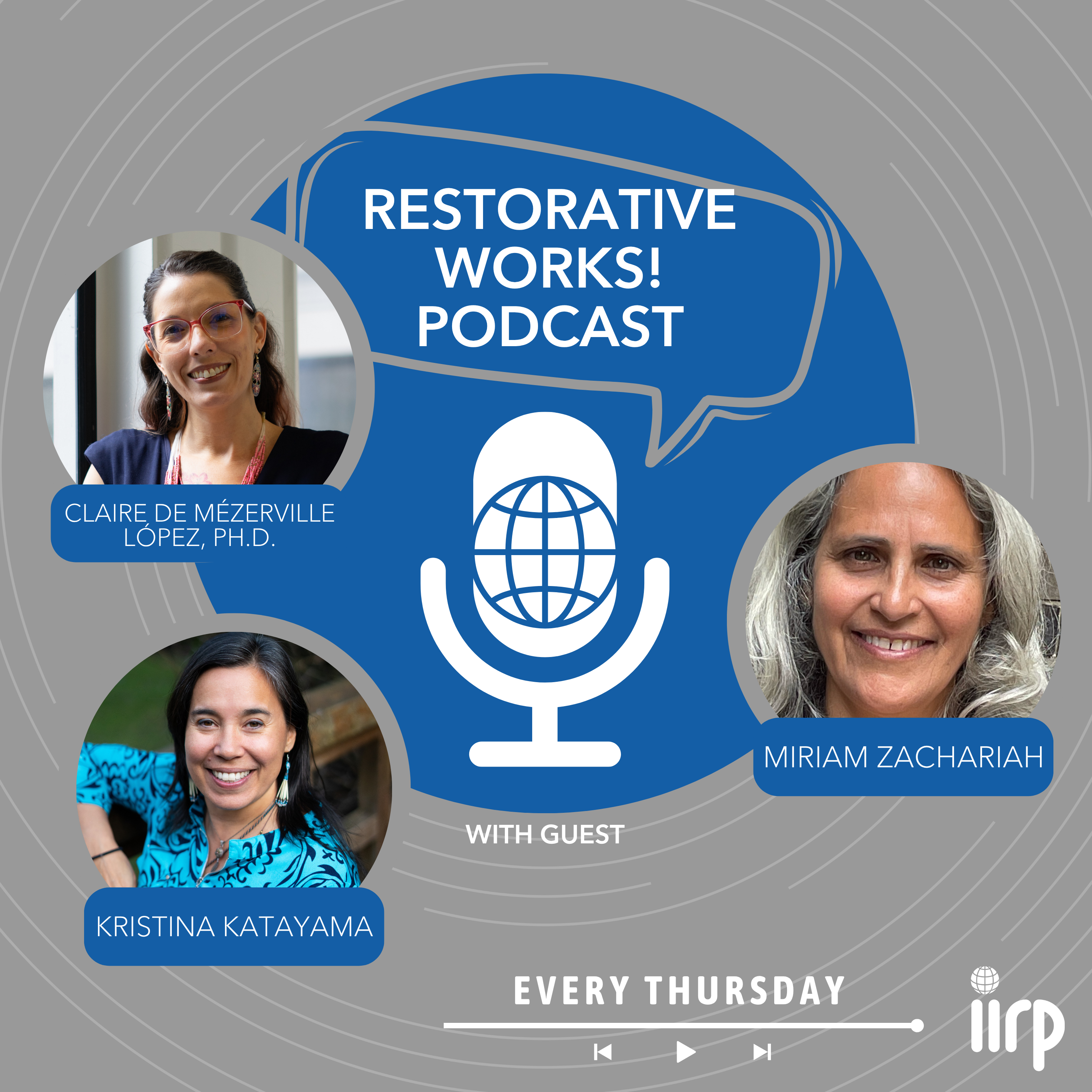
The reality of today's organizations: tension runs high, trust feels fragile, and progress stalls under the weight of reactivity. Seasoned practitioners Kristina Katayama and Miriam Zachariah join us to explore relational methods for charting a path forward rooted in awareness, connection, and intentional change.
With decades of experience across education, leadership, and organizational transformation, Kristina and Miriam reveal what truly drives lasting change in complex systems. They tell stories of lived practice, showing how leaders and teams can break free from cycles of defensiveness, conflict avoidance, and burnout. Instead of focusing solely on what's broken, they introduce an "appreciative approach", a mindset shift that uncovers what's already working and expands it into sustainable transformation. They share why readiness, not hierarchy, drives meaningful engagement. Rather than relying on top-down mandates, this approach invites participation, builds shared ownership, and fosters cultures of belonging without "othering."
This episode brings systems thinking, nervous system awareness, and restorative practices into one integrated conversation. Through real-world stories, including a simple yet powerful moment of workplace courage, Kristina and Miriam demonstrate how individual agency fuels collective change.
Kristina Katayama is the founder and lead consultant of Be Possible. With over 25 years of experience, she supports discerning, legacy-minded leaders across public, nonprofit, and private organizations who are called to effect social change beyond their job description. Her work helps leaders and teams transform conflict into connection and operationalize values through nervous-system-wise, relational practices in everyday interactions. Kristina designs appreciative, action-learning processes that build relational accountability, strengthen agency at every level, and create scalable micro-practices for vibrant engagement, trust, and collaboration. Grounded in appreciative inquiry, adaptive leadership, and trauma-informed principles, her approach integrates organizational change, leadership practice, and healthy nervous-system dynamics.
Miriam Zachariah has been a public school educator for over 30 years and recently retired as an elementary school principal. She has continued her grandfather J.L. Moreno's work to facilitate human connection, manage conflict, and foster collaborative decision-making in communities. She is a recognized trainer in restorative practices and Peacemaking Circles. The focus of her work as an educator, consultant, and trainer has been on developing community in workplaces, intervening in conflict, and fostering educational practices that decolonize schools for those whose voices have been silenced.
Tune in to discover how small, intentional shifts, like observing internal reactions, speaking up with clarity, or amplifying moments of connection, can ripple outward to transform entire teams.
Connect with Be Possible on LinkedIn and Instagram, access their 5-minute quiz: "What's really driving tension on your team?" to get a snapshot of what may be underneath recurring friction, silence, stress, or stalled accountability on your team, and view video clips of clients describing their experience.
Transcription
Claire de Mezerville Lopez
Hello and welcome to Restorative Works, a podcast where learning, practice, and research open new paths for transformation. My name is Clare de Mezerville López and it is my honor to introduce this episode and welcome Kristina Katayama and Miriam Zachariha as our guests. And Kristina, Miriam, welcome. How are you today?
Kristina Katayama
Good morning, thank you. Feeling good.
Miriam Zachariah
Yeah, good morning. Happy to be here.
Claire de Mezerville Lopez
I am so happy to have the opportunity to learn from both of you today. Before getting started, I’m going to introduce you to our audience. Miriam, I will start with you. Miriam Zachariah has been a public-school educator for over 30 years and recently retired as an elementary school principal. She has continued the work of her grandfather, J.L. Moreno, to facilitate human connection, manage conflict, and foster collaborative decision making. She is a recognized trainer in restorative practices and peacemaking circles. The focus of her work as an educator, consultant and trainer has been on developing communities in workplaces, intervening in conflict and fostering educational practices that decolonize schools for those whose voices have been silenced. She has trained hundreds of educators, community workers, police officers, lawyers, and therapists to use restorative practices, social drama, and sociometry to develop safe and supportive communities. And as for Kristina, with over 25 years' experience, Kristina Katayama is the founder and lead consultant of Be Possible. She supports discerning legacy-minded leaders across public, nonprofit, and private organizations who are called to effect social change beyond their job description. Her work helps leaders and teams transform conflict into connection and operationalize values through nervous system-wise relational practices in everyday interactions. Kristina designs appreciative action learning processes that build relational accountability, strengthen agency at every level, and create scalable micro-practices for vibrant engagement, trust, and collaboration. Grounded in appreciative inquiry, adaptive leadership, and trauma-informed principles, her approach integrates organizational change, leadership practice, and healthy nervous system dynamics. She helps organizations shift from reactive cultures to cultures of vitality, shared ownership, and belonging without othering. Over time, operations shift from hero-based firefighting, striving and carrying it all alone, to human systems that are more capable of handling complexity and thrive while doing it.
I've been looking forward to interviewing both of you. Kristina, allow me to start with you. You mentioned before our recording that your clients are often leading in environments where tensions are high, trust is uneven, and too much energy is being spent on managing reactivity instead of advancing the mission. And I think that sadly, many of us can relate to this situation at one time or another in our lives. In a situation like that, if change was to happen, where would people start?
Kristina Katayama
So, thank you. And I think one place to start is just recognizing that you're in it together, first of all, right? So, leaders, the leaders that we work with really care about what it is they're doing. They care about the people that they're working with as well as the people that they are serving together. And one of the places to begin is with awareness and developing awareness so that they can recognize that what is actually happening both inside themselves and their perception, and how they can shape their work together.
Claire de Mezerville Lopez
Miriam, I would like to follow up with you on that same question on such complex situations because you deal with complexity quite a bit in the work that you do. Where could people start?
Miriam Zachariah
So I think the beginning is what Kristina said, is often there'll be some really positive intent by both leaders and people working in an organization and they'll get to a place of knowing that just by themselves they are not going to be able to get out of the situation they're in. The situation has become what I call, you know, in sociometry it gets fixed. So that's group dynamics and people get into a perspective that they can't hear the other perspective. A leader will have maybe made a set of decisions that will cause some, you know, upset in the organization and instead of being able to kind of hear that, they will just sort of double down on why their decision is the right decision. So, there'll be a sort of defensive reaction and that will create a defensive reaction in everybody else, and everybody just kind of gets locked in their positions. I think that's often when either Be Possible or myself is sort of asked to come in and that comes from a place of knowing that there's a problem and they need some help to be able to navigate their way into a different place.
Claire de Mezerville Lopez
That is so interesting and I have this question for both of you because it goes to systems, you know, and the collectiveness of approaching all of this. Systems theory can be useful, but it can also be very disheartening. You explain that systems are often overstretched, underrelated and patterned by avoidance, mistrust, and pressure. However, you both have witnessed courageous leadership navigate through that. Will you tell us about that? How about Miriam? How about we start with you this time?
Miriam Zachariah
So, I think one of the sort of projects that Kristina and I have shared, there was a situation where leadership had, again, gotten themselves into a place of some fracture that was going on where they had initiated that they wanted to work on creating a more equitable workplace and they have really strong commitment to that and they really wanted to forward that movement and as a result of that a bunch of people whose awareness was raised about that then felt like the decisions that they didn't like, that they couldn't work with decisions that were oppressive in nature, right? And we're oppressing certain groups of people. And again, so this is one of those situations where there was a bit of a lock. And I think one of the things that Be Possible has been really good at and that I've learned from as well is this idea that we look at what's working, which, you know, where are the, even if there's only just few moments where there's success, let's find out what those moments are. Let's understand the conditions that make that success possible. And then let's think about what we could do to generalize those conditions. It really changes the dynamic because then we're not focusing so much on the problem. We're focusing on the kernels of the solution that already exist in the organization that we're in.
Claire de Mezerville Lopez
Wow, thank you. Kristina, how about you? What do you think?
Kristina Katayama
I think Miriam described it very well. The only thing that I would add is also just some recognition about how the brain works and how we get into this space. So, one of the functions, if you will, of the survival function of the brain is to recognize and react or respond when something's wrong or a threat like that. And so, without thought by default, we will habitually notice what's not working, where the problem is. And it really takes intention and effort to build the habit and the muscle of paying attention and learning from what's working. And when we begin to do that, there's a significant shift that happens right away. When people start building that habit and noticing what is working, instead of withdrawing in the many ways that we withdraw when there's tension, there's movement towards, right? Because there is a... we call it an appreciative approach. There's an appreciation. We're looking for the appreciation. We're looking for what it is that's real. This is not superficial polyamory positivity or toxic positivity. This is, yeah, that moment, that worked really well. And what was it that made that possible? And what could we do now to amplify that or make it more reliable?
Claire de Mezerville Lopez
I love that. And what I'm loving about this conversation is going into all of these different levels because we talk about systems and we talk about the nervous system and we talk about how we integrate all of that into acknowledging our human experience and how we interact with one another. We're going to take a very short break and we're going to continue this valuable conversation with Kristina Katayama and Miriam Zachariah. Please stay tuned.
Welcome back to Restorative Works. Kristina, Miriam, we learned so much from the stories that people share. Theory is so necessary. It helps us to paint a picture in our minds of things that we want to do and pathways that we want to walk through. But it is through experience that we actually connect with the humanness of doing this work. Would you please share with us some of your stories? What are the most common struggles you see in your clients and communities that you work with? What has helped? Kristina, is it okay if we start with you this time?
Kristina Katayama
Sure. So, what has helped? One of the key things that we've learned over time is that human beings are human beings, and it doesn't matter what position you have or hold or have been assigned inside of an organization, whether you have authorization or you're an individual contributor. There's a readiness that makes a difference in this work. And when you're called at whatever time that might be, is the time to engage. So, for example, we've shifted from saying, we just need to work with the whole leadership team and get the leadership team aligned. And then the rest of the organization will follow. And what we found is that it's an individual choice to say, yeah, this work is important to me and I'm in a good place to do it now. And so instead of structurally saying, these are the people that we're gonna work with, it is more of a process of creating an invitation to convene and attract those people who are ready to engage and do this work. So, they step in from all parts of the organization and all levels in the organization. And that's a really important thing. It actually is a shift already when Miriam was bringing up earlier, decolonizing, right? There's not an authority or somebody telling you, this is what you need to do. This is how you're going to do it, et cetera. It's like: here's an invitation, who's called to do this work? And so, choice happens and autonomy happens from the beginning. Agency happens from the beginning.
Claire de Mezerville Lopez
And I think that brings up the co-responsibility, you know, and as you mentioned that ownership of the process. Miriam, how about you? What are the most common struggles you see? What has helped?
Miriam Zachariah
So, I think just to build off what Kristina was saying, there is sort of a couple of organizations that we talked about to highlight. And the first thing was choice and being able to look at that appreciative lens that helps being able to sort of stop focusing or continue to focus on the challenges. Once that process is done and there are sort of a set of things that come out of that that are like these are the things we want to, we've discovered these successes; we discovered these areas of success. If we were to be able to create success across these areas in our organization, then there would be transformation. And the next step of that is, well then how do we create that transformation? What are the action steps actually going to be? And again, there's a call for volunteers who want to engage in that process. And recently we were part of an organization that focused on transformative conflict. So that was the focus. Can we transform an organization that was quite conflict-avoidant? And the conflict-avoidant patterns created again these sort of silos where people were feeling like, they could maybe find a few people that they felt things in common with, but then across lines of business or even within the same team, there would be a lot of conflict and it would be silent and sort of stratified. And what we asked people to do was to make some very, very small steps in the way that they interacted. So really the first thing we asked them to do was we asked them to observe themselves. Whenever there was tension, what was coming up for them? What did they notice? What did they notice they chose to do? What did they notice they didn't choose to do? And then slowly we began to ask them to actually make some changes in what they actually did.
And what we noticed, and these people were working across lines of business, so they were not in the same team or the same area of work. Some people were doing very, you know, front line, hands on kind of work. Some people were working in offices, but they were mixed together in these teams. And what we discovered is that people who often had been very, very reluctant to engage in any kind of meaningful dialogue around difference, were all of a sudden willing to do that. And we're finding it transformed not only their work experience, but the work experience of the small team that they were part of in a coaching group, but also in the teams that they were in in their own area of business in the organization.
Kristina Katayama
Yeah, and Miriam, you're reminding me, actually of a very specific story if you're looking for stories now. So, starting with the process of observing one's inner world and oneself. So, one person was feeling very frustrated in their team meetings, particularly with their manager and decided that's where they were going to do the micro experiment of observing themselves. And so they shared sitting in a team meeting, noticing they were clenching their teeth, noticing that they were making fists, noticing that they were feeling resentful towards the manager and noticing the idea that they had that their manager just kept talking at them, working through their agenda and that they were the ones that had to pick up and do this work, but there was no space for them to ask a question or to make a statement about the impact of this work that they were being asked to do. And when she came back with these observations, then the next part of that was reflection. What they noticed was that the resentment that they were feeling, that they thought was towards their manager, was actually towards themselves, right? It was towards herself because what she noticed is, wow, I'm the one that's not speaking up. I'm the one that's not saying what I need to say. And processed a little bit further and then noticed the reason why that is, is because I'm making an assumption that when I speak up, he'll say, yes, I want to hear what you have to say. And then I'll say something and he'll just continue on with the agenda. It won't be addressed. And so we came up with a strategy about, what can you do? And it was a simple thing, which is: go ahead and speak up, right? And ask the question to be able to get your need met, which is to know whether or not you've been heard. So simply ask, would you be willing to tell me what you heard? And so she went back to their next team meeting. She spoke up in the meeting. She noticed that he was typing while she was talking. She felt that surge of emotion and she said, okay, now I'm going to redirect that emotional energy that I'm feeling into creating a connection, and speak up. And so she spoke up and then, when she noticed he was typing, when she got to the end of it and in a respectful tone, she just said: would you be willing to tell me what you heard? And her manager took a little bit of a moment and then said: I'm sorry. I was distracted. I didn't hear what you said. Would you repeat it? And that was a little moment, right, the whole dynamic changed, the dynamic changed between her and her manager and the dynamic changed between her and the team, actually the whole team, right? So that's just one story of many.
Claire de Mezerville Lopez
I think, yeah, I can imagine. Again, how valuable it is to look at these situations from such an integrated lens to include the nervous system, systems theory, power dynamics, because these are very complex. As we get close to wrapping up, Kristina, you've mentioned that your processes go from fragmentation to integrity. So, I would like to ask both of you, thinking about aiming for integrity, will there be a final, very short piece of advice that you would like to offer our listeners? Miriam, how about we start with you?
Miriam Zachariah
So I think the first thing that I would offer is to notice. You probably, if you're in a tough spot, you've noticed where everything that's wrong and allowed yourself to have that. And then have yourself begin to notice maybe where things, are there small moments where things are going well? Are there folks in your organization or in your team that you do feel connected to? And begin to sort of notice those and maybe amplify those. It's a little bit like keeping a gratitude journal, like noticing a little bit of those moments and maybe beginning a little bit of a dialogue with people in your team. Often I will say to people, find allies who can begin to amplify that for you. That is one of the first steps that I would suggest.
Claire de Mezerville Lopez
I love that. Kristina?
Kristina Katayama
Yeah, and the other thing that I would add to that, in addition to an appreciative stance, is also actually noticing and listening to yourself, your needs, your thoughts, your emotions, and responding to them, responding to them in a way that you become the leader that you need and you want for yourself. So, when you notice that tension is rising in you, what is it that you need to feel good again, in this moment? And give that to yourself. If that's to take a break, if that's to take a drink, if that's to get up and go for a walk, if that's to offer appreciation to yourself, whatever it is, even simply taking an intentional breath to allow yourself to reset.
Claire de Mezerville Lopez
That's beautiful. And I can testify that it works. I ask the restorative questions to myself all the time. Thank you so much, Miriam and Kristina for being on the podcast today. And thank you all for tuning into Restorative Works. To learn more about our guests, log onto IIRP.edu and let's continue to build transformation through dignifying relationships, kind conversations, and stronger communities. Until our next episode.