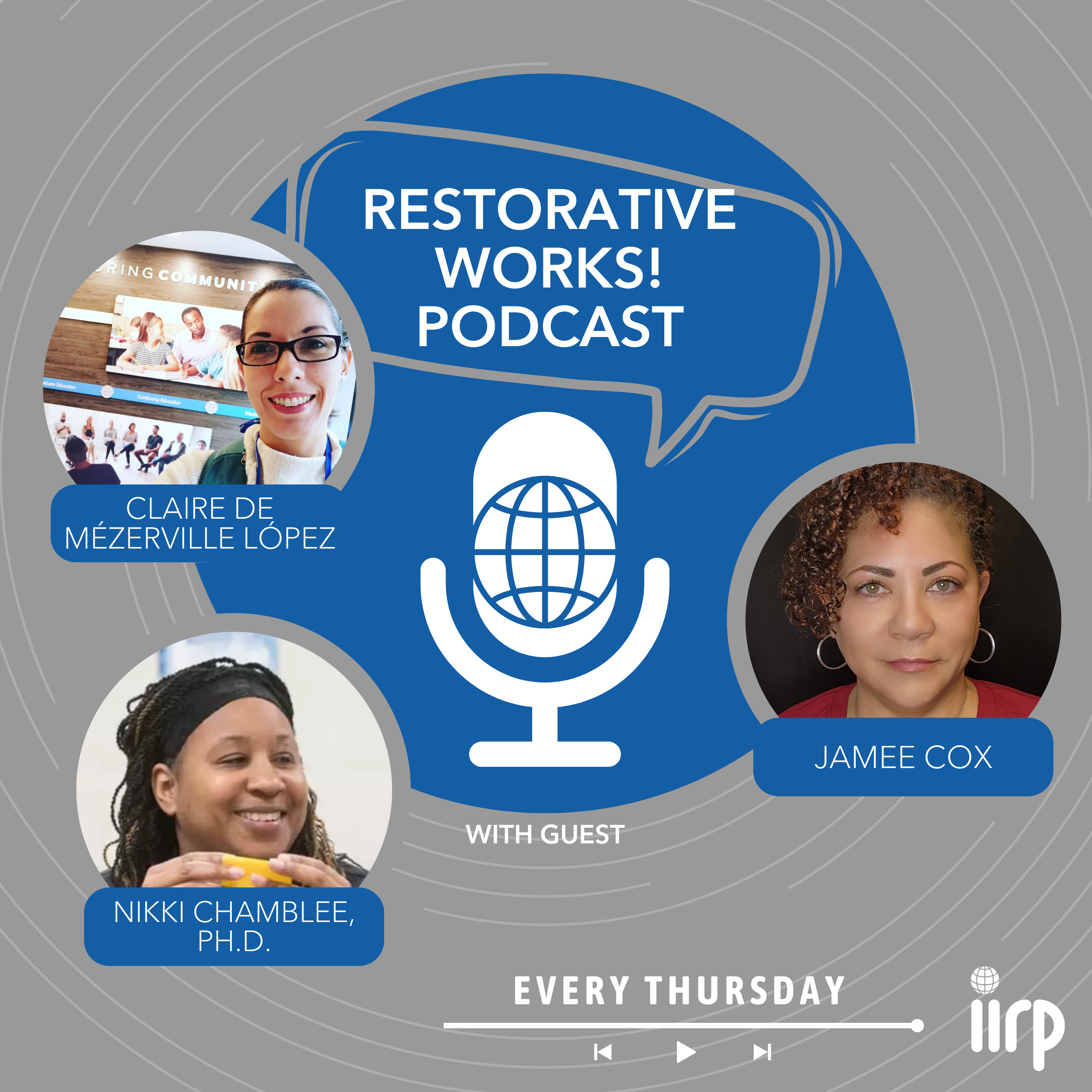
In this episode of Restorative Works!, the Restorative Pedagogies Series continues with a rich, practice-forward conversation on how restorative practices transform English Language Arts classrooms from the inside out. Host Claire de Mezerville López is joined by co-host Nikki Chamblee and special guest Jamee Cox, an eighth-grade English Language Arts teacher and IIRP Graduate School student, for a grounded exploration of what it means to teach reading, writing, and critical thinking through relationships.
This episode centers on a timely and pressing question for K–12 educators: Can restorative practices deepen academic learning, not just strengthen school culture? Drawing from her classroom experience in Texas, Jamee makes the case that relationships are not an "add-on" to instruction; rather, they are the pathways to engagement, comprehension, and meaningful learning. At a time when students read less, test more, and often disengage from traditional instruction, Jamee shares how circles and community-centered dialogue reignite students' interest in reading and learning.
Jamee offers concrete examples of restorative pedagogy in action, from using the restorative conferencing questions to analyze fiction and character development, to journaling practices that build literacy while honoring student voice. The conversation also explores the human side of teaching. Jamee speaks candidly about navigating grief, emotional resilience, and self-restoration while leading a middle school classroom.
Jamee Cox is a current IIRP Graduate School student and eighth-grade teacher at DeSoto Independent School District in DeSoto, Texas. She previously served as a restorative practices specialist for Fort Worth Independent School District in Fort Worth, Texas, working in a network of 10 schools, where she trained teachers, administrators, and staff in restorative practices.
Tune in to learn how dignifying relationships and intentional community-building can transform English Language Arts instruction and help students learn not only how to read and write, but how to connect, reflect, and grow.
Transcription
Claire de Mezerville López
Hello everybody and welcome to Restorative Works, a podcast where learning, practice and research open new paths for transformation. My name is Claire de Mezerville López and it is my honor to introduce this podcast series titled Restorative Pedagogies along with wonderful co-host, leader, trainer, coach and friend, Nikki Chamblee. Hi, Nikki.
Nikki Chamblee
Hi, Claire. I want to start with a definition from Belinda Hopkins. So, she defines relational pedagogies as those that foster a stronger connection between teachers and students, among students themselves, and also between students and curriculum. Restorative Pedagogies is a series that focuses on the application of restorative practices as part of the pedagogical approach in K-12 to enhance effective learning of specific subjects. Beyond that relational richness necessary to create school community, can restorative practices help us to learn better when it comes to math, English, science or history? Today, we will focus on English Language Arts and for that, we welcome our wonderful guest and a very dear friend of mine, Jamee Cox.
Claire de Mezerville López
It's so wonderful to have you on the podcast, Jamee. And I hear that you guys go way back, but let me introduce you to our audience. And then we'll go right into the conversation. Jamee Cox is a current IIRP Graduate School student and eighth grade teacher at DeSoto independent school district in Texas. She previously served as a restorative practices specialist for Fort Worth independent school district working in a network of 10 schools where she trained teachers, administrators and staff in restorative practices. And Nikki first introduced you to restorative practices as she was serving as an English teacher at the Disciplinary Alternative Education Program. And it makes me happy to have this conversation as a reunion as well. So, we're really looking forward to learning from you. Nikki, why don't you lead us through the first question?
Nikki Chamblee
Thanks so much, Claire. So, Jamie, tell us about your experience as an English teacher and how students engage with this subject.
Jamee Cox
Well, I started teaching English back in 2013 at a charter school and it was an accidental career for me and that's a long story that we'll save for some other podcasts. But I've always had experience working with disadvantaged youth. And so that's kind of been my area where I stick to. So, I just taught basically ninth grade, 10th grade English and then I moved to the disciplinary school, of course, where I met you at, which was a whole other ballgame, which was a lot of fun. I learned a lot there. And also, where you introduced me to restorative practices. So now I took a break from the classroom and now I'm back in the classroom teaching middle school, ELR, English Language Arts and Reading. And it's a challenge in 2025 because our kids, don't… they don't read a lot now, so you have to look for new ways to kind of get them engaged.
Claire de Mezerville López
I am in San Jose, Costa Rica. I'm in a very different place. And yet I also find those challenges regarding getting kids engaged with reading. One of the things that I loved about restorative practices was about thinking that interest is an emotion, being engaged with the subject is actually an emotional connection. When you say that it's more challenging to get kids engaged with reading, what is one example where you've seen that happening?
Jamee Cox
I think the biggest thing that I'm seeing in classrooms, for reading in general… schools are one thing, but I think in general, the populace of America, and I'm going to say America because this is where I live, we don't really read anymore. We get our information in spurts, you know, we're on social media. We read about a paragraph, if that, and then we move on. And the other big factor, I think, in this country is we do a lot of testing of our students. And so, a lot of times I find that we're teaching for kids to pass a test instead of really engaging them in the actual act of learning. And part of learning is being a part of a community, which of course is what Restorative is based on. So, I had to try to think of a way to engage the students in reading and community at the same time. So, using Restorative to get them back interested in reading has been what's been helpful with kind of bringing that reading level up for my students.
Claire de Mezerville López
And Jamie, you and Nikki go way back, but I'm getting to know you and I would like to know the story. Tell us about your experience with restorative practices.
Jamee Cox
So, Dallas is my home, but I used to live, I lived in Houston for 10 years and then I moved back to Dallas and I said, okay, I need to find a job. And so, I started applying for jobs, for teaching jobs. I applied at the Juvenile Justice Center, and I applied at the regular school districts and then I saw a listing for a job at the alternative center, the alternative education center for DeSoto. And I said, yeah, that's it, I'm gonna go work with those kids. So, I applied for that job and at that time, Nikki had that job. So, she interviewed me, we got along splendidly, I was hired, I took her job, she left and went to Fort Worth. But of course, we stayed connected. So, she's in Fort Worth for about a year and then lo and behold, here she comes back to DeSoto. She leaves Fort Worth, comes back to DeSoto and at the time the disciplinary system was, like the school was a little bit in chaos and she comes in and says, I'm going to teach you this. I'm going to teach you how to do restorative practices and it's going to work." And I was like, no, it's not going to work. These kids have lost their minds. It's not going to work. Trust me, it's going to work. Here she goes. Trust me, it's going to work. So, she starts teaching me. I go through her training and everything. And then she comes in and she models it and she does it. And the kids were so receptive. The temperature starts changing at the school. The kids start changing at the school. And I'm like, huh, this chick might be pretty doggone smart. So, then I'm just like, girl, give me everything, give me everything, teach me everything. So, she took me kind of on a journey, took me under her wing and she's been my mentor ever since. And I couldn't be more grateful for that. I say all the time that it was like a destiny thing for me to meet her and then for her to turn around and come full circle. I got that job with her. She left, she came back and we just always had like a connection.
And she has been the great, the greatest teacher for me and supported me through my restorative journey. And then she was like, yeah, I think you should go get a degree in this. And I was like, yeah, because of course I want to go back to school at my big age, of course. So, I'm still on a journey and I learn more every day and I love it. Just take what I learned and I try to put it into the classroom. So that's been really, really helpful this year because this is my first year teaching only middle school and teaching one grade level. And the eighth graders are, you know, they're a breed all in to themselves.
Claire de Mezerville López
Yeah, I have a son that makes me think that you are spot on, but I wish people could see your faces because the smiles in this conversation and the story that you have shared is wonderful.
Jamee Cox
Yeah.
Claire de Mezerville López
If you allow me just one more question before we go into our break. Jamie, do you have a specific story or anecdote about your experimenting with restorative practices that you would like to share?
Jamee Cox
What I'm currently really involved in, in my classrooms, I have quite a few emerging bilingual students and quite a few special populations’ students. And I find that they don't engage as much. And I really struggle because I'm not bilingual, I'm unilingual, even though most people think I can speak Spanish, but I cannot. So, I struggle with trying to reach those students. And I wasn't sure if their not communicating with me was because of a language barrier or if they weren't understanding the work. So, as I've evolved, I tried to pull more restorative practices in where we get together as a community, I sit the kids in circle, like if we're reading something and then we pass a talking piece as we're discussing these conflicts or these resolutions that are in some of the things that we're reading, as we're doing character analysis of some of the stuff that we're reading. Those students are now starting to engage more and engage more with their peers, really helping me know what their level of understanding is, but also making them more comfortable with speaking even though they somehow, you know, they're still struggling with the language a little bit. So that's been my greatest, I feel like achievement so far this school year is really being able to reach those students that are normally very quiet and timid and don't want to speak and really getting them involved in the classroom community and part of the conversation and part of the learning.
Claire de Mezerville López
That's wonderful. We're going to take a short break and then we're going to come back to this conversation with Jamee Cox. Please stay tuned.
Nikki Chamblee
All right, welcome back to Restorative Works. And I so appreciate Jamee sharing how we met. It was, I was trying to take a position doing restorative full time and I needed Jamee, I needed her to come in as the English teacher and she arrived just at the right time. And I remember when she came, we actually had to teach together two days in the same room because of some district level policies. And I remember she came in the room and she looked at how the students were sitting, they were facing each other. And she was like, what is going on here? And, you know, it was a challenge because I had been with my students, had a relationship with them. And so, what we were doing was working. And she just embraced getting to know them and really pushed me to be humble and kind of step back because when you're passing off your babies, you want to keep your hands on them. But I had to trust that she had their best interest in heart as she restructured things in ways that made sense to her. And then the way she just embraced restorative, she was the Social Emotional Learning lead when I came back. And so, we really built out a robust system that I always talk about in training that really helped us anchor how staff operated from the front door to the back door restoratively. And how students entered and exited the suspension site restoratively. And so, one of the highlights has been being in the trenches with her. So, I have a question. So English classes can cover everything from grammar and punctuation to reading and literature comprehension to understanding symbolism and poetry. And so, with such a broad subject, how have you found ways to help bring restorative concepts or ideas or practices or processes into those different areas?
Jamee Cox
I'm still working on a lot of it. I think some of the key elements that I've done is when we have class discussions in the classroom, I try to use restorative sentence stems with them so that when they're communicating, they're learning that language of “restorativeness”. And it's a big deal to me, and I say this a lot, and some people may not understand it, but for me, relationships come before content and that is because if you build a relationship they will want to do and learn the work and one of the problems I see in middle school -that I see in public in general- is that we don't know how to talk to people, and so a lot of times we're misunderstood when we say something. Maybe we didn't mean it that way so I'm teaching the children to speak to each other using sentence stems that are restorative in nature so that they do learn to speak to people. They do learn to communicate with each other and get their point across in a respectful way and then, to respect other people's opinions. And that's one of the key things that I'm doing right now. I don't know how I'm gonna do restorative in grammar, but I could probably come up with some great sentences.
One of the things that Nikki and I did at DAEP is we had Marvelous Mondays where you would ask the students two questions. And we did that to not just the students, but the adults as well. So, she still sends out a newsletter, you know, in the morning time is like, this is the questions of the day. But it's hard, harder to do that when you've got 40 kids in a classroom. When I was at DAEP, it was easier. I got 10, 12 kids in the classroom, but we've got 40, it's harder. But I wanted to still be able to do that. So, one of the things that I've done, which is to help them with their writing and with their speaking is I've turned it into a restorative journal. So, we have the question and we have them write, you know, I have them write three to five sentences pertaining to what that is, whether it's something they like or don't like or something they've seen or haven't seen, whatever the question is. And then I just use our talking piece to have a couple of kids share out. And that way it doesn't take up so much of the morning because trying to do a question in the morning with 40 kids in middle school kids, who want to be goofy 24 hours a day. They're gonna stand there and try to talk for seven minutes so that they don't have to do classwork. So that's one of the things. I'm working on how to facilitate it in our poetry learning and some other things. It's easy to do in fictional writing and nonfiction, to have those kinds of restorative conversations, but I'm still working on some of the other ways that we can also keep restorative for, for most in our classroom.
Claire de Mezerville López
Jamee, one of the things that I really like is when you mentioned how middle schoolers, want to be goofy and… well, of course they do. And through restorative practices, I think there are ways where we can find those underlying needs of feeling seen, of feeling happy, of being silly, but in a way that is still conductive to learning.
Jamee Cox
You're exactly right. That's exactly what it is because that goofiness equates to them wanting attention and wanting to be seen by their friends and restorative allows them every single day and every single conversation that we have to have an opportunity to be seen. You're not, you're just not the only one that's being seen. Look at others as well. And it really helps with the learning because we have pockets of populations that live a life this kind of way that aren't exposed to maybe cultural differences within other people. So that's something that I really enjoy is to be able to spread that to our students because that's one of the things about reading that I think students are really missing is that's how we learn. That's how we learn about the places we may never go and the people we may never meet. That's how we learn how to critically think is to think about an example we read in a book or something that's gonna help us formulate an opinion or know what's good and what's bad and what's right and what's wrong. So being able to at least bring those conversations in through our restorative encounters in the classroom and that the way that we're using restorative sentence stems and restorative conversations and letting everybody have a voice, teaching them how to be respectful to each other and respecting where other people come from and their feelings, I think is really invaluable. And it's the small way that I can bring what Nikki and I did at DAEP, which was a smaller scale to a larger scale that hopefully we can expand it to the next classroom and the next classroom so that it can hit the entire school.
Nikki Chamblee
Yeah, and I think one of the things I admired about working with Jamee is that she's a creative. And so, when we would think about these ideas of activities for the students, I'd have like the baseline idea. And Jamee's like, I'm going to go home and create. So, we did like hope and fear trees as one of our activities to kind of help the students… kind of process through what were their hopes for the school year, what were their fears. And Jamie went home and created leaves and she got the cricket going. And so, the children actually were able to have like a visual representation of the hope and fear trees that they could see and admire. We did a gratitude wall around the holiday time. And so, we have this huge yellow piece of butcher paper and each student got to put on there like what they were grateful for. So, bringing in that kind of hands-on visual that we often neglect…
Jamee Cox
Yeah, for Thanksgiving. All the way down the school hallway.
Nikki Chamblee
When we think about how people can express themselves and show who they are, it is one of the skills that she's definitely has brought as a part of her to the process.
Claire de Mezerville López
And that was one of the things that I wanted to ask because you mentioned restorative sentences, restorative stem sentences. How do you call them? Would you give us a couple of examples?
Jamee Cox
Sentence stems, yes. So, when we're speaking about... like, let's say we're doing a fictional story, you know, and there's five components to fiction and that's the setting and the exposition and the conflict and the resolution. So, when we talk about it, we use the sentence stems like: who was impacted in the story? And that's a question that's derived from restorative. And how was it repaired? How was it restored? That's the resolution part of the story. Who was involved? Who was harmed doing this?, or who was engaged in this period? So those are just some of the shortest stems and the easiest ones to really introduce, which is great because fiction is normally how we start the school year off. So, it's easy to bring those restorative components in at the beginning, right after we've done our respect agreement at the beginning of the school year, for what's gonna happen. We just continue that same process and build on those little pieces of restorative language that help the students understand as well.
Claire de Mezerville López
Such a wonderful exercise! And I can see how it doesn't only help with teaching students about restorative practices and the restorative questions, but it also stimulates critical thought, empathy, going beyond just knowing what happened in the story, but going on a deeper level. I think that's so exciting. Nikki, I imagine that you have a lot of anecdotes from the work that you have shared beyond the ones that you've mentioned previously. Is there anything that you would like to tell us or ask Jamee before we wrap up this episode?
Nikki Chamblee
I think one of the things I'd like to give Jamie an opportunity to talk about is because she's had a challenging year. And so, kind of what that part of being restorative with yourself has been like as you prepare to go back into the classroom and to be able to manage eighth graders?
Jamee Cox
You know, and I appreciate you asking me that. And Nikki knows that sometimes I get lost on my restorative way, sometimes because I just want to pull my hair out and I have to call her and I'm just like, okay, balance me out here. I'm having some issues. It has been challenging. I've always felt like I'm really good at building relationships with students. But I've also always worked in an environment where those students had something to lose. They felt like, when I started teaching, it was at a charter school for students that had been expelled from their school. When I worked for the DAEP, those are students that are trying to get back to their home campus because they've been suspended for whatever reason. But the challenge was going into the regular classroom was that I've just had some students that just really wanted to push my buttons and I was emotionally going through some turmoil this year. My mom passed away two days before school started. So, it was two days before school started. It's a new school. So, I kind of went into school on a bad note. I was there the first day for the students trying to keep from breaking down. So, Nikki was a great support during that time. So, I did have some struggles trying to focus on what needed to be done to get my classroom up and my students engaged and building those relationships with my students when personally I was so withdrawn at the same time. So, I really had to dig deep into what I had learned about being restorative and what that was going to look like for me this year. And I still, I'm still struggling with it. You know, I still have my moments, of course. So, it's been a learning experience this year.
I think every little step that I take towards, you know, hitting a goal or a mini milestone where my students are concerned makes me feel a little bit better about what I'm doing. And the more that I try to incorporate restorative so that I can teach the way I want to, where the kids are still going to be able to take a test, but they're going to take away from my class more than just the ability to choose the right answer on a test, but maybe they can choose the right answer in their relationships and their involvement in their community, and their families, and their friends, and their siblings, and all of the things. So, we're halfway through the school year. So, we'll check back in with me on spring break and see what the improvements are.
Claire de Mezerville López
I would love to do that. Jamee, Nikki, thank you so much for being on the podcast today.
Jamee Cox
Thank you for having me. I've so enjoyed it. Thank you so much.
Nikki Chamblee
It's always fun to hang out with my friend.
Claire de Mezerville López
Thank you so much! And thank you all for tuning into Restorative Works! To learn more about these series and about our guests log into IIRP.edu and let's continue to build transformation through dignifying relationships, kind conversations and stronger communities. Until our next episode!