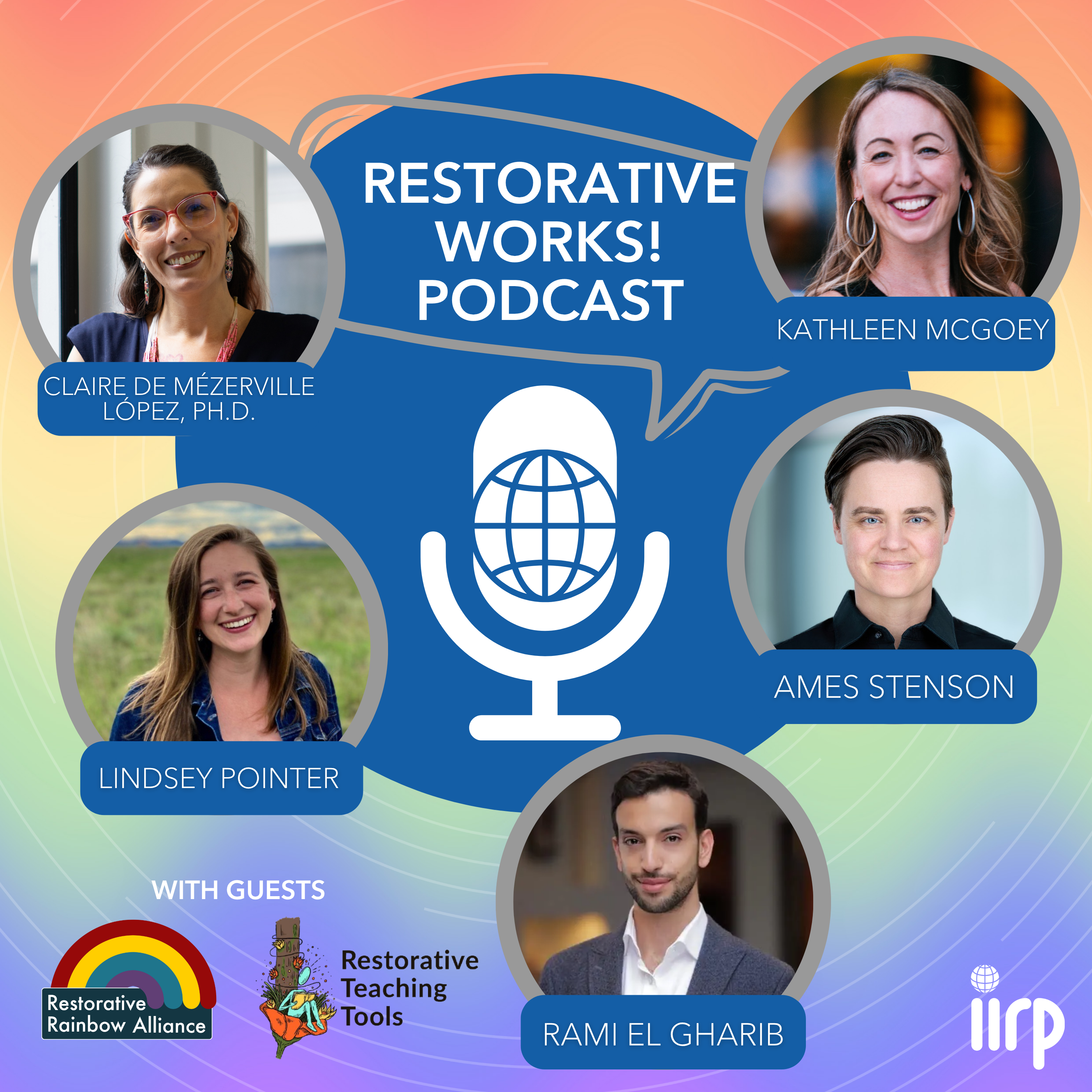
In this special roundtable episode of Restorative Works!, host Claire de Mezerville López brings together a powerful group of restorative justice practitioners, educators, and leaders to explore the creation and impact of the Restorative Rainbow Alliance's Facilitator Code of Conduct.
Guests Ames Stenson and Rami El Gharib, co-founders of the Restorative Rainbow Alliance, join Lindsey Pointer and Kathleen McGoey, co-authors of The Little Book of Restorative Teaching Tools, to share the story behind this groundbreaking initiative. Together, they reflect on the urgent need for LGBTQ+ affirming practices within restorative justice, drawing from lived experiences, community dialogue, and the gaps that led to harm when identity and power were not fully considered in restorative conferences.
The conversation explores how the Alliance's Code of Conduct, now adopted as a foundational document in Colorado, offers both guidance and a call to reflection for practitioners seeking to move beyond cis-heteronormative frameworks and toward truly inclusive, equitable practice.
The group also highlights a collaborative effort to bring the code to life through an engaging, experiential learning activity: Inclusive Facilitation: Increasing LGBTQ+ Awareness in Restorative Justice. Designed as a companion tool, this resource supports practitioners in navigating discomfort, building empathy, and applying inclusive principles to real-life scenarios through dialogue, play, and reflection.
Throughout the episode, listeners are invited into a rich and honest conversation about harm, accountability, identity, and growth. The guests emphasize the importance of curiosity, compassion, and the willingness to sit with complexity as essential elements of restorative practices, especially when working toward belonging for LGBTQ+ communities. This episode offers both inspiration and practical pathways for anyone committed to deepening fostering spaces where all identities are affirmed and valued.
Tune in to learn from these wonderful guests, and we invite you to explore the Restorative Teaching Tool activity for the Facilitator Code of Conduct here.
Transcription
Claire De Mezerville Lopez
Hello everybody and welcome to Restorative Works, a podcast where learning, practice, and research open new paths for transformation. My name is Claire de Meserville Lopez, and it is an honor to host this very special episode where we will partake on a round table to learn from friends and leaders that create new and necessary pathways to strengthen relationships and community. The Restorative Rainbow Alliance came together throughout 2021 and 2022 to draft and finalize a code of conduct for restorative justice and restorative practices facilitators. It is intended to serve as an addendum to general codes of conduct and guidelines for facilitators. It outlines and describes best practices and norms for LGBTQ affirmation in restorative proceedings. In 2022, it was adopted by the Colorado Restorative Justice Coordinating Council as a foundational document alongside the Colorado Restorative Justice Facilitator Code of Conduct and Standards of Training and Practice. And it is our honor to welcome today Ames Stenson and Rami El Gharib, co-founders of the Restorative Rainbow Alliance, and Lindsay Pointer and Kathleen McGoey, co-authors of the Little Book of Restorative Teaching Tools and the Little Book of Restorative Teaching Tools for Online Learning, as we discussed a collaborative project which uplifts the Restorative Rainbow Alliance's work through an engaging, accessible, and effective activity. Before getting started, I just wanted to thank you all for being here today. How are you this morning?
Lindsey Pointer
Wow, thanks Claire.
Rami El Gharib
Thanks for having us. Super excited.
Claire De Mezerville Lopez
I've been looking forward to this as well. So how about we start with introductions? I suggested that we can do a go-around where I introduce Ames and Ames introduces Lindsay. Lindsay introduces Rami and Rami introduces Kathleen, if that's okay with everyone. So Ames, I'm going to start with you. Ames Stenson, they/them pronouns, Hails from Denver, Colorado. The territory of the Arapaho, Cheyenne, and Youth Nations. They have 25 years of experience in systems and community-based social service agencies, including over 15 years in the restorative justice field. Ames is the program manager for the City of Englewood's Municipal Court Restorative Justice Program, appointed to the Colorado Restorative Justice Coordinating Council, founding and current board member of the Restorative Rainbow Alliance, ex-official board president.
For the Colorado Coalition for Restorative Justice Practices, 2023-2024 Colorado Governors Fellow and former adjunct faculty at the Graduate School of Social Work at the University of Denver. Ames received a bachelor's in criminal justice from the University of Portland, a master's of theological studies from the Elive School of Theology, a Master's in Social Work from the University of Denver and is a licensed social worker in Colorado. And Ames, it's such an honor to have you here. Hi, welcome.
Ames Stenson (they/them)
Thank you so much, Claire. Thanks for the warm welcome. Happy to be here. So I get the privilege and honor of introducing Lindsey Pointer. Lindsey is a research professor at Vermont Law School and Graduate School and principal investigator of the National Center on Restorative Justice. She has a PhD in restorative justice from Victoria University of Wellington in New Zealand and is a former Fulbright Fellow and Rotary Global Grant recipient.
Lindsey has worked as a restorative justice facilitator, community program manager, educator, and researcher. She is the author of four books on restorative justice: The Little Book of Restorative Teaching Tools, The Little Book of Restorative Teaching Tools for Online Learning, The Restorative Justice Ritual, and a Children's Picture Book, Wally and Freya.
Lindsey Pointer
Thanks so much, Ames. Fun to share this space together. And I have the privilege of getting to introduce my good friend Rami El Gharib. And he is a Lebanese restorative justice leader and program builder with over a decade of experience leading community-based restorative justice initiatives across the United States. He most recently served as restorative and community justice manager in the King County Executive's office, where he launched two restorative justice programs. Organized the county's first summit on crime survivors and led cross-sector public safety collaborations. Rami previously built restorative justice programs in Georgia, Colorado, and Connecticut, and is the founder of the Restorative Justice Rainbow Alliance, the first LGBTQIA+ focused restorative justice nonprofit. He serves on the board of the King County Sexual Assault Resource Center and holds a master's degree in industrial organizational psychology from the University of New Haven.
Rami El Gharib
Thanks, Lindsey. And I have the privilege of introducing my friend, Kathleen McGoey. Kathleen is a trainer and facilitator of restorative justice practices and conflict transformation. She is the former executive director of Longmont Community Justice Partnership, where she oversaw community restorative justice programs in partnership with police and schools for over eight years. Kathleen launched Kathleen McGoey and Associates in April 2021. She and her team provide training in restorative workplace culture and facilitate restorative processes to address incidents of harm within businesses, nonprofits, families, and community groups nationwide. Kathleen co authored the Little Book of Restorative Teaching Tools and runs RestorativeTeachingTools.com, a free online collection of activities for teaching restorative practices. Kathleen speaks Spanish and is recognized for her ability to create engaging, inclusive learning environments that prioritize embodiment, authenticity, and well-being.
Kathleen McGoey (she/her)
Thanks, Rami.
Claire De Mezerville Lopez
Rami, thank you so much, and Kathleen, we could close the circle with you introducing me, but I already introduced myself, so I'm just going to say bienvenida. I am so glad that we have you all here. What a beautiful table to share. So let's continue with the first go-around. and I would like for us to start by going back. Rami, how about we start with you? And then you decide who you want to pass the word to, and the next person does the same until everybody went, and so that way we go around in the circle. So, Rami, what was the situation that led to identifying a need and deciding to create the restorative Rainbow Alliance and its code of conduct?
Rami El Gharib
Yeah, thanks for asking that, Claire. I love answering that question. because it always makes me reflect on my own experience again and again every time I answer it. So a bit of a background about me. I'm a gay man from Lebanon where it's illegal to be queer. So that comes with a lot of its own struggles and a lot of its own heartaches. And so moving to the US and going into restorative justice, I was super excited about entering this new field and thought, you know, this is the field that is going to like embrace my authentic identity as a queer person. There's no homophobia or biophobia or harm towards queer trans people. And started this job in Colorado. This was one of my first restorative justice jobs. And I was talking to a volunteer, and this volunteer was telling me about this case they had facilitated with the previous person who was managing the program, where they were referred a case where a young queer person was being bullied for over a year by another person and decided to retaliate after having had enough by physically punching the other person. And so the case was referred to restorative justice and the young queer person was in the basically the seat of the responsible party, the person responsible for harm. And the person who had bullied them for over a year was the person who was harmed. And so that to me was really alarming. It was like, okay, what is going on here? What are we using this process for? I was just thinking of like myself, if this was me at the age of like 14, 15, going through what I was going through, and I naturally like would have had enough from someone and did decide to retaliate, going through a process like that would have been really harmful because it would have told me that my experiences don't matter. And that's something that queer and trans people already feel, young queer and trans people. And so got together with Ames and a bunch of other folks and we opened an open space with the Colorado Coalition for Restorative Justice Practices. And we discussed queer needs in the field of restorative justice. And unfortunately, there was no shortage of traumatic incidents that people had to share going through this process as queer and trans folks, because of either being like it's gendered in its place, either being like the the the power and identity and traumas not being considered. So it there was a real need to kind of create a toolkit and a guide for people to have a queer lens when doing this work. Because, you know, I mean the tools are important, but if we don't know how to use them then appropriately then I think there's not much use for them. And I'll pass it to Ames to add.
Ames Stenson (they/them)
Thank you, Rami. I've heard you share that story many times and I'm always hearing new things and picking up new learnings from you and your wisdom with that. So thank you for sharing.
Yeah, so I wanna also just invite our dear friend Laura Beth Waltz into this conversation, because she has been kind of our other third person up upholding and really working towards creating with the Restorative Rainbow Alliance as well as the Restorative Justice Facilitator code that we put together.
And the we decided that that was such a pressing issue because there were so many harms that have been named. And even ourselves as queer practitioners, we decided that we wanted to create a code of conduct that hopefully felt supportive and accessible to to practitioners in restorative justice. And we've since learned it's actually been utilized all over the world, not just for restorative justice practitioners, but for other folks that are facilitating and working with groups and working with with queer folks and and allies, et cetera. And so what we decided at the time is we wanted to write the code to be in alignment with at that point the Colorado restorative justice facilitator code, which had initially been published in 2012, and I believe was the first kind of code published, as Kathleen can speak more to this in a minute for sure. and so we wanted to make sure that that this was kind of within some of the languaging of that code because we wanted it to be adopted by the state of Colorado Restorative Justice Coordinating Council. And so we wrote that code over the two years as you'd mentioned when we started. And fortunately unanimously in October of 2022, the Restorative Justice Coordinating Council said, yeah, we we need to adopt this as a standard foundational document for the state of Colorado to support
Restorative justice practitioners in our state and beyond. So that was why we decided to go with that language and also knowing that that language is not static, right? And so we know that we wrote it within a certain framework, but the idea is that, you know, folks can kind of take some of the main points and reflect and utilize them in a way that not only supports continuing to create inclusion for queer and trans folks and within restorative practices as well as practitioners, but also to kind of use as a lens of a pause of what kind of this reflective pause of what lens am I looking at in in my restorative justice practices? Am I just looking at it through this cis heteronormative lens? If so, then we're we're inviting and encouraging and in fact stating that's actually not restorative justice. We need to be able to include and expand all lenses and perspectives as much as possible in order for it to be an actually inclusive opportunity for people to participate. So I I think actually Kathleen I'd love to pass to you because you've been so integral in the work of guidelines, not just in Colorado but in the country. So I'd love to pass to you to to kind of add other thoughts that you might have about that.
Kathleen McGoey (she/her)
Thanks so much, Ames. I'm so grateful to share this story. And what I would add to where Ames left off is that in Colorado, there was a need to update the statewide facilitator code of conduct that Ames mentioned that had initially been written in 2012. And I was able to facilitate the rewrite of that code of conduct around 2023, which became guidelines. And as Ames and Rami have both mentioned, the language and how the tool is used is probably just as important or more important than the tool itself. And so we were really grappling in 2023 as we rewrote these statewide guidelines for restorative justice practitioners.
How do we walk that line of inviting people to engage with the guidelines, but not feel like they're too restrictive or that they're an authoritative policy that someone's going to enforce or going to come in and judge and assess whether something is an RJ practice or not? And so, one of the conversations that I had was talking with program managers and facilitators in Colorado. And I heard from one program manager that they were really struggling with how to implement the Restorative Rainbow Alliance Code of Conduct because of some of the language they had chosen in that set of guidelines, and that code to use language like should and shall, which of course serves a really helpful purpose. And this particular program manager was saying, you know, when I share this with my facilitators, they feel a little overwhelmed, they're scared, they're not gonna get it right. They don't know how to really interpret the code of conduct into their practice. And so it planted this seed for me that there was a need, both with the Restorative Rainbow Alliance code and our new guidelines for statewide practitioners, that we need to go further in offering a resource for people to actually be able to discuss and unpack these guidelines and apply them to case scenarios and really create more active opportunities to learn and share experiences so that people won't just put aside the guidelines because they maybe feel like it's too daunting to figure them out, but instead create entry points and pathways, just like this podcast, a restorative pathway to really bringing those guidelines and code of conduct to life.
Claire De Mezerville Lopez
And you know, I think that is the challenge of having a tool, but then having that living messy human work of saying, “how do we make this tool real for us?” Before continuing the circle, we're going to take a very short break so we can learn more from this wonderful experience. Please stay tuned.
Welcome back to Restorative Works. I am loving this circle and now I would really love to hear more about the new activity that you worked together to create. And Lindsey, now we pass it to you. Would you please tell us more about Restorative Teaching Tools and what led you to this collaboration with Ames and Rami?
Lindsey Pointer
Absolutely. So Restorative Teaching Tools, the body of work that is Restorative Teaching Tools, it's a collection of games and activities for teaching restorative justice. So Kathleen and I both through the two books that were mentioned earlier and through the website RestorativeTeachingTools.com have this offering of games and activities for building relationships, for understanding the restorative justice paradigm, and for building really essential practitioner skills.
Things that each of us need to be doing and working and honing as our abilities as restorative practitioners. And so that's the position that Kathleen and I came to this collaboration from, is, you know, having this love for designing new gains and activities that bring this kind of experiential, playful, relational way of learning about restorative justice and deepening our skills and understandings as practitioners and community. As you know, as Kathleen has mentioned, and you know, just to speak for myself, when the Restorative Rainbow Alliance when they released their facilitator code of conduct, it was this kind of wow moment of okay, this is already and will be far into the future a foundational document in the restorative justice field, something that people need to be looking to in the United States and abroad as kind of core to, you know, how we're facilitating restorative justice. And so there was a lot of excitement, enthusiasm for us about that work, about wanting to, you know, do what we could to help spread the word about this resource and encourage engagement. And so we were really grateful that Rami and Ames were excited about this opportunity to collaborate, to design an activity together. That's one of Kathleen and I's favorite way to develop new material is to work with folks and to collectively identify what is a learning need that feels really pressing in the field and how can we put all of our heads and hearts together to come up with a really great activity to meet that learning need. And so it was a great opportunity to think, you know, from that perspective that Kathleen talked about before the break of you know, people who might be encountering that code of conduct from the Restorative Rainbow Alliance and thinking, wow, this is amazing. And I know that my facilitators might also feel a little intimidated or a little scared or a little worried about how do I actually bring this into my practice? And so finding ways through an activity that kind of breaks down that fear or hesitation and creates kind of a warm, welcoming space to feel in through scenarios to what does this look like in practice? You know, how can we be adjusting our way that we're doing this work as practitioners? And so it was really, yeah, such a wonderful experience. And I learned so much and just got so much through getting to work with Rami and Ames on pulling this activity together. So maybe Rami and Ames, I'll pass to you two to talk more about that process of design and how you hope folks will use the activity as a companion resource.
Rami El Gharib
Sure. thank you all. And I think, for me, it's when we were writing this code, we were really just at a point where we were really frustrated, to be honest, because we're like, well, why isn't there anything available? Why are we trying to look for queer and trans practitioners or organizations in the field of restorative justice who we could look to to kind of adopt some frameworks and and there's not much out there. And so, as we're adopting, as we're writing the code, we really... like a lot of our own trauma and stories started coming out. And so a lot of that is it's what you'll see with the shall / shall not language, where it was also like a sense of urgency of: we don't want any more harm being caused to people, trans folks will go through the process And also there is a need to kind of call people in in ways that are very collaborative and activity based. And so I was super excited when Kathleen and Lindsey reached out. I think it was honestly it's it's the perfect complement to our code.
Ames Stenson (they/them)
Yeah, thank you. It's so fun to hear this conversation and be a part of the conversation. I would say, from my perspective, to know Kathleen and Lindsey and work with them is equal part amazing focused work and equal part laughter. Like it's a combination of those things, and that's what makes it so joyful and playful. And I agree, I think it is the perfect entry point because in doing, in utilizing this tool in a way that allows folks to kind of tap into what is happening for me personally. Do I feel uncomfortable? And if so, what I would say is what a beautiful point to practice some empathy, right? For oneself and for folks in the queer community. Like we are often facing shalls and shall nots in our world all the time. And so I think it's kind of this using a game as these two know and really here are leaders in that of how do we engage folks through a playfulness that also allows us, all of us to drop in in a deeper level. And I think the way that they wrote this activity as far as the structure and then in our kind of sharing some scenarios, it's perfect for this self-reflection point and opportunity for some internal dialogue and seeing what's going on as well as some group work together and being able to talk through while using the actual sort of Rainbow Alliance code to kind of figure out how and where does this fit and how does this impact or inform my thinking of how I might respond in this certain situation of our practice. So I agree. I think it's a really wonderful parallel and work to to be able to kind of offer and engage in a deeper way. So yeah, thank you. Thank you both Kathleen and Lindsey for your support in uplifting the work of the Restorative Rainbow Alliance in all of the ways that you have. Kathleen, can I pass it to you?
Kathleen McGoey (she/her)
Yeah, thanks, Ames and Rami. I wanted to mention just specifically that the name of the activity is Inclusive Facilitation, Increasing LGBTQ+ Awareness in Restorative Justice. And it lives on the website restorativeteachingtools.com under the category Building Skills. And something I wanted to add to the story that I remembered as I was listening to you all was that I had actually been listening to a different podcast that Ames and Rami were being interviewed on a few years ago. And they were talking about the importance of curiosity and compassion in how we are creating a more inclusive and queer lens world. And I just thought, hearing those words, curiosity and compassion that are already so central in restorative practice, it just sort of like lit this light bulb where I thought, yeah, this is sort of the path forward with doing something additional to bring more attention and inviting people into engagement with the Restorative Rainbow Alliance. And so I just wanted to highlight that, that I think that's a key aspect to how we would encourage you to engage with this activity is knowing that there's typically a lot of different ideas, many different contexts, cultural contexts, different needs in the room, which we know when we are restorative justice facilitators, and this activity really encourages people to bring in their story, to question some of their beliefs or their initial reactions or assumptions about others and create an environment where there can really be dialogue and a creation of a supportive learning community so that we can really be serving the LGBTQ+ community in a more respectful and compassionate way.
Claire De Mezerville Lopez
Lindsey, would you like to add something? I'm sure you would before we go into our final circle.
Lindsey Pointer
Yeah, absolutely. I think you know, one thing I want to add that I love about how the activity ended up taking shape was just that it's both you know creating that opportunity for the awareness around harm that's being caused in restorative justice processes where we're supposed to be, you know, holding supportive, safe space for people. And so it's creating a way to really identify that harm and that self-reflection, like Ames was talking about. But then it also gives the kind of rewrite opportunity of like, okay, turn back time. Now let's imagine this scenario and the actions of the facilitator or others in that case going really well in a really supportive, inclusive way, you know, of the identities of all folks present. And I think there's something healing and helpful to getting to play out both that like understanding and identifying of the harm and then having that kind of reparative action in the learning of you know, what does this look like done well in this same exact scenario? And getting to kind of re rewrite it together, that collective rewrite feels honestly similar to kind of the feeling that we get in restorative justice encounters where you get to kind of like feel through something going differently and going in a more supportive, inclusive, healing direction and having that opportunity in a learning community, I think, you know, makes this kind of really positive takeaway in addition to that really important self-reflection work on identifying instances and specific actions that cause harm.
Claire De Mezerville Lopez
And I love that because in the work of healing, and I will go back to what Ames said, I loved when Ames mentioned there was laughter, you know, in this creative work. And it's a a work of healing and it's a work of a lot of commitment. But as a mentor of mine said once, we need to make room for joy. And I am just feeling grateful for having this conversation with all of you. So as we begin a circle of closing for this podcast episode, I wanted to suggest that we follow the question of what would be a final thought that you would like to share with our audience that joined us in this circle? What would be a final thought of inspiration? And Kathleen, I suggest we start with you. And you pass it and then we go around.
Kathleen McGoey
Thanks, Claire. I think a final thought is I'm going to thank the listeners in advance for their willingness to engage with this activity and the Restorative Rainbow Alliance Code of Conduct and just really honor and appreciate folks who are willing to experience some discomfort in perhaps questioning some of the decisions that they've made in the past, as I have personally as a facilitator, and to sit in that discomfort and take care of yourself, of course, and also explore in community how to keep learning and be open to discovering how we can continue advancing this field in a way that is responsive and inclusive. And I'll pass to Rami.
Rami El Gharib
Love what you just said. And also, Claire, I love what you said of having space for joy. I think, you know, I'd like to the listeners to know that there's a space for joy, there's a space for anger and fear. And human interactions are are messy and complex. There's so many layers to them. I think as long as there's the intention and willingness of being able to self-reflect and being able to adjust practices as we move forward in this field. I think that's really key. And also, I would like to also tell our trans practitioners, LGBTQ folks out there that it's hard to separate our identity from the work a lot of the times. So embracing that authenticity is important and embracing our emotions and validating them in this work is really key to pushing forward the field. And I'll pass it to Lindsey.
Lindsey Pointer
Thanks, Rami. Yeah, final takeaway. I would just really again encourage folks to check out the Restorative Rainbow Alliance's Facilitator Code of Conduct. It's such a rich document and has just such great attention to both you know what we say, what we do, how we frame things, where we hold processes, just all so many layers in that guide, in that tool. And I think the best resources in our field are the ones that make us as practitioners think back and think, hey, I wish I had done that differently. And that's how we know that we're on this constant growth edge. And so, you know, just encouragement to us as a field to keep feeling out those growth edges and as individual practitioners and collectively as a field, and just huge appreciation to Ames and Rami and Claire to you for having us on this. It's been a lovely conversation. So I'll pass to Ames.
Ames Stenson (they/them)
Thanks, Lindsey. Yeah, wow, what a rich, beautiful conversation. I'll be tuning on this for a little while here. So I'll just say that in 2024, when the Restorative Rainbow Alliance was presenting at the NACRJ conference, someone came up to me and said, why are you so focused on queer folks in how to queer restorative justice? And one of the thoughts that came to my mind was, this person doesn't know what that means, right? And so I think when we're saying we want to queer restorative justice, it's really about thinking outside the norms and binaries for everyone, which actually serves all of us. It actually serves all of us in the integration of all of our differences and beautiful, beautiful identities and intersectionalities. And so that's what actually restorative querying restorative justice is about. That's what the Restorative Rainbow Alliance is really trying to help support. And I think that this tool and working with Lindsay and Kathleen is the perfect way for folks to engage in that and to really dive in a little bit deeper and be in those conversations. So thank you all so much for for being a part of this.
Claire De Mezerville Lopez
I am feeling so grateful because not only are we talking about such a valuable resource, but here I get to speak with the people and the stories and the collaboration. So Kathleen, Ames, Lindsey, Rami, thank you so much for participating in this circle with us. And thank you all for tuning into this episode. Please make sure to check out the Restorative Rainbow Alliance facilitator code of conduct. The link is on this episode's description. And thank you for tuning in to Restorative Works. To learn more about our guests, log on to IIRP.edu and let's continue to build transformation through dignifying relationships, kind conversations, and stronger communities. Until our next episode.