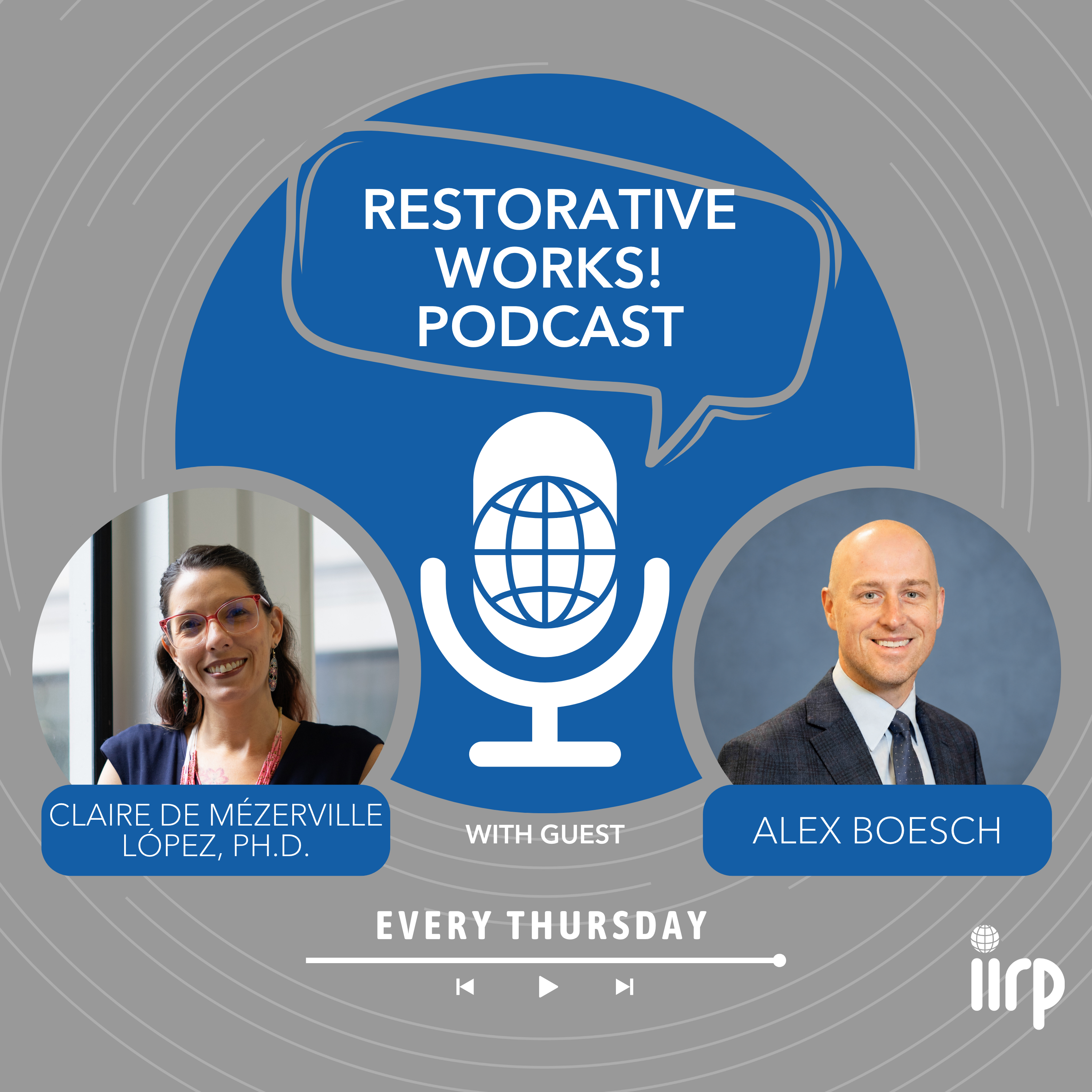
In this episode of Restorative Works!, host Claire de Mezerville López welcomes Dr. Alex Boesch, educator, higher education administrator, and organizational culture expert, for a thoughtful conversation about how restorative practices can bridge intercultural competence and social justice in higher education.
Drawing on more than 15 years of experience implementing restorative practices on college campuses, Dr. Boesch explores how circles create space for meaningful dialogue across differences. He shares real-world examples from his work at Wayne State University, including facilitating listening circles following moments of community trauma and creating spaces where students, faculty, and staff can process difficult events with care and dignity. He discusses the importance of intentional facilitation and how structures rooted in restorative practices provide emotional safety, ensuring every voice has the opportunity to be heard.
In his current role at Wayne State University, Dr. Alex Boesch leads strategic initiatives that support a positive and healthy organizational culture. He regularly designs and facilitates workshops, retreats, and learning experiences for employees. He is skilled at leading working groups to improve organizational culture. Dr. Boesch has infused restorative practices in his higher education and consulting work for 15 years. He has presented at conferences on the intersection between restorative practices, intercultural competence, and social justice. Dr. Boesch holds a doctorate in educational leadership from Eastern Michigan University.
Tune in to discover how intentional dialogue and restorative practices can transform how we lead higher education.
Transcription
Claire de Mezerville Lopez
Hello everybody and welcome to Restorative Works!, a podcast where learning, practice, and research open new paths for transformation. My name is Claire de Mezerville Lopez, and it is a joy to introduce our guest, Dr. Alex Boesch. Alex, welcome. How are you today?
Alex Boesch
Doing so great. How are you?
Claire de Mezerville Lopez
I'm really looking forward to learning from you, and learning about higher ed. But before going into the questions, allow me a minute to introduce you to our audience. Dr. Alex Boesch is an educator, higher education administrator, consultant, and expert facilitator. In his current role at Wayne State University, he leads strategic initiatives that support a positive and healthy organizational culture. He regularly designs and facilitates workshops, retreats, and learning experiences for employees. Dr. Boesch also has a leadership role within the Council on Inclusive Excellence, Employee Engagement, Group Program, and Culture and Climate Study. He is skilled at leading working groups or change teams in order to improve organizational culture. Dr. Boesch has infused restorative practices in his higher education and consulting work for 15 years. He was initially trained under the Building Campus Community Framework through the IIRP, and he is now a trained trainer of Reimagining Campus Community with Restorative Practices. He has presented at conferences on the intersection between restorative practices, intercultural competence, and social justice. Dr. Boesch holds a PhD in educational leadership from Eastern Michigan University. He holds a Master of Education from the University of Vermont and a Bachelor of Science from Loyola University in Chicago. In his free time, he enjoys spending time with his family, exercising and catching up with friends. And Alex, welcome to the podcast. I cannot start anywhere else. Please tell us about the intersection between restorative practices, intercultural competence and social justice.
Alex Boesch
Thanks so much, Claire, for that warm introduction. I'm so happy to be here. And absolutely, it's a great place to start. So that question and ultimately my answer to it is largely foundational to my educational approach. As you indicated in my bio, I've been working in the space of higher education for 15 years, and all of that time has been under the positive influence of a restorative practices framework. And I see the connection between these things, as restorative practices can really serve as a bridge between intercultural competence and social justice frameworks. So, many listeners and probably yourself included are really probably familiar with these concepts, but in case they're maybe a little bit conflated in individuals' minds, you know, intercultural competence and the research, and this is my area of research as well, ultimately goes back to our skills to engage effectively across our differences. In many cases that's our differences of culture. And so inherent within that definition of what it is, there's not necessarily a critique of let's say systems of power or privilege or oppression. It's just the skills that we can engage, that we can build to engage across those differences. And there's research into well what are the building blocks of those skills? Well things like active awareness or a self-awareness, active listening, curiosity, a tolerance for ambiguity. So some of these are the fundamental skills. Now, a social justice framework is really considered of like equal access to rights, you know, or economic rights or political rights. And so, in many cases it's connected to this civil rights framework and inherent within that is a belief that something should change. That if someone is espousing a social justice framework, we should be changing things so that there can be more equal access to these various rights or privileges, whether it's a nation or organization or beyond. And so, sometimes there can be a tension between those two things, right? Social justice having this one paradigm, intercultural competence having a slightly different one.
And I've found that there can be even still then a tension between individuals who hold implicitly or explicitly, because sometimes it's pretty deep down in us that it's implicit, of which one of those paradigms feels most natural to us in an education setting or just even in a life setting. And I found that restorative practices is really well positioned to be a bridge between these two frameworks. Because if you can imagine being in a circle setting, or even just any part of the restorative practices continuum, from affective statements and questions, but to a circle. But let's think about circles for a second, where the questions are intentionally crafted for a circle, where people are situated equidistant from each other, ideally all kind of in the same chair, that they will be able to hear each other and see each other, that we're naturally beginning to try to break down any inequalities that exist that are impacting the circle’s experience because we're coming together in this particular framework. Then the questions invite self-reflection. Remember I was talking about self-awareness, right? Many of us are reflecting on our own identities and culture, whatever it may be. And we're gonna go a little bit deeper with some of these questions over time to really think about how we engage with each other and we dialogue and we engage across those differences. And there's active listening as a portion in it. And so no matter what the paradigm someone may come to the circle with, we're able to engage in that circle as a bridge from an intercultural mindset and a social justice mindset so that we can hear each other more effectively. And oftentimes, no matter what perspective we are in, since the circle is held many times in a sequential way, there is that necessary moment where I'm going to empathize with that person across the circle from me and try to understand their perspective a little bit better, knowing that I'll be able to have my turn to speak at some point, anyways. And so I've been using this particular way of engaging and dialoguing in all of my professional experience since my master's program 15 years ago when I was introduced to it.
Claire de Mezerville Lopez
I love that. And I love the idea of restorative practices as a bridge because I can imagine and I have experienced how when you talk about social justice and when you talk about different paradigms, there's a lot of passion and there's a lot of knowledge and there's a lot of work that you want to advance, that you wanna do, you really want to take steps forward. But restorative practices offer a community the how, to open up to uncertainty where I am going to see myself forced through the structure of the practice to speak but also to listen and to wait and to discover things that maybe I don't imagine. And I I think that's always hard to do, you know, to slow down and beyond this “knowing”, to go together into that unknowing, especially with things that are complex and that are not going to be easily solved, fast.
Alex Boesch
Indeed. Yeah. And in that circle setting, you know, I can use myself as an example. I identify as a white man. I grew up in a homogeneously white and Catholic community in St. Louis, Missouri. And so, you know, my worldview was informed by my upbringing. And so being in circles where I was invited to hear different perspectives from other individuals' cultural practices and in belief structures, but also invited to wrestle with any sort of systems that are out there, that are that are, you know, providing a privilege to some or marginalized in others in the circle, I was hearing those perspectives and then having to invite them deeper into me, and recognize, huh, you know, what can I learn from this? What more research can I be engaging with? If anything, this individual just shared something that was really deep and personal to them and it only came up in this particular container. And so I thought of it as a bridge ever since then. That when we are all participating in that circle setting effectively and honestly and vulnerably, then we can go deeper to hear across those differences and hopefully and learn more and figure out how we want to operate thereafter.
Claire de Mezerville Lopez
And I will go back to the idea of the structure because that also offers us emotional safety to navigate difficult situations. Just yesterday I was doing community work and, not to go into too many details, but this is a prison context about themes that are sensitive for the people that are participating in the circle. And there was a time when a couple of these people were escalating just a little bit because they were talking about things that are important to them, and they have very different mindsets about how to approach them. And we had time for that. And then the prompt was: well, okay, but let's go back to the circle, you know, let's go back to the circle in a sequential way. And you could see how everyone was able to calm down because they knew that everyone is going to get to be listened to. But that's something that the structure offers you, because if not, is very much personality-based or strength-based, whether you are, you know, able to speak up or not. Now I am curious, Alex, how does this intersection play out specifically in higher ed environments?
Alex Boesch
So yeah, that's a great question. And in my lived experience, you know, working in higher education and also studying it for the past fifteen years, I have come to really believe that the university is a microcosm of the environment in which it's situated and some people actually argue that the external information and news and what's going on in the world and nation should be grappled with and engaged on the campus, whether it's in the campus forum or in the right classroom, whatever it may be, there is a question of the time, place, and manner. So, this question of social justice, intercultural competence, and sort of practices intersecting is that it can intersect on college campuses, but I don't think it happens every day in that particular way that I've nuanced because, in framing for how we can wrestle with things going on in in the nation and the in the world or even local information doesn't happen by accident. It's really intentionally designed and facilitated. And I can give an example. You know I've facilitated more responsive circles and listening circles than I can count over the last 15 years in the in the higher education space. And in this example, your listeners may remember in May of 2020 two white supremacists committed a mass shooting in a supermarket in Buffalo, New York, killing ten black people. And since that time, individuals pled guilty to murder, hate crimes, domestic terrorism. And I think there's even ongoing federal litigation that people could learn more about if they wanted to and do their own research. So, my work at Wayne State University is in the heart of Detroit, Michigan, where many people may know that Detroit is seventy-seven percent or seventy eight depending on the on the number you find, seventy eight percent African American or black identifying in its citizen population. And so many of the folks that are from this community, the Detroit community, come to Wayne University, whether it's to be a student or whether it's to work, be a staff member or a faculty member. And so we immediately in the aftermath of this horrific and tragic incident, we recognized that we would likely need to create a space for people to engage because this was impacting them so deeply. And so we did that. We spoke with our colleagues and immediately we felt that having a space for people to process this was going to be helpful. And you can think about a circle in an aftermath of an event like this, that you could have individuals showing up to that space who have never thought about the ongoing history of racism and particularly a racism toward the black and African American community in the United States. Or you could have people that identify as such who have had multiple experiences over their lifetime having been harmed by racism in this particular way or in different ways. And so the circle space needs to be such that it can hold all of that and that gives space for everyone to process. So you might come back to the things I was talking about: intercultural confidence, engaging across differences, social justice, that this isn't right, that this is rooted in some historical roots of oppression and systemic racism. How does this circle create this? And so anyone's participation in this space gives them space to reflect, listen, be curious and dialogue. And then you think about me, and once again in my identities and how I am trying to intentionally hold this space with a co-facilitator so that all can emerge and that any feeling, thought, concern, or ultimately the last question we landed was what do you need from this group? What do you need from your colleagues? What do need from your students? To feel that you can continue to be an active participant in this environment. But by nature of going through the questions, people felt that they were seen, valued, and heard. And they're a member of this community, this Wayne State community, that wanted to engage with some of the hard questions that were going on there and recognized that what was happening a couple states away was really, really deeply personal to many members of our community and we needed to wrestle with it. So, this intersection that I'm talking about is not necessarily easy.
Like you know, holding conversations like this, holding a dialogue like this, intentionally is necessary in many cases especially in the public university setting and it needs to be nuanced with care, intention, excellent facilitation, and ultimately this work can be done proactively too. I've been giving examples of responsive for the little bit here but you can do this proactively too where you are nurturing a team, let's say you're leading a team of staff members that you want to be effective at their building to just engage across their differences or to share when something is going on in their personal lives that may be negatively impacting their work, or something like that. That you can nurture the space gradually over time. And I would be happy to share some examples about that as our conversation unfolds.
Claire de Mezerville Lopez
And I'm really looking forward to listening to more of that. Alex, thank you so much. We're going to take a very short break and then let us come back to learn more from these examples and from more of these stories. Please stay tuned.
Welcome back. Alex, as you were speaking about this, higher ed is a space with so much opportunity. And as we go through such challenging times, I continue to think, for example, just about artificial intelligence. And I remember a circle that we had with students where we were thinking about this and just trying to reflect about this. And one of the students said, and I will always remember this, she said: it just feels that you really don't care so much, and she didn't mean me personally as Claire, as her teacher, she meant teachers in general, that you really don't care as much of whether we are developing critical thought, but you are just way too concerned that we don't cheat. And that gave me pause to say what's going on with our relationships as teachers and learners in higher ed? So, there is that, but there are also all the social things that are going on, the ones that you were mentioning before the break. Would you share with us a couple more stories about how restorative practices can be integrated into higher education and what you would like to see in the US and around the world around this work?
Alex Boesch
Yeah, thank you for that. So, you know, as I alluded to before the break, there's many ways that I have, and educators could or higher education administrators could, embed restorative practices into their day-to-day work that is proactive. Because we know that, from the research and restorative practices, that when we're investing in that proactive, when we're building the trust and the strengthening relationships and investing in that social capital, that we've got something from which we can repair more likely than if some sort of conflict or harm comes into the community. And so, with that sort of proactive mindset, how do I do this? I have been asking, Claire, let me tell you, I've been asking the same three questions of groups, of teams, of classrooms that I've led. That it'll be a longer term experience for years. And I used to lead undergraduate student leaders, and now I then shifted to supervising professional staff members teams, and I always begin the year with this first question. We come together in circle format and ask, what are your hopes for the year?
I facilitate that question sequentially, giving people one a turn to go around. Then the next question I ask, which is really intentional, because what I want is I want to give people some agency and some permission to be a little bit nervous, to be a little bit anxious, to show the fact that things might not be perfect every day. And so I asked this question, I say, going into this year, what are you a little bit nervous about or a little bit anxious about? But the way I ask this one is I ask people to talk to their peer to their next door neighbors, just a pair share or a triad share. Instead of having to speak in a circle of 10 or 15 or 20. Because that might be a little bit too far, right? That might be, this might be someone's second day at work and they're asked to talk about something they're nervous about. Let's just talk amongst our peers a little bit.
What I'm inviting there is a dip of toe into this honesty, vulnerability, humanness. This humanness that I think comes back to what some of your students were getting at like we want to be seen as humans. And then the last thing, once that is talked about in the pair shares or the triad shares, you can feel the energy in the room change. That we're not just people at work. We are people who are here. You know what I mean? That we are here together and that I have something that makes me nervous and you do too, Claire. And even if they're not the same thing, we're humans. And the last thing that I ask, and this can be facilitated in different ways, is you know, what is your commitment to the success of this dot dot dot group or classroom? Because that actually can be a recipe for a first day of class conversation that ultimately leads to our class community standards. You know, how are we going to exist together? And make sure that this classroom environment is vibrant, that it helps you to feel like you learn. Not we all learn, but you and your uniqueness. What are the commitments that you want to sort of offer to the room or what would you even ask for the room if there's time from that as well. And so, this is a way to put into many, many different spaces, whether it's team building of staff, students, or fair first aid class norm setting.
And this is also the check-in circle. This is a different example. I weave in the check-in circle to pretty much every meeting I facilitate. Some people that are not necessarily used to my leadership style, they come into a meeting and it's an hour long meeting and they're like, Okay, let's get to it. We gotta get right in. And I say, all right, I I tell everyone my explicit practice, “hey, so if you haven't been in a meeting with me recently or ever before, I always bring in with some check ins. So, I just wanna hear, hey, how are you feeling coming into today's meeting?” And if it's a big, big meeting, maybe it's just one word that people will share. But this is important because we have to situate ourselves in in the fact that we are humans before the task at hand. And I'll tell you what, the next, if it's an hour-long meeting, we take a 10-minute circle check-in, the next 50 minutes are way better because of it. Because we've just taken the time to acknowledge all the things going on in people's lives.
Whether they be really great things, like someone just got a research paper published or something that's not so great, that maybe someone's family member is ill. But we wouldn't know any of those things had we not paused to do a check-in. And then this overlaps with just great organizational development research. You know, I think Jane Dutton has done research into high quality connections, where at work, when you have high quality connections with people, you're more likely to feel positive about your work environment. And you're more likely to wanna show up and you have a positive regard and people see you. And so, you know, here is like an intersection of where, you know, you can just do a little bit of that positive work and proactive work for your teams, whether it be students, staff, faculty or so on.
Claire de Mezerville Lopez
There's so much there, Alex. Thank you so much. And thank you so much for being on the podcast today.
Alex Boesch
I'm really, really happy to have been here. I appreciate the time. and thank you so much for the invitation.
Claire de Mezerville Lopez
It was wonderful to learn from you and thank you all for tuning in to Restorative Works. To learn more about our guests, log on to IIRP.edu and let's continue to build transformation through dignifying relationships, kind conversations, and stronger communities. Until our next episode.
Alex Boesch
Take care.