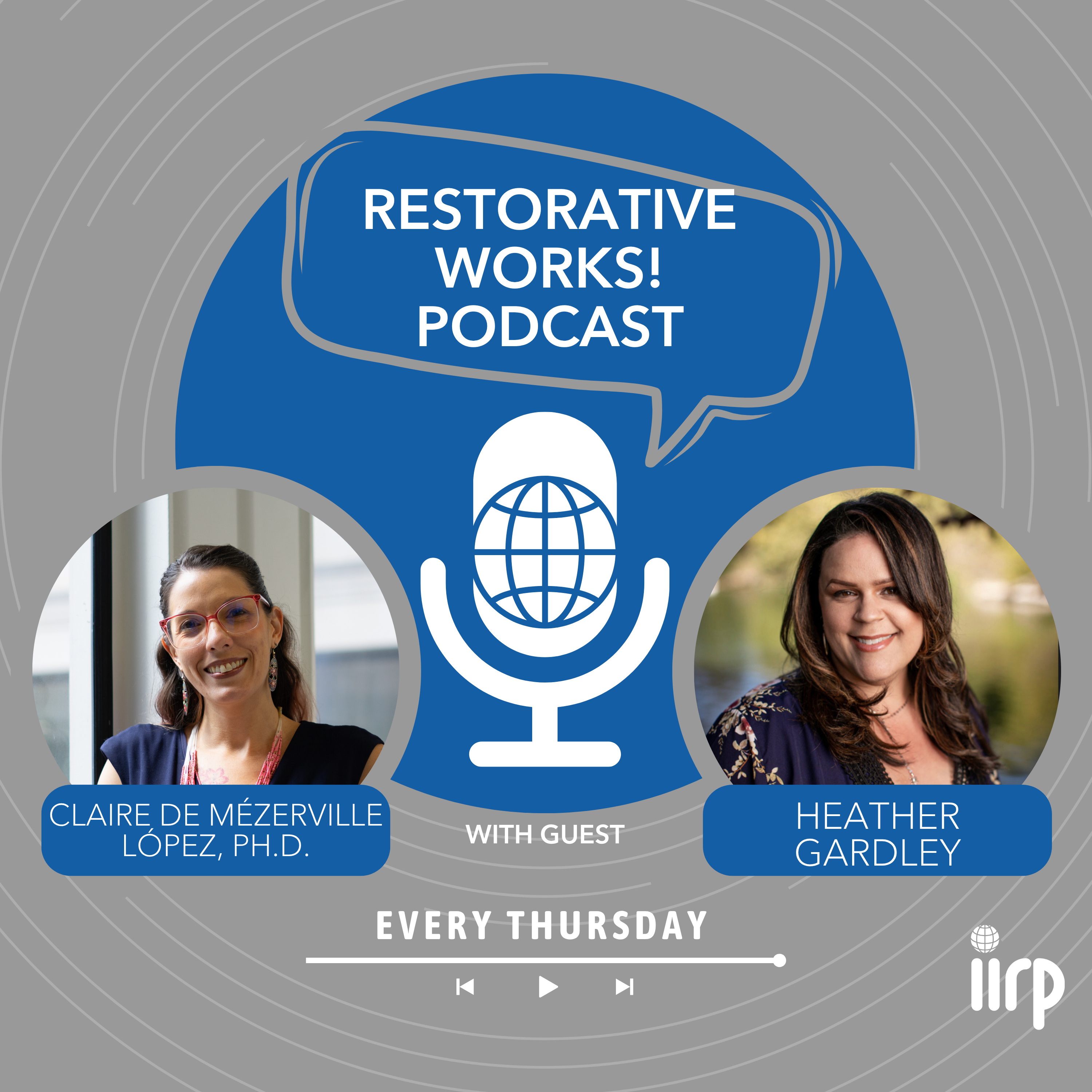
In this episode of Restorative Works!, we are joined by Heather Gardley, a leader deeply committed to advancing community-centered approaches through restorative practices in higher education. Heather shares insights from her work supporting schools and organizations in building cultures rooted in trust, belonging, and accountability.
Heather invites us to consider how we can implement restorative practices on campuses to build community, whether that be during new student orientation, student employee training, problem solving spaces, or when conflicts occur. Through moving stories of real-world impact, this episode offers a thoughtful look at how restorative practices can help transform not only institutions, but also the ways we show up for one another in our daily work.
Heather Gardley serves as the Director of Student Conduct, Rights & Responsibilities at California State University, East Bay. With over 20 years of experience in higher education, she is recognized as a strategic and thoughtful leader committed to fostering ethical development, student advocacy, and retention. Her work is grounded in a student-centered approach, with a strong emphasis on care, accountability, and growth. A dedicated restorative practitioner, Heather brings a balanced perspective to student conduct work, prioritizing both responsibility and support. Heather earned her bachelor's degree from San José State University and a master's degree in organizational communication from CSU East Bay. She is also a proud member of Sigma Gamma Rho Sorority, Inc., reflecting her ongoing commitment to service, leadership, and community engagement.
Tune in to discover how restorative practices can transform educational higher ed spaces and support the work of joining students and strengthening campus community.
Transcription
Claire de Mezerville Lopez
Hello everybody and welcome to Restorative Works!, a podcast where learning, practice and research open new paths for transformation. My name is Claire de Mezerville Lopez and it is a joy to introduce our guest today, Director of Student Conduct, Rights and Responsibilities at California State University, Heather Gardley. Welcome, Heather. How are you today?
Heather Gardley
Good morning. Thank you. I'm great.
Claire de Mezerville Lopez
I am looking forward to learning from you this morning. But before we do that, before going into the questions, allow me to introduce you to our audience. With over 20 years of experience in higher education, Heather is recognized as a strategic and thoughtful leader committed to fostering ethical development, student advocacy, and retention. Her work is grounded in student-centered approach with a strong emphasis on care, accountability, and growth. A dedicated restorative practitioner, Heather focuses on creating equitable processes that support learning and community repair. She brings a balanced perspective to student conduct work, prioritizing both responsibility and support. Heather earned her bachelor's degree from San Jose State University and a master's degree in organizational communication from CSU East Bay. She is also a proud member of Sigma Gamma Sorority, reflecting her ongoing commitment to service, leadership, and community engagement. And Heather, welcome to the podcast, but let me start going back. Tell us about how you learn about restorative practices and how they apply when it comes to a student's conduct, rights, and responsibilities.
Heather Gardley
Thank you for having me today. I'm really excited for this conversation. I first learned about restorative practices being a parent of middle school children. And it was being used as a part of the disciplinary process within their middle school. I have triplets that are now 16, but at the time this was middle school age. And when one of my triplets had gotten into trouble into a fight with another student, instead of suspending him, the school used restorative practices to help repair the harm that had occurred between them because they were friends at one point. And then of course the subsequent fight. And that was really when I saw how useful and beneficial and impactful restorative practices can be in the educational setting.
However, I had only seen it in that K-12 setting. And so, as I was getting into this position of student conduct, I've been in this role for about four years now, I noticed that there was nothing like that here. It was really about educational sanctions or sometimes more punitive sanctions, depending on what was happening. But I was noticing over time that there were cases that I was receiving that could totally be resolved by using a restorative approach instead of a punitive one. And that even with educational sanctions, it wasn't necessarily having the impact or allowing for repair of what had happened in that situation. And so, I started to investigate what it would look like to bring restorative practices to our campus and what training would I need to be able to receive to become a practitioner in this space. And it was clear to me that once I received the training, and once I got connected with somebody that was already doing it in the higher education space, it was completely possible. And it has transformed many of the cases that I've had in this last year as we've really ramped up the implementation on our campus of not requiring students to go through this long drawn out conduct process, but really be able to kind of nip things in the bud by having direct one-on-one conversations with the students.
Claire de Mezerville Lopez
I work in higher ed as well. And I can also wonder how we can see so much in K to 12 apply to this different school setting. And Heather, in your opinion, if we're envisioning this, how this could be explored or expanded in an educational setting like this, what are efforts that universities could do or maybe are already doing regarding a student's wellbeing? How do you think restorative practices could help?
Heather Gardley
So, most institutions have what's referred to as a care team. So, a care team is various administrators across different divisions. So academic affairs, student affairs, what have you, that come together to address students of concern, whether that be housing insecurity, food insecurity, mental health issues, any variety of issues, death in the family, they're a caretaker, they're falling behind on classes, to our university housing and residence life where we have roommate conflicts. And sometimes those roommate conflicts escalate and can get out of hand. Again, looking at these different areas that we use for retention or just student support, looking at how we can be proactive, of course, as well as reactive when we've had a situation, and helping the students find resolution and helping them to resolve conflict with one another. And sometimes that is in the faculty and student relationship. Sometimes there is a conflict between the two that can really be resolved fairly quickly with a restorative conversation and doing some circle work. I think that as we look to retain students, we look at what makes a student want to stay in school. Oftentimes it is rooted in their sense of community and belonging.
And so, us taking a step back to see how can we use restorative practices again in a proactive way to help build community on our campuses, whether that be during new student orientation, student employee training. Again, when there are conflicts, whether that be in housing or on the academic side or in student conduct to bring people together so that we're having conversations and we're teaching young adults and sometimes fully formed adults, how to resolve conflict. What we were noticing was that coming back from COVID, this crop of students that had graduated high school, had maybe done some of their schooling during COVID times from home, were really lacking in some of their social skills and being able to relate to one another and again, resolve conflict. And so, seeing that there's this gap, in my mind, I'm a gap filler, gap identifier, how can we seek to close that gap? And to teach these skills that we had assumed they had already started cultivating in high school or maybe community college before they got here. But then we quickly realized they don't have some of these skills or if they do, it's very minimal and how can we help develop them further? And so that is how I see this work spanning across or just beyond student conduct, rights and responsibilities.
Claire de Mezerville Lopez
I love that because if I play the role of the devil's advocate and we talk about, well, these are young adults. We're not supposed to treat them as children or teenagers. They are meant to be autonomous. Are we quote unquote, babying them if we're doing these kinds of practices? But then when we work with restorative practices in K-12, we're actually fostering autonomy and responsibility and more ownership of situations so that they can resolve them. So what would you say to someone that questions whether these can be applied with adults that are supposed to be more independent?
Heather Gardley
I would say it can completely be applied. I think that as young adults or again fully formed adults, because we do have non-traditional students here as well, we do have students in their 30s and 40s and 50s that still might be lacking some of those conflict management skills or just interpersonal skills, right? Because sometimes it's not necessarily just conflict. That it is entirely possible. I think what was challenging for me in the beginning was all of the research, the writings were really heavily rooted in just K-12. And so my thought partner here, Crystal, and I really thinking and strategizing about how can we apply this in the higher ed space? We're used to seeing this with children and them bringing parents and families into the conversation. Well, here, 18 and up, we have for policies and things, and we're not bringing in your parent to sit in on the meeting. You are a full-fledged adult now, even our 18-year-olds, and you are having to go this alone. My son is here as a freshman, and it's been interesting to see he and his peers, his fellow freshmen, navigate this first year and navigate some conflicts, even in a student leader setting, right? So our student clubs and organizations and them having some intergroup dynamic kind of things going on and how restorative approaches, whether that be circles or what have you, can even help in those groups. So for example, I had one of our dance teams, the SO student organization, all female students that were having some really heavy intergroup issues, conflicts that were ongoing for months. And so the on-campus advisor of the group we had done a training with her among other staff members. And she said, you know, I think that our group could really benefit from doing a circle. Can you come in and facilitate a circle for us? And so I did, it was a group of eight girls. And in that circle, they were able to share their own account of what happened, you know, how they were impacted or hurt, and then what they felt needed to happen to be able to move forward as a group and operate in cohesion. And that was the first group circle that we had done of that kind of a student organization before it was just kind of, you know, a one on one or, you know, two on two kind of dynamic. And so that was really interesting to see that at play with those group dynamics. But it allowed me to see this is entirely possible. Coming up this summer, I'll be working with our nursing department who had a lot of different issues going on with students going through personal trauma. They had had a couple of deaths within the program of students and it's really heavily impacted the faculty and the students. So it's just been a tough year and so I had reached out to the department chair and I said, what do you think about doing a circle or a couple of circles? You know, one for your students but one also for your faculty. This has been a heavy year, a heavy past semester. Even just using that circle to be able to kind of just debrief, share feelings. And if they think that there needs to be some changes, allow it to be a circle for feedback for the department chair as well so that we can look at, you know, how do we minimize some of the stress that's on our students for next year so that our students aren't having such heavy burnout and ultimately some mental health struggles from it. And so they were very receptive to it. And so I'm really looking forward to leading that circle this summer.
Claire de Mezerville Lopez
I think it's going to be so important. And I could also say that just going through these skills and experiencing the skills also prepares you for life, for community life, for professional life. We're going to take a short break and then we're going to continue this important conversation with Heather. Please stay tuned.
Claire de Mezerville Lopez
Welcome back to Restorative Works. Heather, thank you so much for being on the podcast. Now, continuing on the conversation and what you were explaining to us, balancing responsibility and supporting higher ed is very different in comparison with other community or educational spaces. As we were just mentioning before, what are some of the main considerations that higher ed professionals should keep in mind from what you have learned?
Heather Gardley
I think it's important to have a village of supporters on your campus that support the work, see the value in the work, and are willing to help you implement to execute the work. Bringing something new into the campus, because really this is a part of campus culture and how you are adding to it or looking to shift the campus culture, you have to have allies. Without allies, it would be a whole lot harder to move forward with the work. And so for us, it was a matter of involving our student affairs colleagues. I personally am in the division of student affairs, as well as academic affairs, because we recognize the value outside of just student affairs and in the classroom. Again, sometimes we have classroom management issues, some classroom conduct going on that if we're able to train our faculty that they can feel comfortable and confident and leading circles within the classroom and don't necessarily need to bring me or my partner in to do it for them. And so I think that having that institutional buy-in is crucial to the success of bringing restorative practices to your campus. I can't stress that enough.
Claire de Mezerville Lopez
Because it is also strengthening community! And the community needs to feel capable to embrace this. I completely agree with you. Will you share with us a story or a couple of stories that brought you hope and inspiration about the importance of this work?
Heather Gardley
Yeah, for sure. So this past semester, there had been a conflict between a former boyfriend and girlfriend, and it was spilling out into social media. And there is an anonymous posting app that students have taken to using. We thought it had died a while ago, but it's made a resurgence. so in that, accusations and allegations were being made against the male student alleging sexual assault of the ex-girlfriend and so it was just further creating more tension between the two. And one of the students was running for a student government position and it was really creating a lot of stress, a lot of just mental anguish and it was becoming a student conduct issue. And not one party was at fault for anything, but there was a lot of miscommunication. There was a lot of rumor, a lot of gossip. And so I had approached both parties when I met with them individually in my office. And I said, how would you feel about doing a restorative circle with this other person? From my conversations with both of you, I think that this could be resolved through a conversation. Since your breakup, neither one of you have spoken to the other. You have avoided each other like the plague. What if I'm there to help facilitate that conversation? Do you think that you would be open to that? Do you think that that would be beneficial to you? While they were both a little hesitant, they both agreed and said, okay, yes, I'll do it. Because as we know, it's a voluntary process. I can't mandate, although sometimes I wish I could, for people to participate in the process because I believe it can work. And so we got together for the circle. They were both extremely nervous. So I had us take some deep breaths before we got started and got into it. By the end of the circle, there were definitely some, some revelations as far as, you know, I never said that or I, my friends weren't responsible for that. what have you and the other person, you know, thank you for saying that. That means a lot to me. I didn't think you were responsible, but I couldn't be sure. And it was just really, you know, troubling to me, you know, impacting my reputation here and very damaging. And by the end of the circle, they were hugging it out. I was hugging them, they were hugging each other. It was great. And as I was sitting there and I'm seeing the repair happening in front of my face, I'm thinking to myself, this is what it's all about. This is why we want to encourage students to have these crucial, difficult conversations that we all want to avoid. Nobody, nobody, I don't think intentionally seeks out conflict. I think we're, tend to be more avoidant. And so that was my first time again, like with a boyfriend, girlfriend, or a relationship type circle, but it was very helpful, very restorative and they walked away smiling and I just sat back and I thought, I am doing the Lord's work here. This is great. We need to continue this. wish every circle could be like this, because it was just such a model example.
You know, I provided the example before about the student organization, the dance team. I also had another, my very first circle I did was with two male students, both on the spectrum, that had known each other since high school and transferred here and were now college students together. And they had been having a lot of verbal and sometimes physical conflict. They were both residents in our university housing. you know, again, just kind of close quarters, community living kind of thing. And it just kept bubbling up into being student conduct incident reports. And the more I was getting these reports and having to meet with the students each time, again, my thought was, you two need to have a conversation. There's some beef here and that they did not have the skills to be able to sit there together like that and take turns with talking. And so it was really crucial to have the talking piece and to have somebody mediating that conversation because they really didn't have the skill set to be able to do that on their own. And again, at the end of that conversation, there were apologies made on both ends, unprompted, and in a promise to do better going forward, they ultimately decided that they didn't want to be friends anymore.
They just wanted to be able to move their own separate ways in peace and they were able to do that and they had no more issues from either party and one of those students just graduated last week. So anytime we can successfully move somebody through and help them get to degree and graduation day, that's a success for us. So I see the value in bringing restorative practices here. And my hope is that going into this next school year, we're able to further build it out and expose to more populations on campus.
Claire de Mezerville Lopez
I love that, and I can see how situations can be very sensitive. They can be very delicate and how we can also, we also need to have the protocols to manage specific situations in certain ways, but how valuable is for students to have options and to be able to own those options and to experience them and then bring them into their lives as well.
Heather Gardley
Yeah, you know what's interesting too, that last example with the two gentlemen, neither one of them thought the other would be willing to participate. They said, well, I'll do it, but I don't think he'll do it. And I was like, well, I don't know. Let's see. Let me just ask. And so when I came to the other person, OK, he said he would do it, but he thought that you might not. And he's like, well, if he'll do it, I'll do it. So sometimes there is a little bit of just kind of nudging, convincing that happens, but, ultimately I try to give them as much reassurance as I can in the process and explain the process, very well beforehand. So it takes away some of the fear, some of the anxiety, because ultimately every circle that I've had, there's always a great deal of nervousness and anxiety going into the circle. And sometimes again, just being able to read the room. if I see that we need to do a little bit of breath work before we get started to calm everyone's nerves then that's what we do and just you know really getting us grounded in what we're there to do that day.
Claire de Mezerville Lopez
That's wonderful. Heather, thank you so much for being on the podcast today.
Heather Gardley
Thank you for having me. This was fun.
Claire De Mezerville Lopez
And thank you all for tuning into Restorative Works. To learn more about our guests, log on to IIRP.edu and let's continue. Let's build transformation through dignifying relationships, kind conversations, and stronger communities. Until our next episode.