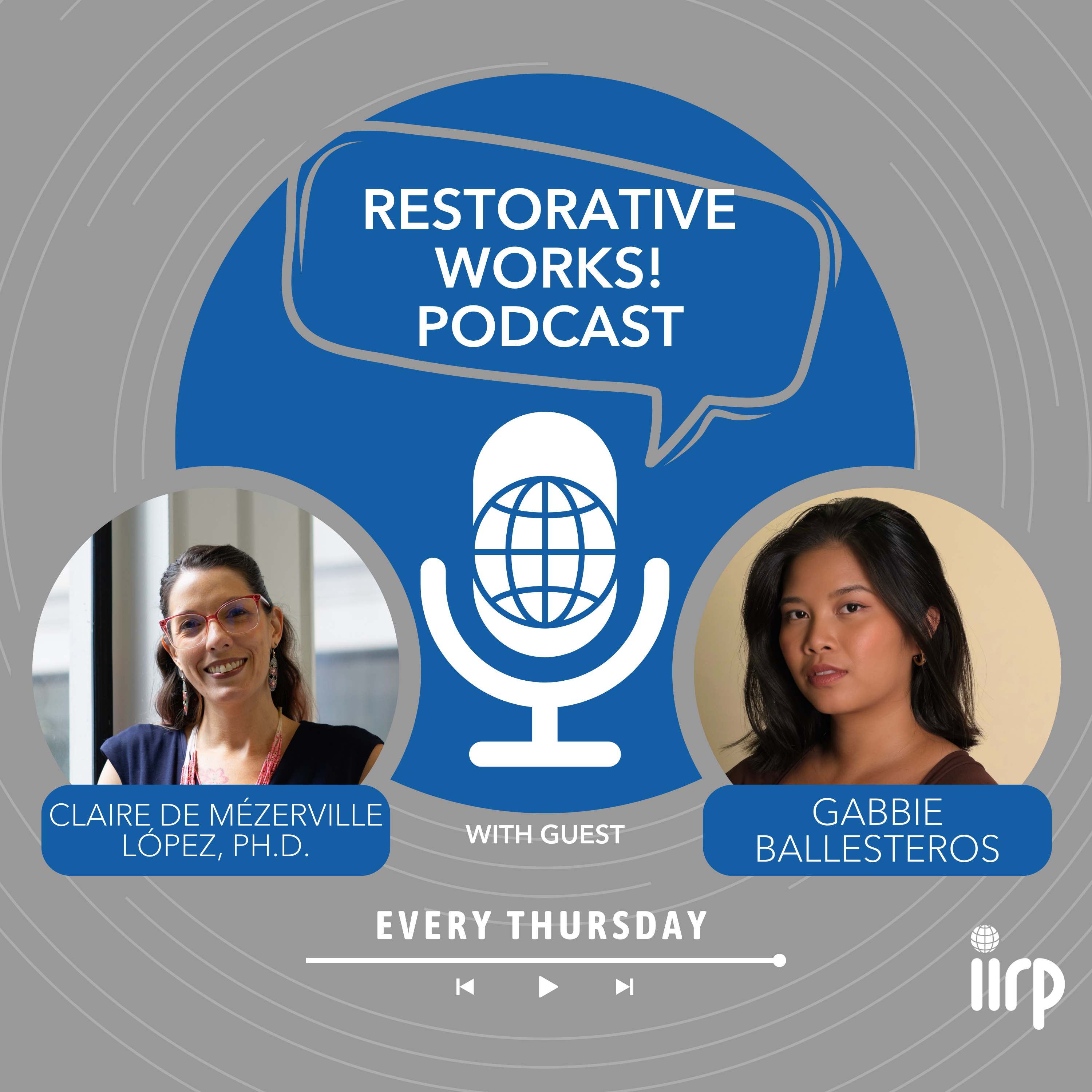
In this episode of Restorative Works!, host Claire de Mezerville López welcomes Assistant Director of Learning and Community Engagement at Manhattan Theatre Club, Gabbie Ballesteros. Together, they explore the powerful intersection of art, advocacy, and restorative practices, revealing how creative expression can strengthen relationships, amplify voices, and inspire meaningful social change.
Drawing from her work in classrooms, community organizations, and theaters across New York City and around the world, Gabbie shares how theaters create spaces where people feel seen, heard, and valued. She discusses the parallels between restorative practices and theater, explaining how both rely on trust, vulnerability, dialogue, and shared accountability to build stronger communities.
The conversation also highlights Punch, the Broadway production inspired by a real restorative justice story, and the innovative post-show dialogue circles that invited audiences to move beyond passive viewing into authentic community conversation. Gabbie reflects on how storytelling encourages empathy, sparks curiosity, and creates opportunities for lasting transformation both on and off the stage.
Gabbie is a multi-disciplinary administrator, teaching artist, and performer who believes deeply in universal access to and engagement with the arts. In her role at the Manhattan Theatre Club, she collaborates on programs spanning classrooms and community spaces throughout New York City, across the US, and around the world that empower learners to engage joyfully and authentically with theater. Gabbie has led a session on community partnerships with the American Alliance for Theatre and Education, moderated special panel events and audience discussions, and was selected for the 2026 Emerging Leaders Program with the New York Foundation for the Arts. She has proudly served as an educator in the New York and Washington, D.C., areas and her home country of the Philippines. She strives to uplift the intersection of art and advocacy across all avenues of her work.
Tune in to hear about Manhattan Theatre Club's educational initiatives, including international playwriting programs, partnerships with community organizations, and free theater resources that make storytelling accessible to educators and learners worldwide.
Transcription
Claire de Mezerville Lopez
Hello and welcome to Restorative Works, a podcast where learning, practice, and research open new paths for transformation. My name is Claire de Mezerville Lopez, and it is my joy to introduce our guest, Assistant Director of Learning and Community Engagement at Manhattan Theatre Club, Gabbie Ballesteros. Gabbie, welcome. How are you today?
Gabbie Ballesteros
I'm well, Claire. Thanks so much for having me today.
Claire de Mezerville Lopez
I'm looking forward to learning from you and your experience. But before doing that, allow me to introduce you to our audience. Gabbie Ballesteros is a multidisciplinary administrator, teaching artist, and performer who believes deeply in universal access and engagement with the arts. As the assistant director of learning and community engagement at Manhattan Theater Club, a non-for-profit theater company that produces work on Broadway and off-Broadway, she collaborates on programs spanning classrooms and community spaces throughout New York City, across the US, and around the world that empower learners to engage joyfully and authentically with theater. Gabbie has led a session on community partnership with the American Alliance for Theater and Education, moderated special panel events and audience discussions and was selected for the 2026 Emerging Leaders Program with the New York Foundation for the Arts. She has proudly served as an educator in the New York and Washington, DC areas and her home country of the Philippines, and strives to uplift the intersection of art and advocacy across all avenues of her work. And Gabbie, this is amazing. Welcome. Allow me to start by going to this final idea. Please tell us about that intersection of art and advocacy, and what does that look like in your work?
Gabbie Ballesteros
Sure. I think for me that intersection is rooted in the fact that art has such a unique and beautiful capacity to evoke change, because it's rooted in connecting to people's emotions and lived experiences and hearts and minds in a really beautiful way. And that can happen through theater, which is you know, the medium that I work most in, as well as dance, but that can happen through music, it can happen through visual art, it can happen through poetry, it can happen through podcasts. And that connection to people's you know, either lived experiences, to memories, to something that they resonate with, can evoke change in a way that can be much more dynamic and compelling than maybe a written proposal or
policy jargon in some ways. And that's not to say that that's not equally important, but I think art is a really powerful tool that can be leveraged to create change and to further advocacy in a meaningful way. So, for me, I think that the intersection is rooted in that unique potential. And then for me too, I think advocacy is inherently tied to my values. So I'm rooted in community and in safety and in joy, you know, and resiliency and care. And I think that I believe everyone has a right to experience and to grow those things in in their lives and in their work. But in my professional life, in my artistic life, I'm drawn to work, to artistic projects that are rooted in those values. So in an administrative context, that can mean managing and designing and developing and contributing to programs that empower young people to discover their artistic voice and to celebrate their unique artistry and perspectives. It can look like working on an artistic project that's rooted in my own cultural history and celebrates others' cultural history and encourages them to get in touch with those memories. So yeah, I think across both my administrative practice and my teaching practice and my performance practice, I'm thinking about those truths and that potential for change and capacity for growth.
Claire de Mezerville Lopez
I love that. That is so inspiring. And I cannot help but to think about how art elicits those emotions. It validates experiences. It's so connected to memory. Your work, Gabbie, is on programs in both classrooms and community spaces. Can you describe them a little bit? And I I'm really curious as to how community spaces are similar and different compared to classrooms.
Gabbie Ballesteros
Yeah, so you mentioned in my bio, which you read very beautifully, I work at Manhattan Theater Club, which is a non-for-profit theater company based in New York City. I'm the assistant director of our learning and community engagement department. So it's sort of an education and community engagement team and office within this producing theater company. and our mission is to empower learners to engage joyfully and authentically with theater to create experiences that empower them to do so. That can happen both in classrooms and in community spaces. So, we work on theater going experiences for high school students and learners of all ages, you know, teaching artists working with students through theater games, through writing exercises, through theater experiences to prepare them to see an MTC production. and then they go and see the production live at our theaters through a student matinee or another theater going experience. So that can happen in classrooms and does happen in classrooms across New York City through our in-school programs. We also have a long-distance virtual playwriting and production program that's international. So that spans, last year we had 14 high schools in nine US states and then in five different international school. So, in South Africa, in Greece, in Singapore, and then in my hometown in Kazan City in the Philippines. So, encouraging and empowering young people to write their own original plays, to pass it to an international partner school, who then produces that play. They're the playwrights and the producers of two original works through this process. So that's a snippet of our work in classrooms. and then in community spaces, which is the the portfolio I work most directly with. It's working with mission-focused community-based organizations in New York City, and basically taking our in-school model and bringing that to community spaces. So, I think the difference is often community spaces are folks that are self-selecting.
So, whether that's an after-school program for youth seeking social services, whether that's an organization like our partner, the Fortune Society, over in Lowland City in Queens, that works with folks who might be coming home from incarceration or folks that are in programs for alternatives to incarceration. Folks are often either self-selecting to be there, or it's not a school mandated kind of schedule. Sometimes usually it's a safer space; it's a community centric space. There might be less sort of rigor and schedule the way that there can sometimes usually be in schools. The work I think at its core is the same. The mission is the same. I think the values are always the same. but the way that the work happens can be tailored and can bespoke depending on the group, depending on the school or the community org, depending on the teaching artist and the facilitator in the space.
Claire de Mezerville Lopez
I think this makes a perfect segue for the next question. Is there something, Gabbie, that restorative practitioners can apply in educational spaces from what you've learned in this artistic work?
Gabbie Ballesteros
Yeah, I think this past year I had the great honor and the privilege to connect with quite a few restorative practitioners and specifically in the realm of restorative justice and I was struck in many of our collaborations and conversations by how many similarities there were in restorative practice with theater practice. I think so much of theater is, especially in an artistic process, but even in a playwriting experience or in a classroom experience, is creating that sense of community, of trust, of shared vulnerability, of accountability in an artistic collaborative process where we're working together towards a product or towards a goal that we're trying to achieve. And I think often that's rooted in the heart of restorative practice, too, is community and connection and dialogue. And theater is a really beautiful way to introduce that in a safe way, in an engaging way, you know, in a fun theater games way that can actually lead to great vulnerability and conversation in a space. And I think in my work specifically, I think playwriting is such a beautiful tool that invites self-expression and asking young people to access their innate imagination. They can write about their own experiences and celebrate that, or they can, you know, write about the most far-flung situation and most imaginative situation they can. But the beauty of playwriting is that they can then hand that off to an actor that will then give credence to their words and that celebration, that giving, that respect and that weight to someone's voice is always a really empowering experience. And I think that's something that I see mirrored in restorative practice in people's voices being respected and people's perspective being acknowledged. And sometimes if that's the first time that's happened for that person, that really can be transformational.
So, I think theater activities, playwriting activities, artistic activities in any way can give people a fun and dynamic way to access that part of themselves, but also hopefully can spark a tool that they can go back to again and again, or a hobby they can go back to again and again. It doesn't need to be a professional endeavor or a professional pursuit. It can just be something that sparks joy for you and that can grow your imagination and heart in really meaningful ways.
Claire de Mezerville Lopez
And I think joy and imagination are such a significant part of learning. Gabbie, this is so beautiful. We're going to take a short break and then we're going to continue with this interesting conversation. Please stay tuned.
Welcome back. Gabbie, I want to take a moment to speak about you. You were selected for an emerging leaders program in the field of arts and culture administration. Please tell us about that. I would love to learn from that experience and how it has impacted your work.
Gabbie Ballesteros
Yeah, so through the New York Foundation for the Arts or NAIFA, I applied and was selected for their Emerging Leaders Program, which is a professional development cohort made up of arts administrators from New York City and from the surrounding area. And the program is meant for sort of manager level folks who are interested in future advancement and in in growing their professional development and in sort of empowering us to think about and develop our contributions to the field. And I think it's been most impactful for me in creating community with that cohort. I think everybody I'm with, my peers in theprogram and the space are very accomplished and incredible thinkers and administrators. And our facilitators are really skilled and wonderful as well. So it's been lovely to build community in that way. And I think it's also given me a lot of new frameworks for leadership and tools that I can use for my self-care, for my self-empowerment. It's been instrumental, I think, to build my own confidence, because I come from a performing arts background. I went to school for musical theater. I sort of did my minors in education and in applied theater, and art and advocacy. I think, as I said before, has always been a huge part of my life and my practice, but I didn't really jump into arts administration until I came to MTC. And that was a new experience for me. So in growing my work over the last few years and in really diving into the development of what I value and the type of work I'm engaged in and most drawn to and that I can contribute to, the program has been really special to allow me to reflect on that growth and to stand in what I do and to have confidence that this is a field that I now am immersed in and that I'm excited to continue growing in as well as with my artistic practice.
Claire de Mezerville Lopez
Gabbie, that is so significant. Now I have this question and I've been looking forward to asking you this. Community engagement can take many different forms. Will you please share a couple of stories so we can understand what it looks like and how it brings you joy in this work that you're doing?
Gabbie Ballesteros
Yeah, I love this question. I think community engagement in the artistic field and in anywhere is so special because it really can take many different forms. And I want to shout out, I think, which is the reason why I was connected with you all. Our Broadway show, our first Broadway show at MTC last season was a play called Punch. It was written by James Graham and directed by Adam Penford. It was a true story, a restorative justice story about a young man named Jacob Dunn from Nottingham, England. And he had gone through a restorative justice process after being incarcerated, came out, made a connection, you know, was introduced to RJ, made a connection with the facilitator, the practitioner, who then connected him to the parents of the person who had passed away due to the fight that he had been in. And that transformed his life. He became an advocate for restorative justice. He wrote a book. The book was then adapted into this play and had a really beautiful and empowering and engaged life in the UK. And MTC produced its Broadway transfer last fall. And so, when thinking about how to create the impact of this work beyond just the stage, you know, the company was tremendous, the production was tremendous, and I think we were specifically interested in connecting with organizations, with groups, with individuals who do this kind of work in New York City, and in creating educational opportunities for audience members that maybe hadn't had access to this work or this field or this practice before. And how could we do that in a meaningful way and in an engaging and dynamic way attached to this show? So I had the great privilege of connecting with a few community partners, shouting out too to the Center for Justice Innovation and Alice Genty Waxburg and Hillary Packer there. We co-produced a discussion series with restorative justice practitioners paired with MTC teaching artists and myself to co-facilitate post-show discussions after Saturday matinees of the show.
And you know, informing the audience that this is inspired by the circle practice that they had just seen in the play, the experiences that Jacob goes through in his RJ process. So, we started with community agreements. We invited folks to share questions, share their experiences, we invited the company members to participate in the circle discussion as well. So, seven of those happened, and were very well attended, and it was a really beautiful opportunity to sort of redesign our typical programming and maximize audience members' engagement with the show. And it was a play that really to no surprise, probably invited conversation and invited curiosity and empathy. And I think that was really clear in the conversations that happened. And I think that is sort of a microcosm of what theater can do that if a story moves you, either in curiosity or in emotion or in kinship, that you want to talk about it, and you want to talk about it with people that might feel the same way, you want to talk about it with people that might feel differently, you want to talk about it with folks that might have worked directly on it, but that invitation to engage, I think, is something that theater does so beautifully. So I'll shout out that. And I think I'd be remiss if I didn't also shout out my work with the Fortune Society, who I mentioned earlier. Their director of creative arts, Jamie Meleshka Tate, is a close collaborator and now dear friend of mine. And I think something she often says is how we do the work is the work, reminding ourselves that we are in community with one another and that we show up with care and with empathy for another. And that extends of course to the community participants that we work with, and to our colleagues and to everybody in the space, but that it also extends to ourselves and that bringing in this care and this commitment to building relationships and to showing up for one another and to being thoughtful about one another in the smallest of details really is what community looks like. And all the better if that can happen and results in a beautiful artistic process or a beautiful, you know, playwriting experience. But how we do the work is the work.
Gabbie Ballesteros
That community engagement can happen at all levels. That community engagement happens 360 and so that's been really instrumental, I think, to the joy that I have in my work and to the fulfillment that I find in my work. So I'll share those two examples and I think the last is just across all of our programs. I think our teaching artists do such a beautiful job of inviting joy into this space. And you mentioned joy and imagination earlier. And those are core to a lot of artistic processes, right? Like joy, imagination, play to some extent. And that can be really transformational for young people and learners of all ages that maybe haven't had the opportunity to access that in a while or maybe ever, that can really change the way that somebody feels just in the space. And if that changes how they feel for the next five minutes, amazing. If that changes how they feel for the next five years, fantastic. But that continued invitation, I think, is something that restorative practice is rooted in, and I think that art making and theater is rooted in as well.
Claire de Mezerville Lopez
That is so inspiring, Gabbie. Before wrapping up, would you please tell us about the free theater programming we have available for folks in the New York City area and beyond?
Gabbie Ballesteros
Yeah, so I'll shout out a fairly new program we have. It's called Lights Up Library. So our in-class or in-school program is called Lights Up. And Lights Up Library sort of takes that model and creates global access for it. So it provides for educators a performance recording of an MTC production, as well as a lesson plan and sort of suggested curriculum that you can facilitate alongside that performance recording. And those lesson plans and activities and writing prompts and things are taken from the curriculum that our teaching artists brought into schools for that production. And Punch is one of those offerings that we have on there. So, in thinking about artistic tools that restorative practitioners can take into educational spaces if anyone is interested in showing or sharing Punch or working on Punch, and that restorative justice story, that's one of the selections that we have on Lights Up Library. Folks can go to the Manhattan Theater Club website and check that out as well. And if you are in the New York City area, please feel free to check out our website and take a look at our programs. We have a free intergenerational family matinee program that invites high school students and an adult of their choice to come and take a theater workshop and then go and see an MTC show free of cost. So we're always welcoming new friends and old friends to those spaces. And I think if anyone, you know, is interested in talking more about community partnership, about community engagement, and collaboration in any way, whether in New York City or not, always feel free to reach out and ask.
Claire de Mezerville Lopez
Beautiful. Gabbie, thank you so much for being on the podcast today.
Gabbie Ballesteros
Thank you so much for having me. It's such an honor and it was a real pleasure to speak to you today.
Claire de Mezerville Lopez
Same here! And thank you all for tuning in to Restorative Works. To learn more about our guests, log on to IIRP.edu and let's continue to build transformation through dignifying relationships, kind conversations, and stronger communities. Until our next episode.