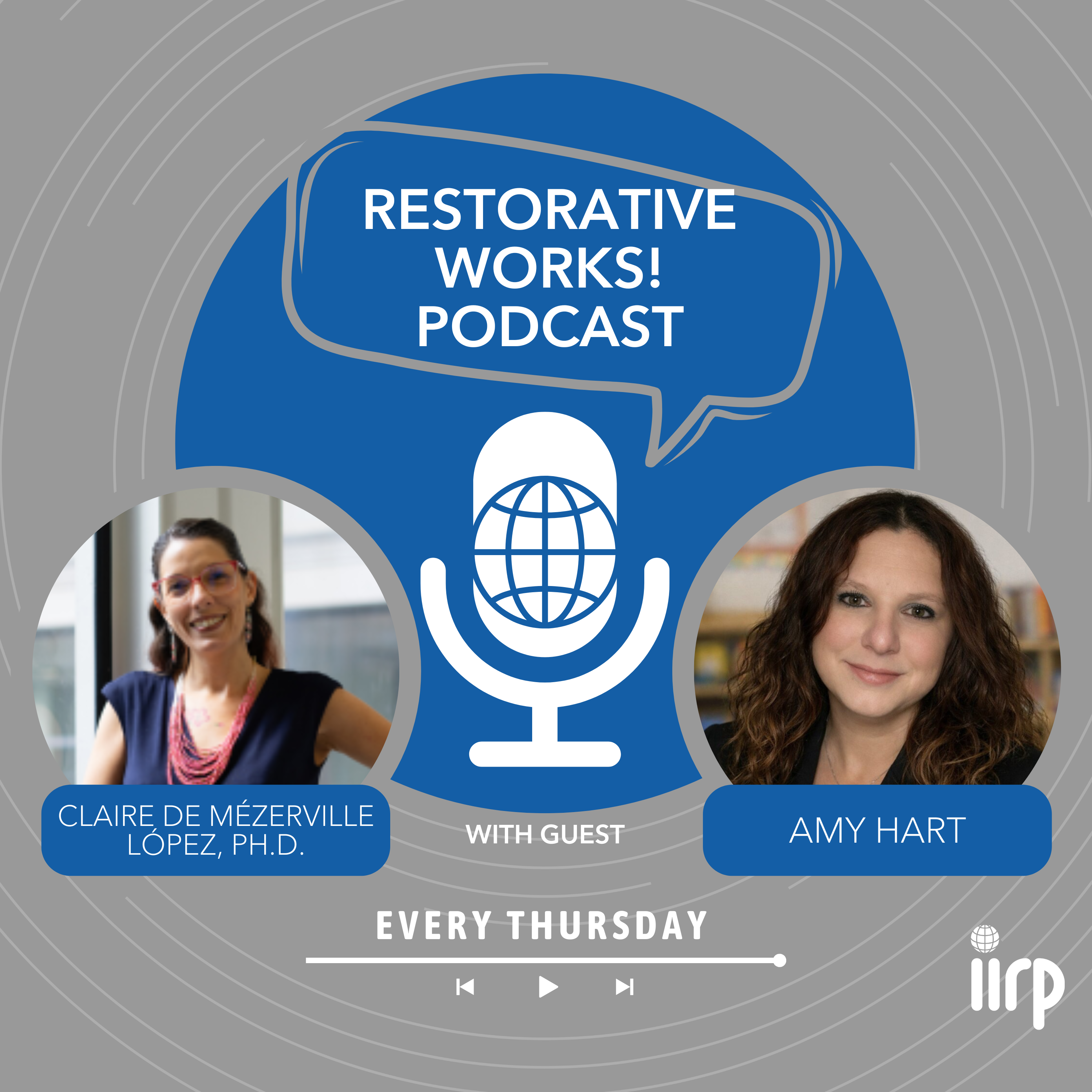
Dr. Claire de Mézerville López welcomes Amy Hart, principal of Stanley Elementary in Wichita, Kansas, to the Restorative Works! Podcast.
Drawing from more than 14 years in education, Amy shares how relationship-centered leadership improves school culture, even amid systemic change, limited resources, and community mistrust. Through a real-world story involving two fifth-grade students on the brink of a physical fight, Amy illustrates why conversations rooted in restorative practices create lasting change. Instead of relying on suspension as a solution, her school engaged families, centered accountability, and facilitated conversations that allowed the harm to be named and repaired. This story brings restorative justice in education to life and shows how trauma-informed leadership builds safety, trust, and resilience.
The episode also explores what it means to lead during disruption. As a "welcoming school" absorbing hundreds of new students without additional staff, Stanley Elementary faced fractured trust and growing pains. Amy explains how her team responded by returning to their mission, vision, and shared values—embedding restorative and trauma-informed approaches into every system, expectation, and relationship. From listening and learning circles to inclusive community events, the school rebuilt its foundation and strengthened its capacity to serve all students.
Amy is the principal of Stanley Elementary in Wichita, Kansas, where she has proudly served for the past four years. With 14 years of experience in education, Amy began her career as a middle school teacher, spending seven years teaching English language arts, math, and broadcast journalism. Her passion for leadership led her to become an assistant principal for three years before stepping into her current role. Amy is trained in trauma-informed practices and restorative practices approaches, ensuring that every student feels supported and valued. Guided by transformational leadership principles, she believes that all students and staff can achieve success when provided with the right resources and feel empowered to grow. Amy is committed to fostering a positive, inclusive school culture where learning thrives and relationships matter.
Tune in to learn how restorative practices frameworks help leaders shift power from control to collaboration, creating environments where students, staff, and families feel seen, valued, and accountable to one another.
Transcription
Claire de Mezerville-López
Hello, and welcome to Restorative Works, a podcast where learning, practice, and research open new paths for transformation. My name is Claire de Mezerville-Lopez, and it is my honor to introduce this episode to learn more about transformational and trauma-informed leadership. Today, we have Amy Hart as our guest. Amy, welcome! How are you today?
Amy Hart
Hi, good morning! I'm doing very well, how about yourself?
Claire de Mezerville-López
I am very much looking forward to this conversation, but before getting started, I'm going to introduce you to our audience. Amy Hart is the principal of Stanley Elementary in Wichita, Kansas, where she has proudly served for the past 4 years. With 14 years of experience in education, Amy began her career as a middle school teacher, spending 7 years teaching English Language Arts, Math and broadcast journalism to grades 6 through 8. Her passion for leadership led her to become an assistant principal for 3 years, one year at Cloud Elementary and two years at Colvin Elementary. Before stepping into her current role. Amy is trained in trauma-informed practices and restorative approaches, ensuring that every student feels supported and valued. Guided by transformational leadership principles, she believes that all students and staff can achieve success when provided with the right resources and empowered to grow. Amy is committed to fostering a positive, inclusive school culture where learning thrives and relationships matter. And Amy,
I have been looking forward to this interview for a while. I read about this story of two boys that got into a scuffle. How about we begin with that? Will you please share that story with us?
Amy Hart:
Of course! So, in this situation, we had two 5th grade boys. One of them has been here at Stanley his entire elementary career, the other one was new to us this year. They have very similar characteristics, and sometimes when you have kids together that have those characteristics, they can bump heads. In this situation, both boys can get heated, and will either elope, so leave a classroom, or they might shout out at classmates. So, this morning, they were in music class, they did get into…I wouldn't necessarily say an argument. One was kind of teasing the other one about having a girlfriend. You know, fifth graders get involved in those types of situations, and it resulted in one of them Walking out of the room. When he walked out of the room, he did slightly…shoulder-check the other student, and so the other student got upset. He did say some things to him, ended up in a quick pushing match as that student was walking out the door, but then the teacher showed up to pick up the class, they're transitioning, and the student who was shoulder checked came barreling out of that classroom at the other student. He wanted his revenge. He wanted to feel vindicated.
So, at that situation, it could have resulted in a fistfight. There were some punches thrown, but nothing actually connected. The teacher immediately stepped in between. did what we have from training here, which is we don't put hands on kids, so it was hands up, worked to de-escalate. Both students walked away from each other, and at that point, administration was called. So, we started investigating the situation. Because it could be constituted as a fight, the physical blows could have connected, all of those pieces. The boys were facing a day of suspension.
So, as we called both moms to come up to school, they actually showed at the exact same time. So, one of the boys happened to be in my office, one in my assistant principal's office. We each pulled a mom in to have the conversation separate, but when we were walking out, both moms were by each other at the exact same time. The student that I had, his mom had turned and looked at the other mom and said, I'm so sorry for what my son did. If you were open to it, I would love to go back in here and sit down and all of us have a conversation together. So that's the type of community that we have been able to build, fortunately, that our parents want to help problem solve as well.
So, as part of this conversation, the other mom agreed. We took them all into the conference room, we sat back just as facilitators, and we allowed the parents to lead this conversation and the boys to be involved in it. So, it came out that the boys were able to identify the things that they had alike, and then come up with a plan to support each other. So, even though they were suspended the remainder of that school day, the very next day they came back, and it was like nothing had even happened. They didn't bring anything from the past, they let it all go, and they stuck to their agreement. And even now, they still stick to that agreement. If they notice that one of them is getting upset in class, they'll go check in on each other. We have safe spaces built in every single one of our community spaces, but all of our classrooms as well.
And they'll go encourage each other to go into those spaces, to go take those regulation breaths, or to work on a calming activity. So having those two together could have been disastrous, but in turn, because we were able to have family get involved, and because we were able to have that conversation, we were able to take this into a different direction.
Claire de Mezerville-López
And what I love about this story is, as you mentioned, the leadership from the families to navigate through what happened, but also I can understand how…A sanction needs to be in place, and how sometimes you need some time for things to cool off. But please allow me to say, things got better not because these kids were suspended. That one-day suspension was not the reason why things Got better later on, right?
Amy Hart:
That is 100% accurate. The only reason things got better and they got better so fast was because they had that conversation. Because they were able to sit there, and they were able to talk through, this is what upset them. This was the harm I caused, this is how I'm going to repair it, and this is how we're going to move forward from it. Because if you just give a suspension to a kid, it's an escape. So they get to leave for the day, but when they come back, if they haven't processed all of that, that's still going to remain. In this situation, they processed, and they planned, and they've been successful.
Claire de Mezerville-López
I love that. Amy, I understand that because of structural changes with schools, you've needed to absorb more families into the services you provide, and without additional staff. Would you please tell us how that has been, especially regarding restorative approaches that you embed into everything that you do?
Amy Hart:
Of course! With our district, we've continued to have to downsize. So, our population is continuing to decrease. So, beginning of last school year, the 24-25 school year, we were considered a welcoming building. They had closed down 6 schools in Wichita, and 4 of them were elementary, and so one of those elementaries is less than a mile and a half away from us, and they got split into 3 different buildings. So that took our enrollment from about the 375 range up to 450 the next school year. we had tried attempts to bring families in and welcome them prior, but really, there was… there was broken trust. They felt like all of this was being done to them, not with them, even though our district tried to offer listening sessions. Everybody was very much, “don't close my school”, and when the decision was made, they felt like that decision was made long before. So, upset families, having to bring them in, with our attempts to even welcome them prior, we only had two families that showed up to see us before the school year even began. So we brought in all of those students, our enrollment jumped, we didn't get additional staff. No teachers, we brought them in. We worked extremely hard that entire school year, because the year before, we had gone through the official restorative practice training. But even with that training, because the sessions were capped our staff was divided. So half of our staff was in one building with one trainer, half of our staff was in another building with a different trainer.
And we noticed right off the bat, just with having the different trainers, there were different messages that may have been relayed. So, we were addressing those issues the year prior. Then the year that we're welcoming everybody in. I'm also getting another new assistant principal, because my previous one had been promoted to a different building. So, bringing in some new staff, but not additional staff, new families that have broken trust, restorative practices that we're still trying to align and get everybody the same message. So, we went backwards. Not every time that you implement something are you going to see 100% success right off the bat. we had our challenges. And it was through those challenges we were able to identify what it was we needed to fix.
So we started with our mission and vision. We brought everybody on board, we talked about our shared values, and we built a brand new mission and vision. And that included restorative practices, that included trauma-informed, and that included the fact that we wanted inclusion and opportunity for all of our kids. We are a pre-K through 5th grade building. We also have students with mixed abilities. We want to make sure every person that walks through our doors experiences success to some level. So, as we did all of this, we were able to create all of those systematic changes that have led us to where we are now. So, no matter if we're bringing on new staff, no matter if we're bringing in new families, we have a solid foundation. And going through the training and identifying the challenges, that's the only reason that we've been able to find the things that work for us now.
Claire de Mezerville-López
That is so inspiring. I…Cannot stop thinking how much of a treasure it is to have that solid foundation, but also how important it is to come together and to create together that community resilience when changes and challenges continue to come your way.
Amy, we're going to take a short break, and then we're going to continue with this interesting conversation. Please stay tuned. Welcome back to Restorative Works. Today, I'm sharing this important conversation with Amy Hart, and Amy. As we were talking about facing these challenges, creating this solid foundation, finding that mission and vision to move forward, I am curious about how transformational leadership principles support restorative practices. They seem like, very aligned frameworks, but different ones, so would you please teach us a little bit more about that?
Amy Hart
So transformational leadership principles and restorative practices, they align naturally, because they're both relationship-centered, values-driven, and focused on growth rather than control. We use together, especially in schools, they… when used together, especially in schools, they reinforce a culture where people feel seen, empowered, and accountable to one another, rather than managed through punishment or compliance. So, thinking about transformational leadership, one of the core pieces is that shared focus on relationships. It prioritizes trust, strong relationships, and emotional connection. For restorative practices, it emphasizes listening, empathy, and understanding harm. So both see that relationships are a foundation for a healthy organization. Leadership influence and behavior changes happen through connection, not fear or punishment.
And then it has an emphasis on empowerment and voice. For transformational leadership and restorative practices, they really focus on giving all parties a voice in addressing harm. So, it shifts the power from authority, to more of an “us”. It's…It's aligning everything back together, that we really are in this microcosm, and unless we're all rowing in the exact same direction, our ship's gonna veer off course. So, all of this comes down to, like I was talking about, the foundation work having the shared norms and expectations, which is in both aspects. We have what's called CHAMPS in our building, so that's our line norms across the entire building about what our expectations are. And that's from anywhere in the classroom to the hallways to out at recess time. And it's the same when we do a morning work. for the first 20 minutes of every day, we call it SEL, social-emotional time, and that's built into our trauma-informed work through social-emotional lessons, but also our restorative practice circles. So we begin and end weeks with check-in circles, check-out circles.
But all of this really just aligns because it goes back to our values and beliefs here. Every person that we have hired has the same values and beliefs. There are things in education you can teach, but you can't teach your value and belief system.
Claire de Mezerville-López
And that makes me think, because… We may be very different people, very different cultures, different family cultures, different family histories. You might have all of that diversity, but while having that, having those core values aligned, so that you can build community together, I cannot…Help but to think that… That contributed significantly to those two moms being open to have that conversation. Is that… is that the case?
Amy Hart:
That is, our families feel empowered. We are in a very low socioeconomic neighborhood. We are very close to our downtown district, which just continues to build that poverty line. 87% of our building is free or reduced lunches, and we are a 67% Hispanic population, even though they're not identified as English as second language learner students. So, we know the different barriers that we face just within our community. And that was one of the really awesome things that we were able to do this year, is to be a pilot for community schools. There's only 7 schools in our entire district that are doing this. And so that's just continued to align with our work to bring and empower not only our community members, but our families and our students. So, we build inclusivity through all of our practices, because we want to make sure that no matter what, they feel heard, they feel valued. They know that we are the safe place, and that we're going to do everything that we can in order to help them be successful when they're outside of our walls.
Claire de Mezerville-López
Wow. Amy, what are needs that you identify, both in the larger landscape and in the day-to-day, that we can begin to respond to in order to remain responsible keepers of students' growth?
Amy Hart
Trust is number one. So, going through the welcoming building process, We've felt that. first and foremost is that our district wasn't trusted, and because our district wasn't trusted, we weren't trusted.
And it's the same when you bring people in who have had broken trust from other buildings. They felt like promises weren't kept, or they felt like their students weren't priorities, or that they weren't priorities. So once you're able to build that trust. then you continue to build that culture. And through that culture, then you can work on your mission, your vision, your shared values and beliefs, and then from there, it's going back to your systems. Because without systems, without consistency, you don't set that foundational work, and if you don't have a foundation, you're never going to grow anything on it.
Claire de Mezerville-López
That is so beautiful. Amy, before we started recording this conversation, I was mentioning that I was scolding my children that are around the house, because they were being a little messy and chaotic, and you mentioned, well. It's… chaos, is life, you know, when you're navigating life with young children, but also with coworkers. Before finishing our conversation, will you share with us one or two stories on working with children that bring you joy?
Amy Hart
Oh, of course. So, being in a building that serves 3-year-olds up through 10-11-year-olds, you get to experience chaos every day, but you also get to experience the joy. So, I actually shared a story yesterday. We have a student who is in the foster care system. His aunt just took over, kind of, the foster care place right now. When he started with us, and he was new with us this year due to some transient things, he hasn't had a consistent background. His teacher is one of our strongest teachers with Caring, love, and patience. She has very high expectations, but she also meets kids where they're at. He was reading 13 words a minute. But because of the consistencies, because of the communication that she's had, both with biological mom when she had him, and now with aunt, as of yesterday, and this is just in about an 8-week time frame, he read 100 words per minute.
So, being able to share those successes with kids, too. And then being in a building that serves such a different population, we are able to honor not only our heritage and our culture around here, we're able to honor our differences. So there are two really cool programs that staff here have asked to start, or events. And we've just continued them, so now they have become part of who we are. The first one is our Buddy Bunch, and that is with our students with mixed abilities, and so it is a mix of K-5 students, and they are partnered with general education peers. Every month, they get to come together, they get to do projects, they spend time together, and we believe in the full inclusion just within classes, so a lot of times, they spend good chunks of their day together. We don't have concerns here with our students who don't have exceptionalities picking on or making fun of our students that do. They treat them as if they're anybody else. They include them in everything, and in fact, they stand up for them if something were to happen. So we've… we've been able to see all of that grow. And then the other event that is really big to us is our carnival. And that is built around the day of the child.
So, every April, there is a Hispanic culture… or a Hispanic event called the Day of the Child, and it's to recognize how important children are, and we recognize on the emphasis of education, but also resources for families. So we almost build it like a giant block party. We have games for kids, prizes and things, and a lot of what we hand out are academic-tied things. So last year, we were able to hand them LCR writing tablets and other reading resources, but then also the fun things, candy, cotton candy, all of the stuff. But then it turns into a resource fair. So we have our Department of Childs and Families that come, which typically have a negative bias. But we've been able to build that positive affect with them and the families, so they don't feel like they're… if they get called, that they're coming to take their children away.
Amy Hart: It's more of, they are there to help, and they are there to provide resources or supports, so that they don't get to a situation where children are taken away. We have our public library come in and do summer reading cards for the kids, so that way they can keep the active engagement going, but also that our local library does passes to different places around the city, like a free zoo pass for families and things like that. We have the Wichita Gardening Club come in, and they teach kids how to garden and have a green thumb, and then we also have other organizations that come in to teach about resources with food pantries and other things. So that way, when our families are home with their kids over the summer, they do have the systems and supports in place, so kids aren't missing school and missing that consistency as much.
Claire de Mezerville-López
That is…so much proactive community building that I find it incredibly inspiring. And it makes me so happy to learn that you celebrate Children's Day. In Costa Rica, our Children's Day is September 9th.
I just think it's such a wonderful holiday to have. Everyone should have it. And, you know, a funny thing is that in social media, some of us always post a picture of us when we were small children to see, you know.
Everyone's pictures of when they were small. Anyway, Children's Day, everyone should do it. I'm loving that you guys do it, too.
Amy Hart:
So it is something, when we knew we came in, and like, this is only year four for me here, but I came in with other new staff, and we just had that priority. We believe in servant leadership, and so how can we continue to serve our community, serve our kids, and help them feel like
Even though we may not always look like them, we understand them, and that we just want to be here to support them.
Claire de Mezerville-López
I love that. Amy, thank you so much for being on the podcast today.
Amy Hart
Thank you for the opportunity.
Claire de Mezerville-López
And thank you all for tuning in to Restorative Works. To learn more about our guests, please log into IIRP.edu, and let's continue to build transformation through dignifying relationships, kind conversations, and stronger communities. Until our next episode!