Creating a school environment that truly breathes restorative practices into its culture.
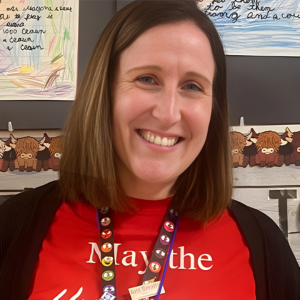
Angela McQuinn is an IIRP student who earned her graduate certificate in Restorative Practices in 2021 and is now pursuing a Graduate Certificate in Relational Facilitation for Healing Trauma.
Angela serves as principal at an elementary school in Minnesota, where she leads a K-6 school community through a whole-child, restorative approach that fosters respect, accountability, and inclusion, while building a positive culture grounded in relationships, belonging, and character development. She is working to embed restorative practices principles into the school culture through daily practice, expanding its use well beyond behavior modification. Staff and students are experiencing the joy of belonging as a result of these efforts.
Q: What brought you to the IIRP?
A: After more than a decade as a school social worker and now serving as principal in a small rural district in Minnesota, I was seeking ways to deepen the healing and community-building practices I was already using with students and staff. I had previously been trained in restorative justice intervention and wanted to expand my learning to focus more on prevention, relationships, and school-wide culture. The IIRP’s emphasis on relational leadership and community alignment perfectly matched my belief that education should be built on potential, belonging, and human connection.
Q: Please tell us about your professional work now and what makes you passionate about it.
A: In my current role, I integrate restorative practices across the school by facilitating circles with students and staff, supporting regulation and relationship repair, and weaving social-emotional learning into daily routines. My restorative work has evolved to include somatic and embodiment-based approaches, grounded in Bruce Perry’s Regulate–Relate–Reason framework and the IIRP’s Engagement Window. I’m passionate about helping educators and students to experience belonging and self-awareness, so that healing and learning can happen together.
Q: What would you like to see happen in the future of this work?
A: I hope to see restorative practices expand beyond behavior response systems to become the heartbeat of school culture — where relationships, reflection, and repair are embedded in how we teach, lead, and learn. I envision schools as communities where every person’s story, regulation, and resilience are valued and where we nurture both collective and individual healing through authentic connection.