The mystery genre meets restorative practices
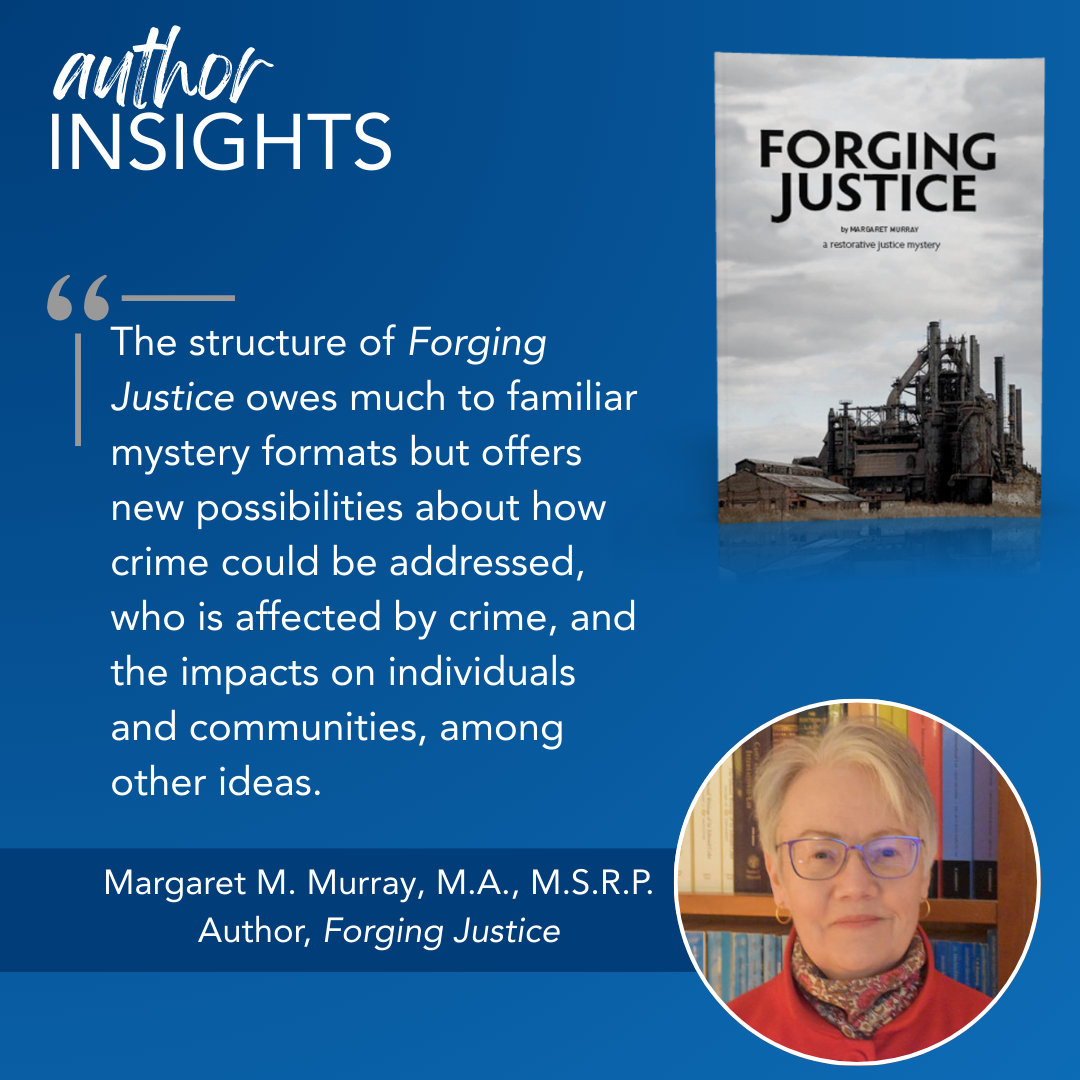
Margaret Murray, the IIRP’s editorial director of new publications and former librarian, is the author of the book Forging Justice. This mystery novel illustrates how restorative justice might be used to address criminal behavior. Margaret’s passions for literature and restorative justice serve as the foundation for the premise of her unique publication.
Exploring the mystery genre through the lens of restorative practices, she invites readers to consider new pathways to solving problems, seeking justice, and building trust. She walks us through what inspired her novel and what it does for restorative practitioners who see value in storytelling and unique avenues for new perspectives.
Q: What inspired you to write this book?
A: I’ve been a fan of mystery fiction since I was a child and read a series about children who discover and solve mysteries. As a teenager, I moved onto the mystery classics like Agatha Christie and then various subgenres such as cozies, police procedurals, and amateur detectives, among others. I found that some writers used mystery to highlight social issues, such as domestic abuse or addiction, since crime often shines a light on vulnerable populations, gender, and race, and power inequities. I realized that mysteries could provide a creative space to explore subjects that weren’t well-known or discussed. Somewhere along the way, I started to wonder if I could write a mystery myself, and I began to play around with what that might look like. I eventually wrote a manuscript that I entered in a contest at St. Martin’s Press for unpublished writers and was thrilled to be named a finalist. With that encouragement, I started to send my manuscript off to publishers and editors. The feedback I received was that I needed something more unique because my manuscript looked like books that were already out there, which is typical for new writers. About that time, I joined the IIRP Graduate School as the founding librarian. I knew a little about restorative justice but had never heard of restorative practices, and I quickly wanted to know more. I started to take courses and completed my Master of Science in Restorative Practices. Somewhere in the middle of the coursework, I began to wonder if I’d found the new idea I was looking for in a mystery. Could there be such a thing as a restorative mystery, and what would that look like? How would I combine the mystery format with restorative justice? What parts of a traditional mystery would I keep, and where and how would I introduce a restorative angle?
Q: What sets your book apart from others of its kind?
A: As a restorative justice-mystery, Forging Justice is a new kind of police procedural, blending traditional elements with restorative ideas and processes. For example, one big influence was the well-known concept of the detective who gathers all the characters together at the end of the story, revealing all the clues, and identifying the culprit. I used this model in Forging Justice, but instead of the detective revealing all, a conference is held to deal with the aftermath of the crime, in addition to legal consequences. So, the structure of Forging Justice owes much to familiar mystery formats but offers new possibilities about how crime could be addressed, who is affected by crime, and the impacts on individuals and communities, among other ideas.
Q: In what ways have readers told you they are using your book?
A: I learned two things from selling my book directly to readers at bookstores, conferences, and other author events in both the U.S. and Canada. Teachers and teenagers in particular respond to the book because the characters and setting resonate with them. A couple of teachers told me they’d used the book in their classrooms – one of them wrote me to ask permission for his students to reproduce the conference scene as a class exercise at their request. Other teachers told me that they’d like to use the book in their teaching but weren’t sure how to do that. This was the genesis of The Teacher’s Guide for Forging Justice that I’m about to publish, which provides exercises and chapter-by-chapter questions to be used in a classroom.
Q: What are the three most important things you hope readers take away from the novel?
A: My first goal was to write a book that could introduce readers to restorative practices and restorative justice who might not know much about those fields. Personally, I’ve always found reading fiction to be a great way to learn about something. One of the best compliments I received after the book was published was from a colleague at the IIRP who told me that she’d shared her copy of the book with a neighbor who, after reading it, said: “I get it now! You’ve been telling me all about restorative practices because of working there, but I really see what you mean now.” So that’s the first thing I hope readers take away.
The second thing is more subtle but maybe more important. New information alone doesn’t change minds, so simply reading a book about restorative practices and restorative justice won’t make someone support it. However, a book can introduce a new idea to readers that they continue to think about; Forging Justice may ultimately expand readers’ perspectives on justice and how and how we respond to crime.
Finally, I want readers to just enjoy the story, including the characters and the setting. Readers have told me they love the setting of Bethlehem, PA, and the history of the Bethlehem Steel company. Also, readers ask about the characters: will Claire stay with the police? What will happen with her and Daniel? The fact that people respond to them this way is very gratifying for a writer because it means I created characters who are appealing and who they care about. Those questions encouraged me to write a second book because I’ve got readers waiting for answers. So, I’ve almost finished the draft of my second Claire Cassidy mystery.