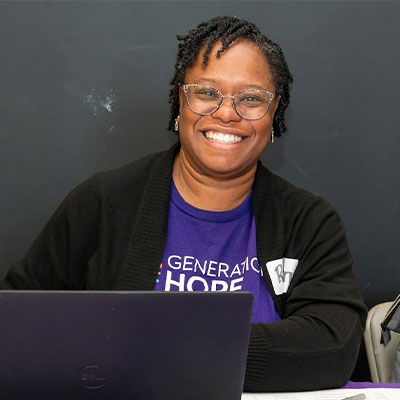
Navigating personal change and supporting the success of young parents pursuing their education.
Robyn is an IIRP alumna, having earned her graduate certificate in Restorative Practices. Currently, she serves as a DC Scholar Coordinator and Hope Coach. In this role, she supports a caseload of 25 scholars, along with their children and mentors, ensuring they have the resources, opportunities, and empowerment needed to build a brighter future for themselves, their communities, and the world.
Robyn sees restorative practices as not just a framework but a way of life. She has integrated restorative practices into the fabric of her personal life as well as her work, helping young parents navigate challenges associated with educational pursuits.
Q: What brought you to the IIRP?
A: I was drawn to the IIRP while working as a Community Liaison and McKinney-Vento Coordinator within Frederick County Public Schools in Maryland. In this role, I realized that my approach to supporting students—particularly those experiencing housing insecurity—aligned closely with the principles of restorative practices. These students often have strained relationships with adults, especially within educational settings, and I saw restorative practices as a way to foster trust, connection, and meaningful support.
At the same time, my personal life was undergoing significant changes. My daughter was entering high school, my son had recently moved back home after college, my mother was diagnosed with dementia, and I experienced a divorce. Amid these transitions, I sought a framework that would help me navigate change while preserving and strengthening my relationships. Restorative practices provided a path toward healing and growth, both professionally and personally.
Q: Please tell us about your professional work now and what makes you passionate about it.
A: Relationships are fundamental to well-being, influencing self-esteem, success, and aspirations. Restorative practices provide a framework for communication that prioritizes respect, understanding, and the shared goals of any relationship. Beyond the workplace, these practices have the power to build stronger communities and transform personal connections. I have witnessed firsthand the profound impact of restorative work in both my personal and professional life—it offers hope to those who need it most.
Since beginning my education with the IIRP, my career has shifted. I now serve as a DC Scholar Coordinator and Hope Coach with a Washington, DC-based nonprofit that supports student parents (ages 19–25) in earning a college degree. Restorative practices are critical in this work, as student parents often face decisions made for them rather than with them. I use restorative approaches to empower them, helping them navigate challenges through the Compass of Shame and Fair Process to create actionable plans for their future. As a Hope Coach, I prioritize strengthening student parents’ relationships with their children, professors, themselves, and their broader community.
Q: What would you like to see in this restorative work in the future?
A: I hope to see more organizations and community leaders fully embrace restorative practices, not just as a concept but as a fundamental approach to communication and problem-solving. Many people already engage in restorative work without realizing it, but because the term has become a buzzword—particularly in education—it is sometimes dismissed as a passing trend rather than a transformative way of life.
Now more than ever, restorative practitioners have an opportunity to lead. In today’s political and social climate, fear and uncertainty are prevalent, and communities need safe spaces to express concerns, fears, and aspirations. By integrating restorative practices more intentionally, we can foster dialogue, healing, and stronger connections in the face of ongoing challenges.